Synthesis and Computational Assessment of 2′,4-Dihydroxy-3-methoxychalcone in Comparison with A Structural Chalcone Isomer
DOI:
https://doi.org/10.48048/tis.2026.13972Keywords:
2′,4-Dihydroxy-3-methoxychalcone, Chalcone isomers, Molecular docking, Bcl-2 family proteins, Drug-likeness, In silico toxicityAbstract
Chalcone derivativesʼ varied biological activity and structural adaptability have drawn a lot of interest. This study synthesized 2′,4-dihydroxy-3-methoxychalcone by Claisen-Schmidt condensation and compared it to its positional isomer, 4′,4-dihydroxy-3′-methoxychalcone. Elucidation of chemical structure based on FTIR, 1H-NMR, 13C-NMR and GC-MS spectroscopic characterization. Molecular docking analysis was employed to investigate interactions with major anti-apoptotic members of the Bcl-2 protein family, while energy minimization was conducted to assess complex stability. In silico toxicity prediction was also performed to estimate acute toxicity profiles. The results showed that both chalcone isomers exhibited favorable binding affinities toward proteins belongingto the Bcl-2 family, particularly Bcl-xL, and formed stable ligand-protein complexes after energy minimization. Predicted LD₅₀ values indicated low acute toxicity for both compounds. Overall, these findings suggest that structural isomerism influences molecular interactions with apoptosis regulating proteins and support futher investigation of hydroxy-methoxychalcones in antitumor-related studies.
HIGHLIGHTS
- 2′,4-Dihydroxy-3-methoxychalcone was synthesized via Claisen–Schmidt condensation and confirmed by spectroscopic characterization.
- Both chalcone isomers showed favorable drug-likeness and pharmacokinetic properties consistent with Lipinski’s Rule of Five.
- Molecular docking demonstrated strong binding affinity toward anti-apoptotic Bcl-2 family proteins, particularly Bcl-xL.
- Energy minimization analyses indicated stable ligand–protein complexes for both chalcone isomers.
- In silico toxicity prediction suggested low acute toxicity, supporting further exploration of chalcone-based antitumor scaffolds.
GRAPHICAL ABSTRACT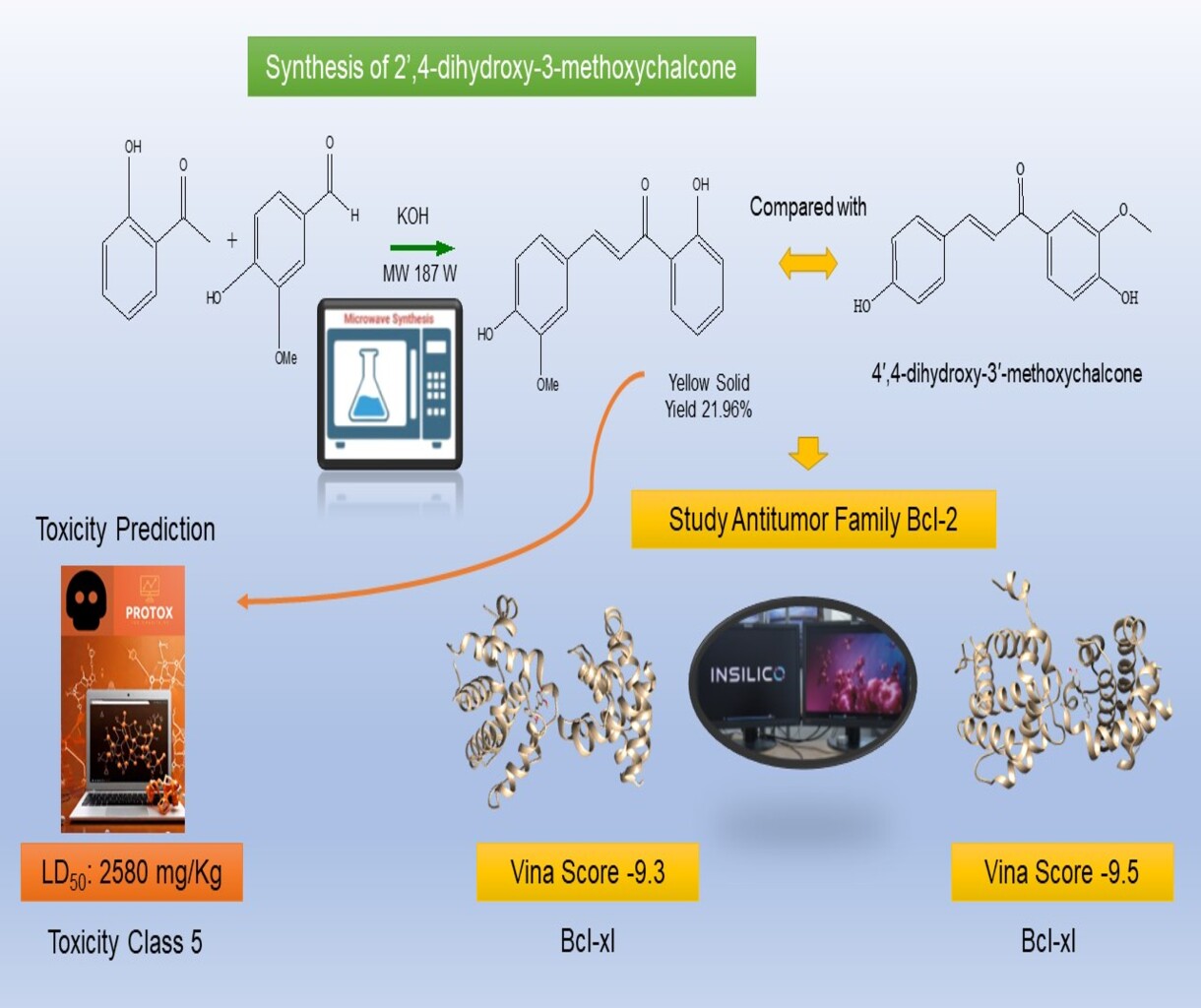
Downloads
References
SM Villa, J Heckman and D Bandyopadhyay. Medicinally privileged natural chalcones: Abundance, mechanisms of action, and clinical trials. International Journal of Molecular Sciences 2024; 25(17), 9623.
I Baramaki, MD Altıntop, R Arslan, FA Altınok, A Özdemir, I Dallali, A Hasan and NB Türkmen. Design, synthesis, and in vivo evaluation of a new series of indole-chalcone hybrids as analgesic and anti-inflammatory agents. ACS Omega 2024; 9(10), 12175-12183.
M Rudrapal, J Khan, AAB Dukhyil, RMII Alarousy, EI Attah, T Sharma, SJ Khairnar and AR Bendale. Chalcone scaffolds, bioprecursors of flavonoids: Chemistry, bioactivities, and pharmacokinetics. Molecules 2021; 26(23), 7177.
AE Varakutin, EA Muravsky, DV Tsyganov, IY Shinkarev, AI Samigullina, TS Kuptsova, RN Chuprov-Netochin, AV Smirnova, AA Khomutov, SV Leonov, MN Semenova and VV Semenov. Synthesis of chalcones with methylenedioxypolymethoxy fragments based on plant metabolites and study of their antiproliferative properties. Russian Chemical Bulletin 2023; 72, 1632-1647.
J Moreira, J Almeida, L Saraiva, H Cidade and M Pinto. Chalcones as promising antitumor agents targeting the p53 pathway: An overview and insights in drug-likeness. Molecules 2021; 26(12), 3737.
S Matsjeh, RT Swasono, C Anwar, EN Solikhah and E Lestari. Synthesis of 2’,4-dihydroxy-3-methoxychalcone and 2’,4’,4-trihydroxy-3-methoxychalcone as a candidate anticancer against cervical (WiDr), colon (HeLa), and breast (T47d) cancer cell lines in vitro. AIP Conference Proceedings 2017; 1823, 020048.
S Qian, Z Wei, W Yang, J Huang, Y Yang and J Wang. The role of BCL-2 family proteins in regulating apoptosis and cancer therapy. Frontiers in Oncology 2022; 12, 985363.
M Vogler, Y Braun, VM Smith, MA Westhoff, RS Pereira, NM Pieper, M Anders, M Callens, T Vervliet, M Abbas, S Macip, R Schmid, G Bultynck and MJS Dyer. The BCL2 family: From apoptosis mechanisms to new advances in targeted therapy. Signal Transduction and Targeted Therapy 2025; 10, 91.
N Mukherjee, J Sheetz and YG Shellman. Targeting the BCL2 family: Advances and challenges in BH3 mimetic-based therapies. International Journal of Molecular Sciences 2025; 26(20), 9859.
Y Jia, L Han, CL Ramage, Z Wang, CC Weng, L Yang, S Colla, H Ma, W Zhang, M Andreeff, N Daver, N Jain, N Pemmaraju, K Bhalla, S Mustjoki, P Zhang, G Zheng, D Zhou, Q Zhang and M Konopleva. Co-targeting BCL-XL and BCL-2 by PROTAC 753B eliminates leukemia cells and enhances efficacy of chemotherapy by targeting senescent cells. Haematologica 2023; 108(10), 2626-2638.
D Ćirin and V Krstonošić. New insights into binding of natural chalcones to Bcl-2, Bcl-xL and Mcl-1 anti-apoptotic proteins. Journal of Molecular Structure 2021; 1241, 130700.
S Zhang, T Li, L Zhang, X Wang, H Dong, L Li, D Fu, Y Li, X Zi, HM Liu, Y Zhang, H Xu and CY Jin. Retracted article: A novel chalcone derivative induces apoptosis through ROS dependent DR5 up-regulation in gastric cancer cells. Scientific Reports 2017; 7, 9873.
X Wang, Y Liang, B Zhang, L He, W Li, W Zhang, C Li, L Luo, T Umar, H Feng and C Qiu. 2′-Hydroxychalcone induces autophagy and apoptosis in breast cancer cells via inhibition of the NF-κB signaling pathway: In vitro and in vivo studies. Nutrients 2024; 16(4), 514.
N Seflini, PR Triananda, F Kurniadewi, Zulhipri and H Dianhar. Synthesis of vanillin-derived chalcone using microwave irradiation method. AIP Conference Proceedings 2024; 2982, 040011.
NM O’Boyle, M Banck, CA James, C Morley, T Vandermeersch and GR Hutchison. Open Babel: An open chemical toolbox. Journal of Cheminformatics 2011; 3, 33.
EF Pettersen, TD Goddard, CC Huang, GS Couch, DM Greenblatt, EC Meng and TE Ferrin. UCSF Chimera—A visualization system for exploratory research and analysis. Journal of Computational Chemistry 2004; 25(13), 1605-1612.
CA Lipinski. Lead- and drug-like compounds: The rule-of-five revolution. Drug Discovery Today: Technologies 2004; 1(4), 337-341.
B Jayaram, T Singh, G Mukherjee, A Mathur, S Shekhar and V Shekhar. Sanjeevini: A freely accessible web server for target-directed lead molecule discovery. BMC Bioinformatics 2012; 13(S17), S7.
A Daina, O Michielin and V Zoete. SwissADME: A free web tool to evaluate pharmacokinetics, drug-likeness, and medicinal chemistry friendliness of small molecules. Scientific Reports 2017; 7, 42717.
S Goldar, MS Khaniani, SM Derakhshan and B Baradaran. Molecular mechanisms of apoptosis and their roles in cancer development and treatment. Asian Pacific Journal of Cancer Prevention 2015; 16, 2129-2144.
NS Pagadala, K Syed and J Tuszynski. Software for molecular docking: A review. Biophysical Reviews 2017; 9, 91-102.
Y Liu, M Grimm, WT Dai, MC Hou, ZX Xiao and Y Cao. CB-Dock: A web server for cavity detection-guided protein-ligand blind docking. Acta Pharmacologica Sinica 2020; 41, 138-144.
Q Wu, Z Peng, Y Zhang and J Yang. COACH-D: Improved protein-ligand binding site prediction with refined ligand-binding poses through molecular docking. Nucleic Acids Research 2018; 46(W1), W438-W442.
BIOVIA. Visualize Your Science. BIOVIA, California, 2021.
MU Johansson, V Zoete, O Michielin and N Guex. Defining and searching for structural motifs using DeepView/Swiss-PdbViewer. BMC Bioinformatics 2012; 13, 173.
P Banerjee, AO Eckert, AK Schrey and R Preissner. ProTox-II: A webserver for the prediction of toxicity of chemicals. Nucleic Acids Research 2018; 46(W1), W257-W263.
GM Morris, R Huey, W Lindstrom, MF Sanner, RK Belew, DS Goodsell and AJ Olson. AutoDock4 and AutoDockTools4: Automated docking with selective receptor flexibility. Journal of Computational Chemistry 2009; 30(16), 2785-2791.
N Helmi. Identification of therapeutic phytochemicals targeting B-cell lymphoma 2 (BCL2) as anti-acute myeloid leukemia agents: An in-silico approach. Advances in Life Sciences 2023; 10(4), 670-674.
O Pokharkar, H Lakshmanan, G Zyryanov and M Tsurkan. In silico evaluation of antifungal compounds from marine sponges against COVID-19-associated mucormycosis. Marine Drugs 2022; 20(3), 215.
PC Agu, CA Afiukwa, OU Orji, EM Ezeh, IH Ofoke, CO Ogbu, EI Ugwuja and PM Aja. Molecular docking as a tool for the discovery of molecular targets of nutraceuticals in diseases management. Scientific Reports 2023; 13, 13398.
R Ancuceanu, BE Lascu, D Drăgănescu and M Dinu. In silico ADME methods used in the evaluation of natural products. Pharmaceutics 2025; 17(8), 1002.
CN Cavasotto and V Scardino. Machine learning toxicity prediction: Latest advances in toxicity end points. ACS Omega 2022; 7(51), 47536-47546.
G Xiong, Z Wu, J Yi, L Fu, Z Yang, C Hsieh, M Yin, X Zeng, C Wu, A Lu, X Chen, T Hou and D Cao. ADMETlab 2.0: An integrated online platform for accurate and comprehensive ADMET predictions. Nucleic Acids Research 2021; 49(W1), W5-W14.
OECD. OECD Guidelines for the Testing of Chemicals: Test No. 423: Acute Oral Toxicity—Acute Toxic Class Method. OECD Publishing, Paris, 2001.
K Savva, M Zachariou, D Kynigopoulos, E Fella, MI Vitali, X Kosofidou, M Spyrou, I Sargiannidou, E Panayiotou, N Dietis and GM Spyrou. Preliminary in vitro and in vivo insights of in silico candidate repurposed drugs for Alzheimer’s disease. Life 2023; 13(5), 1095.
Downloads
Published
How to Cite
Issue
Section
License
Copyright (c) 2026 Walailak University

This work is licensed under a Creative Commons Attribution-NonCommercial-NoDerivatives 4.0 International License.