
Development of Packaging Film from Purple Heart (Tradescantia pallida) Anthocyanin for Fish Freshness Indicator
DOI:
https://doi.org/10.48048/tis.2025.10077Keywords:
Anthocyanin, Chitosan, Corn starch, Fish freshness, Indicator, Packaging film, Tradescantia pallidaAbstract
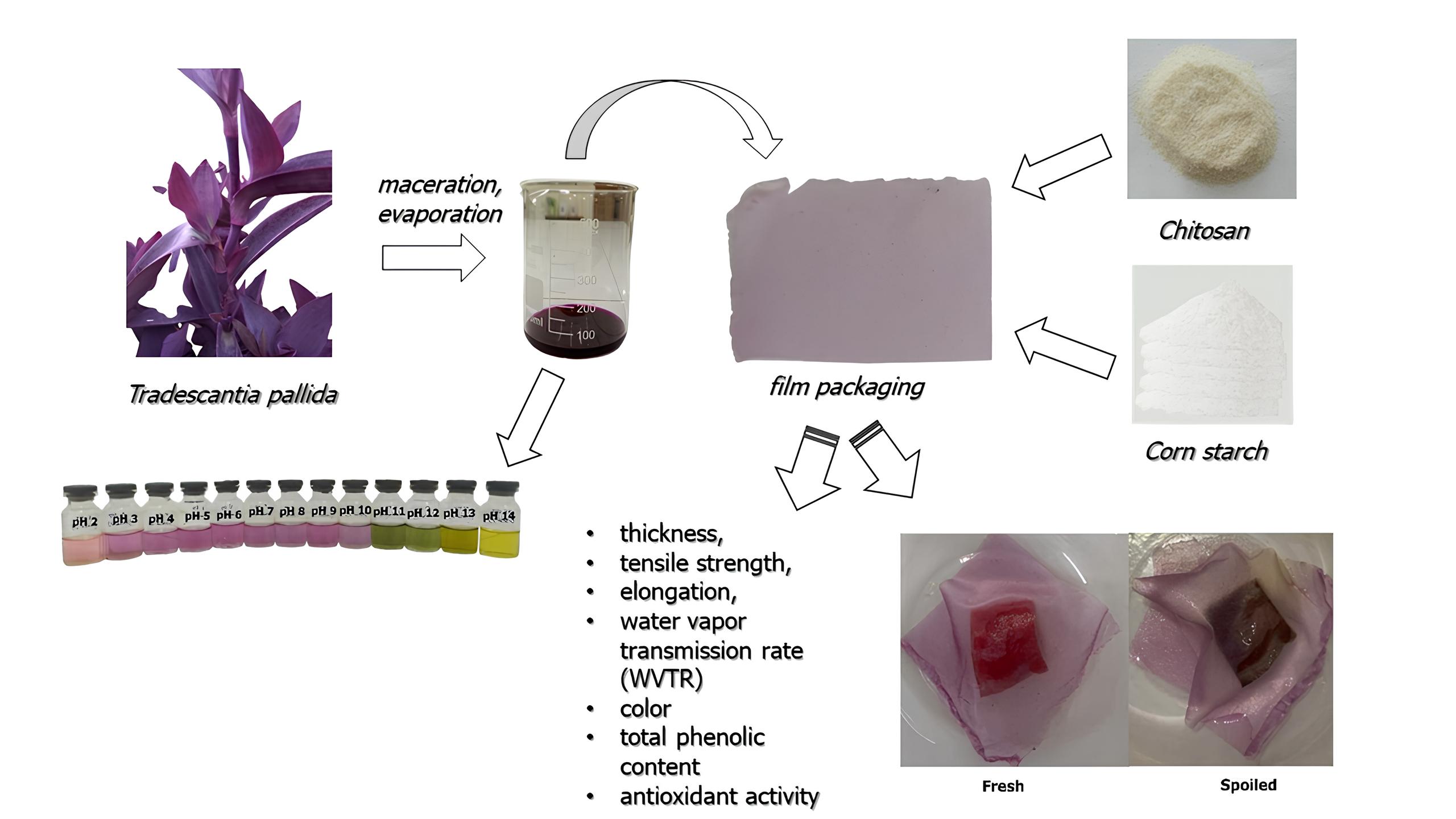
The pH sensitivity of anthocyanins enables their application as indicators of fish freshness, as spoilage is associated with an increase in pH due to the accumulation of volatile basic nitrogen compounds. Purple Heart (Tradescantia pallida) contain cyanidin-based anthocyanins as their primary pigment. In this study, different concentrations of Purple Heart anthocyanin extract (PHA) were incorporated into chitosan-cornstarch-based packaging films to evaluate their physical and chemical properties and to be applied as freshness indicators for tuna fillets. Five formulations with different concentrations of PHA (F0 - F4: 0 - 2 %) were evaluated for their physical properties (thickness, tensile strength, elongation, water vapor transmission rate (WVTR) and color) and chemical properties (antioxidant activity and total phenolic content). The concentration of PHA significantly influenced film thickness, elongation, and chemical properties (p < 0.05), while no significant effect was observed on tensile strength and WVTR (p > 0.05). Color analysis using a chromameter demonstrated that the film containing PHA was sensitive to pH changes. When applied to tuna fillets, the film exhibited a color shift from purple (fresh fish) to yellowish (spoiled fish), confirming its potential as a fish freshness indicator.
HIGHLIGHTS
- Development of packaging film based on chitosan-corn starch with the addition of purple heart anthocyanin extract (Tradescantia pallida).
- Packaging film embedded with purple heart anthocyanin extract can be used as a freshness indicator for fish through visible color changes.
- Variation in the concentration of purple heart anthocyanin extract affects the physical and chemical properties of chitosan-corn starch film.
GRAPHICAL ABSTRACT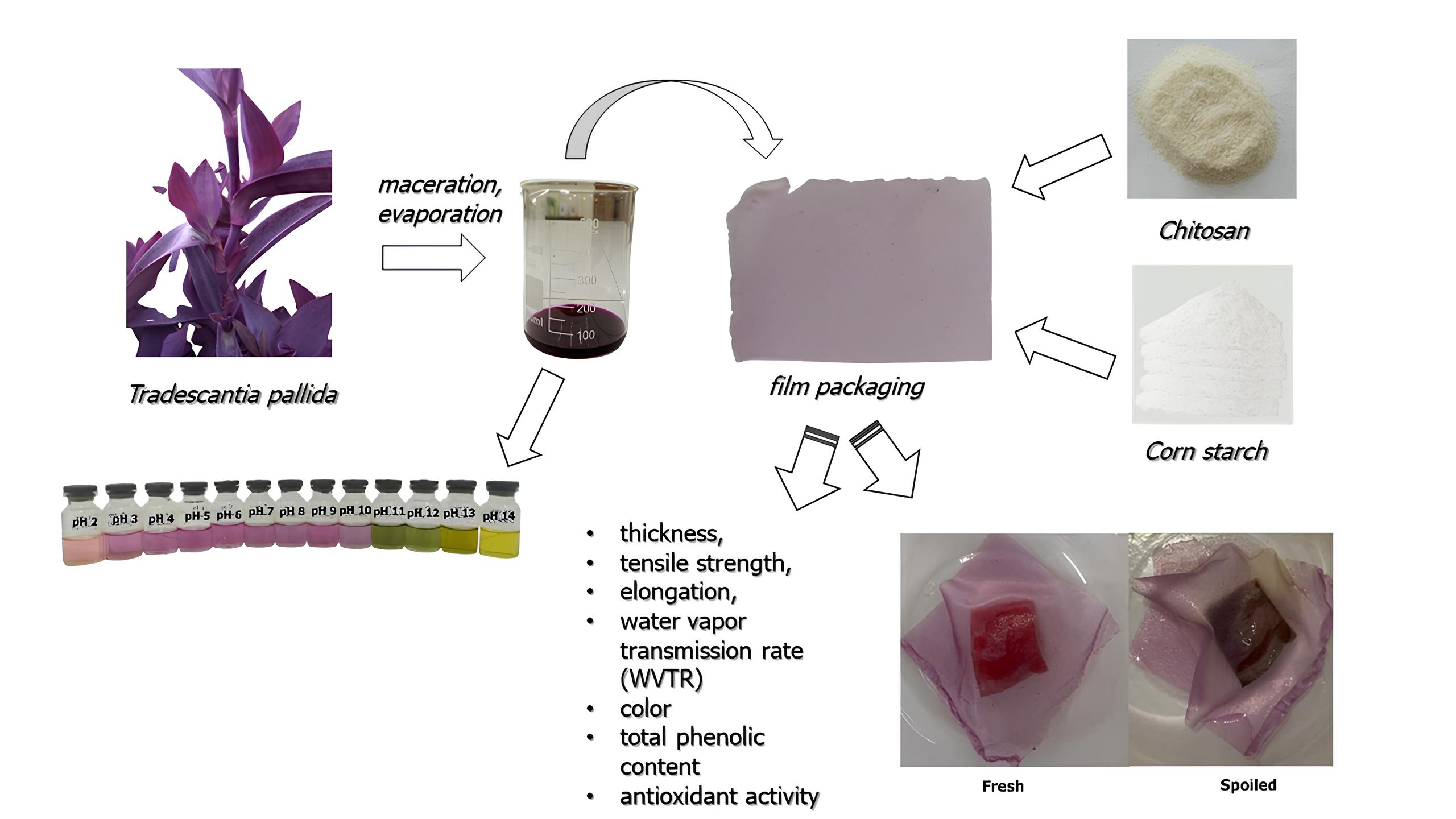
Downloads
References
PM Kris-Etherton, WS Harris and LJ Appel. Fish consumption, fish oil, omega-3 fatty acids, and cardiovascular disease. Circulation 2002; 106(21), 2747-2757.
Z Pieniak, W Verbeke, F Perez-Cueto, K Brunsø and S De Henauw. Fish consumption and its motives in households with versus without self-reported medical history of CVD: A consumer survey from 5 European countries. BMC Public Health 2008; 8, 306.
I Nurhasanah. 2016, Plastik biosensor berbasis kitosanantosianin kulit buah manggis sebagai pendeteksi kerusakan fillet ikan nila (in Indonesian). Bachelor’s Thesis, Universitas Negeri Semarang, Indonesia.
T Karuniawati, A Satria and LN Yuliati. Analisis pembelian ikan segar dan ikan olahan pada ibu bekerja dan ibu tidak bekerja (in Indonesian). Jurnal Ilmu Keluarga dan Konsumen 2017; 10(1), 59-70.
MNI Lokuruka and JM Regenstein. Journal of aquatic food handling and storage of atlantic mackerel (Scomber scombrus) on biogenic amine production. Journal of Aquatic Food Product Technology 2006; 15(4), 17-33.
S Helali, A Abdelghani, N Jaffrezic-Renault, PN Trikalitis, CE Efstathiou and MI Prodromidis. On-site monitoring of fish spoilage using vanadium pentoxide xerogel modified interdigitated gold electrodes. Electrochimica Acta 2010; 55(14), 4256-4260.
MAA Khan and YSA Khan. Insects infestation and preventive measures in dry fish storage of chittagong, Bangladesh. Journal of Biological Sciences 2001; 1(10), 963.
RSD Ratna Sari Dewi, NH Nurul Huda and RA Ruzita Ahmad. Changes in the physicochemical properties, microstructure and sensory characteristics of shark dendeng using different drying methods. American Journal of Food Technology 2011; 6(2), 149.
U Musa, SS Hati, YI Adamu and A Mustapha. Pesticides residues in smoked fish samples from North-Eastern Nigeria. Journal of Applied Sciences 2010; 10(11), 975.
K Immaculate, P Sinduja, A Velammal and J Patterson. Quality and shelf life status of salted and sun dried fishes of tuticorin fishing villages in different seasons. International Food Research Journal 2013; 20(4), 1855-1859.
MR Alberto, ME Arena and MCM de Nadra. A comparative survey of 2 analytical methods for identification and quantification of biogenic amines. Food Control 2002; 13(2), 125-129.
TH Wu and PJ Bechtel. Ammonia, dimethylamine, trimethylamine, and trimethylamine oxide from raw and processed fish by-products. Journal of Aquatic Food Product Technology 2008; 17(1), 27-38.
MK Kim, JH Mah and HJ Hwang. Biogenic amine formation and bacterial contribution in fish, squid and shellfish. Food Chemistry 2009; 116(1), 87-95.
P Visciano, M Schirone and A Paparella. An overview of histamine and other biogenic amines in fish and fish products. Foods 2020; 9(12), 1795.
EC Directive. Fixing the total volatile basic nitrogen ( TVB-N ) limit values for certain categories of fishery products and specifying the analysis methods to be used. Official Journal of the European Communities 1995; 29(4), 95.
C Ruiz-Capillas, CM Gillyon and WFA Horner. Determination of volatile basic nitrogen and trimethylamine nitrogen in fish sauce by flow injection analysis. European Food Research and Technology 2000; 210(1), 434-436.
A Béné, A Hayman, E Reynard, JL Luisier and JC Villettaz. A new method for the rapid determination of volatile substances: The SPME-direct method Part II. Determination of the freshness of fish. Sensors and Actuators B: Chemical 2001; 72(3), 204-207.
S Grassi, S Benedetti, L Magnani, A Pianezzola and S Buratti. Seafood freshness: E-nose data for classification purposes. Food Control 2022; 138, 108994.
S He, B Zhang, X Dong, Y Wei, H Li and B Tang. Differentiation of goat meat freshness using gas chromatography with ion mobility spectrometry. Molecules 2023; 28(9), 3874.
H Chen, M Zhang, B Bhandari and C Yang. Development of a novel colorimetric food package label for monitoring lean pork freshness. LWT-Food Science and Technology 2019; 99, 43-49.
B Riyanto, A Maddu and YW Hasnedi. Kemasan cerdas pendeteksi kebusukan filet ikan nila (in Indonesian). Jurnal Pengolahan Hasil Perikanan Indonesia 2010; 13(2), 129.
A Listyarini, W Sholihah, C Imawan and R Fitriana. Colorimetric method by using natural dye for monitoring fish spoilage. In: Proceedings of the International Seminar on Sensors, Instrumentation, Measurement and Metrology (ISSIMM), Surabaya, Indonesia. 2017.
HE Khoo, A Azlan, ST Tang and SM Lim. Anthocyanidins and anthocyanins: Colored pigments as food, pharmaceutical ingredients, and the potential health benefits. Food & Nutrition Research 2017; 61(1), 1361779.
M Priska, N Peni, L Carvallo and YD Ngapa. Antosianin dan pemanfaatannya (in Indonesian). Cakra Kimia 2018; 6(2), 79-97.
S Silva. Anthocyanin extraction from plant tissues: A review. Critical Reviews in Food Science and Nutrition 2015; 57(14), 3072-3083.
N Basílio and F Pina. Chemistry and photochemistry of anthocyanins and kinetic approach. Molecules 2016; 21(11), 1502.
S Roy and J Rhim. Anthocyanin food colorant and its application in pH-responsive color change indicator films. Critical Reviews in Food Science and Nutrition 2020; 61(14), 2297-2325.
A Castañeda-Ovando, M de Lourdes Pacheco-Hernández, ME Páez-Hernández, JA Rodríguez and C Andrés Galán-Vidal. Chemical studies of anthocyanins: A review. Food Chemistry 2009; 113(4), 859-871.
ZU Shi, MIN Lin and FJ Francis. Anthocyanins of Tradescantia pallida. Potential food colorants. Journal of Food Science 1992; 57(3), 761-765.
CB Steingass, J Burkhardt, V Bäumer, K Kumar, H Mibus-Schoppe, J Zinkernagel, P Esquivel, VM Jiménez and R Schweiggert. Characterisation of acylated anthocyanins from red cabbage, purple sweet potato, and Tradescantia pallida leaves as natural food colourants by HPLC-DAD-ESI(+)-QTOF-MS/MS and ESI(+)-MSn analysis. Food Chemistry 2023; 416, 135601.
F Imtiaz, M Islam, H Saeed, A Ahmed, M Asghar, B Saleem, MA Farooq, DH Khan and L Peltonen. Journal of drug delivery science and technology novel phytoniosomes formulation of Tradescantia pallida leaves attenuates diabetes more effectively than pure extract. Journal of Drug Delivery Science and Technology 2023; 83, 104399.
B Biduski, WMF da Silva, R Colussi, SLM El Halal, LT Lim, ÁRG Dias and E da Rosa Zavareze. Starch hydrogels: The influence of the amylose content and gelatinization method. International Journal of Biological Macromolecules 2018; 113, 443-449.
MD Hazrol, SM Sapuan, ES Zainudin, MYM Zuhri and NI Abdul Wahab. Corn starch (Zea mays) biopolymer plastic reaction in combination with sorbitol and glycerol. Polymers 2021; 13(2), 242.
M Flórez, E Guerra-Rodríguez, P Cazón and M Vázquez. Chitosan for food packaging: Recent advances in active and intelligent films. Food Hydrocolloids 2022; 124, 107328.
MC Silva-Pereira, JA Teixeira, VA Pereira-Júnior and R Stefani. Chitosan/corn starch blend films with extract from Brassica oleraceae (red cabbage) as a visual indicator of fish deterioration. LWT - Food Science and Technology 2015; 61(1), 258-262.
JR Villanueva-Toledo, J Chale-Dzul, C Castillo-Bautista, L Olivera-Castillo, MJ Graniel-Sabido and RE Moo-Puc. Hepatoprotective effect of an ethanol extract of Tradescantia pallida against CCl4-induced liver damage in rats. South African Journal of Botany 2020; 135, 444.
Y Qin, Y Wang, Z Tang, K Chen, Z Wang, G Cheng, H Chi and T Soteyome. A pH-sensitive film based on chitosan/gelatin and anthocyanin from Zingiber striolatum Diels for monitoring fish freshness. Food Chemistry: X 2024; 23, 101639.
D Juliani, NE Suyatma and FM Taqi. Pengaruh waktu pemanasan, jenis dan konsentrasi plasticizer terhadap karakteristik edible film K-karagenan (in Indonesian). Jurnal Keteknikan Pertanian 2022; 10(1), 29-40.
P Ezati and JW Rhim. pH-responsive chitosan-based film incorporated with alizarin for intelligent packaging applications. Food Hydrocolloids 2020; 102, 105629.
Y Pranoto, CM Lee and HJ Park. Characterizations of fish gelatin films added with gellan and κ-carrageenan. LWT-Food Science and Technology 2007; 40(5), 766-774.
L Prietto, TC Mirapalhete, VZ Pinto, JF Hoffmann, NL Vanier, LT Lim, ARG Dias and E da Rosa Zavareze. pH-sensitive films containing anthocyanins extracted from black bean seed coat and red cabbage. LWT - Food Science and Technology 2017; 80, 492-500.
F Hayati, EN Dewi and S Suharto. Characteristic and antioxidant activity of alginate edible film with the addition of Spirulina platensis powder. Saintek Perikanan: Indonesian Journal of Fisheries Science and Technology 2020; 16(4), 286-293.
AI Quilez-Molina, D Merino and M Dumon. Food hydrocolloids porous starch embedded with anthocyanins-CMC coating as bifunctional packaging with seafood freshness monitoring properties. Food Hydrocolloids 2024; 154, 110114.
AJ Baublis and MD Berber-Jimenez. Structural and conformational characterization of a stable anthocyanin from Tradescantia pallida. Journal of Agricultural and Food Chemistry 1995; 43(3), 640-646.
SS El-Hawary, II Mahmoud, AM Faisal, SM Osman, AA Sleem, FA Morsy and MM Sabry. Comparative HPLC-PDA-MS/MS tentative identification of polyphenolics from the leaf extracts of 3 selected Tradescantia species and their in-vivo hepatoprotec-tive activity. Tropical Journal of Natural Product Research 2020; 4(11), 926-935.
A Houghton, I Appelhagen and C Martin. Natural blues: Structure meets function in anthocyanins. Plants 2021; 10(4), 726.
K Chen, J Li, L Li, Y Wang, Y Qin and H Chen. A pH indicator film based on sodium alginate/gelatin and plum peel extract for monitoring the freshness of chicken. Food Bioscience 2023; 53, 102584.
H Xu, Y Shi, L Gao, N Shi, J Yang and R Hao. Preparation and characterization of PH-responsive polyvinyl alcohol/chitosan/ anthocyanin films. Food Science and Technology 2023; 43, e98022.
MM Góes, BM Simões, F Yamashita, S Mali de Oliveira and GM de Carvalho. Plasticizers’ effect on pH indicator film based on starch and red grape skin extract for monitoring fish freshness. Packaging Technology and Science 2023; 36(6), 425-437.
B Zhu, W Lu, Y Qin, G Cheng, M Yuan and L Li. An intelligent pH indicator film based on cassava starch/polyvinyl alcohol incorporating anthocyanin extracts for monitoring pork freshness. Journal of Food Processing and Preservation 2021; 45(10), e15822.
M Faisal, M Bevilacqua, R Bro, HN Bordallo, JJK Kirkensgaard, KH Hebelstrup and A Blennow. Colorimetric pH indicators based on well-defined amylose and amylopectin matrices enriched with anthocyanins from red cabbage. International Journal of Biological Macromolecules 2023; 250, 126250.
N Balasundram, K Sundram and S Samman. Phenolic compounds in plants and agri-industrial by-products: Antioxidant activity, occurrence, and potential uses. Food Chemistry 2006; 99(1), 191-203.
C Di Lorenzo, F Colombo, S Biella, C Stockley and P Restani. Polyphenols and human health: The role of bioavailability. Nutrients 2021; 13(1), 273.
YF Chu, JIE Sun, X Wu and RH Liu. Antioxidant and antiproliferative activities of common vegetables. Journal of Agricultural and Food Chemistry 2002; 50(23), 6910-6916.
U Kuckartz, S Rädiker, T Ebert and J Schehl. Statistik: Eine verständliche Einführung (in German). Springer Verlag Wiesbaden, Wiesbaden, Germany, 2013.
J Yang, RH Liu and L Halim. Antioxidant and antiproliferative activities of common edible nut seeds. LWT-Food Science and Technology 2009; 42(1), 1-8.
E Klinger, H Salminen, K Bause and J Weiss. Interactions between lipid oxidation and anthocyanins from black carrots in ω ‑ 3 fatty acid ‑ rich flaxseed oil ‑ in ‑ water emulsions. European Food Research and Technology 2024; 250(12), 2973-2987.
S Iamkeng, S Santibenchakul and N Sooksawat. Potential of Maranta arundinacea residues for recycling: Analysis of total phenolic, flavonoid, and tannin contents. Biodiversitas 2022; 23(3), 1204.
AI Quilez‐Molina, L Pasquale, D Debellis, G Tedeschi, A Athanassiou and IS Bayer. Responsive bio-composites from magnesium carbonate filled polycaprolactone and curcumin-functionalized cellulose fibers. Advanced Sustainable System 2021; 5(10), 2100128.
Published
How to Cite
Issue
Section
License
Copyright (c) 2025 Walailak University

This work is licensed under a Creative Commons Attribution-NonCommercial-NoDerivatives 4.0 International License.





