
Application of Eucheuma Cottonii Carrageenan as an Emulsifier in the Making of Mosquito Repellent Lotion from Clove Leaf Essential Oil (Syzigium Aromaticum)
DOI:
https://doi.org/10.48048/tis.2025.10379Keywords:
Anti-mosquito lotion, Carrageenan, Clove leaf essential oil, Eucheuma cottonii, Anti-mosquito lotion, Carrageenan, Clove leaf essential oil, Eucheuma cottoniiAbstract
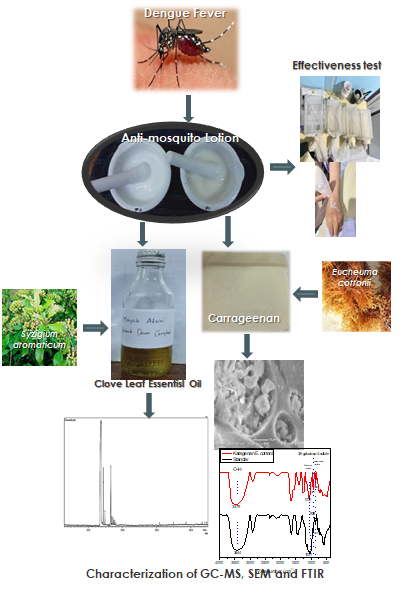
Dengue fever in Indonesia continues to increase every year. One form of prevention is the utilisation of clove leaf essential oil (Syzigium aromaticum) as an anti-mosquito lotion. The abundance of Eucheuma cottonii in Indonesia has the potential to increase the production of carrageenan which can function as an emulsifier for lotions. The objectives of this research to analyze the characteristics and effectiveness of anti-mosquito lotion from clove leaf essential oil with the addition of carrageenan based on red algae E. cottonii. The method used was carrageenan extraction with 0.1 N KOH solvent, antimicrobial test with disc diffusion method and antimosquito effectiveness test. Analysis of carrageenan using FTIR showed the presence of galactose 4-sulfate functional group which identified kappa type in the spectrum of 846 - 927 cm–1. Microstructure characteristics of carrageenan using SEM 2000× magnification showed a rough surface and irregular clumps. Characterization of clove leaf essential oil (Syzigium aromaticum) using GC-MS instrument showed the main content of the compound 4.allyl-2-methoxyphenol with an area of 78.89% which includes eugenol compounds. The optimal anti-mosquito lotion was F2 with 4% carrageenan and 15% clove leaves assential oil. Formula 2 has a level of liking in the sensory test in the neutral category, but has good effectiveness with the support of several characteristics that meet quality standards including a pH value of 7.1, a viscosity value of 5,481.8 cP, a moisture content of 4.91% and microbial inhibition of E. coli and S. aureus at a good concentration of 40%.
HIGHLIGHTS
- This article provides a critical review of the use of anti-mosquito lotion made from clove leaf essential oil
- The production of such lotions is expected to reduce the use of chemicals in health products, particularly those intended for use on human skin
- Eugenol in clove leaves is reported to have great potential as a mosquito repellent
- The neurotoxic properties of eugenol suppress the the insect nervous system, resulting in a weakened body.
GRAPHICAL ABSTRACT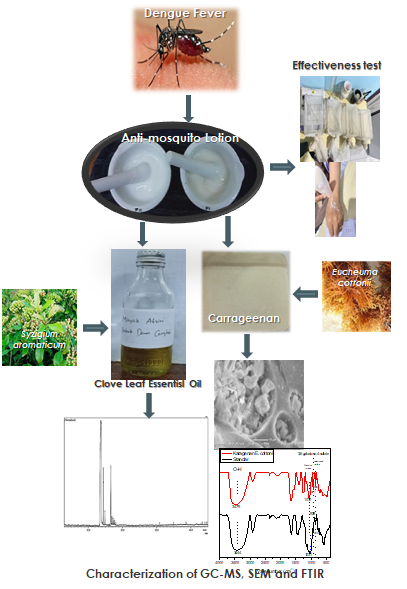
Downloads
References
M Borg, S Krueger-Hadfield, C Destombe, J Collén, A Lipinska and SM Coelho. Red macroalgae in the genomic era. New Phytologist 2023; 240(2), 471-488.
V Dolganyuk, D Belova, O Babich, A Prosekov, S Ivanova, D Katserov, N Patyukov and S Sukhikh. Microalgae: A promising source of valuable bioproducts. Biomolecules 2020; 10(8), 1153.
YO Nainggolan, Masrullita, R Dewi, N Za and E Kurniawan. Pembuatan formula Lotion antinyamuk dari minyak atsiri sereh wangi (Citronella oil) (in Indonesian). Chemical Engineering Journal Storage 2022; 2(5), 29-41.
ARY Eff, RDLA Pertiwi and TP Utami. Efektivitas repelan losion minyak atsiri daun zodia (Evodia suaveolens) terhadap nyamuk Aedes aegypti linnaeus (in Indonesian). Majalah Farmasetika 2020; 4(1), 119-124.
European Centre for Disease Prevention and Control. Dengue worldwide overview. European Centre for Disease Prevention and Control, Solna, Sweden, 2025.
Indonesian Ministry of Health. Demam berdarah masih mengintai, Available at: https://sehatnegeriku.kemkes.go.id/baca/mediakom/20240521/2845637/mediakom-165/, accessed November 2024.
Y Agnesia, Nopianto, SW Sari and DW Ramadhani. Demam Berdarah Dengue (DBD): Determinan dan pencegahan (in Indonesian). NEM Pekanbaru, Riau, Indonesia, 2023.
Soegjianto. Demam berdarah dengue edisi kedua (in Indonesian). Airlangga University Pres, Surabaya, Indonesia, 2006.
RD Halim and A Fitri. Aktivitas minyak sereh wangi sebagai antinyamuk (in Indonesian). Jurnal Kesehatan Masyarakat Jambi 2020; 1, 28-34.
B Dewi, T Wulandari and S Yanti. Formulasi dan uji efektivitas Lotion antinyamuk minyak cengkeh (Syzigium aromaticum) (in Indonesian). Jurnal Ilmiah Farmacy 2020; 7(2), 277-286.
D Kurnianingsih. Uji efektivitas sediaan krim kombinasi ekstrak daun bakau hitam (Rhizophora mucronata) dan jeruk purut (Citrus hystrix) terhadap bakteri Staphylococcus aureus (in Indonesian). Jurnal Ilmiah JOPHUS: Journal of Pharmacy UMUS 2021; 2(1), 28-35.
R Siskayanti and ME Kosim. Analisis konsentrasi minyak atsiri sereh sebagai aditif dalam pembuatan lotion antinyamuk. Jurnal Redoks 2021; 6(1), 26-34.
IH Goetie, R Sundu and R Supriningrum. Uji aktivitas antibakteri ekstrak kulit batang sekilang (Embelia borneensis Scheff) terhadap bakteri Escherichia coli dan Staphylococcus aureus menggunakan metode disc diffusion (in Indonesian). Jurnal Riset Kefarmasian Indonesia 2022; 4(2), 144-155.
IBD Kapelle, HJ Sohilait and ML Haluruk. Analisis minyak atsiri dari bunga dan ganggang cengkeh (Syzygium aromaticum L.) asal pulau saparua maluku (in Indonesian). Tekonotan 2023; 17(2), 131-136.
D Pertiwi, R Desnita and S Luliana. Effect of pH on alpha arbutin stability in niosomal gel (in Indonesian). Majalah Farmasetik 2020; 16(1), 91-100.
RC Rowe, PJ Sheskey and PJ Weller. Handbook of pharmaceutical excipient. The Pharmaceutical Press, London, 2006.
Indonesia Ministry of Health. Pharmacopeia Edition II. Ministry of Health of the Republic of Indonesia, Jakarta, Indonesia, 2017.
A Rivera, B Vinado, N Benito, F Docobo-Pérez, F Fernández-Cuenca, J Fernández-Domínguez, J Guinea, A López-Navas, M Ángel Moreno, MN Larrosa, A Oliver and F Navarro. Recommendation of the Spanish Antibiogram Committee (COESANT) for in vitro susceptibility testing of antimicrobial agents by disk diffusion. Enfermendades Infecciosas y Microbiologia Clinica 2023; 41(9), 571-576.
P Setiawan, N Farid, M Yusuf and RM Latelay. Uji stabilitas sediaan losion antinyamuk dengan variasi konsentrasi ekstrak bunga sukun (Artocarpus altilis) terhadap nyamuk Aedes aegypti (in Indonesian). Journal of Experimental and Clinical Pharmacy 2021; 1(2), 103-111.
AR Juniyanti, A Retnaningsih and S Marcellia. Uji formulasi sediaan lotion dari ekstrak daun cengkeh (Syzigium aromaticum L.) sebagai repellan terhadap nyamuk Aedes aegypti (in Indonesian). Journal of Pharmacy and Tropical Issues 2021; 1(1), 27-35.
MK Ndalu. 2020, Tugas akhir efektivitas ekstrak daun cengkeh (Syzigium aromaticum) sebagai repellent antinyamuk Aedes sp (in Indonesian). Ph. D. Dissertation. Poltekkes Kemenkes Kupang, Nusa Tenggara Timur, Indonesia.
AG Sanga, HD Mazigo, A Manjurano, D Morona, A Thomas and EJ Kweka. Measuring repellence and mortality effects of clove and cinnamon essential oils impregnated nets against Anopheles gambiae senso stricto using tunnel test. Journal of Natural Pesticide Research 2023; 5, 100046.
Budiman, H Ishak, Stang, E Ibrahim, R Yudhastuti, A Maidin, F Naiem, I Wahid and A Mallongi. Effectiveness of clove oil (Syzigium aromaticum) as biolarvaside of Aedes aegypti. Biomedical and Pharmacology Journal 2022; 15(4), 2287-2292.
I Amin, D Setyorin and Indriani. Pengaruh variasi Solvent organik dalam proses maserasi karagenan Eucheuma Cottonii di PT biota laut ganggang pinrang (in Indonesian). Prosiding Seminar Nasional Teknologi Industri IX 2022 2022; 1, 171-175.
CS Sani, MDR Oedjoe, W Turupadang. Analysis of yield and type of carrageenan from different strains at Kupang Bay seaweed production center, East Nusa Tenggara. In: Proceedings of the 3rd International Symposium on Transdisciplinary Approach for Knowledge Co-Creation in Sustainability, Bogor Tengah, Indonesia. 2023.
V Suprunchuk. Ultrasonic-treated fucoidan as a promising thearapeutic agent. Polymers in Medicine 2021; 51(2), 85-90.
BG Bhernama. Analisis karakteristik karagenan Eucheuma cottoni asal aceh jaya menggunakan pelarut alkali (KOH dan NaOH) (in Indonesian). Journal Amina 2019; 1(2), 63-65.
FG Winarno. Teknologi pengolahan rumput laut (in Indonesain). Pustaka Sinar Harapan, Jakarta, Indonesia, 1990.
H Laksono, CK Dyah, RPG Putri and M Purwoto. Characteristic of rapid visco analyze carrageenan extract with enzymatic pretreatment of Kappaphycus striatum. ASEAN Journal of Chemical Engineering 2022; 22(2), 326-336.
Published
How to Cite
Issue
Section
License
Copyright (c) 2025 Walailak University

This work is licensed under a Creative Commons Attribution-NonCommercial-NoDerivatives 4.0 International License.





