
Characteristics of Intelligent Film based on Glucomannan Porang (Amorphophallus oncophyllus) and Gelatin with Addition of Copigmented Anthocyanins from Rambutan Peel for Shrimp Freshness Monitoring
DOI:
https://doi.org/10.48048/tis.2026.12139Keywords:
Anthocyanins, Rambutan, Intelligent films, Glucomannan, GelatinAbstract
This study develops intelligent films from porang-derived glucomannan and gelatin enriched with RPAE (native and gallic-acid-copigmented) for shrimp freshness monitoring. The films showed improved performance, TS up to 9.37 MPa, EAB up to 31.90%, and WVP of 3.10-4.72×10⁻7 g·m⁻1·Pa⁻1·h⁻1 together with enhanced radical-scavenging activity. FTIR indicated hydrogen-bonding interactions among gelatin, glucomannan, and anthocyanins, while SEM revealed smoother, more homogeneous morphologies for copigmented systems. The films exhibited a clear pH-dependent optical response with visually perceptible shifts (ΔE > 5). During shrimp storage, TVB-N increased from 28.11 to 71.03 mg N/100 g and TVC from 5.24 to 6.27 log CFU/g; the film color transitioned from green to yellow in parallel with quality deterioration, enabling non-invasive, real-time indication of spoilage. Leveraging locally abundant biopolymers and colorants, these films advance sustainable, intelligent packaging for seafood quality and safety.
HIGHLIGHTS
- Intelligent films were developed from the polymers of glucomannan, gelatin enriched with anthocyanins from rambutan peel
- The incorporation of anthocyanins improved several characteristics of the films, including thickness, TS, EAB, WVP, and RSA as measured by DPPH and ABTS assays
- Their colorimetric response to pH changes was clearly visible to the naked eye, shifting from pink to yellow and green with increasing pH
- Intelligent films containing copigmented RPAE also exhibited smoother morphology with fewer cracks
- FTIR analysis confirmed the formation of hydrogen bonds between gelatin, glucomannan, and RPAE
- The intelligent films served as freshness indicators for shrimp, exhibiting a distinct color transition from green to yellow in response to increasing pH.
GRAPHICAL ABSTRACT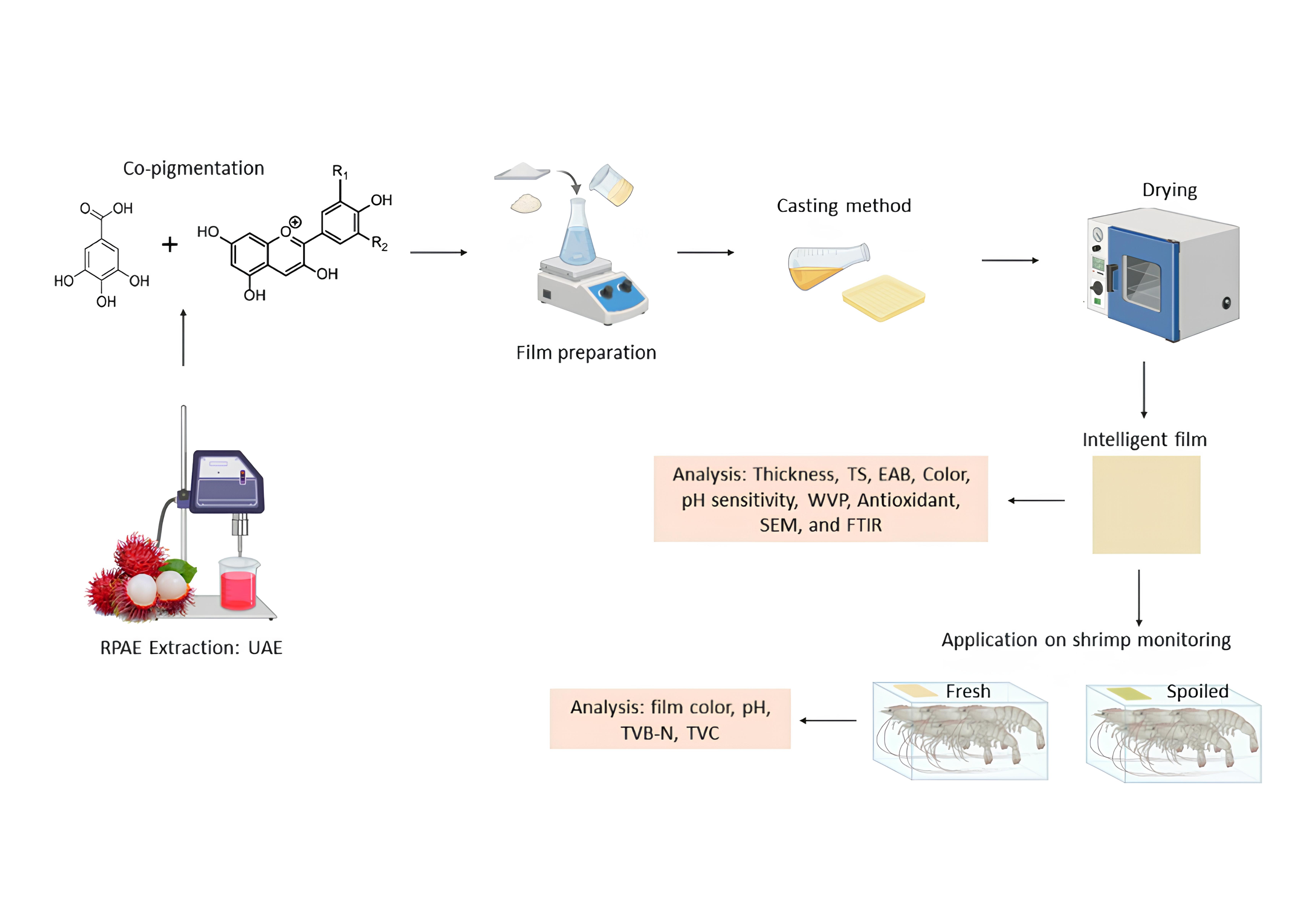
Downloads
References
SF Hosseini and MC Gómez-Guillén. A state-of-the-art review on the elaboration of fish gelatin as bioactive packaging: Special emphasis on nanotechnology-based approaches. Trends in Food Science & Technology 2018; 79, 125-135.
P Ezati and JW Rhim. Starch- and agar-based color-indicator films integrated with shikonin for smart packaging application of shrimp. ACS Food Science & Technology 2021; 1, 1963-1969.
S Zhou, N Li, H Peng, X Yang and D Lin. The development of highly pH-sensitive bacterial cellulose nanofibers/gelatin-based intelligent films loaded with anthocyanin/curcumin for the fresh-keeping and freshness detection of fresh pork. Foods 2023; 12(20), 3719.
N Guo, M Song, W Liu, F Zhang and G Zhu. Preparation of an elderberry anthocyanin film and fresh-keeping effect of its application on fresh shrimps. PLoS One 2023; 18(11), e0290650.
NA Azlim, AM Nafchi, N Oladzadabbasabadi, F Ariffin, P Ghalambor, S Jafarzadeh and AA Al-Hassan. Fabrication and characterization of a pH-sensitive intelligent film incorporating dragon fruit skin extract. Food Science & Nutrition 2022; 10(2), 597-608.
NF Latiff, MI Shaik, NJ Mohamad, WM Khairul, AI Daud, B Nurhadi and NM Sarbon. Recent advances in green halochromic smart film packaging: Investigating the natural colorant as biosensor in smart film packaging for real-time meat freshness monitoring. Food Control 2025; 172, 111157.
F Hematian, H Baghaei, AM Nafchi and M Bolandi. Preparation and characterization of an intelligent film based on fish gelatin and Coleus scutellarioides anthocyanin to monitor the freshness of rainbow trout fish fillet. Food Science & Nutrition 2023; 11(1), 379-389.
Y Zheng, X Li, Y Huang, H Li, L Chen and X Liu. Two colorimetric films based on chitin whiskers and sodium alginate/gelatin incorporated with anthocyanins for monitoring food freshness. Food Hydrocolloids 2022; 127, 107517.
R Pramitasari, LN Gunawicahya and DSB Anugrah. Development of an indicator film based on cassava starch-chitosan incorporated with red dragon fruit peel anthocyanin extract. Polymers 2022; 14, 4142.
NF Latiff, NF Sulaiman, MI Shaik, NJ Mohamad, WM Khairul, AI Daud and NM Sarbon. Halochromic smart film: a gelatin-based pH-sensitive film embedded with anthocyanin from roselle (Hibiscus sabdariffa) extracts for potential food spoilage indicator application. Journal of Food Science 2025; 90(3), e70134.
X He, L Tang, C Li, J Hao and R Huang. Eco-friendly poly(butylene adipate-co-butylene terephthalate)/poly(lactic acid) packaging films with grape seed extract for extending the shelf life of strawberries and broccoli. LWT 2025; 227, 117990.
O Dardari, MA Benzaouia, A El Idrissi, BE Channab, GR Benjellound, A El Gharrak, M El Ouardi and A El Kadib. Anthocyanin and thyme oil embedded carrageenan - PVA towards bioactive and pH-sensitive food-packaging materials. Journal of Biological Macromolecules 2025; 310, 143213.
LT Wu, IL Tsai, YC Ho, YH Hang, C Lin, ML Tsai and FL Mi. Active and intelligent gellan gum-based packaging films for controlling anthocyanins release and monitoring food freshness. Carbohydrate Polymers 2021; 254, 117410.
A Koga, F Tanaka, S Hagiwara, LP Wigati and F Tanaka. Functional properties of gelatin/konjac glucomannan-based coatings with Aomori hiba essential oil and their effect on ethylene production in peach fruit (Prunus persica (L.) Batsch cv. ‘Hikawa Hakuho’) during cold storage. Environmental Control in Biology 2024; 62, 17-28.
SMB Hashemi and D Jafarpour. The efficacy of edible film from konjac glucomannan and saffron petal extract to improve shelf life of fresh-cut cucumber. Food Science & Nutrition 2020; 8(7), 3128-3137.
HC Lai, AA Karim and CC Seow. Effects of water-glycerol and water-sorbitol interactions on the physical properties of konjac glucomannan films. Journal of Food Science 2006; 71(2), E62-E67.
A Dirpan, AF Ainani and M Djalal. A review on biopolymer-based biodegradable film for food packaging: trends over the last decade and future research. Polymers 2023; 15(13), 2781.
E Harmayani, NF Geraldo and A Murdiati. Physicochemical, nutritional and sensory properties of kluklui supplemented with porang glucomannan and banana flour. Indonesian Food and Nutrition Progress 2022; 18(1), 9-15.
AS Sekarina, Supriyadi, HSH Munawaroh, E Susanto, PL Show and A Ningrum. Effects of edible coatings of chitosan–fish skin gelatine containing black tea extract on quality of minimally processed papaya during refrigerated storage. Carbohydrate Polymer Technologies and Applications 2023; 5, 100287.
F Azizah, H Nursakti, A Ningrum and Supriyadi. Development of edible composite film from fish gelatin–pectin incorporated with lemongrass essential oil and its application in chicken meat. Polymers 2023; 15(9), 2075.
PAV Freitas, RRA Siiva, TV de Oiiveira, RRA Soares and NFF Soares. Biodegradable film development by nisin Z addition into hydroxypropylmethylcellulose matrix for mozzarella cheese preservation. International Journal of Food Studies 2020; 9(2), 360-372.
NA Azlim, AM Nafchi, N Oladzadabbasabadi, F Ariffin, P Ghalambor, S Jafarzadeh and AA Al-Hassan. Fabrication and characterization of a pH-sensitive intelligent film incorporating dragon fruit skin extract. Food Science & Nutrition 2021; 10, 597-608.
AW Perdani, AD Setiowati, B Purwono and S Supriyadi. Color enhancement of rambutan peel anthocyanins extracts using co-pigmentation with gallic acid for pH-sensitives dye. Trends in Sciences 2025; 22, 9518.
A Ponnusamy, A Khan, T Prodpran, JW Rhim and S Benjakul. Multifunctional fish gelatin film incorporated with chitosan carbon dots and butterfly pea flower anthocyanins for active/smart packaging of Pacific white shrimp. Food Bioscience 2024; 62, 105483.
M Cissé, P Bohuon, F Sambe, C Kane, M Sakho and M Dornier. Aqueous extraction of anthocyanins from Hibiscus sabdariffa: Experimental kinetics and modeling. Journal of Food Engineering 2012; 109(1), 16-21.
A Manosroi, W Ruksiriwanich, B Kietthanakorn, W Manosroi and J Manosroi. Relationship between biological activities and bioactive compounds in the fermented rice sap. Food Research International 2011; 44(9), 2757-2765.
A Ningrum, AW Perdani, Supriyadi, H Siti Halimatul Munawaroh and S Aisyah. Characterization of tuna skin gelatin edible films with various plasticizers-essential oils and their effect on beef appearance. Journal of Food Processing and Preservation 2021; 45, 15701.
MR Teruel, MD Garrido, MC Espinosa and MB Linares. Effect of different format-solvent rosemary extracts (Rosmarinus officinalis) on frozen chicken nuggets quality. Food Chemistry 2015; 172, 40-46.
National Standardization Agency of Indonesia. Chemical testing method - Part 8: determination of total volatile base nitrogen (TVB-N) and trimethylamine nitrogen (TMA-N) in fishery products. National Standardization Agency of Indonesia, Jakarta, Indonesia, 2009.
R Ran, T Zheng, P Tang, Y Xiong, C Yang, M Gu and G Li. Antioxidant and antimicrobial collagen films incorporating Pickering emulsions of cinnamon essential oil for pork preservation. Food Chemistry 2023; 420, 136108.
D Verma, N Sharma and U Malhotra. Structural chemistry and stability of anthocyanins. The Pharma Innovation 2023; 12, 1366-1373.
M Tavassoli, MA Sani, A Khezerlou, A Ehsani, GJ Khaniki and DJ McClements. Smart biopolymer-based nanocomposite materials containing pH-sensing colorimetric indicators for food freshness monitoring. Molecules 2022; 27, 3168.
R Abedi-Firoozjah, S Yousefi, M Heydari, F Seyedfatehi, S Jafarzadeh, R Mohammadi, M Rouhi and F Garavand. Application of red cabbage anthocyanins as pH-sensitive pigments in smart food packaging and sensors. Polymers 2022; 14, 1629.
S Duarte, GA Valencia and O Ferreiro. Biodegradable colorimetric indicative films based on kurugua (Sicana odorifera) peel powder. Polymers 2025; 17, 1167.
HE Khoo, A Azlan, ST Tang and SM Lim. Anthocyanidins and anthocyanins: Colored pigments as food, pharmaceutical ingredients, and the potential health benefits. Food & Nutrition Research 2017; 61, 1361779.
S Zhou, J Li, D Lin, X Feng, R Zhang, D Wang, A Zhao, H Tian and X Yang. Development of konjac glucomannan-based active–intelligent emulsion films loaded with different curcumin-metal chelates: stability, antioxidant, fresh-keeping and freshness detection properties. International Journal of Biological Macromolecules 2024; 282, 137231.
J Zhang, X Zou, X Zhai, XW Huang, C Jiang and M Holmes. Preparation of an intelligent pH film based on biodegradable polymers and roselle anthocyanins for monitoring pork freshness. Food Chemistry 2019; 272, 306-312.
E da Nóbrega Santos, TC de Albuquerque Sousa, DC de Santana Neto, CV Brandão Grisi, VC da Silva Ferreira and FA Pereira da Silva. Edible active film based on gelatin and Malpighia emarginata waste extract to inhibit lipid and protein oxidation in beef patties. LWT 2022; 154, 112837.
OJ Esua, DW Sun, JH Cheng, H Wang and M Lv. Functional and bioactive properties of Larimichthys polyactis protein hydrolysates as influenced by plasma functionalized water-ultrasound hybrid treatments and enzyme types. Ultrasonics Sonochemistry 2022; 86, 106023.
K Wu, H Wang, Z Zhang, H Cai, K Qian, W Ma, M Fan and L Li. pH-responsive gelatin/diatomite/rose anthocyanin composite films by melt extrusion: physicochemical properties and application in monitoring freshness of Litopenaeus vannamei. Food Science & Nutrition 2025; 38, 739-751.
T Aowpitaya and R Sasanatayart. Properties of gelatin-based films incorporated with anthocyanins and curcuminoids and stability of antioxidant activity during in vitro digestion. Current Applied Science and Technology 2024; 24, e0259441.
Y Qi and Y Li. Colorimetric films based on polyvinyl alcohol and anthocyanins extracted from purple tomato to monitor the freshness of shrimp. Polymers 2024; 16, 495.
M Pouralkhas, M Kordjazi, SM Ojagh and OA Farsani. Physicochemical and functional characterization of gelatin edible film incorporated with fucoidan isolated from Sargassum tenerrimum. Food Science & Nutrition 2023; 11, 4124-4135.
MZ Çoban and ÖE Çoban. Potency and use of chia mucilage coating containing propolis liquid extract for improves shelf-life of sea bass fillets. Acta Scientiarum Polonorum Technologia Alimentaria 2020; 19, 255-260.
N Wannawisan, K Pathanasriwong, J Runglerdkriangkrai, P Wilaipun, A Sane and P Suppakul. Microbiological, chemical and physical attributes and mathematical models for total volatile basic nitrogen formation of Asian seabass (Lates calcarifer) fillets stored under refrigerated and temperature-abuse conditions. Agriculture and Natural Resources 2023; 57(3), 511-522.
E Jaffrès, V Lalanne, S Macé, J Cornet, M Cardinal, T Sérot, X Dousset and J Joffraud. Sensory characteristics of spoilage and volatile compounds associated with bacteria isolated from cooked and peeled tropical shrimps using SPME-GC-MS analysis. International Journal of Food Microbiology 2011; 147(3), 195-202.
S Yang, J Xie and Y Qian. Determination of spoilage microbiota of Pacific white shrimp during ambient and cold storage using next-generation sequencing and culture-dependent method. Journal of Food Science 2017; 82, 1178-1183.
Y He, Y Yuan, Y Gao, M Chen, Y Li, Y Zou, L Liao, X Li, Z Wang, J Li and W Zhou. Enhancement of colorimetric pH-sensitive film incorporating Amomum tsao-ko essential oil as antibacterial for mantis shrimp spoilage tracking and fresh-keeping. Foods 2024; 13, 1638.
D Li, Y Zhao, P Han, C Yang, X Liang, L Li and S Cai. Effect of chitosan-jicama starch coating on changes in qualities of fresh Nile tilapia (Oreochromis niloticus) fillets during ice storage. International Journal of Food Science and Technology 2018; 53(9), 2220-2228.
M Aitboulahsen, H Chairi, A Laglaoui, S Zantar, A Arakrak, M Bakkali and MH Zerrouk. Gelatin/pectin-based film incorporated with essential oils: Functional characteristics and shelf life extension of tilapia fillets under refrigeration. Journal of Food Safety 2020; 40(3), e12774.
Published
How to Cite
Issue
Section
License
Copyright (c) 2025 Walailak University

This work is licensed under a Creative Commons Attribution-NonCommercial-NoDerivatives 4.0 International License.





