
Color Enhancement of Rambutan Peel Anthocyanins Extracts using Co-Pigmentation with Gallic Acid for pH-Sensitives Dye
DOI:
https://doi.org/10.48048/tis.2025.9518Keywords:
Anthocyanins, Rambutan peels, Intelligent packaging, Purification, Sephadex LH-20, Co-pigmentation, Gallic acidAbstract
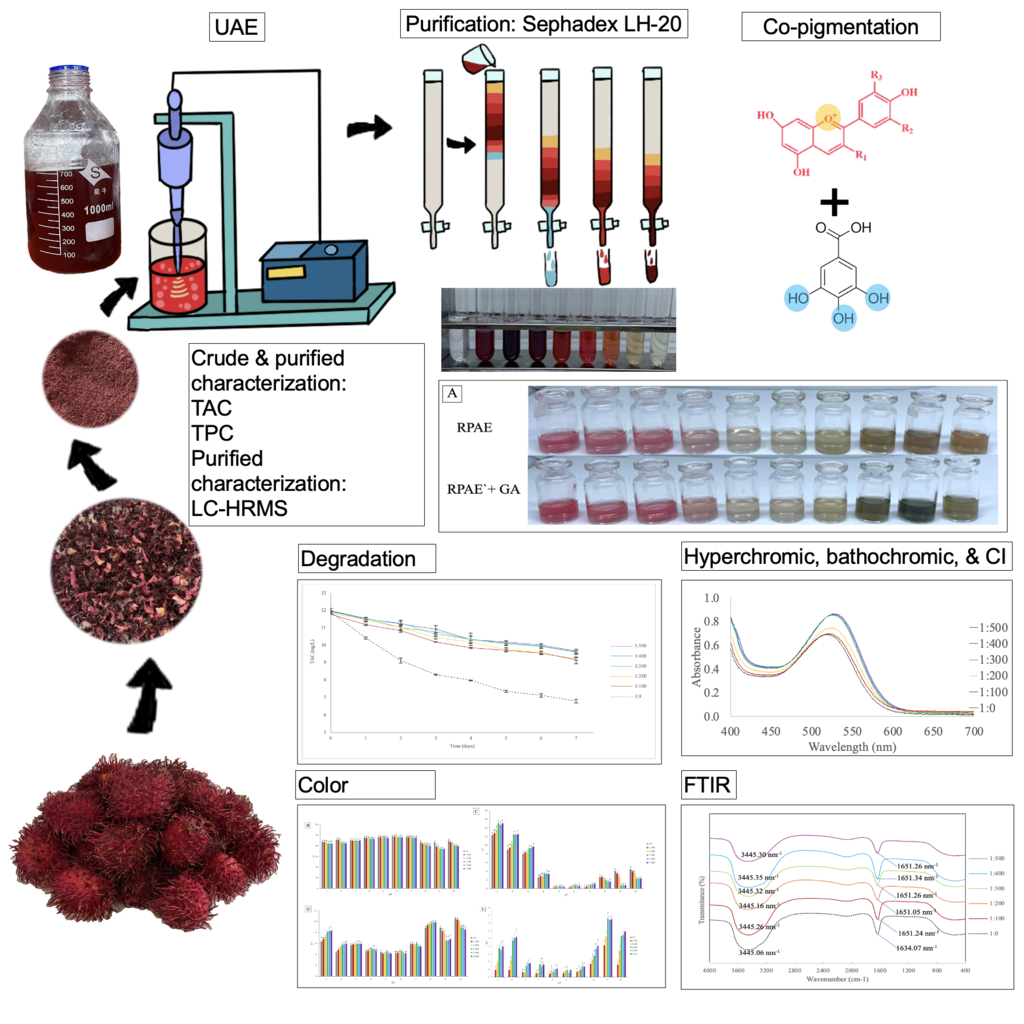
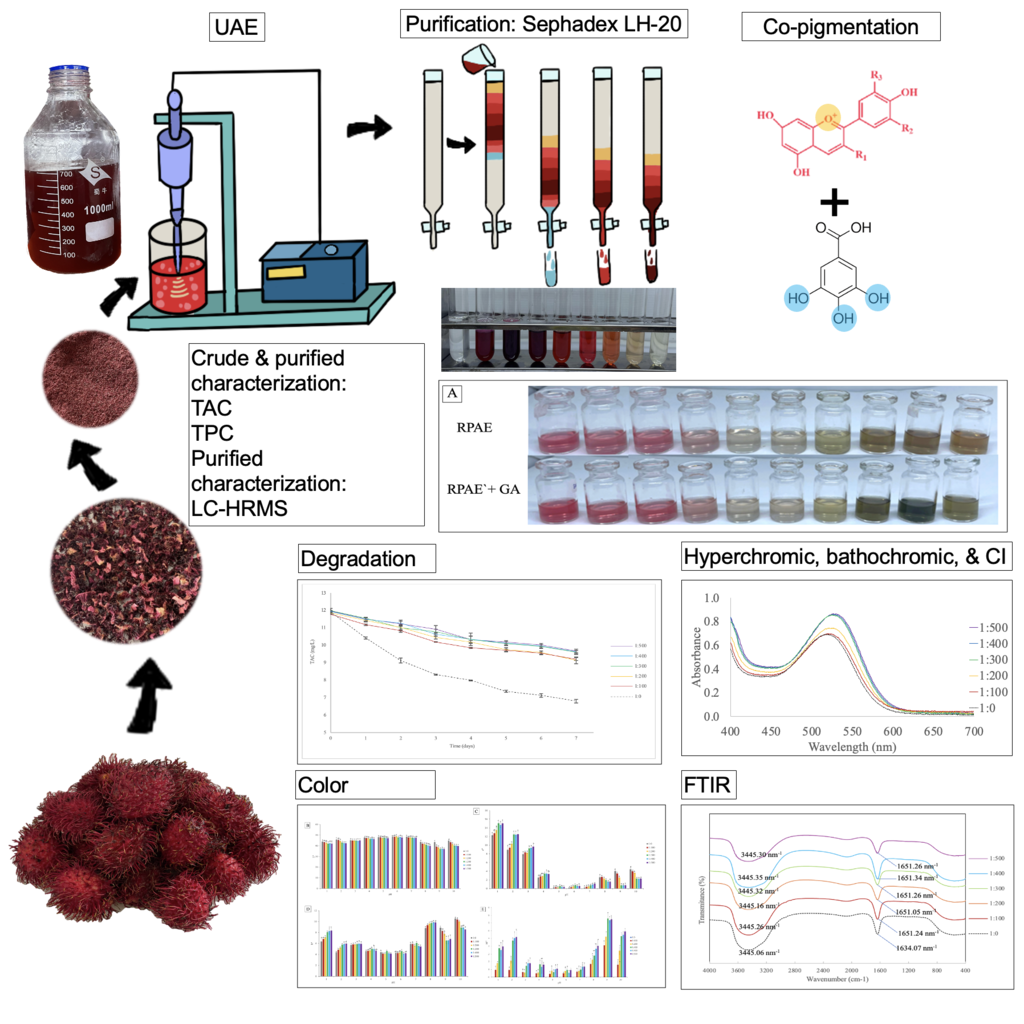
Rambutan peels typically contain anthocyanins that can be utilized as pH-sensitive dye for intelligent food packaging. Therefore, this study aimed to isolate anthocyanins from rambutan peels and investigate their co-pigmentation with gallic acid (GA) to enhance color intensity while maintaining a pH sensitivity. Rambutan peel anthocyanins extracts (RPAE) were extracted using ultrasound-assisted extraction with 0.2 % citric acid in 96 % ethanol. The purification of RPAE was carried out using a chromatography column with Sephadex LH-20 as the stationary phase. Co-pigmentation was then performed using GA at various molar ratios of RPAE to GA (1:0, 1:100, 1:200, 1:300, 1:400 and 1:500). The results showed that the purification process with Sephadex LH-20 increased the anthocyanins content of RPAE to 157.50 mg CyE/100 g extract. After purification, RPAE was found to primarily consist of cyanidin 5-O-glucoside, delphinidin-3-O-glucoside, cyanidin 3-O-galactoside, delphinidin (aglycon), cyanidin-3-O-glucoside, pelargonidin 3-O-glucoside, and cyanidin (aglycon). Co-pigmentation with GA significantly reduced the degradation of total anthocyanin content compared to native RPAE during the 7-day observation period. Additionally, co-pigmentation with GA enhanced color intensity, as demonstrated by a decrease in the L* value across pH 1-10, an increase in the a* and b* values at low pH, and a decrease in the a* and b* values at high pH. However, compared to non-co-pigmentation, co-pigmentation with GA exhibited more pronounced color differences across varying pH levels, marked by higher a* at low pH and lower b* and L* at high pH. The interaction between GA and RPAE, presumably via hydrogen bonding comprising the carbonyl group of RPAE and GA, produced hyperchromic and bathochromic effects. These findings indicate that co-pigmentation with GA enhances the pH sensitivity of RPAE, making it a promising candidate for developing intelligent food packaging systems that can visually indicate changes in pH, such as monitoring food spoilage or freshness.
HIGHLIGHTS
- The purification of rambutan peel anthocyanins extracts using Sephadex LH-20 increased the yield to 157.50 mg CyE/100 g extract, identifying cyanidin, delphinidin, and pelargonidin derivatives.
- Co-pigmentation of rambutan peel anthocyanins extracts with gallic acid reduced the degradation of total anthocyanins, increased color intensity, and maintained pH sensitivity.
- The co-pigmentation mechanism of rambutan peel anthocyanin extracts with gallic acid involved molecular interactions with the carbonyl group of anthocyanins.
GRAPHICAL ABSTRACT
Downloads
References
H Yong and J Liu. Recent advances in the preparation, physical and functional properties, and applications of anthocyanins-based active and intelligent packaging films. Food Packaging and Shelf Life 2020; 26, 100550.
D Zheng, S Cao, D Li, Y Wu, P Duan, S Liu, X Li, X Zhang and Y Chen. Fabrication and characterization of chitosan/anthocyanin intelligent packaging film fortified by cellulose nanocrystal for shrimp preservation and visual freshness monitoring. International Journal of Biological Macromolecules 2024; 264(2), 130692.
S Roy and J W Rhim. Anthocyanin food colorant and its application in pH-responsive color change indicator films. Colloids and Surfaces B: Biointerfaces 2021; 61(14), 2297-2325.
Q Ma, X Lu, W Wang, MA Hubbe, Y Liu, J Mu, J Wang, J Sun and O Rojas. Recent developments in colorimetric and optical indicators stimulated by volatile base nitrogen to monitor seafood freshness. Food Packaging and Shelf Life 2021; 28(59), 100634.
Y Bao, H Cui, J Tian, Y Ding, Q Tian, W Zhang, M Wang, Z Zang, X Sun, D Li, X Si and B Li. Novel pH sensitivity and colorimetry-enhanced anthocyanin indicator films by chondroitin sulfate co-pigmentation for shrimp freshness monitoring. Food Control 2022; 131(4), 108441.
I Choi, H Choi, J S Lee and J Han. Novel color stability and colorimetry-enhanced intelligent CO2 indicators by metal complexation of anthocyanins for monitoring chicken freshness. Food Chemistry 2023; 404(A), 134534.
E Mohammadian, M Alizadeh-Sani and SM Jafari. Smart monitoring of gas/temperature changes within food packaging based on natural colorants. Comprehensive Reviews in Food Science and Food Safety 2020; 19(6), 2885-2931.
D Wu, M Zhang, H Chen and B Bhandari. Freshness monitoring technology of fish products in intelligent packaging. Critical Reviews in Food Science and Nutrition 2021; 61(8), 1279-1292.
A Duan, J Yang, L Wu, T Wang, Q Liu and Y Liu. Preparation, physicochemical and application evaluation of raspberry anthocyanin and curcumin based on chitosan/starch/gelatin film. International Journal of Biological Macromolecules 2022; 220(19),147-158.
X Zhou, X Yu, F Xie, Y Fan, X Xu, J Qi, G Xiong, X Gao and F Zhang. pH-responsive double-layer indicator films based on konjac glucomannan/camellia oil and carrageenan/anthocyanin/curcumin for monitoring meat freshness. Food Hydrocolloid 2021; 118(3), 106695.
L Gao, P Liu, L Liu, S Li, Y Zhao, J Xie and H Xu. κ-carrageenan-based pH-sensing films incorporated with anthocyanins or/and betacyanins extracted from purple sweet potatoes and peels of dragon fruits. Process Biochemistry 2022; 121, 463-480.
A Etxabide, P A Kilmartin and J I Maté. Color stability and pH-indicator ability of curcumin, anthocyanin and betanin containing colorants under different storage conditions for intelligent packaging development. Food Control 2021; 121, 107645.
Q Tang, J Hu, S Li, S Lin, Y Tu, X Gui and Y Dong. Preparation of an aramid nanofiber-reinforced colorimetric hydrogel employing natural anthocyanin as an indicator for shrimp and fish spoilage monitoring. European Polymer Journal 2023; 187(21), 111889.
The Central Statistics Agency of Indonesia (BPS), Fruit Crop Production, Available at https://www.bps.go.id/id/
statistics-table/2/NjIjMg==/produksi-tanaman-buah-buahan.html, accesed September 2024.
A Nurkhasanah, T Fardad, C Carrera, W Setyaningsih and M Palma. Ultrasound-assisted anthocyanins extraction from pigmented corn: Optimization using response surface methodology. Methods and Protocols 2023; 6(4), 69,
J Sun, H Peng, W Su, J Yao, X Long and J Wang. Anthocyanins extracted from rambutan (nephelium lappaceum l.) pericarp tissues as potential natural antioxidants. Journal of Food Biochemistry 2011; 35(5), 1461-1467.
BR Albuquerque, J Pinela, MI Dias, C Pereira, J Petrovic, M Sokovic, RC Calhelha, MBP Oliveira, ICFR Ferreira and L Barros. Valorization of rambutan (Nephelium lappaceum L.) peel: Chemical composition, biological activity, and optimized recovery of anthocyanins. Food Research International 2023; 165, 112574.
J Liao, B Peng, X Chu and G Yu. Effects of process parameters on the extraction of total anthocyanins from purple sweet potatoes by ultrasound with wide frequency and its kinetics study. Journal of Food Processing and Preservation 2022; 46(7), e16732.
C Hernández, J Ascacio-Valdés, HDL Garza, J Wong-Paz, CN Aguilar, GC Martínez-Ávila, C Castro-López and A Aguilera-Carbó. Polyphenolic content, in vitro antioxidant activity and chemical composition of extract from Nephelium lappaceum L. (Mexican rambutan) husk. Asian Pacific Journal of Tropical Medicine 2017; 10(12), 1201-1205.
H He, L Wang, H Huang and Y Li. A novel gallic acid-based anthocyanin Electrospun sensor for monitoring shrimp freshness. Food Analytical Methods 2024; 17(5), 689-700.
Y Osawa. Copigmentation of anthocyanins. In: P. Markakis (Ed.). Anthocyanins as food colors. Academic Press, New York, 1982, p. 41-86.
R Becerril, C Nerín and F Silva. Bring some colour to your package: Freshness indicators based on anthocyanin extracts. Trends in Food Science & Technology 2021; 111(11), 495-505.
X Lv, L Li, X Lu, W Wang, J Sun, Y Liu, J Mu, Q Ma and J Wang. Effects of organic acids on color intensification, thermodynamics, and copigmentation interactions with anthocyanins. Food Chemistry 2022; 396(3), 133691.
S Raharjo, FA Purwandari, P Hastuti and K Olsen. Stabilization of black rice (Oryza Sativa, L. Indica) anthocyanins using plant extracts for Copigmentation and maltodextrin for encapsulation. Journal Food Science 2019; 84(7), 1712-1720.
MT Escribano-Bailón and C Santos-Buelga. Anthocyanin copigmentation-evaluation, mechanisms and implications for the colour of red wines. Current Organic Chemistry 2012; 16(6), 715-723.
F Sari. The copigmentation effect of different phenolic acids on berberis crataegina anthocyanins. Journal of Food Processing and Preservation 2016; 40(3), 422-430.
RJ Robbins. Phenolic acids in foods: An overview of analytical methodology. Journal of Agricultural and Food Chemistry 2003; 51(10), 2866-2887.
X Sun, S Shokri, B Gao, Z Xu, B Li, T Zhu, Y Wang and J Zhu. Improving effects of three selected co-pigments on fermentation, color stability, and anthocyanins content of blueberry wine. LWT 2022; 156(4), 113070.
HH Nurhuda, MY Maskat, S Mamot, J Afiq and A Aminah. Effect of blanching on enzyme and antioxidant activities of rambutan (nephelium lappaceum) peel. International Food Research Journal 2013; 20(4),1725-1730.
M Ziabakhsh Deylami, R Abdul Rahman, CP Tan, J Bakar and L Olusegun. Effect of blanching on enzyme activity, color changes, anthocyanin stability and extractability of mangosteen pericarp: A kinetic study. Journal of Food Engineering 2016; 178, 12-19.
AOAC International and GWL Jr. Official methods of analysis of the association of official analytical chemists. Oxford University Press, Washington DC, 1999.
MM Giusti and RE Wrolstad. Characterization and measurement of anthocyanins by UV-visible spectroscopy. Current Protocols in Food Analytical Chemistry 2001. https://doi.org/10.1002/0471142913.faf0102s00
Husniati, J Permana and T Suhartati. Antioxidant enrichment for artificial red rice by natural red pigment extract from Rhoeo discolor L. her. Biopropal Industri 2020; 11(1), 33-40.
H Xue, J Tan, Q Li, J Tang and X Cai. Ultrasound-assisted enzymatic extraction of anthocyanins from raspberry wine residues: Process optimization, isolation, purification, and bioactivity determination. Food Analytical Methods 2021; 14(7), 1369-1386.
YP Nusantara, LN Lestario and Y Martono. Effect addition of gallic acid as copigment for black mulberry anthocyanin (Morus nigra L.) towards thermal stability. Agritech 2017; 37(4), 428-436.
S Klongdee and U Klinkesorn. Optimization of accelerated aqueous ethanol extraction to obtain a polyphenol-rich crude extract from rambutan (Nephelium lappaceum L.) peel as natural antioxidant. Scientific Reports 2022; 12(1), 21153.
TC Wallace and MM Giusti. Anthocyanins-nature’s bold, beautiful, and health-promoting colors. Foods 2019; 8(11), 550.
LD Vedova, G Ferrario, F Gado, A Altomare, M Carini, P Morazzoni, G Aldini and G Baron. Liquid chromatography-high-resolution mass spectrometry (LC-HRMS) profiling of commercial enocianina and evaluation of their antioxidant and anti-inflammatory activity. Antioxidants 2022; 11(6), 1187.
A Ningrum, AW Perdani, S Supriyadi, HSH Munawaroh, S Aisyah and E Susanto. Characterization of tuna skin gelatin edible films with various plasticizers-essential oils and their effect on beef appearance. Journal of Food Processing and Preservation 2021; 45(9), e15701.
S Naghdi, M Rezaei and M Abdollahi. A starch-based pH-sensing and ammonia detector film containing betacyanin of paperflower for application in intelligent packaging of fish. International Journal of Biological Macromolecule 2021; 191, 161-170.
D Klisurova, I Petrova, M Ognyanov, Y Georgiev, M Kratchanova and P Denev. Co-pigmentation of black chokeberry (Aronia melanocarpa) anthocyanins with phenolic co-pigments and herbal extracts. Food Chemistry 2019; 279, 162-170.
H Xue, L Shen, X Wang, C Liu, C Liu, H Liu and X Zheng. Isolation and purification of anthocyanin from blueberry using macroporous resin combined sephadex LH-20 techniques. Food Science and Technol Research 2019; 25(1), 29-38.
S Torgbo, U Sukatta, P Kamonpatana and P Sukyai. Ohmic heating extraction and characterization of rambutan (Nephelium lappaceum L.) peel extract with enhanced antioxidant and antifungal activity as a bioactive and functional ingredient in white bread preparation. Food Chemistry 2022; 382, 132332.
C Hernández-Hernández, CN Aguilar, R Rodríguez-Herrera, AC Flores-Gallegos, J Morlett-Chávez, M Govea-Salas and JA Ascacio-Valdés. Rambutan (Nephelium lappaceum L.): Nutritional and functional properties. Trends in Food Science & Technology 2019; 85, 201-210.
Y Jiang, J Pei, Y Zheng, YJ Miao, BZ Duan and LF Huang. Gallic acid: A potential anti-cancer agent. Chinese Journal of Integrative Medicine 2022; 28(7), 661-671.
B J Qian, J H Liu, S J Zhao, J X Cai and P Jing. The effects of gallic/ferulic/caffeic acids on colour intensification and anthocyanin stability. Food Chemistry 2017; 228, 526-532.
SS Rosales-Murillo, J Sánchez-Bodón, SLH Olmos, MF Ibarra-Vázquez, LG Guerrero-Ramírez, L Pérez-Álvarez and JL Vilas-Vilela. Anthocyanin-loaded polymers as promising nature-based, responsive, and bioactive materials. Polymers 2024; 16(1), 163.
F Zeng, Y Ye, J Liu and P Fei. Intelligent pH indicator composite film based on pectin/chitosan incorporated with black rice anthocyanins for meat freshness monitoring. Food Chemistry X 2022; 17, 100531.
E Gençdag, EE Özdemir, K Demirci, A Görgüç and FM Yılmaz. Copigmentation and stabilization of anthocyanins using organic molecules and encapsulation techniques. Current Plant Biology 2022; 29, 100238.
X Chen, Q Gao, S Liao, Y Zou, J Yan and Q Li. Co-pigmentation mechanism and thermal reaction kinetics of mulberry anthocyanins with different phenolic acids. Foods 2022; 11(23), 3806.
L Zhang, W Wang, X Yue, GS Wu, P Yue and X Gao. Gallic acid as a copigment enhance anthocyanin stabilities and color characteristics in blueberry juice. Journal of Food Science and Technology 2020; 57(4), 1405-1414.
H Zou, Y Ma, Z Xu, X Liao, A Chen and S Yang. Isolation of strawberry anthocyanins using high-speed counter-current chromatography and the copigmentation with catechin or epicatechin by high pressure processing. Food Chemistry 2018; 247, 81-88.
P Trouillas, J C Sancho-García, V De Freitas, J Gierschner, M Otyepka and O Dangles. Stabilizing and modulating color by copigmentation: Insights from theory and experiment. Chemical Reviews 2016; 116(9), 4937-4982.
Downloads
Published
How to Cite
Issue
Section
License
Copyright (c) 2025 Walailak University

This work is licensed under a Creative Commons Attribution-NonCommercial-NoDerivatives 4.0 International License.





