
The Green Synthesized and Characterized Silver Nanoparticle Modified Screen Printed Carbon Electrode for Cyclic Voltammetric Simultaneous Determination of Cd and Cu
DOI:
https://doi.org/10.48048/tis.2026.12579Keywords:
Electrochemical sensor, Nanomaterials, Green synthesis, SPCE, AgNPs, Cadmium, CopperAbstract
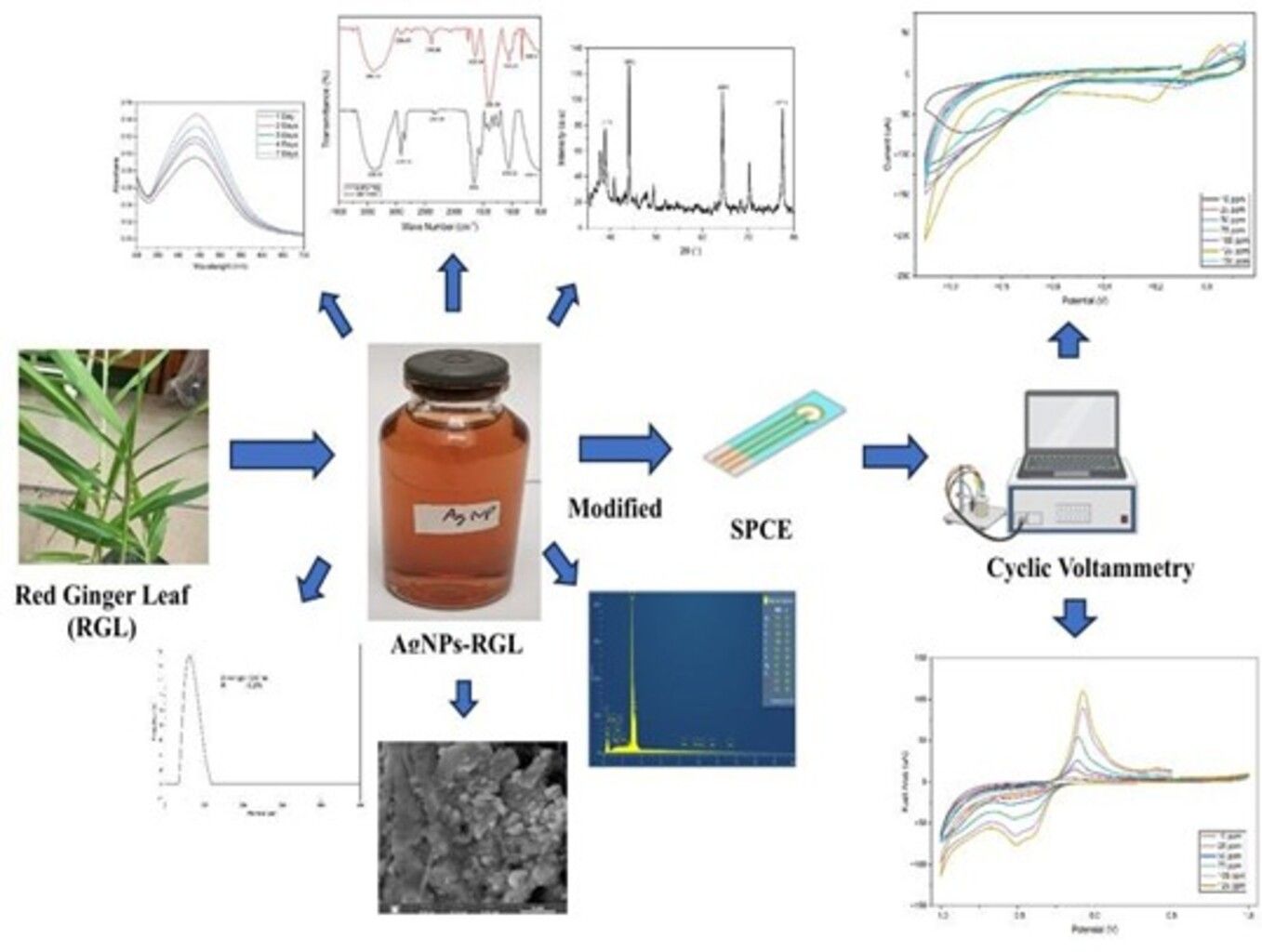
Over the past few decades, nanoscience has gained prominence in green plant-mediated nanoparticle synthesis due to its eco-friendly, easy-to-use, and cost-effective properties. This study was conducted to synthesize silver nanoparticles using red ginger leaf extract as a capping agent and natural reducing agent, and to characterize them. We also evaluated the development of green-synthesized silver nanoparticles (AgNPs-RGL) to modify the Screen Print Carbon Electrode (SPCE) for the simultaneous cyclic voltammetric determination of Cd and Cu. The formation of AgNPs-RGL was visually confirmed by discoloration from yellow to brownish-yellow. UV-Visible analysis reveals a surface plasmon resonance band at 439.5 - 444 nm, which remains stable during the 7-day incubation period. AgNPs-RGL particles have a cubic face-centered shape, an average size of 53.6 nm, and are well distributed, with a polydispersity index of 0.278. EDX analysis confirmed silver (51.1%) as the dominant element, with several other components, including carbon, oxygen, and nitrogen. FTIR analysis confirmed the capping of AgNPs with phytochemicals from the leaf extract. AgNPs-RGL has the potential to be developed as an SPCE modifier for the simultaneous determination of Cd and Cu, providing simple, fast, accurate, and highly sensitive results using cyclic voltammetry. The limits of detection for Cu and Cd are 7.75 and 1.28 ppm, respectively. The sensitivities are 0.199 and 1.206 μAppm−1mm−2, respectively. The accuracies are 42.7% and 85.6%, respectively. These findings show that cyclic voltammetry using SPCE/AgNPs for Cu determination is more sensitive but less accurate. In contrast, Cd determination is less sensitive but more accurate.
HIGHLIGHTS
- Silver nanoparticles can be synthesized using red ginger leaf water extract as a reducing agent.
- Green plant-mediated nanoparticle synthesis has eco-friendly, easy-to-use, and cost-effective properties.
- Silver nanoparticles synthesized from red ginger leaves have the potential to be developed as a SPCE modifier for the simultaneous determination of cadmium Cd and Cu in river water.
- Cyclic voltammetry using a silver nanoparticle-modified Screen-Printed Carbon Electrode for Cu determination is more sensitive but less accurate. In contrast, Cd determination is less sensitive but more accurate.
GRAPHICAL ABSTRACT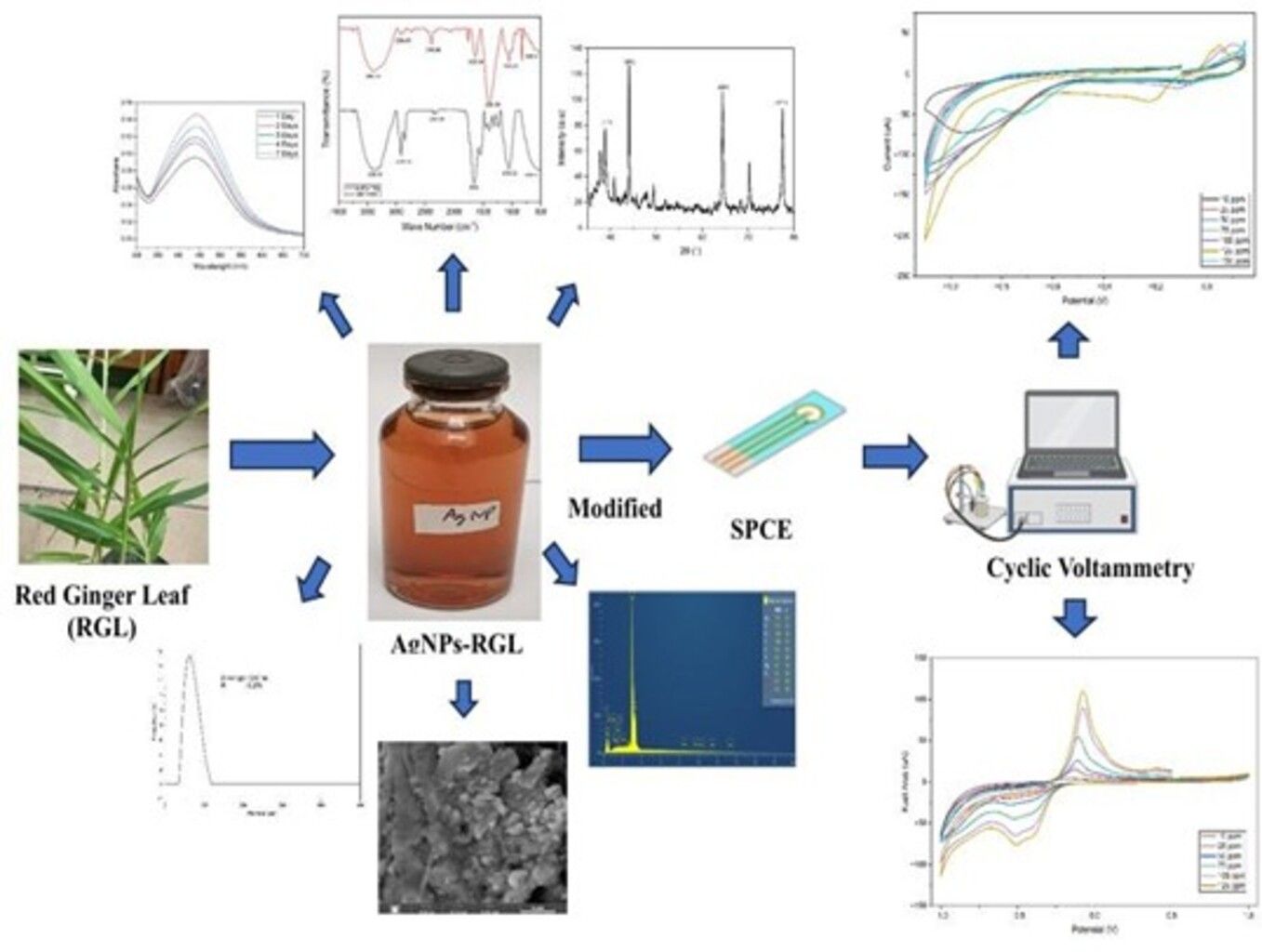
Downloads
References
DL Fedlheim and CA Foss. Metal nanoparticles: Synthesis, characterization, and applications. CRC Press, Florida, United States, 2001.
A Moores and F Goettmann. The plasmon band in noble metal nanoparticles: An introduction to theory and applications. New Journal of Chemistry 2006; 30(8), 1121-1132.
S Anil Kumar, MK Abyaneh, SW Gosavi, SK Kulkarni, R Pasricha, A Ahmad and MI Khan. Nitrate reductase-mediated synthesis of silver nanoparticles from AgNO3. Biotechnology Letters 2007; 29(3), 439-445.
A Lagashetty, S Ganiger and S Reddy. Synthesis, characterization and antibacterial study of Ag-Au Bi-metallic nanocomposite by bioreduction using piper betle leaf extract. Heliyon 2019; 5(12), e02794.
UC Jayaram and A Gurusamy. Biosynthesis and characterization of silver nanoparticles using leaf extract of Abutilon indicum. Global Journal of Biotechnology & Biochemistry 2018; 13(1), 7-11.
MR Bindhu, M Umadevi, GA Esmail, NA Al-Dhabi and MV Arasu. Green synthesis and characterization of silver nanoparticles from Moringa oleifera flower and assessment of antimicrobial and sensing properties. Journal of Photochemistry and Photobiology B: Biology 2020; 205, 111836.
MS Jabir, YM Saleh, GM Sulaiman, NY Yaseen, UI Sahib, YH Dewir, MS Alwahibi and DA Soliman. Green synthesis of silver nanoparticles using Annona muricata extract as an inducer of apoptosis in cancer cells and inhibitor for nlrp3 inflammasome via enhanced autophagy. Nanomaterials 2021; 11(2), 384.
M Narayan, S Divya, D Natarajan, S Senthil-Nathan, S Kandasamy, A Chinnathambi, TA Alahmadi and A Pugazhendhi. Green synthesis of silver nanoparticles from aqueous extract of Ctenolepis garcini L. and assess their possible biological applications. Process Biochemistry 2021; 107, 91-99.
SS Shankar, A Rai, A Ahmad and M Sastry. Rapid synthesis of Au, Ag, and bimetallic Au core-Ag shell nanoparticles using neem (Azadirachta Indica) leaf broth. Journal of Colloid and Interface Science 2004; 275, 496-502.
SD Solomon, M Bahadory, AV Jeyarajasingam, SA Rutkowsky, C Boritz and L Mulfinger. Synthesis and study of silver nanoparticles. Journal of Chemical Education, 84(2), 322-325.
NH Ashiri. 2016, Activity test and identification of antibacterial chemical compounds of ethanol extract of bidara leaves (Ziziphus Spina-Christi L.) against some pathogenic bacteria. Master Thesis. Alauddin State Islamic University, Makassar, Indonesia.
L Natta, K Orapin, N Krittika and B Pantip. Essential oil from 5 Zingiberaceae for anti- foodborne bacteria. International Food Research Journal 2008; 15(3), 337-346.
SV Otari, RM Patil, SJ Ghosh and SH Pawar. Green phytosynthesis of silver nanoparticles using aqueous extract of Manilkara zapota (L.) seeds and its inhibitory action against Candida species. Materials Letter 2014; 116, 367-369.
Y Masakke, Sulfikar and M Rasyid. Biosynthesis of silver nanoparticles using methanol extract of mangosteen leaves (Garcinia mangostana L.). Jurnal Sainsmat 2015; 4(1), 28-41.
Y Haryani, EM Putri and FK Ganis. 2016, Biosynthesis of silver nanoparticles using red ginger rhizome extract (Zingiber officinale) and antibacterial activity test. Master Thesis. University of Riau, Riau, Indonesia.
Y Wang, C Arunachalam, N Omaima and AA Sulaiman. Green synthesis and chemical characterization of a novel anti-human pancreatic cancer supplement by silver nanoparticles containing Zingiber officinale leaf aqueous extract. Arabian Journal of Chemistry 2021; 14(4), 103081.
C Yan, Z Qu, J Wang, L Cao and Q Han. Microalgal bioremediation of heavy metal pollution in water: Recent advances, challenges, and prospects. Chemosphere 2022; 286, 131870.
X Liu, Y Yao, Y Ying and J Ping. Recent advances in nanomaterial-enabled screen-printed electrochemical sensors for heavy metal detection. Trends in Analytical Chemistry. 2019; 115, 187-202.
Z Liu, Y Fei, H Shi, L Mo and J Qi. Prediction of high-risk areas of soil heavy metal pollution with multiple factors on a large scale in industrial agglomeration areas. Science of the Total Environment 2022; 808, 151874.
MJ Mohammadi, F Kiani, M Farhadi, S Ghanbari, D Jalili and L Mirzaei. Evaluation of carcinogenic risk from heavy metal exposure through rice consumption in Southwestern Iran. Toxicology Reports 2024; 12, 578-583.
Z Ali, N Sher, I Muhammad and MM Almutairi. The combined effect of cadmium and copper induces bioaccumulation, toxicity, and disrupts the antioxidant enzymatic activities of goldfish (Carassius auratus). Toxicology Reports 2025; 14, 101972.
H Beitollahi, MA Khalilzadeh, S Tajik, M Safaei, K Zhang, HW Jang and M Shokouhimehr. Recent advances in applications of voltammetric sensors modified with ferrocene and its derivatives. ACS Omega 2020; 5(5), 2049-2059.
S Ulandari, D Iswantini and WT Wahyuni. Voltammetric detection of uric acid at screen-printed electrode: A Review. Jurnal Akta Kimia Indonesia 2021; 14(2), 29-42.
Y Liu, D Zhang, J Ding, K Hayat, X Yang, X Zhan, Y Lu and P Zhou. Label-free and sensitive determination of cadmium ions using a Ti-modified Co3O4-based electrochemical aptasensor. Biosensors 2020; 10(12), 195.
S Singh, A Numan, HH Somaily, MMA Dawsari, MHS Alqarni, A Alam and PA Kumar. A novel, eco-friendly multi-walled carbon nanotubes functionalized copper metal-organic framework for ultrasensitive potentiometric detection of cadmium ions. Journal of Environmental Chemical Engineering 2021; 9(6), 106534.
KM Abd-Elsabur, M Abd-Elsabour, FH Assaf and IMA Hasan. Electrochemical estimation of Cd and Cu ions simultaneously using a modified MgO/Fe2O3 nanocomposite/Carbon Paste Electrode. Electrocatalysis 2023; 14, 875-890.
AM Biasi, EA Takara, ML Scala-Benuzzi, AM Valverde and NN Gómez. Modification of electrodes with polymer nanocomposites: Application to the simultaneous determination of Zn(II), Cd(II), and Cu(II) in water samples. Analytica Chimica Acta 2023; 1273, 341499.
A Numan, AAS Gill, S Rafique, M Guduri, Y Zhan, B Maddiboyina, L Li, S Singh and NN Dang. Rationally engineered nanosensors: A novel strategy for the detection of heavy metal ions in the environment. Journal of Hazardous Materials 2021; 409, 124493.
C Pérez-Ràfols, JB Arrieta, N Serrano, JM Díaz-Cruz, C Ariño, J De Pablo and M Esteban. Ag nanoparticles drop-casting modification of screen-printed electrodes for the simultaneous voltammetric determination of Cu(II) and Pb(II). Sensors 2017; 17(6), 1458.
A Aravind, M Sebastian and B Mathew. Green silver nanoparticles as a multifunctional sensor for toxic Cd(II) ions. New Journal of Chemistry 2018; 42, 15022-15031.
M Zhou, L Han, D Deng, Z Zhang, H He, L Zhang and L Luo. 4-mercaptobenzoic acid modified silver nanoparticles-enhanced electrochemical sensor for highly sensitive detection of Cu2+. Sensors and Actuators B: Chemical 2019; 288, 45-54.
Y Chen, H Li, C Fang, L Ai, J Chen, J Su, Q Zhang and Q Fu. Facile synthesis of reduced graphene oxide/silver nanoparticles composites and their application for detecting heavy metal ions. Journal of Alloys and Compounds 2019; 791, 117-124.
PS Nayak, SS Ramamurthy and JKK Kumar. Green synthesis of silver nanoparticles-decorated reduced graphene oxide nanocomposite as an electrocatalytic platform for the simultaneous detection of dopamine and uric acid. Materials Chemistry and Physics 2020; 252, 123302.
N Joudeh and D Linke. Nanoparticle classification, physicochemical properties, characterization, and applications: A comprehensive review for biologists. Journal of Nanobiotechnology 2022; 20, 262.
K Ghanbari, M Moloudi and S Bonyadi. Modified glassy carbon electrode with silver nanoparticles/polyaniline/reduced graphene oxide nanocomposite for the simultaneous determination of biocompounds in biological fluids. Journal of Electrochemical Science and Technology 2019; 10(4), 361-372.
I Ivanisevic. The role of silver nanoparticles in electrochemical sensors for aquatic environmental analysis. Sensors 2023; 23(7), 3692.
M Amare, A Worku, A Kassa and W Hilluf. Green synthesized silver nanoparticle modified carbon paste electrode for SWAS voltammetric simultaneous determination of Cd(II) and Pb(II) in Bahir Dar Textile discharged effluent. Heliyon 2020; 6(7), e04401.
A Nourbakhsh, M Rahimnejad, M Asghary and H Younesi. Simultaneous electro-determination of trace copper, lead, and cadmium in tap water by using silver nanoparticles and graphene nanoplates as a nanocomposite modified graphite electrode. Microchemical Journal 2022; 176, 107137.
G Paimard, E Ghasali and M Baeza. Screen-printed electrodes: Fabrication, modification, and biosensing applications. Chemosensors 2023; 11(2), 113.
A Economou. Screen-printed electrodes modified with “green” metals for electrochemical stripping analysis of toxic elements. Sensors 2010; 10(9), 8160-8178.
R Manikandan, Y Jang-Hee and CC Seung. Emerging Trends in nanostructured materials-coated screen printed electrodes for the electrochemical detection of hazardous heavy metals in environmental matrices. Chemosphere 2023; 333, 140231.
RD Crapnell, CE Banks and DA Brownson. Electroanalytical Overview: Screen-printed electrochemical sensing platforms. ChemElectroChem 2024; 11, e202400370.
K Liu, Q Wang and S Miah. Mercury (II) sensor based on nanosilver/chitosan modified screen-printed carbonelectrode. Inorganic Chemistry Communications 2025; 163, 113639.
P Taba, NY Parmitha and S Kasim. The synthesis of silver nanoparticles uses bay leaf extract (Syzygium polyanthum) as a bioreducer and tests its activity as an antioxidant. Indonesian Journal of Chemical Research 2019; 7(2), 65-72.
AK Roddu. 2021, Synthesis of gold and silver nanoparticles using bioreductor of okra leaf extract (Abelmoschus esculentus (L.) Moench) and its application in the design of blood sugar sensors. Ph. D. Dissertation. Hasanuddin University, Makassar, Indonesia.
S Choudhary and S Yadav. Silver nanoparticle-modified electrodes for electrochemical sensing: Stability and performance considerations. Sensors and Actuators B: Chemical 2020; 309, 127753.
E Eksin, A Erdem, T Fafal and B Kıvçak. Eco-friendly sensors developed by herbal-based silver nanoparticles for electrochemical detection of Mercury (II) ion. Electroanalysis 2019; 31, 1-9.
M Sebastian, A Aravind and B Mathew. Green silver-nanoparticle-based dual sensor for toxic Hg(II) ions. Nanotechnology 2018; 29, 355502.
MS Punnoose, D Bijimol, T Abraham, NJ Plathanam and B Mathew. Green synthesized unmodified silver nanoparticles as reproducible dual sensor for mercuric ions and catalyst to abate environmental pollutants. Bionanoscience 2021; 11, 739-754.
JM George and B Mathew. Curcuma longa rhizome extract-mediated unmodified silver nanoparticles as a multisensing probe for Hg(II) ions. Materials Research Express 2019; 6, 1150h5.
AA Ganash and RA Alghamdi. Fabrication of a novel polyaniline/green-synthesized, silver-nanoparticle-modified carbon paste electrode for electrochemical sensing of lead ions. Journal of the Chinese Chemical Society 2021; 68, 2312-2325.
M Sebastian, A Aravind and B Mathew. Green silver nanoparticles based multi-technique sensor for environmental hazardous Cu(II) ion. Bionanoscience 2019; 9, 373-385.
A Aravind, M Sebastian and B Mathew. Green silver nanoparticles as a multifunctional sensor for toxic Cd(II) ions. New Journal of Chemistry 2018; 42, 15022-15031.
Yulirohyami, P Gani, I Fatimah, D Siswantaa and M Mudasir. Green synthesis of AgNPs-dithizone@chitosan for highly selective and reusable electrochemical sensors of Hg2+. Microchemical Journal 2025; 199, 114015.
JB Arrieta, A Ferré, C Pérez-Ràfols, N Fontàs and J Poch. Green synthesis of Ag nanoparticles using grape stalk waste extract for the modification of screen-printed electrodes. Nanomaterials 2018; 8(6), 1055.
S Girousi, V Keramari, I Paraschi, S Karastogianni and EE Golia. Development of a carbon paste electrode modified with saffron-conjugated silver nanoparticles for the simultaneous determination of Cd, Pb, Zn, Cu, and Cl in soils and plants. Chemosensors 2025; 13(3), 91.
R Munadi and Hutpriyanto. Identification of secondary metabolite compounds and antioxidant activity test of red ginger leaf extract (Zingiber officinale rosc. Var. Rubrum). Chemica: Scientific Journal of Chemistry and Chemistry Education 2023; 24(2), 83-93.
S Ceylan, E Yilmaz, M Yilmaz and M Soylak. Green synthesis of silver nanoparticles using plant extracts and their application in heavy metal sensing. Journal of Molecular Structure 2021; 1234, 130118.
E Gecer, G Akgül, D Yıldırım and N Yıldız. Electrochemical determination of heavy metals using modified carbon electrodes: A review. Electrochimica Acta 2022; 403, 139689.
JR Guimarães, FA Silva, MS Souza and AC Pereira. Silver nanoparticle-modified electrodes for electrochemical detection of Cd and Cu. Sensors and Actuators B: Chemical 2020; 313, 128021.
JM Hawar, MK Mohammed and HH Abdullah. Plant-mediated synthesis of silver nanoparticles and their analytical applications. Materials Today: Proceedings 2022; 65, 120-126.
H Jabbar, M Khan and S Rehman. Green-synthesized AgNPs for electrochemical sensing of heavy metals: A comprehensive review. Journal of Environmental Chemical Engineering 2020; 8(6), 104519.
SN Shah, R Ali, UA Khan and AZ Naqvi. Advances in silver nanoparticle-based electrochemical sensors for environmental monitoring. Analytical Methods 2020; 12, 5400-5412.
Fatimah, W Wahab and A Karim. Synthesis of silver nanoparticles using beluntas leaf (Pluchea Indica L.) extract. Indonesia Chimica Acta 2019; 12(1), 7-12.
R Handoko, L Pratama and N Sari. Electrochemical performance of silver nanoparticle-modified electrodes for heavy metal detection. Journal of Electroanalytical Science 2022; 18(4), 112-120.
A Hermanto, B Widodo and D Kurniawan. Green-synthesized AgNPs from plant extracts for enhanced voltammetric analysis. Materials Chemistry Research 2024; 9(2), 55-67.
T Kebede, H Alemu and G Dessie. Electrochemical sensing of cadmium and copper using nanoparticle-modified carbon electrodes. Sensors and Actuators B: Chemical 2021; 345, 130350.
J Willian, L Pereira and F Costa. Advances in AgNP-modified screen-printed electrodes for environmental metal analysis. Analytical Chemistry Research 2023; 36, 100512.
I Khan, K Saeed and I Khan. Nanoparticles: Properties, applications and toxicities. Arabian Journal of Chemistry 2019; 12(7), 908-931.
F Eker, E Akdaşçi, H Duman, M Bechelany and S Karav. Green synthesis of silver nanoparticles using plant extracts: A comprehensive review of physicochemical properties and multifunctional applications. International Journal of Molecular Sciences 2025; 26(13), 6222.
A Almuqrin, CJ Seneviratne, LJ Walsh and S Zafar. Tailored synthesis and profiling of capped silver and selenium nanoparticles for topical applications in paediatric dentistry. Dentistry Journal 2025; 13(10), 456.
MT Hamid, NN Hussein, GM Sulaiman and HA Mohammed. Antibacterial and antibiofilm properties of silver nanoparticles synthesized using Carthamus tinctorius extract against various multidrug-resistant bacterial strains. Discover Applied Science 2025; 7, 548.
J Kesharwani, KY Yoon, J Hwang and M Rai. Phytofabrication of silver nanoparticles by leaf extract of Datura metel: Hypothetical mechanism involved in synthesis. Journal of Bionanoscience 2009; 3(1), 39-44.
S Behboodi, F Baghbani-Arani, S Abdalan and SAS Shandiz. Green engineered biomolecular enclosed silver nanoparticles made from cichorium intybus extract: In vitro assessment of apoptosis properties of human breast cancer cells (MCF-7). Research on Biological Trace Elements 2019; 187(2), 392-402.
ZM Ayad, OMS Ibrahim and LW Omar. Biosynthesis and characterization of silver nanoparticles by Silybum marianum (Silymarin) fruit extract. Advances in Animal Science and Veterinary Medicine 2019; 7(2), 122-130.
A Syaifuddin, Salmiati, T Hadibarata, MR Salim, ABH Kueh and AA Sari. Synthesis of pure green silver nanoparticles using Carica papaya, Manihot esculenta, and Morinda citrifolia: Synthesis and evaluation of antibacterial. Bioprocess and Biosystem Engineering 2017; 40, 1349-1361.
N Saha, P Trivedi and SD Gupta. Optimization of surface plasmon resonance-based silver nanoparticles of rhizome extract of Curculio orchioides Gaertn and its antioxidant potential. Journal of Cluster Science 2016; 27, 1871-1885.
PJ Ogren. Using the asymmetric stretch band of atmospheric CO2 to obtain the C=O bond length. Journal of Chemical Education 2022; 79(1), 79-82.
M Sirajuddin. 2022, Synthesis of silver nanoparticles using nutmeg seed essential oil (Myristica fragrans houtt) and its application as an inhibitor of moss growth in rocks. Master Thesis. Islamic University of Indonesia, Yogyakarta, Indonesia.
K Jemal, BV Sandeep and S Pola. Synthesis, characterization and evaluation of antibacterial activity of Allophylus serratus leaves and silver nanoparticle-mediated leaf derivative callus extract. Journal of Nanomaterials 2017; 3, 1-11.
BL Bogale, TB Adamu, MA Kebede, MT Ayana, WW Kebede and T Fetene. Green and facile synthesis of silver nanoparticles (AgNPs) using Rhamnus prinoides (Gesho) leaf extract for antibacterial, antioxidant and photocatalytic activities. Next Nanotechnology 2025; 7, 100163.
VS Suvith and D Philip. Catalytic degradation of blue methylene using gold and silver nanoparticles biosynthesis. Spectrochimica Acta Part A: Molecular and Biomolecular Spectroscopy 2014; 118, 526-532.
K Jeeva, M Thiyagarajan, V Elangovan, N Geetha and P Venkatachalam. Caesalpinia coriaria leaf extract-mediated biosynthesis of silver nanoparticles and their antibacterial activity against clinically isolated pathogens. Industrial Crops and Products 2014; 52, 714-720.
M Sharifi-Rad, HS Elshafie and P Pohl. Green synthesis of silver nanoparticles (AgNPs) by Lallemantia royleana leaf extract: Its bio-pharmaceutical and catalytic properties. Journal of Photochemistry and Photobiology A: Chemistry 2024; 446, 115318.
Y Tkachenko and P Nieldzelski. FT-IR as a method for qualitative assessment of solid materials — pitfalls from atmospheric CO₂ and H₂O. Molecules 2022; 27(24), 8846.
EN Gecer, R Erenler, C Temiz, N Genc and I Yildiz. Green synthesis of silver nanoparticles from echinacea purpurea (l.) moench with antioxidant profile. Particle Science and Technology 2022; 40(6), 730-740.
MT Yassin, FO Al-Otibi, AAF Mostafa and AA Al-Askar. Facile green synthesis of silver nanoparticles using aqueous leaf extract of Origanum majorana with potential bioactivity against multidrug-resistant bacterial strains. Crystals 2022; 12(5), 603.
A Sharma, A Sagar, J Rana and R Rani. Green synthesis of silver nanoparticles and their antibacterial activity using fungus Talaromyces purpureogenus isolated from Taxus baccata Linn. Micro & Nano Systems Letters 2022; 10, 12.
AW Alshameri, M Owais, I Altaf and S Farheen. Rumex nervosus mediated green synthesis of silver nanoparticles and evaluation of its in vitro antibacterial and cytotoxic activity. OpenNano 2022; 8, 100084.
S Singla, A Jana, R Thakur, C Kumari, S Goyal and J Pradhan. Green synthesis of silver nanoparticles using Oxalis Griffithii extract and assessing their antimicrobial activity. OpenNano 2022; 8, 100047.
R Plesnicute. Eco-Friendly synthesis of silver nanoparticles with significant antimicrobial activity Sustainability 2025; 17(12), 5321.
JC Martínez-Espinosa, MA Ramírez-Morales and R Carrera-Cerritos. Silver nanoparticles synthesized using eichhornia crassipes extract from yuriria lagoon, and the perspective for application as antimicrobial agent. Crystals 2022; 12(6), 814.
C Vishwasrao, B Momin and L Ananthanarayan. Green synthesis of silver nanoparticles using sapota fruit waste and evaluation of their antimicrobial activity. Waste and Biomass Valorization 2019; 10, 1631-1641.
FK Alsammarraie, W Wang, P Zhou, A Mustapha and M Lin. Green synthesis of silver nanoparticles using turmeric extracts and investigation of their antibacterial activities. Colloids and Surface B Biointerfaces 2018; 1(171), 398-405.
A Al Mashud, Moinuzzaman, S Hossain, S Ahmed, G Ahsan, A Reza, RBA Ratul, H Uddin, A Momin and MHAM Jamal. Green synthesis of silver nanoparticles using Cinnamomum tamala (Tejpata) leaf and their potential application to control multidrug resistant pseudomonas aeruginosa isolated from hospital drainage water. Heliyon 2022; 8, e09920.
H Basalius, A Mani, A Michael, SM Mary, M Lenin, P Chelliah, MR Siddiqui, SM Wabaidur and MA Islam. Green synthesis of nanosilver using syzygium samarangense flower extract for multifaceted applications in biomedical and photocatalytic degradation of methylene blue. Applied Nanoscience 2023; 13, 3735-3747.
FE Ettadili, M Azriouil, B Chhaibi, FZ Ouatmane, OTAlaoui, F Laghrib, A Farahi, M Bakasse, S Lahrich and MAEL Mhammedi. Green synthesis of silver nanoparticles using Phoenix dactylifera seed extract and their electrochemical activity in ornidazole reduction. Food Chemistry Advances 2022; 1, 100146.
G Aragay and A Merkoçi. Application of nanomaterials in electrochemical detection of heavy metals. Electrochimica Acta 2012; 84, 49-61.
T Han, J Jin, C Wang, Y Sun, Y Zhang and Y Liu. Ag nanoparticles-modified 3D graphene foam for binder-free electrodes of electrochemical sensors. Nanomaterials 2017; 7(2), 40.
JW Seo, KJ Kim, JY Kim, J Jo, W Al-Harthi and WC Jeong. Silver nanoparticle modified electrode covered by graphene oxide for the enhanced electrochemical detection of dopamine. Sensors 2017; 17(12), 2771.
Y Shi, S Zhang, H Zhou, Y Dong, G Liu, W Ye, R He and G Zhao. Recent developments in heavy metals detection: Modified electrodes, pretreatment methods, prediction models and algorithms. Metals 2025; 15(1), 80.
A Abbas and HMA Amin. Review article silver nanoparticles modified electrodes for electroanalysis: An updated review and a perspective. Microchemical Journal 2022; 174, 107166.
DS Ben Ali, F Krid, AS Saadi, M Nacef and ML Chelaghmia. Simultaneous electrochemical detection of Cd²⁺ and Pb²⁺ using a green silver nanoparticle/polyaniline-modified carbon paste electrode. RSC Advances 2025; 15(36), 29654-29665.
Y Cheng, H Li, C Fang, L Ai, J Chen, J Su and Q Fu. Facile synthesis of reduced graphene oxide/silver nanoparticles composites and their application for detecting heavy metal ions. Journal of Alloy and Compounds 2019;788,123-132.
H Darmokoesoemo, M Khasanah, L Kustyarini, Y Kadmi, H Elmsellem and HS Kusuma. Development of electrode carbon paste/molecularly imprinted polymer (MIP) with methacrylic acid as monomer to analyze glucose by potentiometry. Results in Physics 2017; 7, 2201-2207.
R Tahaei, H Shayani-Jam and MR Yaftian. Voltammetric determination of trace copper (II), cadmium (II), and lead (II) using a Schiff base modified glassy carbon working electrode. Monatshefte für Chemie 2021; 152, 51-59.
DC Harris. Quantitative chemical analysis. 9th ed. W. H. Freeman and Company, New York, 2015.
J Wang. Analytical electrochemistry. 3rd ed. Wiley, New Jersey, United States, 2006.
AJ Bard and LR Faulkner. Electrochemical methods: Fundamentals and applications. 2nd ed. Wiley, New Jersey, United States, 2001.
A Shrivastava and VB Gupta. Methods for the determination of limit of detection and limit of quantitation. Chronicles of Young Scientists 2011; 2(1), 21-25.
Y Li, H Zhang and J Wang. Nanostructured electrode materials for electrochemical detection of heavy metals. Electrochimica Acta 2019; 296, 1100-1112.
A Dzhan. Stability and surface behavior of silver nanoparticles under ambient storage conditions. Journal of Nanomaterials Research 2012; 14(3), 215-224.
P Blaubaum. Silver nanoparticle-modified electrodes for heavy-metal electrochemical sensing: A review. Journal of Electrochemical Analysis 2020; 45(3), 215-229.
A Jiménez, MBG García, DH Santos and PF Bolado. Screen-printed electrodes modified with metal nanoparticles for small molecule sensing. Biosensors 2020; 10(2), 9.
M Rubino, L Rossi and A Bianchi. Enhancement of metal-ion preconcentration and sensitivity in screen-printed electrodes using ultrasmall metal nanoparticles. Journal of Electroanalytical Science 2023; 128(4), 345-356.
N Mphuthi, LM Sikwhivhilu, SS Ray and B Ntsendwana. Electrooxidation of dopamine using MoS2-Ag conductive ink on screen-printed electrodes for electrochemical sensing. Frontiers in Sensors 2025; 6, 1650004
AE Kartika, H Setiyanto, RV Manurung, SNA Jenie and V Saraswaty. Silver nanoparticles coupled with graphene nanoplatelets modified screen-printed carbon electrodes for rhodamine b detection in food products. ACS Omega 2021; 6(47), 31477-31484.
S Chatziathanasiou, K Papageorgiou and A Economou. Electrochemical sensors for heavy metal ions: A comprehensive review. Journal of Electroanalytical Chemistry 2024; 957, 117563.
MB Gholivand and A Pourhossein. Simultaneous determination of copper and cadmium in environmental water and tea samples by adsorptive stripping voltammetry. Talanta 2012; 93, 129-135.
KC Honeychurch. Voltammetric analysis of metals using carbon-based electrodes: A review. Sensors 2023; 23(2), 1-35.
Published
How to Cite
Issue
Section
License
Copyright (c) 2025 Walailak University

This work is licensed under a Creative Commons Attribution-NonCommercial-NoDerivatives 4.0 International License.





