
Design and Evaluation of Mn(II) Cysteine-Alanine Dithiocarbamate Complexes: Insights from Molecular Docking and Cytotoxicity Against MCF-7 Breast Cancer Cells
DOI:
https://doi.org/10.48048/tis.2025.10194Keywords:
Complex, Breast Cancer, MCF-7 cell lines, IC50, Complex, Breast cancer, MCF-7 cell lines, IC50Abstract
This study aims to synthesize, characterize, and evaluate the anticancer potential of a manganese(II) cysteine-alanine dithiocarbamate complex to overcome challenges posed by drug resistance in breast cancer treatment. The Mn(II) cysteine-alanine dithiocarbamate complex was synthesized using manganese chloride, alanine, cysteine, and carbon disulfide under controlled conditions. The synthesized complex exhibited strong thermal stability (melting point: 200 – 218 °C) and weak electrolyte behavior (conductivity: 1.5 mS/cm at 28 °C). Characterization techniques included UV-Vis (absorption peaks at 253, 274, 284, 294, and 305 nm), FTIR (notable bands at 3338.78, 2918.30, 1597.06 and 689.30 cm⁻¹), XRD (sharp peaks at 28°, 32°, 43°, 60°, lattice parameters a = 3.40 Å, b = 2.48 Å), and SEM-EDS (porous morphology with dominant Mn and S content). Molecular docking revealed strong interactions with estrogen receptor alpha (ERα) through hydrogen bonds, van der Waals forces, and salt bridges, with a binding energy of −59.93 kJ/mol. Cytotoxicity was evaluated on MCF-7 cells using the MTS assay, revealing a dose-dependent inhibition with an IC50 value of 61.66 µg/mL. The Mn(II) cysteine-alanine dithiocarbamate complex exhibits promising structural stability, receptor binding affinity, and cytotoxic potential against MCF-7 breast cancer cells, highlighting its potential as an effective and selective anticancer agent.
HIGHLIGHTS
- A novel Mn(II) cysteine-alanine dithiocarbamate complex was successfully synthesized and structurally characterized using UV-Vis, FTIR, XRD, SEM, and EDS.
- The complex exhibits good thermal stability (melting point 200–218 °C) and behaves as a weak electrolyte with conductivity of 1.5 mS/cm.
- Molecular docking analysis shows strong binding affinity to estrogen receptor alpha (ERα), stabilized by hydrogen bonds, van der Waals forces, and salt bridges.
- The complex demonstrates dose-dependent cytotoxicity against MCF-7 breast cancer cells with an IC₅₀ value of 61.66 µg/mL.
- The Mn(II) complex shows promising potential as an aternative metal-based anticancer agent, with comparable or better activity than similar Mn-based compounds.
GRAPHICAL ABSTRACT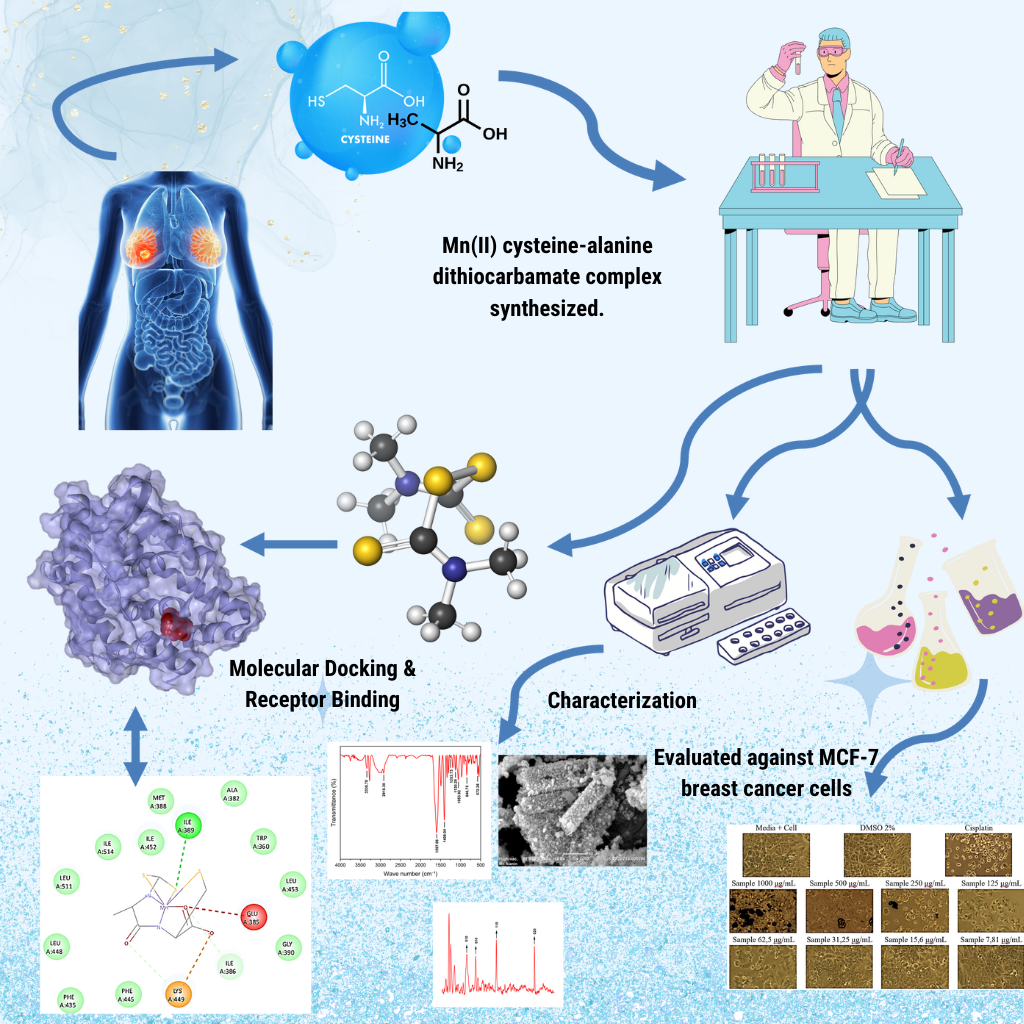
Downloads
References
L Lv, S Yang, Y Zhu, X Zhai, S Li, X Tao and D Dong. Relationship between metabolic reprogramming and drug resistance in breast cancer. Frontiers in Oncology 2022; 12, 942064.
SS Said and WN Ibrahim. Cancer Resistance to Immunotherapy: Comprehensive Insights with Future Perspectives. Pharmaceutics 2023; 15(4), 1143.
ST Wong and S Goodin. Overcoming drug resistance in patients with metastatic breast cancer. Pharmacotherapy: The Journal of Human Pharmacology and Drug Therapy 2012; 29(8), 954-965.
WS Dalton. Mechanisms of drug resistance in breast cancer. Seminars in Oncology 1990; 17(4S 7), 37-39.
M Xiao, J He, L Yin, X Chen, X Zu and Y Shen. Tumor-Associated macrophages: Critical players in drug resistance of breast cancer. Frontiers in Immunology 2021; 12, 799428.
B Biersack, A Ahmad, FH Sarkar and R Schobert. Coinage metal complexes against breast cancer. Current Medicinal Chemistry 2012; 19(23), 3949-3956.
P Zhang and PJ Sadler. Redox‐active metal complexes for anticancer therapy. European Journal of Inorganic Chemistry 2017; 2017(12), 1541-1548.
EJ Martinez-Finley, CE Gavin, M Aschner and TE Gunter. Manganese neurotoxicity and the role of reactive oxygen species. Free Radical Biology and Medicine 2013; 62, 65-75.
S Yadamani, A Neamati, M Homayouni-Tabrizi, SA Beyramabadi, S Yadamani, A Gharib, A Morsali and M Khashi. Treatment of the breast cancer by using low frequency electromagnetic fields and Mn(II) complex of a Schiff base derived from the pyridoxal. The Breast 2018; 41, 107-112.
Y Wang, D Zhong, F Xie, S Chen, Z Ma, X Yang, MZ Iqbal, Q Zhang, J Lu, S Wang, R Zhao and X Kong. Manganese phosphate-doxorubicin-based nanomedicines using mimetic mineralization for cancer chemotherapy. ACS Biomaterials Science & Engineering 2022; 8(5), 1930-1941.
JO Adeyemi and DC Onwudiwe. The mechanisms of action involving dithiocarbamate complexes in biological systems. Inorganica Chimica Acta 2020; 511, 119809.
H Tang, D Chen, C Li, C Zheng, X Wu, Y Zhang, Q Song and W Fei. Dual GSH-exhausting sorafenib loaded manganese-silica nanodrugs for inducing the ferroptosis of hepatocellular carcinoma cells. International Journal of Pharmaceutics 2019; 572, 118782.
N Pothayee, N Pothayee, N Hu, R Zhang, DF Kelly, AP Koretsky and JS Riffle. Manganese graft ionomer complexes (MaGICs) for dual imaging and chemotherapy. Journal of Materials Chemistry B 2014; 2(8), 1087-1099.
EP Istyastono. Docking studies of curcumin as a potential lead compound to develop novel dipeptydyl peptidase-4 inhibitors. Indonesian Journal of Chemistry 2010; 9(1), 132-136.
RA Arfah, E Pratiwi, I Raya, H Natsir, P Taba, H Rasyid, M Alfliadhi, AB Khaerunnisa, R Irfandi and S Jarre. Design, synthesis and characterization of Mn(II)cysteine-tyrosine dithiocarbamate complex for against the cancer on MCF-7 breast cancer cell line. Asian Pacific Journal of Cancer Prevention 2024; 25(9), 3251-3261.
S Jarre, I Raya, Prihantono and S Santi. Synthesis, characterization, molecular docking studies of Mn(II)Prolinedithiocarbamate and its potential as anticancer agents. Molecular Diversity 2024; 28(2), 889-900.
M Remelli, M Peana, S Medici, M Ostrowska, E Gumienna-Kontecka and MA Zoroddu. Manganism and parkinson’s disease: Mn(II) and Zn(II) interaction with a 30-amino acid fragment. Dalton Transactions 2016; 45(12), 5151-5161.
L Gao, Y Tu, P Wegman, S Wingren and LA Eriksson. Conformational enantiomerization and estrogen receptor α binding of anti-cancer drug tamoxifen and its derivatives. Journal of Chemical Information and Modeling 2011; 51(2), 306-314.
R Ugarte. FMO study of the interaction energy between human estrogen receptor alpha and selected ligands. arXiv, New York, 2022.
DC Onwudiwe and AC Ekennia. Synthesis, characterization, thermal, antimicrobial and antioxidant studies of some transition metal dithiocarbamates. Research on Chemical Intermediates 2017; 43(3), 1465-1485.
G Gurumoorthy. Synthesis and characterization of cobalt(III) dithiocarbamate complexes. International Journal of Modern Agriculture 2020; 9(4), 2200-2203.
ABD Nandiyanto, R Ragadhita and M Fiandini. Interpretation of fourier transform infrared spectra (FTIR): A practical approach in the polymer/plastic thermal decomposition. Indonesian Journal of Science and Technology 2023; 8(1), 113-126.
ZP Zhang, MZ Rong, MQ Zhang and C Yuan. Alkoxyamine with reduced homolysis temperature and its application in repeated autonomous self-healing of stiff polymers. Polymer Chemistry 2013; 4(17), 4648-4654.
A Puspita, S Budi and F Kurniadewi. Sintesis besi bervalensi nol menggunakan polifenol dari ekstrak biji kopi. Jurnal Riset Sains dan Kimia Terapan 2019; 8(2), 9-15.
P Martini, A Boschi, L Marvelli, L Uccelli, S Carli, G Cruciani, E Marzola, A Fantinati, J Esposito and A Duatti. Synthesis and characterization of manganese dithiocarbamate complexes: New evidence of dioxygen activation. Molecules 2021; 26(19), 5954.
C Dong. PowderX: Windows-95-based program for powder X-ray diffraction data processing. Journal of Applied Crystallography 1999; 32(4), 838.
ML Low. Synthesis, characterization and bioactivites of dithiocarbazate schiff base ligands and their metal complexes. Universite Pierre et Marie Curie, Paris, France, 2014.
MA Wahab. Determination of crystal structure parameters. Springer, Singapore, 2021.
D Asmi, P Manurung and IM Low. Manufacture of graded ceramic matrix composites by infiltration technique. Woodhead Publishing, Sawston, 2018.
N Nurlia, M Anas and E Erniwati. Analisis variasi temperatur aktivasi terhadap struktur kristalin arang aktif dari tandan aren (arenga pinnata merr) dengan agen aktivasi potassium silicate (K2SiO3). Jurnal Penelitian Pendidikan Fisika 2020; 5(4), 300.
R Maharani, DY Kurnia, AT Hidayat, J Al-Anshori, D Sumiarsa, D Harneti and N Nurlelasari. Upaya optimasi sintesis pentapeptida Leu-Ala-Asn-Ala-Lys dengan pengurangan nilai loading resin. Chimica et Natura Acta 2020; 8(1), 26-35.
N Zare, A Zabardasti, A Mohammadi, F Azarbani and A Kakanejadifard. Sonochemical synthesis, characterization, biological applications, and DFT study of new nano-sized manganese complex of azomethine derivative of diaminomaleonitrile. Journal of the Iranian Chemical Society 2019; 16(7), 1501-1516.
Y Wang, DT Nguyen, G Yang, J Anesi, Z Chai, F Charchar and J Golledge. An improved 3-(4,5-di¬methylthiazol-2-yl)-5-(3-carboxymethoxy¬phenyl) -2-(4-sulfophenyl)-2H-tetrazolium prolif¬eration assay to overcome the interference of hy¬dralazine. ASSAY and Drug Development Technologies 2020; 18(8), 379-384.
Prihantono, R Irfandi, I Raya and Warsinggih. Potential anticancer activity of Mn (II) complexes containing arginine dithiocarbamate ligand on MCF-7 breast cancer cell lines. Annals of Medicine and Surgery 2020; 60, 396-406.
L Jamalzadeh, H Ghafoori, R Sariri, H Rabuti, J Nasirzade, H Hasani and MR Aghamaali. Cytotoxic effects of some common organic solvents on MCF-7, RAW-264.7 and human umbilical vein endothelial cells. Avicenna Journal of Medical Biochemistry 2016; 4(1), e33453.
ES Oz, E Aydemir and K Fiskin. DMSO exhibits similar cytotoxicity effects to thalidomide in mouse breast cancer cells. Oncology Letters 2012; 3(4), 927-929.
K Prabst, H Engelhardt, S Ringgeler and H Hubner. Basic colorimetric proliferation assays: MTT, WST, and Resazurin. Cell Viability Assays 2017; 1601, 1-17.
L Yang, J Tan, B Wang and L Zhu. Synthesis, characterization, and anti-cancer activity of emodin-Mn(II) metal complex. Chinese Journal of Natural Medicines 2014; 12(12), 937-942.
R Farghadani, J Rajarajeswaran, NB Mohd Hashim, MA Abdulla and S Muniandy. A novel β-diiminato manganese(III) complex as the promising anticancer agent induces G0/G1 cell cycle arrest and triggers apoptosis via mitochondrial-dependent pathways in MCF-7 and MDA-MB-231 human breast cancer cells. RSC Advances 2017; 7(39), 24387-24398.
Published
How to Cite
Issue
Section
License
Copyright (c) 2025 Walailak University

This work is licensed under a Creative Commons Attribution-NonCommercial-NoDerivatives 4.0 International License.





