
Revolutionizing Lead (II) Ion Removal from Water: Eco-Friendly Composite Film with Graphene Oxide and Bacterial Cellulose
DOI:
https://doi.org/10.48048/tis.2025.9589Keywords:
Bacterial cellulose, Adsorption, Graphene oxide, NanocompositesAbstract
Bacterial cellulose (BC), produced through the natural fermentation of coconut water, is composed of 1-dimensional (1D) nanofibers with remarkable mechanical properties. Within this study, a novel composite material was synthesized by combining bacterial cellulose with graphene oxide (GO) to create an eco-friendly and highly effective adsorbent for the removal of Pb(II) heavy metal ions from water. The research employed a systematic methodology, including the synthesis of BC/GO composites with varying fabrication ratios. Advanced characterization techniques were utilized to analyze the properties of the composites: scanning electron microscopy (SEM) for structural observation, thermogravimetric analysis (TGA) for thermal stability assessment, Fourier-transform infrared spectroscopy (FTIR) for chemical bonding identification, and atomic absorption spectrophotometry (AAS) for quantifying Pb(II) ion adsorption capacity. The results demonstrated the successful fabrication of BC/GO composites featuring a nanostructure with intertwined BC nanofibers and GO layers. These composites exhibited impressive mechanical strength and a high adsorption efficiency for Pb(II) ions, exceeding 90 % at an optimal pH of 5. Notably, the BC/GO composite with a fabrication ratio of 1:7 showed superior structural and thermal properties, with a maximum adsorption capacity of 315.5 mg g⁻¹. The findings highlight the potential of BC/GO composites as high-performance, eco-friendly adsorbents for heavy metal removal. The combination of BC and GO provides a robust material with excellent adsorption capacity and mechanical properties, paving the way for future applications in water purification technologies. This revised abstract is structured to ensure clarity and logical flow, presenting the study’s key aspects concisely. The methodology has been clearly described, and typographical issues have been corrected.
HIGHLIGHTS
- A novel eco-friendly composite film was successfully fabricated by integrating bacterial cellulose (BC) with graphene oxide (GO) for Pb(II) ion removal.
- The BC/GO composites exhibited a highly porous nanostructure, strong mechanical strength, and enhanced thermal stability.
- The optimal composite ratio (BC:GO = 1:7) achieved a maximum Pb(II) adsorption capacity of 315.5 mg g⁻¹ at pH 5.
- Advanced characterization techniques (SEM, FTIR, TGA, AAS) confirmed the structural integration and adsorption efficiency of the composites.
- The study demonstrates the potential of BC/GO composites as sustainable and high-performance adsorbents for heavy metal removal from water.
GRAPHICAL ABSTRACT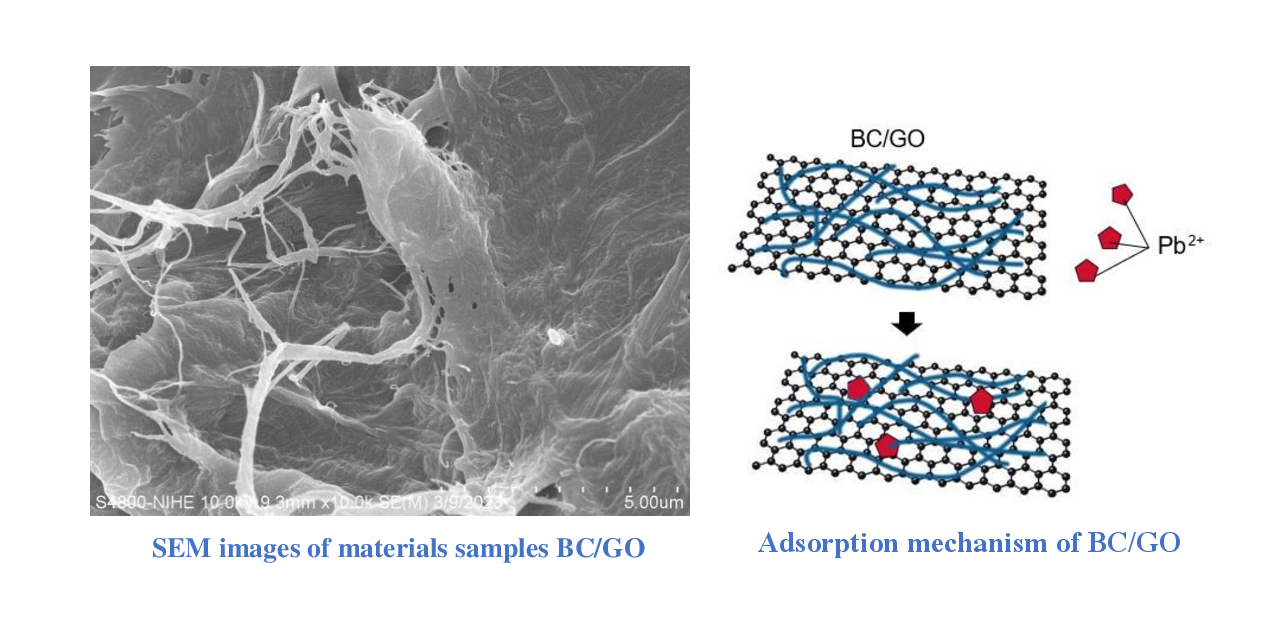
Downloads
References
E Ghasemi, A Heydari and M Sillanpää. Superparamagnetic Fe3O4@EDTA nanoparticles as an efficient adsorbent for simultaneous removal of Ag(I), Hg(II), Mn(II), Zn(II), Pb(II) and Cd(II) from water and soil environmental samples. Microchemical Journal 2017; 131, 51-56.
DW O’Connell, C Birkinshaw and TF O’Dwyer. Removal of lead(II) ions from aqueous solutions using a modified cellulose adsorbent. Adsorption Science and Technology 2006; 24(4), 337-347.
MA Barakat. New trends in removing heavy metals from industrial wastewater. Arabian Journal of Chemistry 2011; 4(4), 361-377.
S Dervin, DD Dionysiou and SC Pillai. 2D nanostructures for water purification: Graphene and beyond. Nanoscale 2016; 8(33), 15115-15131.
A Lee, JW Elam and S Darling. Membrane materials for water purification: Design, development, and application. Environmental Science: Water Research & Technology 2016; 2(1), 17-42.
W Peng, H Li, Y Liu and S Song. A review on heavy metal ions adsorption from water by graphene oxide and its composites. Journal of Molecular Liquids 2017; 230, 496-504.
A Adjarodi, SM Ferdowsi, RZ Dorabei and A Barzin. Highly efficient ultrasonic-assisted removal of Hg(II) ions on graphene oxide modified with 2-pyridinecarboxaldehyde thiosemi carbazone: Adsorption isotherms and kinetics studies. Ultrasonics Sonochemistry 2016; 33, 118-128.
CN Nupearachchi, K Mahatantila and M Vithanage. Application of graphene for decontamination of water; Implications for sorptive removal. Groundwater for Sustainable Development 2017; 5, 206-215.
L Bulgariu and D Bulgariu. Functionalized soy waste biomass-A novel environmental-friendly biosorbent for the removal of heavy metals from aqueous solution. Journal of Cleaner Production 2018; 197(P1), 875-885.
Z Abbas, S Ali, M Rizwan, IE Zaheer, A Malik, MA Riaz, MR Shahid, MZU Rehman and MI Al-Wabel. A critical review of mechanisms involved in the adsorption of organic and inorganic contaminants through biochar. Arabian Journal of Geosciences 2018; 11(16), 448.
C Liu, RN Jin, XK Ouyang and YG Wang. Adsorption behavior of carboxylated cellulose nanocrystal - Polyethyleneimine composite for removal of Cr(VI) ions. Applied Surface Science 2017; 408, 77-84.
H Luo, H Ao, G Li, W Li, G Xiong, Y Zhu and Y Wan. Bacterial cellulose/graphene oxide nanocomposite as a novel drug delivery system. Current Applied Physics 2017; 17(2), 249-254.
A Stoica-Guzun, M Stroescu, SI Jinga, N Mihalache, A Botez, C Matei, D Berger, CM Damian and V Ionita. Box-Behnken experimental design for chromium(VI) ions removal by bacterial cellulose-magnetite composites. International Journal of Biological Macromolecules 2016; 91, 1062-1072.
Y Wang, S Yadav, T Heinlein, V Konjik, H Breitzke, G Buntkowsky, JJ Schneider and K Zhang. Ultra-light nanocomposite aerogels of bacterial cellulose and reduced graphene oxide for specific absorption and separation of organic liquids. RSC Advances 2014; 4(41), 21553-21558.
AG Nandgaonkar, Q Wang, K Fu, WE Krause, Q Wei, R Gorga and LA Lucia. A one-pot biosynthesis of reduced graphene oxide (RGO)/bacterial cellulose (BC) nanocomposites. Green Chemistry 2014; 16(6), 3195-3201.
W Shao, H Liu, X Liu, S Wang and R Zhang. Anti-bacterial performances and biocompatibility of bacterial cellulose/graphene oxide composites. RSC Advances 2015; 5(7), 4795-4803.
X Du, Z Zhang, W Liu and Y Deng. Nanocellulose-based conductive materials and their emerging applications in energy devices-a review. Nano Energy 2017; 35(2), 299-320.
F Esa, SM Tasirin and NA Rahman. Overview of bacterial cellulose production and application. Agriculture and Agricultural Science Procedia 2014; 2, 113-119.
SAS Keshk. Bacterial cellulose production and its industrial applications. Journal of Bioprocessing & Biotechniques 2014; 4(02), 151.
N Sriplai, W Mongkolthanaruk, SJ Eichhorn and S Pinitsoontorn. Magnetically responsive and flexible bacterial cellulose membranes. Carbohydrate Polymers 2018; 192, 251-262.
S Pirsa, T Shamusi and EM Kia. Smart films based on bacterial cellulose nanofibers modified by conductive polypyrrole and zinc oxide nanoparticles. Journal of Applied Polymer Science 2018; 135(34), 46617.
P Lv, Q Feng, Q Wang, G Li, D Li and Q Wei. Biosynthesis of bacterial cellulose/carboxylic multi-walled carbon nanotubes for enzymatic biofuel cell application. Materials 2016; 9(3), 183.
AA Yakout, RH El-Sokkary, MA Shreadah and OGA Hamid. Cross-linked graphene oxide sheets via modified extracted cellulose with high metal adsorption. Carbohydrate Polymers 2017; 172, 20-27.
K Lü, G Zhao and X Wang. A brief review of graphene-based material synthesis and its application in environmental pollution management. Chinese Science Bulletin 2012; 57(11), 1223-1234.
G Zhao, X Ren, X Gao, X Tan, J Li, C Chen, Y Huang and X Wang. Removal of Pb(II) ions from aqueous solutions on few-layered graphene oxide nanosheets. Dalton Trans 2011; 40(41), 10945-10952.
C Santhosh, P Kollu, S Felix, V Velmurugan, SK Jeong and AN Grace. CoFe2 O4 and NiFe2 O4 @graphene adsorbents for heavy metal ions-kinetic and thermodynamic analysis. RSC Advances 2015; 5(37), 28965-28972.
AIA Sherlala, AAA Raman, MM Bello and A Asghar. A review of the applications of organo-functionalized magnetic graphene oxide nanocomposites for heavy metal adsorption. Chemosphere 2018; 193, 1004-1017.
M Yusuf, FM Elfghi, SA Zaidi, EC Abdullah and MA Khan. Applications of graphene and its derivatives as an adsorbent for heavy metal and dye removal: A systematic and comprehensive overview. RSC Advances 2015; 5(62), 50392-50420.
A Mensah, P Lv, C Narh, J Huang, D Wang and Qufu Wei. Sequestration of Pb(II) ions from aqueous systems with novel green bacterial cellulose graphene oxide composite. Materials 2019; 12(2) 218, 218.
AT Nguyen and XC Nguyen. Bacterial cellulose-based biofilm forming agent extracted from vietnamese nata-de-coco tree by ultrasonic vibration method: Structure and properties. Journal of Chemistry 2022; 2022(14), 1-10.
H Luo, J Dong, F Yao, Z Yang, W Li, J Wang, X Xu, J Hu and Y Wan. Layer-by-layer assembled bacterial cellulose/graphene oxide hydrogels with extremely enhanced mechanical properties. Nano-Micro Lett 2018; 10(3), 42.
H Luo, F Feng, F Yao, Y Zhu, Z Yang and Y Wan. Improved removal of toxic metal ions by incorporating graphene oxide into bacterial cellulose. Journal of Nanoscience and Nanotechnology 2020; 20(2), 719-730.
D Deswati, ON Tetra, LP Isara, DI Roesma and H Pardi. Samhong mustard cultivation by utilizing tilapia waste in Nutrient Film Technique (NFT) aquaponics system based on biofloc, and its impact on water quality. Rasayan Journal of Chemistry 2021; 14(4), 2559-2566.
D Deswati, ON Tetra, Syafrizayanti, Y Yusuf, Suparno and H Pardi. Dynamics and fluctuations of ammonia, nitrite and nitrate in the utilization of tilapia cultivation waste in Aquaponics-NFT (nutrient film technique) based on biofloc. Aquaculture, Aquarium, Conservation & Legislation - International Journal of the Bioflux Society 2023; 16(3), 1254-1265.
D Deswati, E Yani, S Safni, ON Tetra and H Pardi. Development methods in aquaponics systems using biofloc to improve water quality (ammonia, nitrite, nitrate) and growth of tilapia and samhong mustard. International Journal of Environmental Analytical Chemistry 2022; 102(19), 7824-7834.
D Deswati, R Zein, ON Tetra, H Pardi and S Suparno. Development of biofloc technology to improve water quality in Clarias batrachus cultivation. Aquaculture, Aquarium, Conservation & Legislation - International Journal of the Bioflux Society 2022; 15(6), 2957-2968.
D Deswati, K Khairiyah, S Safni, Y Yusuf, R Refinel and H Pardi. Environmental detoxification of heavy metals in flood & drain aquaponic system based on biofloc technology. International Journal of Environmental Analytical Chemistry 2020; 102(385), 7155-7164.
D Deswati, S Safni, K Khairiyah, E Yani, Y Yusuf and H Pardi. Biofloc technology: Water quality (pH, temperature, DO, COD, BOD) in a flood & drain aquaponic system. International Journal of Environmental Analytical Chemistry 2020; 102(18), 6835-6844.
D Deswati, ON Tetra, Latisha Putri Isara, Dewi Imelda Roesma and Hilfi Pardi. Samhong mustard cultivation by utilizing Tilapia waste in nutrient film technique (nft) Aquaponics system based on bioflocs, and its Impact on water quality. RASAYAN Journal of Chemistry 2021; 14(4), 2559-2566.
D Deswati, S Safni, LP Isara and H Pardi. Hydroton-biofloc-based aquaponics (hydro tonflocponics): Towards good water quality and macro-micro nutrient. Aquaculture, Aquarium, Conservation & Legislation - International Journal of the Bioflux Society 2021; 14(5), 3127-3144.
D Deswati, N Ulya, Y Yusuf, ON Tetra, TW Edelwis and H Pardi. Improvement of water quality (Cu, Fe, Zn) in biofloc aquaponics systems by utilizing fish waste as a source of micronutrients. Aquaculture, Aquarium, Conservation & Legislation - International Journal of the Bioflux Society 2021; 14(6), 3440-3449.
Indrawati, R Achmad, H Suyani, R Suhaili, H Pardi and D Deswati. Application of planting media of charcoal coconut shell and charcoal rice husk in lettuce (Lactuca sativa L.) cultivation to reduce ammonia, sulfide, copper, and zinc in the hydroponics system. Pollution Research 2018; 37(2), 9-14.
D Deswati, N Febriani, H Pardi, Y Yusuf and H Suyani. Applications of aquaponics on pakcoy (Brassica rapa L.) and Nila fish (Oreochromis niloticus) to the concentration of ammonia, nitrite, and nitrate. Oriental Journal of Chemistry 2018, 34(5), 2447-2455.
D Deswati, E Munaf, H Suyani, R Zein and H Pardi. Simultaneous determination of trace amounts of iron, cobalt, nickel and chromium in water samples with Calcon as complexing agent by adsorptive stripping voltammetry. Asian Journal of Chemistry 2015; 27(11), 3978-3982.
I Rahmi, H Pardi, D Deswati, ON Tetra and TW Edelwis. Application of the adsorptive stripping voltammetry-response surface methodology (AdSV-RSM) in the simultaneous determination of copper ions in an aquaponics system. International Journal of Environmental Analytical Chemistry 2021; 103(3), 1-15.
D Deswati, K Khairiyah, S Safni, Y Yusuf, R Refinel and H Pardi. Environmental detoxification of heavy metals in flood & drain aquaponic system based on biofloc technology. International Journal of Environmental Analytical Chemistry 2020; 102(18), 7155-7164.
H Suyani, I Rahmi and H Pardi. Optimization for the simultaneous determination of zinc in environmental samples with calcon by adsorptive stripping voltammetry: Response surface methodology. Oriental Journal of Chemistry 2017; 33(04), 2060-2070.
AT Nguyen, D Thi, Y Oanh, MH Nguyen, NT Huu, T Thu, P Nguyen, T Hong, L Nhung, MV Nguyen, T Mai, H Pham and TQ Nguyen. Research to develop the ability to remove As(III) ions in water of an environmentally friendly hybrid material based on bacterial cellulose and graphene oxide. Vietnam Journal of Chemistry 2024; 62(5), 1-15.
TA Nguyen, DTY Oanh, TTP Nguyen, MH Nguyen, TH Nguyen, TTT Bui, NT Nguyen, MV Nguyen, QT Nguyen and TD Hoang. Exploring sustainable solutions: Utilizing recycled coffee grounds as a new bio‐adsorbent material for removal of Pb(II) ions from water. Vietnam Journal of Chemistry 2024.
W Czaja, A Krystynowicz, S Bielecki and RM Brown. Microbial cellulose-the natural power to heal wounds. Biomaterials 2007; 28(2), 145-151.
N Lin, J Huang and A Dufresne. Preparation, properties and applications of polysaccharide nanocrystals in advanced functional nanomaterials: A review. Nanoscale 2012; 4(11), 3274.
OP Troncoso and FG Torres. Bacterial cellulose-graphene based nanocomposites. International Journal of Molecular Sciences 2020; 21(18), 6532.
J Wang, Q Cheng and Z Tang. Layered nanocomposites inspired by the structure and mechanical properties of nacre. Chemical Society Reviews 2012; 41(3), 1111-1129.
C Xu, G Wang, C Xing, LM Matuana and H Zhou. Effect of graphene oxide treatment on the properties of cellulose nanofibril films made of banana petiole fibers. BioResources 2015; 10(2), 2809-2822.
R Sitko, M Musielak, B Zawisza, E Talik and A Gagor. Graphene oxide/cellulose membranes in adsorption of divalent metal ions. RSC Advances 2016; 6(99), 96595-96605.
R Sahraei and M Ghaemy. Synthesis of modified gum tragacanth/graphene oxide composite hydrogel for heavy metal ions removal and preparation of silver nanocomposite for antibacterial activity. Carbohydrate Polymers 2017; 157, 823-833.
G Zhao, X Ren, X Gao, X Tan, J Li, C Chen, Y Huang and X Wang. Removal of Pb(II) ions from aqueous solutions on few-layered graphene oxide nanosheets. Dalton Transactions 2011; 40(41), 10945-10952.
AA Yakout, RH El-Sokkary, MA Shreadah and OGA Hamid. Cross-linked graphene oxide sheets via modified extracted cellulose with high metal adsorption. Carbohydrate Polymers 2017; 172, 20-27.
J Wang, X Lu, PF Ng, KI Lee, B Fei, JH Xin and JY Wu. Polyethylenimine coated bacterial cellulose nanofiber membrane and application as adsorbent and catalyst. Journal of Colloid and Interface Science 2015; 440, 32-38.
R Saravanan and L Ravikumar. The use of new chemically modified cellulose for heavy metal ion adsorption and antimicrobial activities. Journal of Water Resource and Protection 2015; 7(6), 530-545.
Published
How to Cite
Issue
Section
License
Copyright (c) 2025 Walailak University

This work is licensed under a Creative Commons Attribution-NonCommercial-NoDerivatives 4.0 International License.





