
Multifunctional Biocomposite Membrane of Bacterial Cellulose/Chitosan Incorporated with Green Tea Leaf Extract as a Smart Colorimetric Sensor for Sustainable Packaging
DOI:
https://doi.org/10.48048/tis.2025.10667Keywords:
Bacterial cellulose, Chitosan, Green tea extract, Epigallocatechin gallate (EGCG), Biocomposite films, Smart packaging, Colorimetric sensor, Heavy metal adsorption, Antibacterial activity, Moisture barrier, Pharmaceutical packagingAbstract
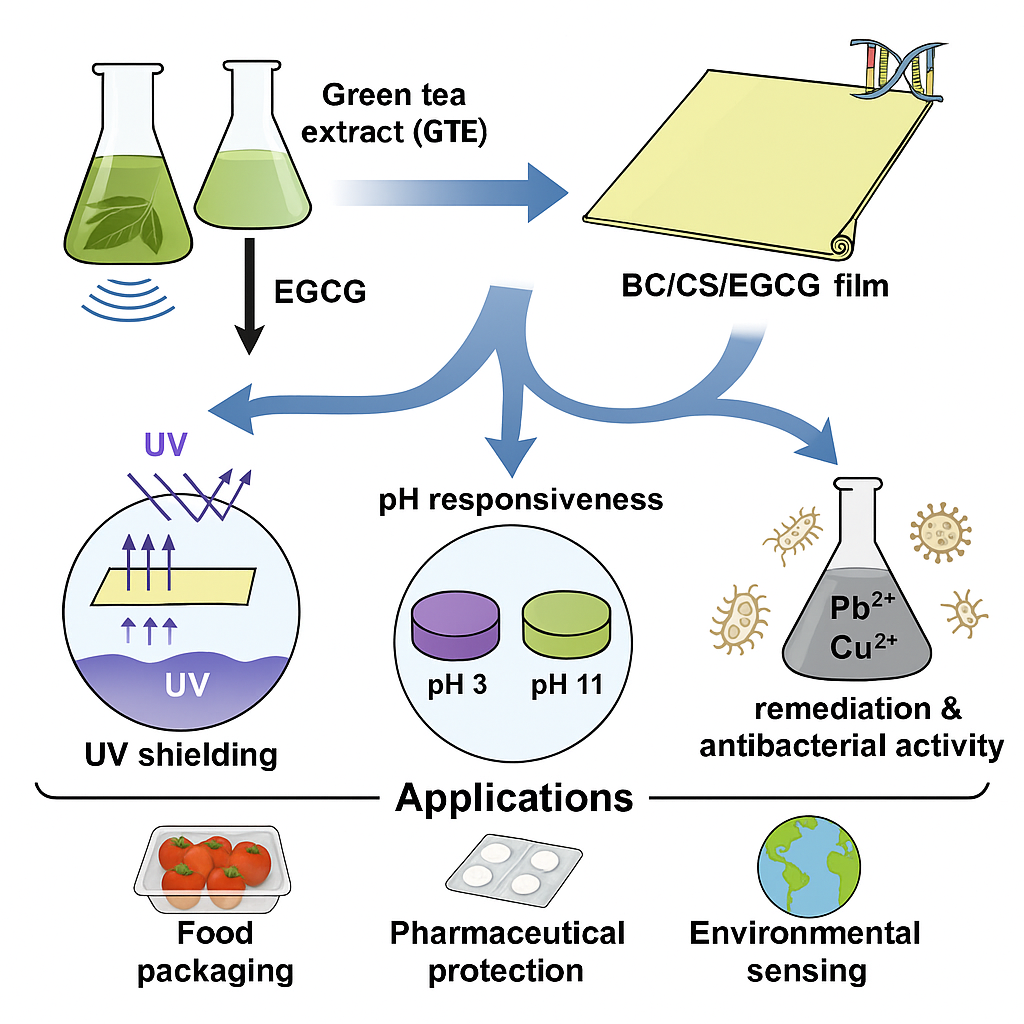
This study presents the development of multifunctional biocomposite films based on bacterial cellulose (BC) and chitosan (CS), integrated with green tea extract (GTE) rich in epigallocatechin gallate (EGCG), aimed at active food preservation, pharmaceutical packaging, and environmental remediation. EGCG was extracted using ultrasound-assisted extraction and quantified via high-performance liquid chromatography (HPLC), yielding approximately 5.01 mg/g of dried tea leaves. Composite films incorporating 0.2 - 0.4% EGCG (w/v) were fabricated and evaluated. At an optimal concentration of 0.3% EGCG, the film exhibited superior tensile strength (43 MPa), elongation at break (13.5%), and toughness (~11 MJ/m³). Thermal analysis showed an increased degradation onset temperature (~300 °C) and higher residual mass (~30%), confirming improved thermal stability. Functionally, the BC/CS/EGCG film demonstrated strong UV absorption (~81% at 280 nm) and reduced UV transmittance (<10% across 230 - 300 nm). The film also showed pH-responsive colorimetric behavior, with a color difference (ΔE) rising from 3.5 to 30.2 between pH 3 and 11. Heavy metal adsorption tests revealed maximum capacities of 26.96 mg/g (Pb²⁺), 24.51 mg/g (Fe³⁺), and 23.75 mg/g (Cu²⁺), with a limit of detection (LOD) for Pb²⁺ as low as 0.70 µM. Antibacterial activity was confirmed against E. coli (18 mm) and S. aureus (24 mm) at 0.3% EGCG. Notably, tablets wrapped in BC/CS/EGCG films experienced only 3.7% mass loss after 14 days under 75% humidity, compared to 21% for those wrapped in pure BC. These results demonstrate the excellent mechanical, optical, antibacterial, adsorptive, and sensing properties of the EGCG-integrated BC/CS films. The films hold strong potential for application as smart, sustainable materials in food packaging, moisture-sensitive pharmaceutical protection, and real-time environmental sensing.
HIGHLIGHTS
- Multifunctional biocomposite films based on bacterial cellulose/chitosan were developed by integrating green tea extract rich in EGCG.
- The optimized film (0.3% EGCG) showed enhanced mechanical strength (43 MPa), thermal stability (onset ~300 °C), and UV shielding (~81% absorbance at 280 nm).
- The films exhibited pH-responsive colorimetric behavior, with ΔE increasing from 3.5 to 30.2 between pH 3 and 11, enabling real-time environmental sensing.
- Heavy metal adsorption capacities reached 26.96 mg/g (Pb²⁺) and LOD for Pb²⁺ was as low as 0.70 µM, indicating excellent remediation potential.
- Antibacterial activity was significant against E. coli and S. aureus, and films effectively protected pharmaceutical tablets under high humidity.
GRAPHICAL ABSTRACT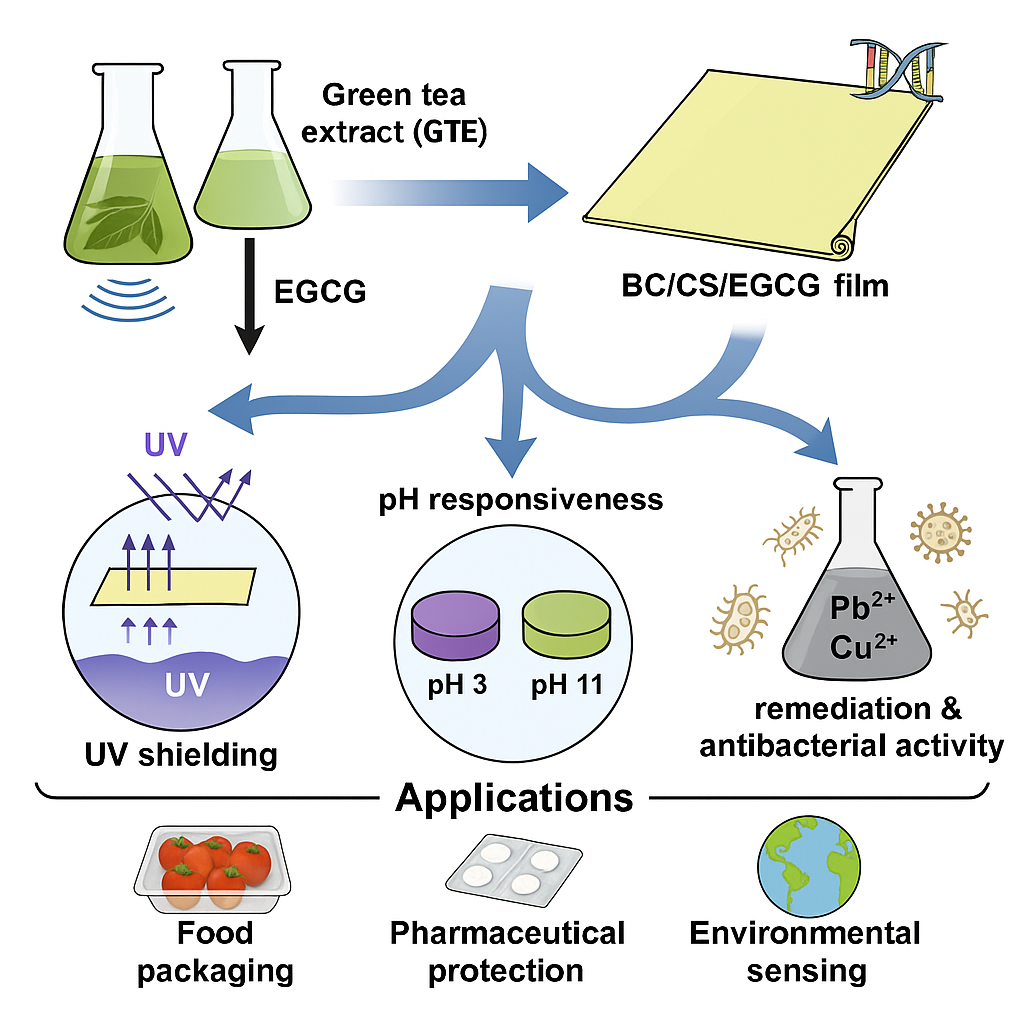
Downloads
References
X Chen, X Ding, Y Huang, Y Zhao, G Chen, X Xu, D Xu, B Jiao, X Zhao and G Liu. Recent advances in polysaccharide-based nanocomposite films for fruit preservation: Construction, applications, and challenges. Foods 2025; 14(6), 1012.
] R Priyadarshi, A Jayakumar, CK de Souza, JW Rhim and JT Kim. Advances in strawberry postharvest preservation and packaging: A comprehensive review. Comprehensive Reviews in Food Science and Food Safety 2024; 23(4), e13417.
M Su, F Liu, T Abdiryim and X Liu. Polysaccharides and their derivatives for solar-driven water evaporators. Cellulose 2024; 31(12), 7251.
X Cai, L Chen, X Yang, Y Wang, J Xu, R Zhang, S Ling and Y Liu. Active curcumin-loaded γ-cy.clodextrin-metal organic frameworks as nano respiratory channels for reinforcing chitosan/gelatin films in strawberry preservation. Food Hydrocolloids 2024; 159(5), 110656.
Y Li, B Bian, R Tang and K Zhang. Characterization of a clove essential oil slow-release microencapsulated composite film and its preservation effects on blueberry. ACS Omega 2024; 9(11), 12643.
T Li, C Chen, AH Brozena, JY Zhu, L Xu, C Driemeier, J Dai, OJ Rojas, A Isogai, L Wågberg and L Hu. Developing fibrillated cellulose as a sustainable technological material. Nature 2021; 590(7844), 47-56.
M Abdelraof, MS Hasanin, MM Farag and HY Ahmed. Green synthesis of bacterial cellulose/bioactive glass nanocomposites: Effect of glass nanoparticles on cellulose yield, biocompatibility and antimicrobial activity. Int. J. Biol. Macromol. 2019; 138, 975-985.
M Aliabadi, BS Chee, M Matos, YJ Cortese, MJD Nugent, TAMD Lima, WLE Magalhães and GGD Lima. Yerba mate extract in microfibrillated cellulose and corn starch films as a potential wound healing bandage. Polymers 2020; 12(12), 2807.
RSCMDQ Antonino, BRPL Fook, VADO Lima, RÍDF Rached, EPN Lima, RJDS Lima, CAP Covas and MVL Fook. Preparation and characterization of chitosan obtained from shells of shrimp (Litopenaeus vannamei Boone). Marine Drugs 2017; 15(5), 141.
FS Jebel, L Roufegarinejad, A Alizadeh and S Amjadi. Development and characterization of a double-layer smart packaging system consisting of polyvinyl alcohol electrospun nanofibers and gelatin film for fish fillet. Food Chemistry 2025; 462, 140985.
Z Miao, M Yang, SYH Abdalkarim and HY Yu. In situ growth of curcumin-loaded cellulose composite film for real-time monitoring of food freshness in smart packaging. International Journal of Biological Macromolecules 2024; 279(P1), 135090.
W Zhang, M Li, J Chen, Y Chen, C Liu and X Wu. A review of modified gelatin: Physicochemi cal properties, modification methods, and applications in the food field. Journal of Agricultural and Food Chemistry 2024; 72(38), 20705.
QB Yao, F Huang, YH Lu, JM Huang, M Ali, XZ Jia, X Zeng and YY Huang. Polysaccharide-based food packaging and intelligent packaging applications: A comprehensive review. Trends in Food Science & Technology 2024; 147, 104390.
T Sarwar, ZA Raza, MA Nazeer and A Khan. Synthesis of aminolyzed gelatin-mediated chitosan as pH-responsive drug-carrying porous scaffolds. International Journal of Biological Macromolecules 2024; 256(P2), 128525.
C Phaenark, T Jantrasakul, P Paejaroen, S Chunchob and W Sawangproh. Sugarcane bagasse and corn stalk biomass as a potential sorbent for the removal of Pb(II) and Cd(II) from aqueous solutions. Trends in Sciences 2022; 20(2), 6221.
E Melro, FE Antunes, GJD Silva, I Cruz, PE Ramos, F Carvalho and L Alves. Chitosan films in food applications. Tuning film properties by changing acidic dissolution conditions. Polymers 2021; 13(1), 1.
Indriyati, F Dara, I Primadona, Y Srikandace and M Karina. Development of bacterial cellulose/chitosan films: Structural, physicochemical and antimicrobial properties. Journal of Polymer Research 2021; 28(3), 02328.
Y Xu, X Liu, Q Jiang, D Yu, Y Xu, B Wang and W Xia. Development and properties of bacterial cellulose, curcumin, and chitosan composite biodegradable films for active packaging materials. Carbohydrate Polymers 2021; 260(2), 117778.
MA Ghamari, S Amiri, M Rezazadeh-Bari and L Rezazad-Bari. Physical, mechanical, and antimicrobial properties of active edible film based on milk proteins incorporated with Nigella sativa essential oil. Polymer Bulletin 2022; 79, 1097.
B Wang, Y Dan, H Zhang, C Huang, L Xiong, J Luo and XD Chen. Preparation of esterified bacterial cellulose for improved mechanical properties and the microstructure of isotactic polypropylene/bacterial cellulose composites. Polymers 2016; 8(4), 129.
YB Azaza, M Hamdi, C Charmette, AVD Lee, M Jridi, S Li, M Nasri and R Nasri. Development and characterization of composite films based on chitosan and collagenous proteins from bluefin tuna: Application for peeled shrimp preservation. Cellulose 2023; 30, 373-395.
C Cabrera, R Artacho and R Giménez. Beneficial effects of green tea - A review. Journal of the American College of Nutrition 2006; 25(2), 79-99.
QV Vuong, JB Golding, M Nguyen and PD Roach. The impact of aqueous extraction conditions on the phenolic content and antioxidant activities of green tea extract. LWT-Food Science Technology 2011; 44, 1328.
J Steinmann, J Buer, T Pietschmann and E Steinmann. Anti-infective properties of epigallocatechin-3-gallate (EGCG), a component of green tea. British Journal of Pharmacology 2013; 168(5), 1059-1073.
M Friedman. Antibacterial, antiviral, and antifungal properties of green tea catechins. Journal of Food Protection 2007; 70, 2223.
Published
How to Cite
Issue
Section
License
Copyright (c) 2025 Walailak University

This work is licensed under a Creative Commons Attribution-NonCommercial-NoDerivatives 4.0 International License.





