
Green Evolution: Advancing Epoxy Composite Materials with Durian Peel Fiber Innovation
DOI:
https://doi.org/10.48048/tis.2025.9099Keywords:
Epoxy, Composite materials, Durian peel fibers, Tensile strength, Flexural strength, Compressive strength, Izod impact strength, Minimum oxygen index, UL 94, Fire retardancyAbstract
This study explores the transformative effects of treating durian peel fibers with Ca(OH)2 solution and their subsequent application as a reinforcing agent in epoxy composite materials. Morphological and structural analyses reveal a notable improvement in compatibility and adhesion between treated fibers and epoxy resin, particularly at a 5 % Ca(OH)2 concentration. Durian fruit peel, after being treated with clear lime water (Ca(OH)2), is used to reinforce the epoxy composite material at the ratio of epoxy/durian fiber peel = 70/30. The results were established when durian peel fibers treated with 5 % lime water solution had the best mechanical properties (tensile strength: 65.68 MPa, flexural strength: 92.11MPa, compressive strength: 147.38 MPa, Izod impact strength: 9.07 kJ/m2). In terms of fire retardancy, the best results were also obtained when reinforcing durian peel fibers treated with 5 % concentration of lime solution in Ca(OH)2, specifically: Minimum oxygen index: LOI = 21.9 %, Burning speed according to UL 94: 20.66 mm/min. The structural morphology of the epoxy/durian peel fiber composite was evaluated using SEM. The results demonstrated good compatibility, with no evidence of layer exfoliation or phase separation at the epoxy resin-durian peel fiber interface when subjected to external forces. The results of the project indicate that epoxy composites reinforced with durian peel fibers hold great promise as a green, environmentally friendly material. By utilizing waste from the food industry, these composites offer potential applications across various fields, including the automotive, transportation, and construction industries.
HIGHLIGHTS
- Durian Peel Fiber Treatment: Durian peel fibers treated with 5 % Ca(OH)₂ solution for better adhesion to epoxy.
- Composite Reinforcement: Epoxy composite reinforced with 30 % durian peel fiber (epoxy/durian fiber = 70/30).
- Mechanical Properties: Best results with 5 % Ca(OH)₂-treated fibers (tensile strength: 65.68 MPa, flexural strength: 92.11 MPa, compressive strength: 147.38 MPa, impact strength: 9.07 kJ/m²).
- Fire Retardancy: Improved fire resistance (LOI = 21.9 %, burning speed: 20.66 mm.min-1).
- Applications: Promising for use in automotive, transportation, and construction industries.
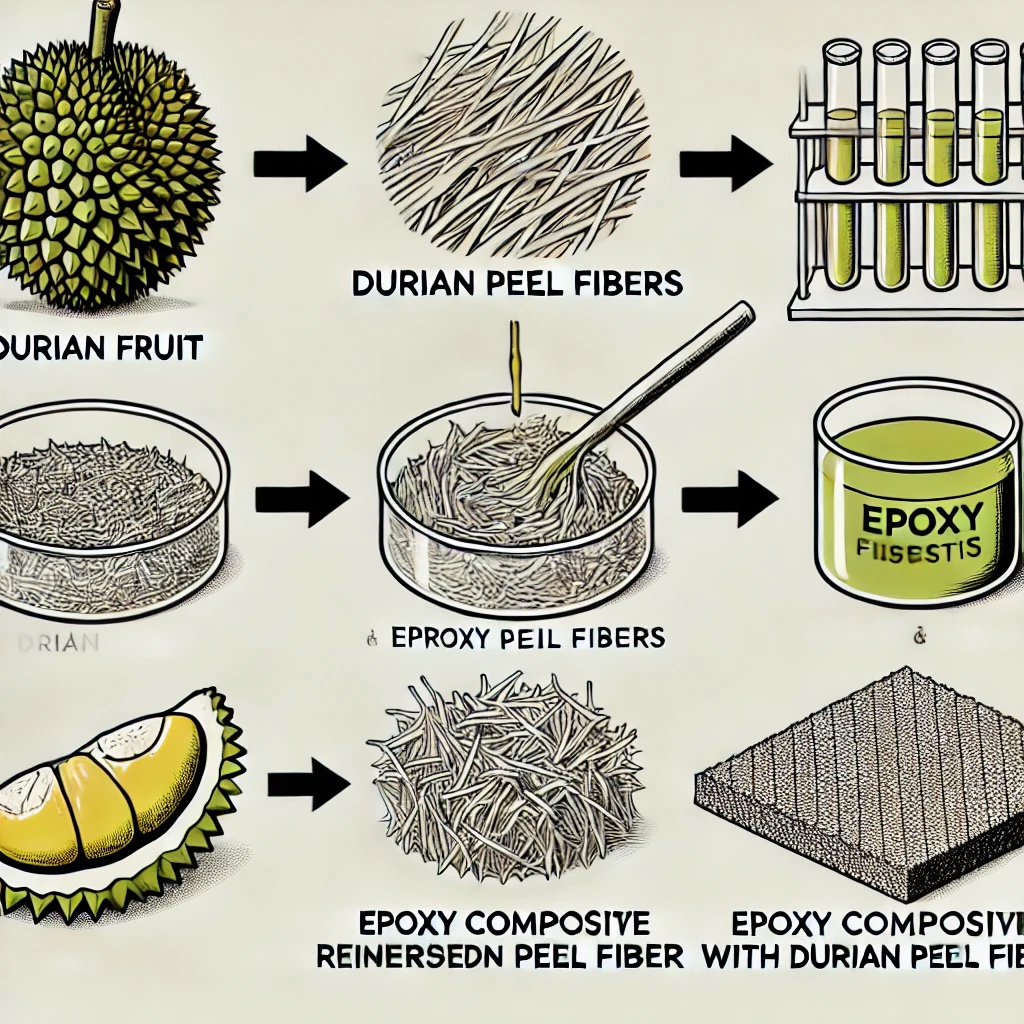
GRAPHICAL ABSTRACT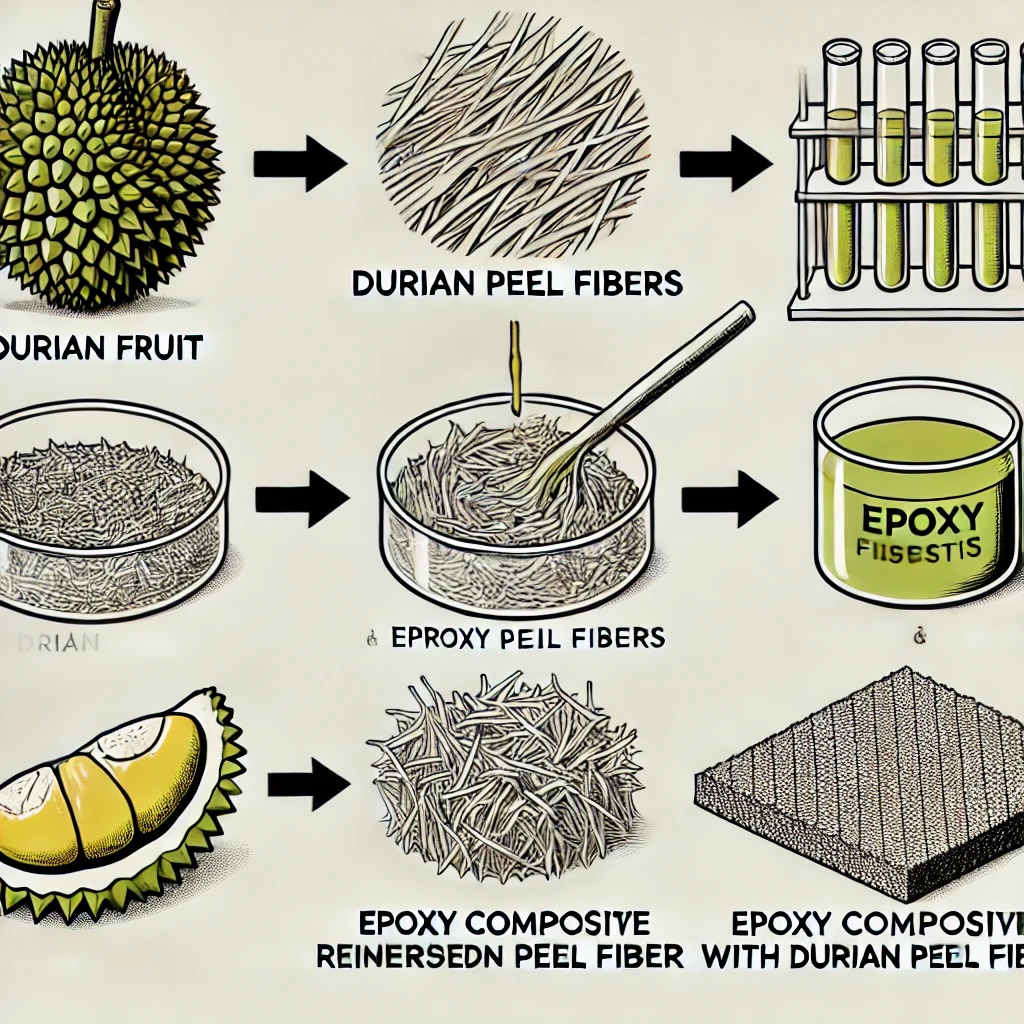
Downloads
References
Z Ying-Chen, W Hong-Yan and Q Yi-Ping. Morphology and properties of hybrid composites based on polypropylene/polylactic acid blend and bamboo fibre. Bioresource Technology 2010; 101(20), 7944-7950.
G Gamon, P Evon and L Rigal. Twin-screw extrusion impact on natural fibre morphology and material properties in poly(lactic acid) based biocomposites. Industrial Crops and Products 2013; 46, 173-185.
DY Liu, XW Yuan, D Bhattacharyya and AJ Easteal. Characterisation of solution cast cellulose nanofibre-reinforced-poly(lactic acid). Express Polymer Letters 2010; 4(1), 26-31.
F Gapsari, TM Putri, W Rukmana, H Juliano, AM Sulaiman, FGU Dewi, Zuliantoni, SM Rangappa and S Siengchin. Isolation and characterization of Muntingia Calabura cellulose nanofibers. Journal of Natural Fibers 2023; 20(1), 2156018.
T Insung, N Chaiyut, B Ksapabutr and M Panap. Preparation and properties of silane-treated banana fiber/poly(lactic acid) biocomposites. IOP Conference Series: Materials Science and Engineering 2019; 544, 12011.
TA Nguyen and TH Nguyen. Banana fiber-reinforced epoxy composites: Mechanical properties and fire retardancy. International Journal of Chemical Engineering 2021; 2021, 1973644.
TA Nguyen. Biocomposites developed with litchi peel based on epoxy resin: Mechanical properties and flame retardant. Journal of Chemistry 2021; 2021, 3287733.
TA Nguyen and QT Nguyen. Hybrid biocomposites based on used coffee grounds and epoxy resin: Mechanical properties and fire resistance. International Journal of Chemical Engineering 2021; 2021, 1919344.
TA Nguyen and TH Nguyen. Study on mechanical properties of banana fiber-reinforced materials poly (lactic acid) composites. International Journal of Chemical Engineering 2022; 2021, 8485038.
MNN Aimi, H Anuar, M Maizirwan, SM Sapuan, MU Wahit and S Zakaria. Preparation of durian skin nanofibre (DSNF) and its effect on the properties of polylactic acid (PLA) biocomposites. Sains Malaysiana 2015; 44(11), 1551-1559
R Jumaidin, LY Whang, RA Ilyas, KZ Hazrati, KZ Hafila, T Jamal and RA Alia. Effect of durian peel fiber on thermal, mechanical, and biodegradation characteristics of thermoplastic cassava starch composites. International Journal of Biological Macromolecules 2023; 250, 126295.
S Charoenvai. Durian peels fiber and recycled HDPE composites obtained by extrusion. Energy Procedia 2014; 56, 539-546.
AH Alias, ES Zainudin, MNM Norizan and AI Rushdan. Development and characterisation of biocomposite insulator board from durian skin fibres. Pertanika Journal of Science and Technology 2023; 31(S1), 59-85.
RAJ Gamay, PMN Botecario, PDC Sanchez and MC Alvarado. Durian (Durio zibenthinus) waste: A promising resource for food and diverse applications - a comprehensive review. Food Production, Processing and Nutrition 2024; 6, 27.
TA Nguyen, DTY Oanh, TV Ngo, TTP Nguyen, MV Nguyen, TH Nguyen, TTT Bui, THN Le, MH Nguyen and QT Nguyen. Enhancing epoxy composite materials through lime-treated sugarcane bagasse and glass fiber reinforcement: Morphological, mechanical, and flame-retardant insights. Vietnam Journal of Chemistry 2024; 2024, 1-12.
A Vinod, R Vijay, DL Singaravelu, A Khan, MR Sanjay, S Siengchin, F Verpoort, KA Alamry and AM Asiri. Effect of alkali treatment on performance characterization of Ziziphus mauritiana fiber and its epoxy composites. Journal of Industrial Textiles 2022; 51(S2), 2444S-2466S.
WP Raharjo, B Kusharjanta and WW Raharjo. Characterization of calcium hydroxide-treated Zalacca fibers for improving properties as reinforcement for composites. IOP Conference Series: Materials Science and Engineering 2021; 1096(1), 12036.
J Tengsuthiwat, A Vinod, R Vijay, TGY Gowda, SM Rangappa and S Siengchin. Characterization of novel natural cellulose fiber from Ficus macrocarpa bark for lightweight structural composite application and its effect on chemical treatment. Heliyon 2024; 10(9), e30442.
M Pokhriyal, PK Rakesh, SM Rangappa and S Siengchin. Effect of alkali treatment on novel natural fiber extracted from Himalayacalamus falconeri culms for polymer composite applications. Biomass Conversion and Biorefinery 2024; 14(16), 18481-18497.
R Vijay, A Vinod, DL Singaravelu, MR Sanjay and S Siengchin. Characterization of chemical treated and untreated natural fibers from Pennisetum orientale grass - A potential reinforcement for lightweight polymeric applications. International Journal of Lightweight Materials and Manufacture 2020; 4(1), 43-49.
A Khan, R Vijay, DL Singaravelu, MR Sanjay, S Siengchin, F Verpoort, KA Alamry and AM Asiri. Characterization of natural fibers from Cortaderia Selloana grass (Pampas) as reinforcement material for the production of the composites. Journal of Natural Fibers 2020; 18(11), 1893-1901.
M Aravindh, S Sathish, RR Raj, A Karthick, V Mohanavel, PP Patil, M Muhibbullah and SM Osman. A review on the effect of various chemical treatments on the mechanical properties of renewable fiber-reinforced composites. Advances in Materials Science and Engineering 2022; 2022(1), 2009691.
PP Das, R Sahu, V Chaudhary, K Srinivas and SP Dwivedi. Physico-mechanical and morphological studies of jute/glass reinforced epoxy composites and its hybrids. In: Proceedings of the 3rd International Conference on Computational and Experiment Methods in Mechanical Engineering, Khaldiyah, Kuwait. 2021, p. 1-14.
MTGA Selvan, JS Binoj, BB Mansingh and JAB Sajin. Physico-chemical properties of alkali treated cellulosic fibers from fragrant screw pine prop root. Journal of Natural Fibers 2023; 20(1), 2129897.
PK Kushwaha and R Kumar. Influence of chemical treatments on the mechanical and water absorption properties of bamboo fiber composites. Journal of Reinforced Plastics and Composites 2010; 30(1), 73-85.
V Vidyashri, H Lewis, P Narayanasamy, GT Mahesha and KS Bhat. Preparation of chemically treated sugarcane bagasse fiber reinforced epoxy composites and their characterization. Cogent Engineering 2019; 6(1), 1708644.
T Batu and HG Lemu. Investigation of mechanical properties of false banana/glass fiber reinforced hybrid composite materials. Results in Materials 2020; 8, 100152.
MS Islam, KL Pickering and NJ Foreman. Influence of alkali fiber treatment and fiber processing on the mechanical properties of hemp/epoxy composites. Journal of Applied Polymer Science 2010; 119(6), 3697-3707.
KMF Hasan, PG Horváth, Z Kóczán, M Bak, L Bejó and T Alpár. Flame‐retardant hybrid composite manufacturing through reinforcing lignocellulosic and carbon fibers reinforced with epoxy resin (F@LC). Cellulose 2023; 30, 4337-4352.
P Kurniasih, WA Wirawan, A Narto, OS Pribadi, NA Imron, NF Rachman and A Pradipta. Flammability and morphology of Agel leaf fibre-epoxy composite modified with carbon powder for fishing boat applications. Archives of Materials Science and Engineering 2023; 122(1), 13-21.
Downloads
Published
How to Cite
Issue
Section
License
Copyright (c) 2024 Walailak University

This work is licensed under a Creative Commons Attribution-NonCommercial-NoDerivatives 4.0 International License.





