
High-Performance Flame-Retardant PVA/Nanoclay/MWCNTs Composite Films: Fabrication, Multifunctional Properties, and Advanced Characterization
DOI:
https://doi.org/10.48048/tis.2025.10219Keywords:
Multi-walled carbon nanotubes (MWCNTs), Polyvinyl alcohol (PVA) composite, Flame retardancy, Mechanical and thermal properties, NanoclayAbstract
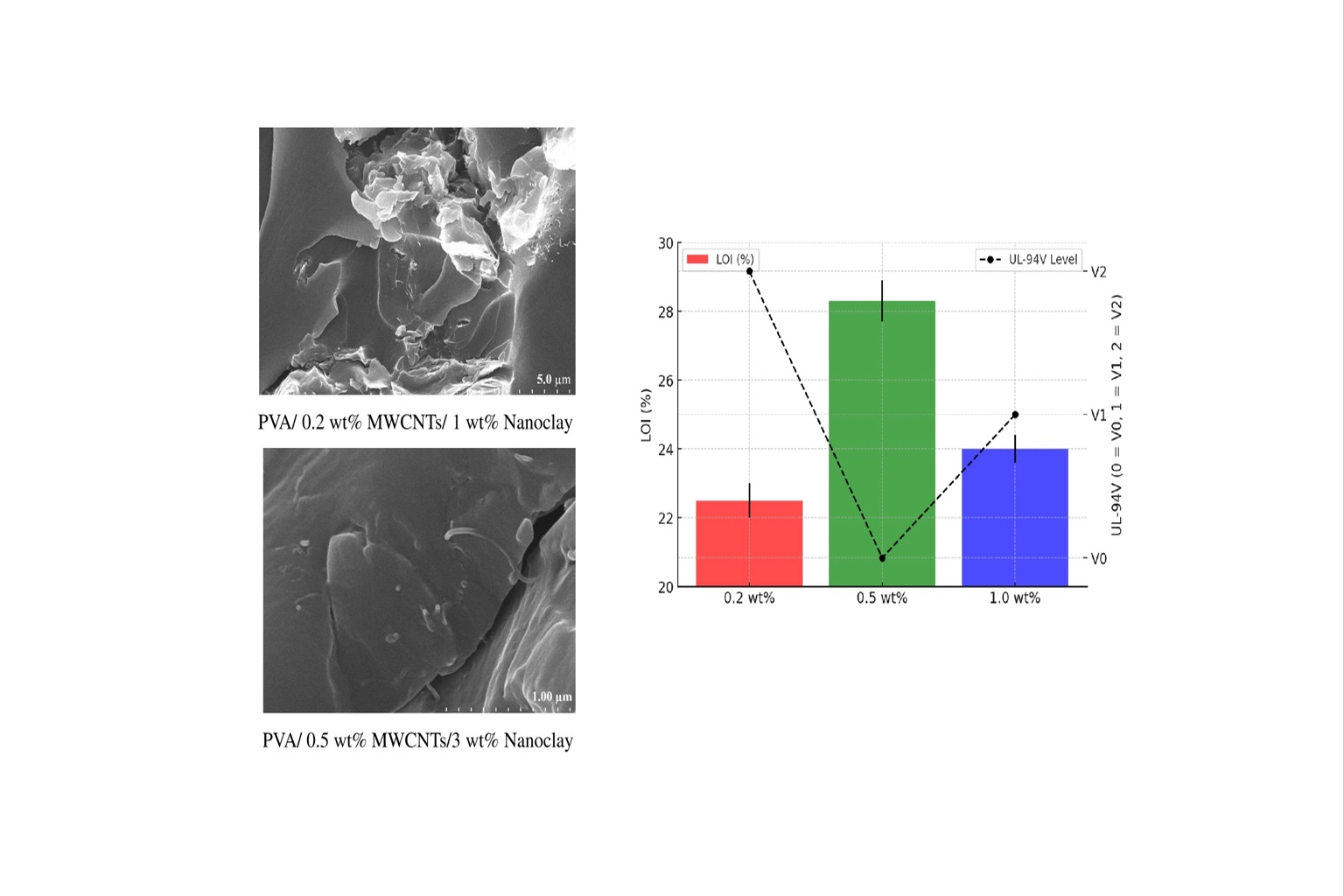
This study focuses on the fabrication and evaluation of polyvinyl alcohol (PVA)-based composite films reinforced with nanoclay and multi-walled carbon nanotubes (MWCNTs) to enhance their mechanical, thermal, and flame-retardant properties. The composite films were synthesized using the solution blending and casting method, where PVA was dissolved in water, followed by the ultrasonic dispersion of MWCNTs and nanoclay. The mixture was magnetically stirred to ensure uniform dispersion before film casting and drying. The composite samples were prepared with nanoclay contents of 1%, 3% and 5% and MWCNTs contents of 0.2%, 0.5% and 1% by weight. Mechanical analysis revealed that the sample containing 3% nanoclay and 0.5% MWCNTs achieved the highest tensile strength, increasing by 40.8% from 32.8 to 46.2 MPa. The flexural strength also improved by 34.5% from 53.2 to 71.5 MPa. Scanning Electron Microscopy (SEM) images demonstrated uniform dispersion of nanoclay and MWCNTs within the PVA matrix, which significantly enhanced phase interactions. Thermogravimetric Analysis (TGA) results showed that the degradation temperature of the PVA/0.5% MWCNTs/3% nanoclay sample reached 318.7 °C, which is 27.6 °C higher than that of pure PVA (291.1 °C), indicating improved thermal stability. Regarding flame retardancy, the limiting oxygen index (LOI) of the composite reached 31.5%, significantly higher than that of pure PVA (19.8%), while also achieving a UL-94 V-0 rating, confirming its self-extinguishing ability. The novelty of this study lies in the synergistic reinforcement of MWCNTs and nanoclay in the PVA matrix, leading to simultaneous enhancements in mechanical strength, thermal stability, and flame resistance, a combination that has not been fully explored before. The optimized formulation (PVA/0.5% MWCNTs/3% nanoclay) offers great potential for applications in industries requiring heat-resistant and flame-retardant materials, such as smart packaging, thermal insulation, and protective coatings.
HIGHLIGHTS
- Polyvinyl alcohol (PVA) composite films reinforced with nanoclay and MWCNTs were successfully fabricated using solution casting.
- The optimized composite (0.5% MWCNTs and 3% nanoclay) exhibited a 40.8% increase in tensile strength and 34.5% increase in flexural strength.
- Thermal stability improved significantly, with the degradation temperature rising from 291.1 °C (pure PVA) to 318.7 °C.
- Flame retardancy was enhanced, achieving an LOI of 31.5% and a UL-94 V-0 rating.
- The study demonstrates the synergistic effect of MWCNTs and nanoclay in improving mechanical, thermal, and flame-retardant performance of PVA-based films.
GRAPHICAL ABSTRACT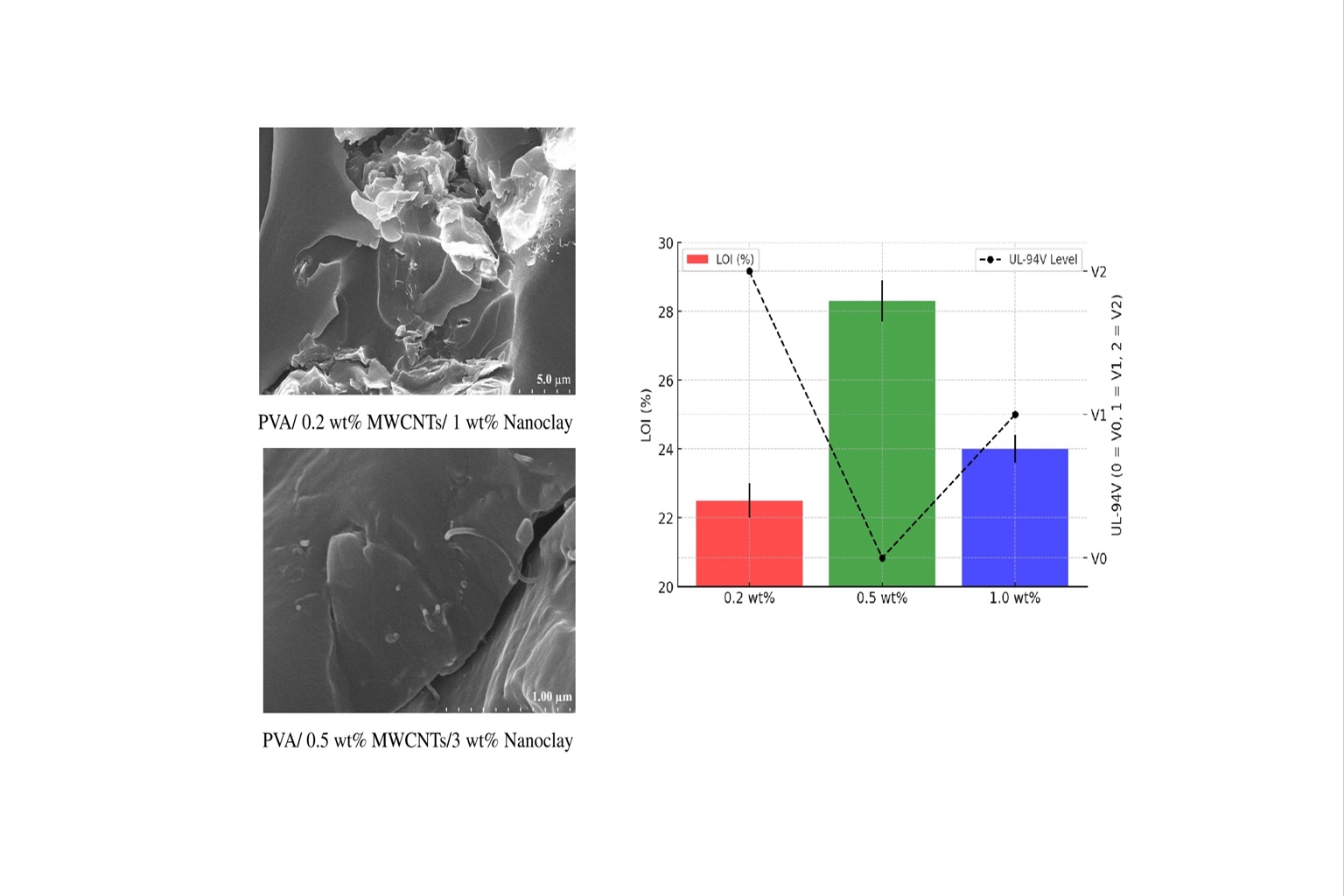
Downloads
References
G Vahidi, DS Bajwa, J Shojaeiarani, N Stark and A Darabi. Advancements in traditional and nanosized flame retardants for polymers-A review. Journal of Applied Polymer Science 2021; 138(12), e50050.
W He, P Song, B Yu, Z Fang and H Wang. Flame retardant polymeric nanocomposites through the combination of nanomaterials and conventional flame retardants. Progress in Materials Science 2020; 114, 100687.
Z Kovacevic, SF Grgac and S Bischof. Progress in biodegradable flame retardant nano-biocomposites. Polymers 2021; 13(5), 741.
W Xie, B Wang, Y Liu, Q Wang and Z Yang. Flame retardancy of a novel high transparent poly (methyl methacrylate) modified with phosphorus-containing compound. Reactive and Functional Polymers 2020; 153, 104631.
W Xing, W Yang, W Yang, Q Hu, J Si, H Lu, B Tang, L Song, Y Hu and RKK Yuen. Functionalized carbon nanotubes with phosphorus and nitrogen-containing agents: Effective reinforcer for thermal, mechanical, and flame-retardant properties of polystyrene nanocomposites. ACS Applied Materials & Interfaces Related Journals 2016; 8(39), 26266-26274.
RA Mensah, V Shanmugam, S Narayanan, JS Renner, K Babu, RE Neisiany, M Forsth, G Sas and O Das.
A review of sustainable and environment-friendly flame retardants used in plastics. Polymer Testing 2022; 108, 104511.
M Altarawneh, A Saeed, M Al-Harahsheh and BZ Dlugogorski. Thermal decomposition of brominated flame retardants (BFRs): Products and mechanisms. Progress in Energy and Combustion Science 2019; 70, 212-259.
D Qureshi, A Sahoo, B Mohanty, A Anis, V Kulikouskaya, K Hileuskaya, V Agabekov, P Sarkar, SS Ray, S Maji and Kunal Pal. Fabrication and characterization of poly (vinyl alcohol) and chitosan oligosaccharide-based blend films. Gels 2021; 7(2), 55.
S Choudhary, K Sharma, PK Mishra, V Kumar and V Sharma. Development and characterization of biodegradable agarose/gum neem/nanohydroxyapatite/polyoxyethylene sorbitan monooleate based edible bio-film for applications towards a circular economy. Environmental Technology & Innovation 2023; 29, 103023.
L Gautam, SG Warkar and M Jain. Physicochemical evaluation of polyvinyl alcohol films crosslinked with saturated and unsaturated dicarboxylic acids: A comparative study. Polymer Engineering & Science 2024; 64(8), 3425-4011.
S Pattadakal, V Ghatti, S Chapi, Vidya G, YK Kumarswamy, MS Raghu, GT Vidyavathi, N Nandihalli and
DR Kasai. Poly(vinyl alcohol) nanocomposites reinforced with CuO nanoparticles extracted by Ocimum sanctum: Evaluation of wound-healing applications. Polymers 2025; 17(3), 400.
E Guler, HB Yekeler, B Uner, M Dogan, A Asghar, F Ikram, Y Yazir, O Gunduz, DM Kalaskar and ME Cam.
In vitro neuroprotective effect evaluation of donepezil-loaded PLGA nanoparticles-embedded PVA/PEG nanofibers on SH-SY5Y cells and AP-APP plasmid related Alzheimer cell line model. Macromolecular Materials and Engineering 2025; 310(3), 2400160.
L Chai, Y Chen, X Yan, P Alcouffe, F Ganachaud, E Fleury and J Bernard. Poly(vinyl alcohol)s and their glycoderivatives as efficient Shell-Builders of nanocapsules by nanoprecipitation. Biomacromolecules 2024; 25(6), 3596-3606.
L Cao, Y Liu, J Wang, Y Pan, Y Zhang, N Wang and J Chen. Multi-functional properties of MWCNT/PVA buckypapers fabricated by vacuum filtration combined with hot press: Thermal, electrical and electromagnetic shielding. Nanomaterials 2020; 10(12), 2503.
V Mahesh, SJ Athul, D Harursampath, M Loja and TN Thoi. A comprehensive review on analysis of nanocomposites: From manufacturing to properties characterization. Materials Research Express 2019; 6, 092002.
TA Nguyen, QT Nguyen and TP Bach. Mechanical properties and flame retardancy of epoxy resin/nanoclay/multiwalled carbon nanotube nanocomposites. Journal of Chemistry 2019; 2019(1), 105205.
TA Nguyen. Mechanical and flame-retardant properties of nanocomposite based on epoxy resin combined with epoxidized linseed oil, which has the presence of nanoclay and MWCNTs. Journal of Chemistry 2020; 2020(1), 353827.
TA Nguyen. Research on fabrication of flame retardant nanocomposite coating to protect steel structures on Epikote 240 epoxy resin base with the synergy of MWCNTs and fly ash. International Journal of Chemical Engineering 2021; 2021(1), 9961321.
TA Nguyen and TT Bui. Effects of hybrid graphene oxide with multiwalled carbon nanotubes and nanoclay on the mechanical properties and fire resistance of epoxy nanocomposite. Journal of Nanomaterials 2021, 2021(1), 2862426.
TA Nguyen. Mechanical and flame-retardant properties of epoxy Epikote 240/epoxidized linseed oil composites using fiber-glass. Mehran University Research Journal of Engineering and Technology 2020; 39(1), 9-20.
TA Nguyen, TMH Pham, TH Dang, TH Do and QT Nguyen. Study on mechanical properties and fire resistance of epoxy nanocomposite reinforced with environmentally friendly additive: Nanoclay I.30E. Journal of Chemistry 2020; 2020(1), 3460645.
Published
How to Cite
Issue
Section
License
Copyright (c) 2025 Walailak University

This work is licensed under a Creative Commons Attribution-NonCommercial-NoDerivatives 4.0 International License.





