
Advanced Bio-Based PVA Composite Films Reinforced with Bacterial Cellulose and Graphene Oxide: Enhanced Mechanical, Thermal, Flame-Retardant, and UV-Blocking Properties
DOI:
https://doi.org/10.48048/tis.2025.10357Keywords:
Bacterial cellulose (BC), Graphene oxide (GO), Polyvinyl alcohol (PVA), Bio-based composite films, Mechanical properties, Flame retardancy, Thermal stabilityAbstract
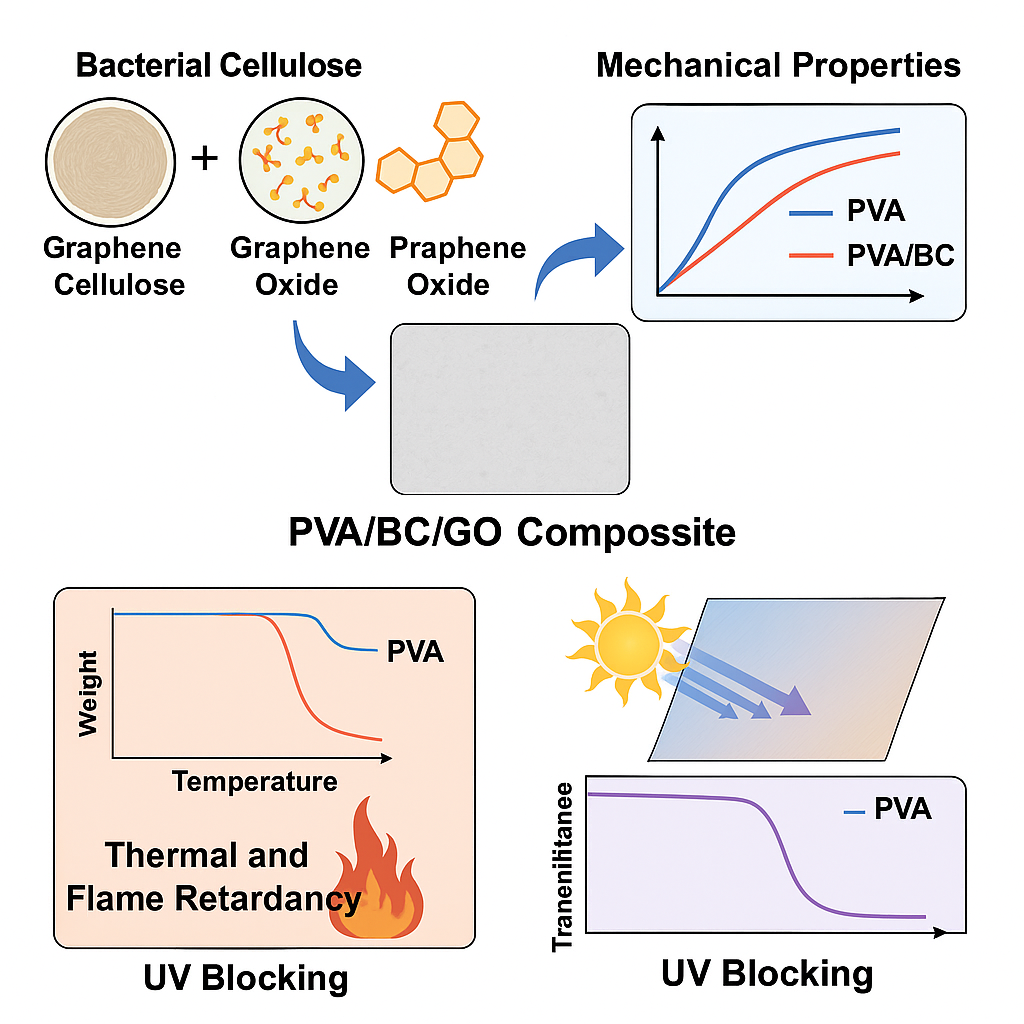
This research elucidates the formulation and characterization of an eco-friendly bio-composite film made with polyvinyl alcohol (PVA), bacterial cellulose (BC), and graphene oxide (GO). The optimized composition, incorporating 3 wt.% BC and 0.5 wt.% GO, yielded substantial improvements in mechanical properties, achieving a 47% increase in tensile strength and a 65% enhancement in impact resistance compared to pure PVA, while preserving desirable flexibility. Microstructural and spectroscopic analyses-including scanning electron microscopy (SEM), Fourier-transform infrared spectroscopy (FTIR), and X-ray diffraction (XRD)-confirmed homogeneous dispersion and strong interfacial compatibility among components. The addition of GO significantly enhanced flame retardancy, raising the limiting oxygen index (LOI) to 27.8% and enabling the film to attain UL-94 V-1 classification. Thermogravimetric analysis revealed improved thermal stability, while UV-visible spectroscopy demonstrated a UV-blocking efficiency of 95.3% at 280 nm. These findings underscore the synergistic reinforcing effect of BC and GO in enhancing the mechanical strength, thermal resistance, flame retardancy, and UV-shielding capacity of the bio-composite film made with PVA, BC and GO, highlighting its promising potential for sustainable applications in packaging, biomedical materials, and protective coatings.
HIGHLIGHTS
- A novel eco-friendly bio-composite film based on PVA, bacterial cellulose (3 wt.%), and graphene oxide (0.5 wt.%) was successfully developed.
- The composite showed significant mechanical improvements: tensile strength increased by 47% and impact resistance by 65% compared to pure PVA.
- Flame retardancy was enhanced with a limiting oxygen index (LOI) of 27.8% and UL-94 V-1 classification.
- The film achieved 95.3% UV-blocking efficiency at 280 nm and demonstrated improved thermal stability.
- Synergistic reinforcement between bacterial cellulose and graphene oxide led to enhanced interfacial compatibility and multifunctional performance, making the composite suitable for sustainable packaging and biomedical applications.
GRAPHICAL ABSTRACT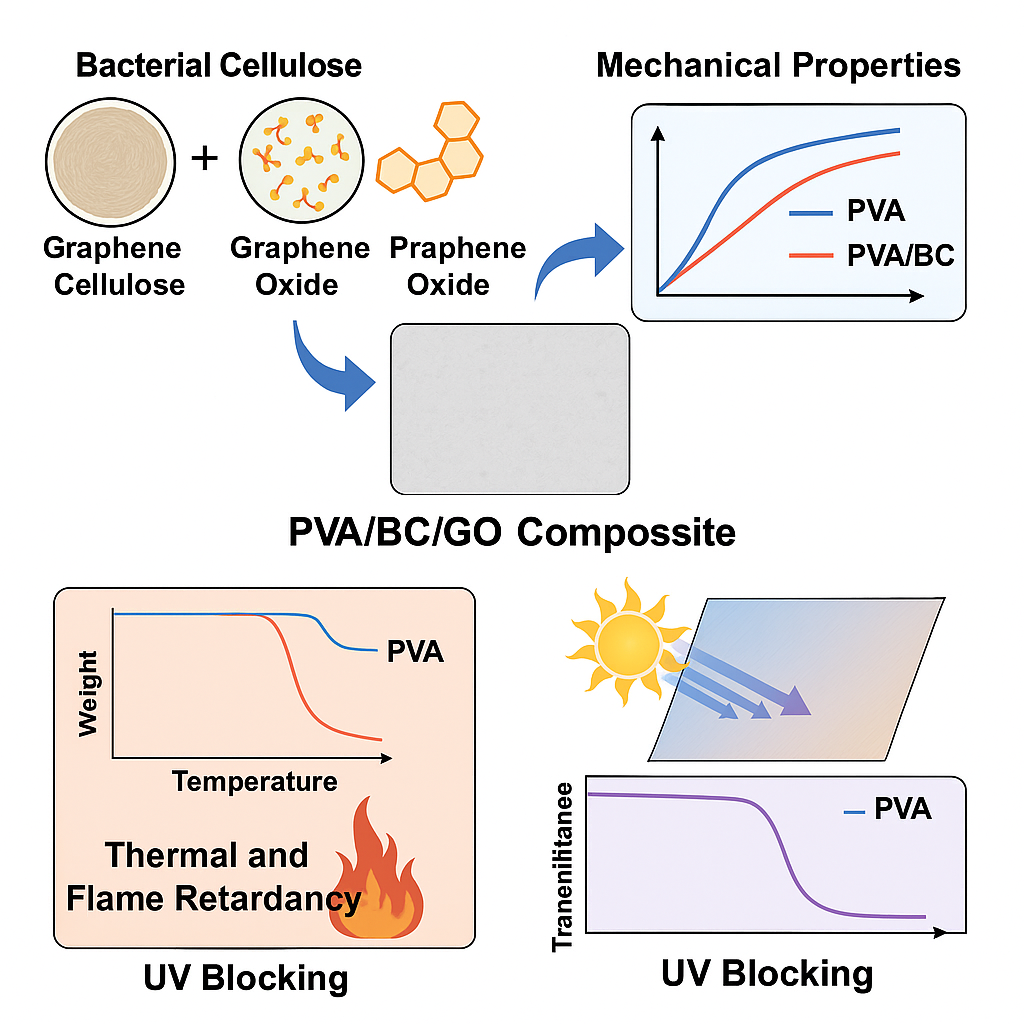
Downloads
References
SC Pinto, G Gonçalves, S Sandoval, AM López-Periago, A Borras, C Domingo, G Tobias, I Duarte, R Vicente and PAAP Marques. Bacterial cellulose/graphene oxide aerogels with enhanced dimensional and thermal stability. Carbohydrate Polymers 2019; 230, 115598.
MA Masanabo, JT Keränen, SS Ray and NA Emmambux. Effect of cowpea lignocellulosic fibers as a low-value reinforcing filler on the properties of poly(butylene succinate-co-adipate) bio-composite foams. Macromolecular Materials and Engineering. 2025; 310(7), 2400369.
N Sridhar, MSA Vallavi and T Mugilan. Synthesis and characterization of polyvinyl alcohol/Senna alata extract incorporated film for biomedical application. Polymer Bulletin 2024; 81(15), 13839-13862.
F Liu, Y Zhang, X Xiao, Y Cao, W Jiao, H Bai, L Yu and Q Duan. Effects of polyvinyl alcohol content and hydrolysis degree on the structure and properties of extruded starch-based foams. Chemical Engineering Journal 2023; 472(7), 144959.
W Guo, Y Hu, X Wang, P Zhang, L Song and W Xing. Exceptional flame-retardant cellulosic foams modified with phosphorus-hybridized graphene nanosheets. Cellulose 2019; 26(2), 1247-1260.
WJ Lee, AJ Clancy, JC Fernández-Toribio, DB Anthony, ER White, E Solano, HS Leese, JJ Vilatela and MS Shaffer. Interfacially-grafted single-walled carbon nanotube/poly(vinyl alcohol) composite fibers. Carbon 2019; 146, 162-171.
A Rafique, KM Zia, M Zuber, S Tabasum and S Rehman. Chitosan functionalized poly(vinyl alcohol) for prospects biomedical and industrial applications: A review. International Journal of Biological Macromolecules 2016; 87(4), 141-154.
D Zhang, D Meng, Z Ma, Z Zhang, H Ning and Y Wang. Synthesis of a novel organic-inorganic hybrid flame retardant based on Ca(H₂PO₄)₂ and hexachlorocyclotriphosphazene and its performance in polyvinyl alcohol. Journal of Applied Polymer Science 2020; 138(13), 50099.
M Aslam, MA Kalyar and ZA Raza. Polyvinyl alcohol: A review of research status and use of polyvinyl alcohol based nanocomposites. Polymer Engineering & Science 2018; 58(2), 2119-2132.
H Li, CW Wu, S Wang and W Zhang. Mechanically strong poly(vinyl alcohol) hydrogel with macropores and high porosity. Materials Letters 2020; 266, 127504.
SP Lin, KY Lo, TN Tseng, JM Liu, TY Shih and KC Cheng. Evaluation of PVA/dextran/chitosan hydrogel for wound dressing. Cell Polymers 2019; 38(11), 15-30.
L Fan, H Yang, J Yang, M Peng and J Hu. Preparation and characterization of chitosan/gelatin/PVA hydrogel for wound dressings. Carbohydrate Polymers 2016; 146, 427-434.
K Kalantari, E Mostafavi, B Saleh, P Soltantabar and TJ Webster. Chitosan/PVA hydrogels incorporated with green synthesized cerium oxide nanoparticles for wound healing applications. European Polymer Journal 2020; 134(3), 109853.
TA Nguyen, TH Nguyen, TTP Nguyen, MH Ngu¬yen, MV Nguyen, NT Nguyen, DTY Oanh, TTT Bui, TV Ngo and XT Dam. Exploring graphene oxide and bacterial cellulose for Cr(VI) removal from water. Vietnam Journal of Chemistry 2025. https://doi.org/10.1002/vjch.70006
TA Nguyen, DTY Oanh, MH Nguyen, TH Nguyen, TTP Nguyen, THN Le, MV Nguyen, TMH Pham, QT Nguyen. Research to develop the ability to remove As(III) ions in water of an environmentally friendly hybrid material based on bacterial cellulose and graphene oxide. Vietnam Journal of Chemistry. 2024; 62(5), 1-15.
Y Wu, M Wang, Z Wang and J Wang. Green fabrication of robust and transparent PVA/BC/GO nanocomposite films with enhanced mechanical, thermal, and UV shielding properties. Carbohydrate Polymers 2023; 317, 120899.
T Zhang, J Song and F Liu. Graphene oxide-bacterial cellulose hybrid aerogels for effective antibacterial and wound healing applications. Materials Science and Engineering: C 2021; 123, 112020.
A Kumar, RP Singh and S Pal. Fabrication of poly(vinyl alcohol)/bacterial cellulose/graphene oxide hybrid hydrogel for wound dressing. International Journal of Biological Macromolecules 2021; 183, 1512-1520.
L He, H Wang and H Liu. Multifunctional PVA/BC/GO membranes for food packaging with improved oxygen barrier and flame retardant properties. Food Packaging and Shelf Life 2022; 33, 100904.
R Morales Narváez and L Merkoçi. Nanomaterials for biosensing, imaging, and drug delivery. Advanced Drug Delivery Reviews 2020; 168, 1-21.
X Chen, S Zhang and Y Zhang. Preparation and characterization of PVA/BC/GO composite films for biomedical applications. Journal of Applied Polymer Science 2022; 139(11), 51854.
M Almasian and S Shahrokhian. Biocompatible nanocomposite films based on bacterial cellulose/graphene oxide/PVA for medical device coatings. Materials Today Communications 2021; 28, 102635.
J Wei, L Li and Q Wang. Flame retardancy and mechanical reinforcement in PVA based nanocomposites via synergistic effects of bacterial cellulose and graphene oxide. Polymer Degradation and Stability 2021; 183, 109490.
Z Lin, Y Zhu and X Liu. Environmentally friendly polymer films reinforced with bacterial cellulose and graphene oxide for protective packaging. ACS Sustainable Chemistry & Engineering 2021; 9(1), 289-298.
M Taghizadeh and B Saber Samandari. PVA based hydrogel incorporating BC and GO: Mechanical enhancement and sustained drug release. European Polymer Journal 2021; 142, 110143.
P Ma, Y Liu, S Wen, B He, X Ma, Q Huang, X Sun, W Gao and Y Bai. A bacterial cellulose nanocrystals-graphene oxide/ poly(vinyl alcohol) @vanillin composite fibers with efficient antibacterial activity and high strength for surgical suturing. Advanced Healthcare Materials 2025. https://doi.org/10.1002/adhm.202404511
Y Wu, Q Zhang, F Li and L Chen. Green fabrication of robust and transparent PVA/BC/GO nanocomposite films with enhanced mechanical, thermal, and UV shielding properties. Carbohydrate Polymers 2024; 317, 120899.
Q Yang, J Tan, S Tao, H Qiu, W Zhou, J Zhu, H Zhang, L Pei, T Zhou and J Wang. Fabrication and properties of conductive films based on bacterial cellulose and poly N isopropylacryla¬mide modified graphene oxide. International Journal of Biological Macromolecules 2024; 278(P2), 134867.
IS Mir, A Riaz, J Fréchette, JS Roy, J Mcelhinney, S Pu, HK Balakrishnan, J Greener, LF Dumée and Y Messaddeq. Bacterial cellulose-graphene oxide composite membranes with enhanced fouling resistance for bio effluents management. npj Clean Water 2024; 7(1), 111.
L Feng, Y Shi, J Liu and T Huang. Recent progress on nanocellulose based nanocomposites for environmental and energy applications. Progress in Materials Science. 2025; 140, 101121.
Published
How to Cite
Issue
Section
License
Copyright (c) 2025 Walailak University

This work is licensed under a Creative Commons Attribution-NonCommercial-NoDerivatives 4.0 International License.





