
Antibacterial and Antifungal Cotton Fabrics Functionalized with Plant Extracts for Sustainable Textile Applications
DOI:
https://doi.org/10.48048/tis.2026.11670Keywords:
Terminalia catappa extract, Cotton finishing, Sustained release, Antimicrobial textiles, Release kineticsAbstract
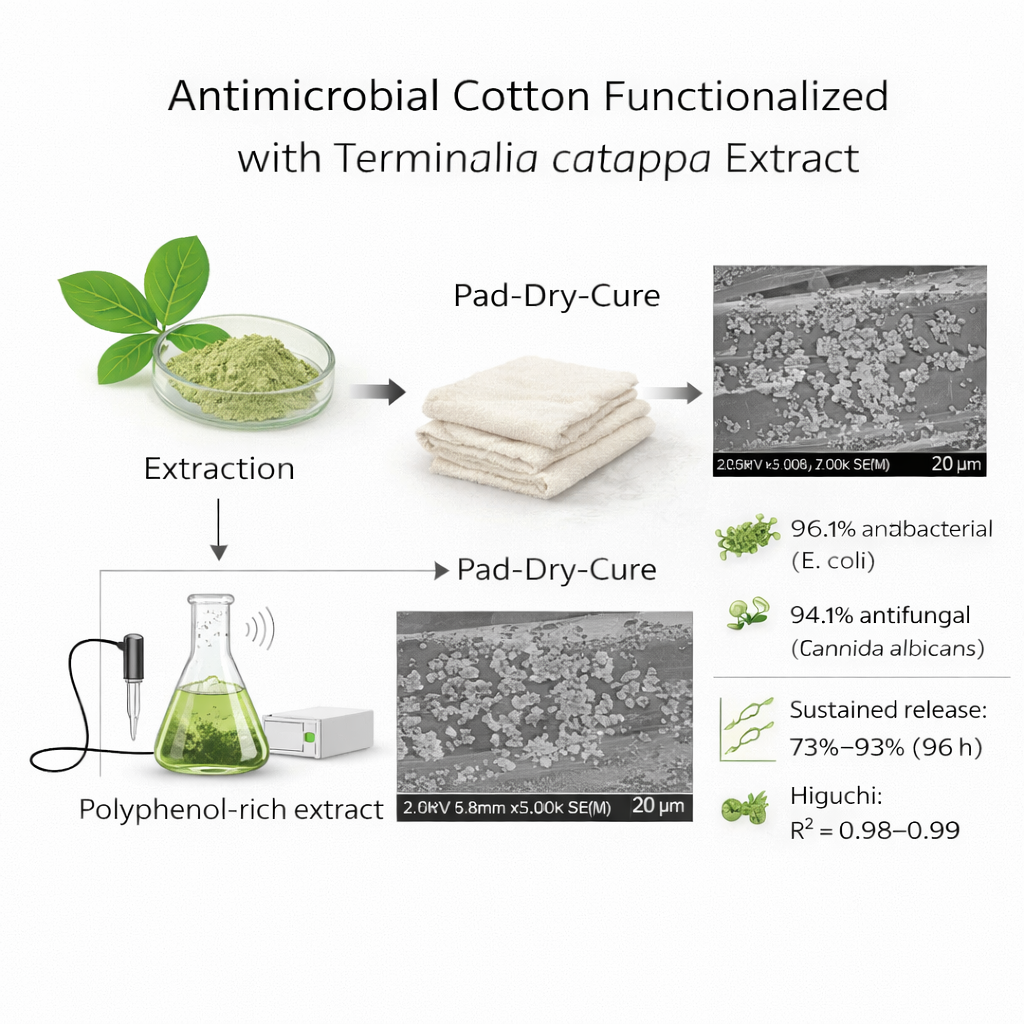
This study reports the development of multifunctional cotton fabrics finished with bioactive extract from Terminalia catappa leaves, with a focus on sustained release kinetics as a novel contribution. A Box-Behnken design was employed to optimize extract concentration (1 - 5 %w/v), bath pH (4 - 8), and treatment time (10 - 60 min). Under the optimized finishing condition (5.0 %w/v extract, pH 6.0, 60 min), the treated cotton exhibited antibacterial efficiency of 96.1% against E. coli, antifungal inhibition of 94.1% against Candida albicans, and washing durability of 90.2%. Phytochemical profiling via GC-MS confirmed the presence of dominant flavonoids (quercetin 2.29 ± 0.10 mg/g DW; kaempferol 1.96 ± 0.09 mg/g DW), phenolic acids (gallic acid 2.85 ± 0.12 mg/g DW; ellagic acid 2.05 ± 0.09 mg/g DW), and triterpenoids (β-sitosterol 5.39 ± 0.21 mg/g DW). Release studies monitored by UV-Vis spectroscopy demonstrated cumulative polyphenol release of 73% (pH 5), 84% (pH 7), and 93% (pH 9) after 96 h. Higuchi fitting (R² = 0.981 - 0.992; kH = 4.82 - 6.38 %·h−1/2) and Korsmeyer-Peppas modeling (n = 0.82 - 0.91) confirmed anomalous transport involving both Fickian diffusion and polymer matrix relaxation. SEM images showed uniform nanoscale deposition on fibers, supporting the controlled release mechanism. These findings demonstrate that T. catappa extract provides a green and effective strategy for sustainable cotton finishing, with the novelty of integrating release kinetics as a critical parameter for durability and functionality.
HIGHLIGHTS
- Polyphenol-rich Terminalia catappa extract functionalized cotton
- 1% antibacterial and 94.1% antifungal efficiency achieved
- Sustained release (73%-93%) over 96 h following Higuchi kinetics
- Strong immobilization with minimal leaching (< 2%)
- Potential low-cost, eco-friendly antimicrobial textile for screening use
GRAPHICAL ABSTRACT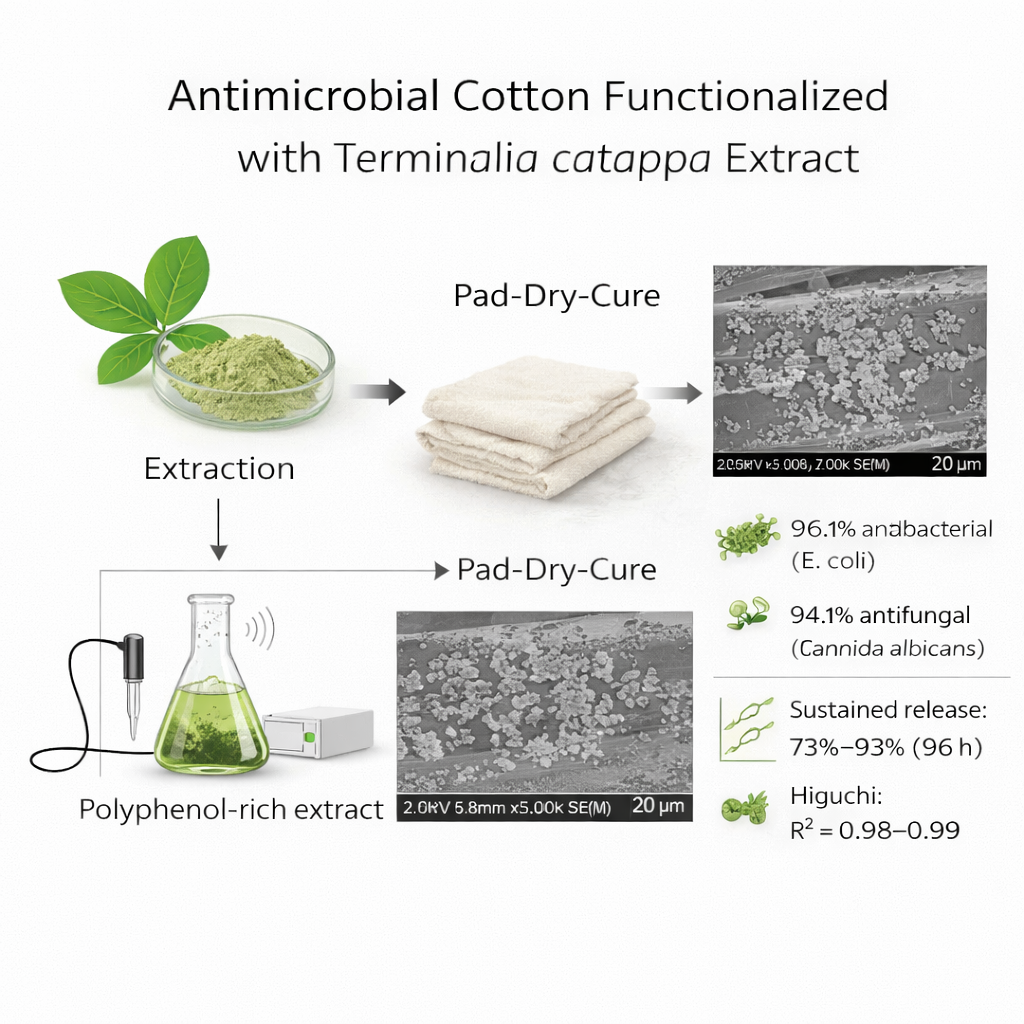
Downloads
References
A Alvarez-Risco, S Del-Aguila-Arcentales, J Delgado-Zegarra, JA Yáñez and S Diaz-Risco. Doping in sports: Findings of the analytical test and its interpretation by the public. Sport Sciences for Health 2019; 15, 255.
EA Skomorokhova, TP Sankova, IA Orlov, AN Savelev, DN Magazenkova, MG Pliss, AN Skvortsov, IM Sosnin, DA Kirilenko, IV Grishchuk, EI Sakhenberg, EV Polishchuk, PN Brunkov, AE Romanov, LV Puchkova and EY Ilyechova. Size-dependent bioactivity of silver nanoparticles: Antibacterial properties, influence on copper status in mice, and whole-body turnover. Nanotechnology, Science and Applications 2020; 13, 137.
H Katouah and NM El-Metwaly. Plasma treatment toward electrically conductive and superhydrophobic cotton fibers by in situ preparation of polypyrrole and silver nanoparticles. Reactive and Functional Polymers 2021; 159, 104810.
JLZ Álvarez, MET Núñez, CA Chávez, DP Salazar, AMO Anaya and CV Gonzales. Obtención y caracterización del nanocomposito: Nanopartículas de plata y carboximetilquitosano (NPsAg-CMQ). Revista de la Sociedad Química del Perú 2019; 85(1), 14.
Z Rajabi, AM Sefidan, M Zarebavani, SS Yazdi, PT Bonab, SZ Mirbagheri and MMS Dallal. Investigation of enterotoxin-producing genes (sea, seb, sec, and sed) in Staphylococcus aureus isolated from raw traditionally and pasteurized milk supplied in Tehran, Iran. Journal of Food Quality and Hazards Control 2023; 10, 221.
G Gherardi. Staphylococcus aureus infection: Pathogenesis and antimicrobial resistance. International Journal of Molecular Sciences 2023; 24, 8182.
S Sfameni, M Hadhri, G Rando, D Drommi, G Rosace, V Trovato and MR Plutino. Inorganic finishing for textile fabrics: Recent advances in wear-resistant, UV protection and antimicrobial treatments. Inorganics 2023; 11, 19.
AAA Salama, RM Koth and RN Shaker. Effect of treatment durability and coloration of coated cotton fabrics on antibacterial, UV-blocking, healing and anti-inflammatory properties. Journal of Chemical and Pharmaceutical Research 2015; 7, 181.
S Gargoubi, R Tolouei, P Chevallier, L Levesque, N Ladhari, C Boudokhabe and D Mantovani. Enhancing the functionality of cotton fabric by physical and chemical pre-treatments: A comparative study. Carbohydrate Polymers 2016; 147, 28.
P Gupta, S Sarkar, B Das, S Bhattacharjee and P Tribedi. Biofilm, pathogenesis and prevention - a journey to break the wall: A review. Archives of Microbiology 2016; 198, 1.
A Sharma, Y Kumar, G Kumar and AK Tahlan. Biofilm production and antibiogram profiles in Escherichia coli and Salmonella. Indian Journal of Microbiology 2023; 64(4), 1512-1517.
M Assefa and A Amare. Biofilm-associated multi-drug resistance in hospital-acquired infections: A review. Infection and Drug Resistance 2022; 15, 5061.
F Ahmad, KS Akhtar, W Anam, B Mushtaq, A Rasheed, S Ahmad, F Azam and Y Nawab. Recent developments in materials and manufacturing techniques used for sports textiles. International Journal of Polymer Science 2023; 2023, 2021622.
MH Swaney, A Nelsen, S Sandstrom and LR Kalan. Sweat and sebum preferences of the human skin microbiota. Microbiology Spectrum 2023; 11(1), e04180.
F Watson, CW Keevil, J Chewins and SA Wilks. Artificial human sweat as a novel growth condition for clinically relevant pathogens on hospital surfaces. Microbiology Spectrum 2022; 10, e02137.
C Kazancı, S Oruç and M Mosulishvili. Medicinal ethnobotany of wild plants: A cross-cultural comparison around Georgia-Turkey border, the Western Lesser Caucasus. Journal of Ethnobiology and Ethnomedicine 2020; 16, 71.
L Grauso, B de Falco and V Lanzotti. Stinging nettle, Urtica dioica L.: Botanical, phytochemical and pharmacological overview. Phytochemistry Reviews 2020; 19, 1341.
M Fournomiti, A Kimbaris, I Mantzourani, S Plessas, I Theodoridou, V Papaemmanouil, I Kapsiotis, M Panopoulou, E Stavropoulou, EE Bezirtzoglou and A Alexopoulos. Antimicrobial activity of essential oils of cultivated oregano (Origanum vulgare), sage (Salvia officinalis), and thyme (Thymus vulgaris) against clinical isolates of Escherichia coli, Klebsiella oxytoca, and Klebsiella pneumoniae. Microbial Ecology in Health and Disease 2015; 26, 23289.
G Nagmetova, A Berthold-Pluta, M Garbowska, A Kurmanbayev and L Stasiak-Różańska. Antibacterial activity of biocellulose with oregano essential oil against Cronobacter strains. Polymers 2020; 12, 1647.
H Morris and R Murray. Healthcare, hygiene, and personal protective equipment (PPE). In: H Morris and R Murray (Eds.). Medical textiles. CRC Press, Boca Raton, United States. 2021.
R Abdur, A Anwar, H Arruje, K Shumaila and F Tahir. Green dyeing of modified cotton fabric with Acalypha wilkesiana leave extracts. Chemistry and Pharmacy 2021; 21, 100468.
K Arpana, J Seiko and S Aaditaa. Antimicrobial activity of natural dyes - a comprehensive review. Journal of Natural Fibers 2022; 19, 5380.
MT Islam, MR Repon, MLR Liman, MM Hossain and MDA Mamun. Functional modification of cellulose by chitosan and gamma radiation for higher grafting of UV protective natural chromophores. Radiation Physics and Chemistry 2021; 183, 109426.
N Lemita, S Deghboudj, M Rokbi, FML Rekbi and R Halimi. Characterization and analysis of novel natural cellulosic fiber extracted from Strelitzia reginae plant. Journal of Composite Materials 2022; 56, 99.
TA Nguyen, TH Do and TD Ha. Multifunctional biocomposite membrane of bacterial cellulose/chitosan incorporated with green tea leaf extract as a smart colorimetric sensor for sustainable packaging. Trends in Sciences 2025; 22(10), 10667.
P Chitichotpanya, N Vuthiganond, P Chutasen and T Inprasit. Green production of simultaneous coloration and functional finishing on hemp textiles through dyeing with Diospyros mollis Griff. extract. Journal of Metals, Materials and Minerals 2023; 33(2), 108-119.
Published
How to Cite
Issue
Section
License
Copyright (c) 2025 Walailak University

This work is licensed under a Creative Commons Attribution-NonCommercial-NoDerivatives 4.0 International License.





