
Enhanced Mechanical Properties and Fire Resistance of Epoxy/Nanoclay Composite Coatings for Advanced Steel Protection
DOI:
https://doi.org/10.48048/tis.2025.10096Keywords:
Epoxy-based nanocomposite coatings, Flame retardancy, UL-94 fire rating, Limiting Oxygen Index (LOI)Abstract
This study investigates the enhancement of mechanical strength and flame retardancy in epoxy-based nanocomposite coatings reinforced with organically modified nanoclay (I.30E) at different concentrations (1, 3, 5 and 7 wt%). The coatings were systematically characterized to assess their mechanical performance, fire resistance, and thermal stability. Results showed that incorporating nanoclay significantly improved the fire retardant properties of the epoxy coatings. The Limiting Oxygen Index (LOI) increased from 21.3 % (pure epoxy) to 24.5, 26.3, 28.5 and 27.0 % for 1, 3, 5 and 7 % nanoclay, respectively. The best flame-retardant performance was observed at 5 wt% nanoclay, which achieved a UL-94 V0 rating, indicating self-extinguishing behavior and minimal dripping. Mechanical properties also exhibited notable improvements. Tensile strength increased from 45 MPa (pure epoxy) to 53, 61, 67 and 62 MPa for 1, 3, 5 and 7 % nanoclay, respectively. Similarly, impact strength improved from 15.2 (pure epoxy) to 20.8, 25.3, 28.7 and 26.5 J/m as the nanoclay content increased. Hardness and scratch resistance were also enhanced, with a maximum increase of 38 % in relative hardness and 133 % in scratch resistance at 5 wt% nanoclay. However, at 7 wt% nanoclay, mechanical performance slightly declined, suggesting a possible agglomeration effect at higher concentrations. Thermal analysis (TGA) revealed that char residue at 700 °C increased by 10, 15, 20 and 18 % for 1, 3, 5 and 7 % nanoclay, respectively, further confirming the improved fire resistance. SEM and XRD analyses demonstrated that nanoclay was well-dispersed in the epoxy matrix at lower concentrations, but slight aggregation was observed at 7 wt%, reducing its reinforcing efficiency. These findings highlight the significant potential of nanoclay-reinforced epoxy coatings for applications requiring enhanced fire resistance, mechanical durability, and thermal stability.
HIGHLIGHTS
- Epoxy coatings were reinforced with 1 - 7 wt% nanoclay I.30E, showing significant improvements in mechanical strength and flame retardancy.
- The optimal concentration of 5 wt% nanoclay yielded the best performance: Tensile strength increased by 49 %, and impact strength by 88 % compared to pure epoxy.
- The composite achieved UL-94 V0 rating and LOI of 28.5 %, indicating excellent self-extinguishing flame resistance.
- Thermal stability improved, with Tmax rising to 395 °C and char residue reaching 22%, demonstrating enhanced fire barrier formation.
- SEM and XRD analyses confirmed good nanoclay dispersion at 5 wt%, while higher concentrations led to agglomeration and performance decline.
GRAPHICAL ABSTRACT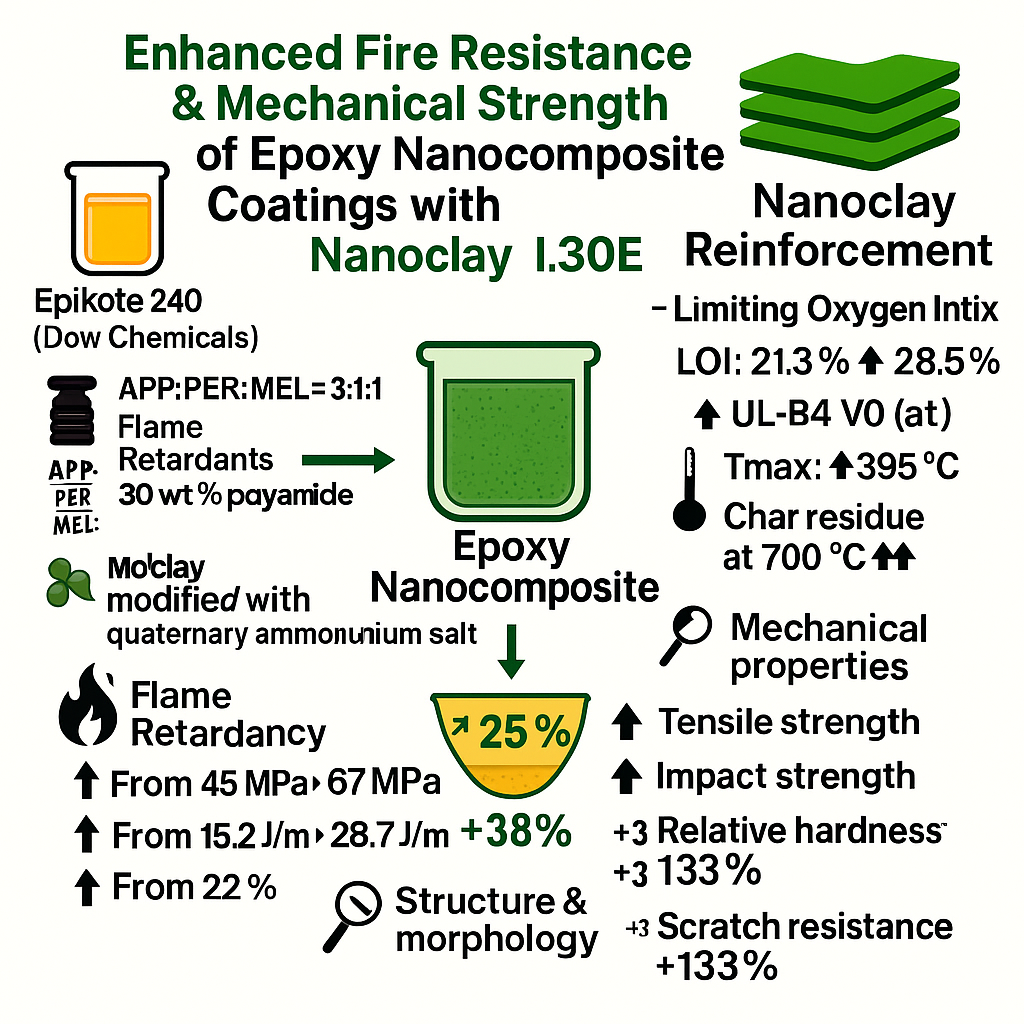
Downloads
References
K Debnath, M Kini and UA Sharma. Epoxy-clay nanocomposite coatings: A review on synthesis and characterization. Materials Research Express 2019; 6(8), 082007.
P Mareri, S Bastide, N Binda and A Crespy. Mechanical behaviour of polypropylene composites containing fine mineral filler: Effect of filler surface treatment. Composites Science and Technology 1998; 58, 747-752.
M Veena, N Renukappa, J Raj, R Chikkakuntappa and KN Shivakumar. Characterization of nanosilica‐filled epoxy composites for electrical and insulation applications. Journal of Applied Polymer Science 2011; 121(5), 2752-2760.
JR Xavier. Innovative nanocomposite coating for aluminum alloy in the aircraft manufacturing industry with increased mechanical strength, flame retardancy, and corrosion resistance. ChemistrySelect 2024; 9(29), e202402056.
JR Xavier, SP Vinodhini and R Ganesan. Innovative nanocomposite coating for aluminum alloy: Superior corrosion resistance, flame retardancy, and mechanical strength for aerospace applications. Journal of Materials Science 2024; 59(27), 12830-12861.
JR Beryl and JR Xavier. Halloysite for clay-polymer nanocomposites: Effects of nanofillers on the anti-corrosion, mechanical, microstructure, and flame-retardant properties-a review. Journal of Materials Science 2023; 58(27), 10943-10974.
AM Fadl, SA Sadeek, L Magdy and MI Abdou. Robust corrosion guard, mechanical and UV aging properties of metal complex/epoxy hybrid composite coating for C steel applications. Scientific Reports 2022; 12(1), 12483.
N Kertmen, ES Dalbaşı, A Körlü, A Özgüney and S Yapar. A study on coating with nanoclay on the production of flame retardant cotton fabrics. Textile and Apparel 2020; 30(4), 302-311.
MW Ho, CK Lam, K Lau, DHL Ng and D Hui. Mechanical properties of epoxy-based composites using nanoclays. Composite Structures 2006; 75(1-4), 415-421.
DD Trung. Influence of nanoclay on the fire resistance properties of epoxy-based intumescent retardant coatings for steel plate. VNU Journal of Science: Natural Sciences and Technology 2023; 39(3), 74-81.
L Yongchun, Z Shuyan, N Ming, L Fuchun, L Jiedong and H En-Hou. Investigation of corrosion resistance of epoxy coatings modified with zirconium nanoparticles. Chinese Journal of Materials Research, 2013; 27(2), 189-196.
TA Nguyen and QT Nguyen. Study on synergies of fly ash with multiwall carbon nanotubes in manufacturing fire retardant epoxy nanocomposite. Journal of Chemistry 2020; 2020(1), 6062128.
R Khan, MR Azhar, A Anis, A Alam, M Boumaza and S Al-Zahrani. Facile synthesis of epoxy nanocomposite coatings using inorganic nanoparticles for enhanced thermo-mechanical properties: A comparative study. Journal of Coatings Technology and Research 2015; 13(1), 159-169.
D Merachtsaki, P Xidas, P Giannakoudakis, K Triantafyllidis and P Spathis. Corrosion protection of steel by epoxy-organoclay nanocomposite coatings. Coatings 2017; 7(7), 84.
JM Yeh, HY Huang, CL Chen, WF Su and YH Yu. Siloxane-modified epoxy resin-clay nanocomposite coatings with advanced anticorrosive properties prepared by a solution dispersion approach. Surface and Coatings Technology 2006; 200(8), 2753-2763.
MD Tomić, B Dunjić, V Likić, J Bajat, J Rogan and J Djonlagić. The use of nanoclay in preparation of epoxy anticorrosive coatings. Progress in Organic Coatings 2014; 77(2), 518-527.
M Behzadnasab, SM Mirabedini and M Esfandeh. Corrosion protection of steel by epoxy nanocomposite coatings containing various combinations of clay and nanoparticulate zirconia. Corrosion Science 2013; 75, 134-141.
CN Njoku, W Bai, IO Arukalam, L Yang, B Hou, DI Njoku and Y Li. Epoxy-based smart coating with self-repairing polyurea-formaldehyde microcapsules for anticorrosion protection of aluminum alloy AA2024. Journal of Coatings Technology and Research 2020; 17(3), 797-813.
E Al-Bermany and AN Obaid. Performance of functionalized graphene oxide to improve anti-corrosion of epoxy coating on 2024-T3 aluminium alloy. Materials Chemistry and Physics 2023; 305, 127849.
J Jia, HJ Cao, T Wang, Y Min and Q Xu. Electrochemical behavior and anti-corrosion property of Ti3C2Tx MXene/LDH heterostructured coating on aluminum alloy. Surface and Coatings Technology 2023; 463, 129551.
K Kowalczyk and T Spychaj. Protective epoxy dispersion coating materials modified a posteriori with organophilized montmorillonites. Surface and Coatings Technology 2009; 204(5), 635-641.
MM Liu, HX Hu, ZB Wang, SL Wu and YG Zheng. Effect of epoxy sealant loaded with modified montmorillonite on the corrosion resistance of Fe-based amorphous metallic coating. Journal of Materials Engineering and Performance 2023; 32(17), 7593-7610.
H Yu, S Zhu and A Fu. The role of the mesh size of modified mica in CO2-Cl-environment resistant epoxy coatings. Protection of Metals and Physical Chemistry of Surfaces 2024; 60, 438-448.
G Acikbas, K Sezer, S Özcan and NC Acikbas. The effect of hydrophobic coating applied to mica reinforced epoxy matrix composites on the water absorption properties of the composite. Polymer Bulletin 2024; 81(2), 6207-6224.
Y Da, J Liu and X Xue. Enhanced thermal stability and corrosion resistance of UV-curing epoxy acrylate coatings by incorporating mica. The Journal of The Minerals, Metals & Materials Society 2024; 76(2), 622-634.
M Turna, F Şen, S Madakbaş and S Karataş. Preparation and characterization of UV-cured epoxy acrylate-based nanocomposite coatings containing organonanoclay. Polymer Bulletin 2023; 80, 7949-7969.
Y Wang, Z Cao, F Liu and X Xue. Synthesis and characterization of UV-curing epoxy acrylate coatings modified with organically modified rectorite. Journal of Coatings Technology and Research 2017; 14(1), 107-115.
TA Nguyen, QT Nguyen and BT Phuc. Mechanical properties and flame retardancy of epoxy resin/nanoclay/multiwalled carbon nanotube nanocomposites. Journal of Chemistry 2019; 2019, 9.
AT Nguyen. Mechanical and flame-retardant properties of nanocomposite based on epoxy resin combined with epoxidized linseed oil, which has the presence of nanoclay and MWCNTs. Journal of Chemistry 2020; 2020(1), 1-8.
TA Nguyen. Research on fabrication of flame retardant nanocomposite coating to protect steel structures on Epikote 240 epoxy resin base with the synergy of MWCNTs and fly ash. International Journal of Chemical Engineering 2021; 2021, 1-12.

Published
How to Cite
Issue
Section
License
Copyright (c) 2025 Walailak University

This work is licensed under a Creative Commons Attribution-NonCommercial-NoDerivatives 4.0 International License.





