
AI-Enhanced RSM Optimization of Green-Treated Spent Coffee Grounds for Superior Chromium (VI) Removal
DOI:
https://doi.org/10.48048/tis.2026.12072Keywords:
Spent coffee grounds, Cr(VI) adsorption, Ca(OH)₂ treatment, Response Surface Methodology (RSM), Artificial Intelligence (AI), Pareto optimizationAbstract
In this study, spent coffee grounds (SCG) were chemically activated with Ca(OH)₂ to develop a sustainable adsorbent for Cr(VI) removal from aqueous solutions. Structural analyses (SEM/EDX, FTIR, XRD, and XPS) confirmed that Ca(OH)₂ pretreatment significantly enhanced surface porosity, exposed additional oxygen-containing functional groups (–OH, –COOH), and introduced Ca–O active sites, thereby improving adsorption performance. The adsorption efficiency was strongly influenced by solution pH. Although the highest removal efficiency was observed under strongly acidic conditions (pH ≈ 2), extremely low pH values are not desirable for practical water treatment due to excessive acid consumption and potential corrosion. Therefore, an operational pH range of 4.5 - 5.0 was selected as the optimal condition to balance adsorption performance and practical applicability. Under these conditions (initial concentration ≈ 50 mg L⁻¹, dosage 1.0 g/100 mL, contact time 180 min, temperature 313 K), the maximum adsorption capacity reached 21 - 22 mg g⁻¹ with a removal efficiency of 88% - 90%, compared with only 12 - 14 mg g⁻¹ for untreated SCG. Kinetic analysis demonstrated that the pseudo-second-order (PSO) model best described the adsorption process (R² ≥ 0.993), while isotherm studies revealed good agreement with both Freundlich (R² = 0.984 - 0.992) and Langmuir (R² = 0.980 - 0.993) models, suggesting heterogeneous adsorption with partial monolayer characteristics. Thermodynamic analysis indicated an endothermic adsorption process (ΔH° > 0), with qₘₐₓ increasing from 20.83 mg g⁻¹ (298 K) to 23.45 mg g⁻¹ (328 K). High-resolution XPS spectra confirmed that the adsorbed chromium existed in mixed oxidation states, with partial reduction from Cr(VI) to Cr(III), particularly in SCG4 (2.5 wt% Ca(OH)₂), where the Cr(III)/Cr(total) ratio was highest. Reusability tests showed that after ten adsorption–desorption cycles, the removal efficiency remained at approximately 44%, demonstrating the material’s stability and regeneration potential. These results indicate that Ca(OH)₂-modified SCG is a low-cost, eco-friendly, and effective adsorbent for chromium-contaminated water treatment, combining efficient Cr(VI) removal, partial detoxification, and good recyclability.
HIGHLIGHTS
- Sustainable Ca(OH)₂ activation significantly improved SCG surface chemistry and adsorption performance.
- High Cr(VI) removal efficiency (up to 90%) achieved at practical pH (4.5–5.0).
- Hybrid RSM–AI modeling revealed nonlinear structure–performance relationships with superior prediction accuracy.
- Combined adsorption–reduction mechanism enabled detoxification of Cr(VI).
- Waste-derived adsorbent offers a scalable and eco-friendly solution for water treatment.
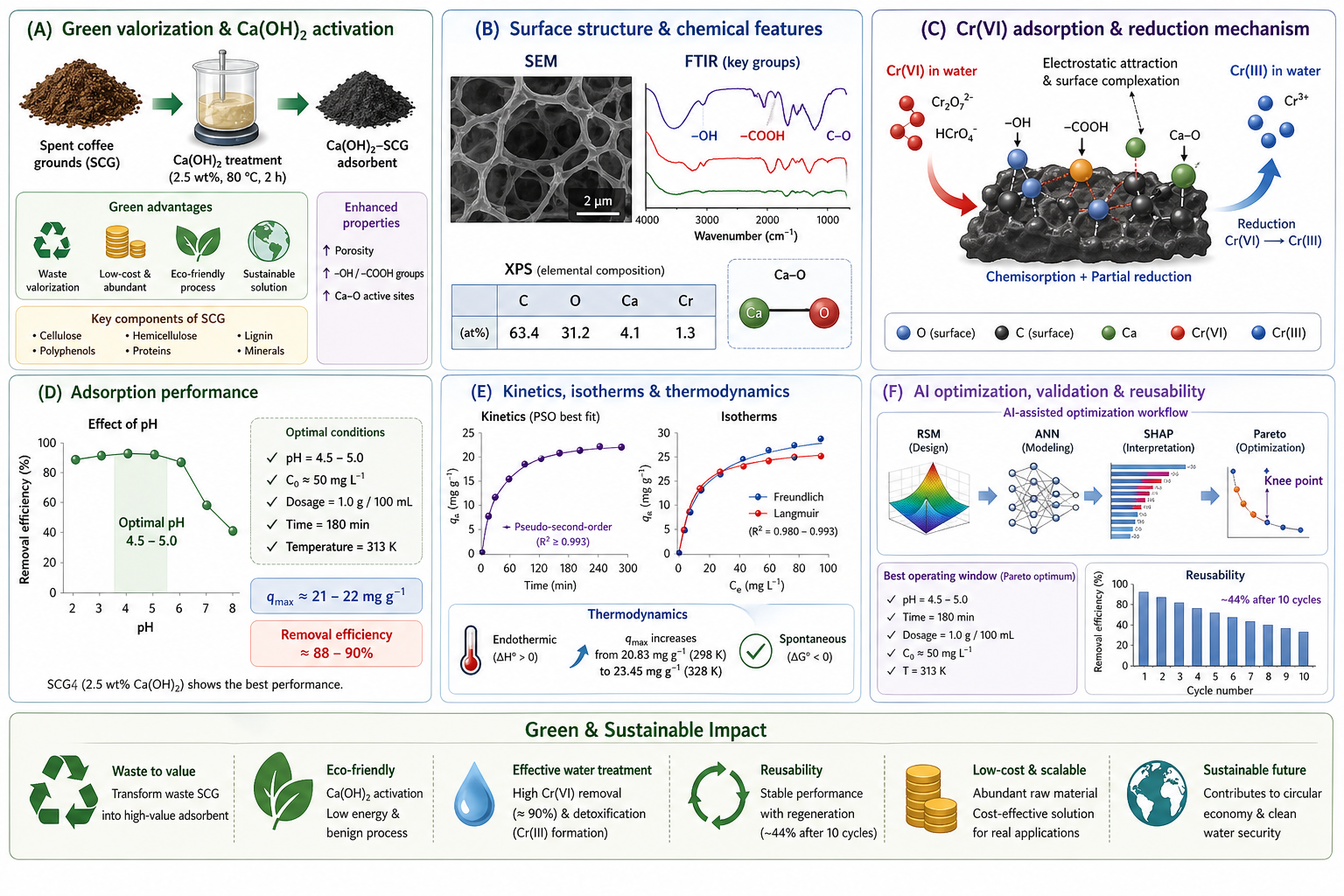
GRAPHICAL ABSTRACT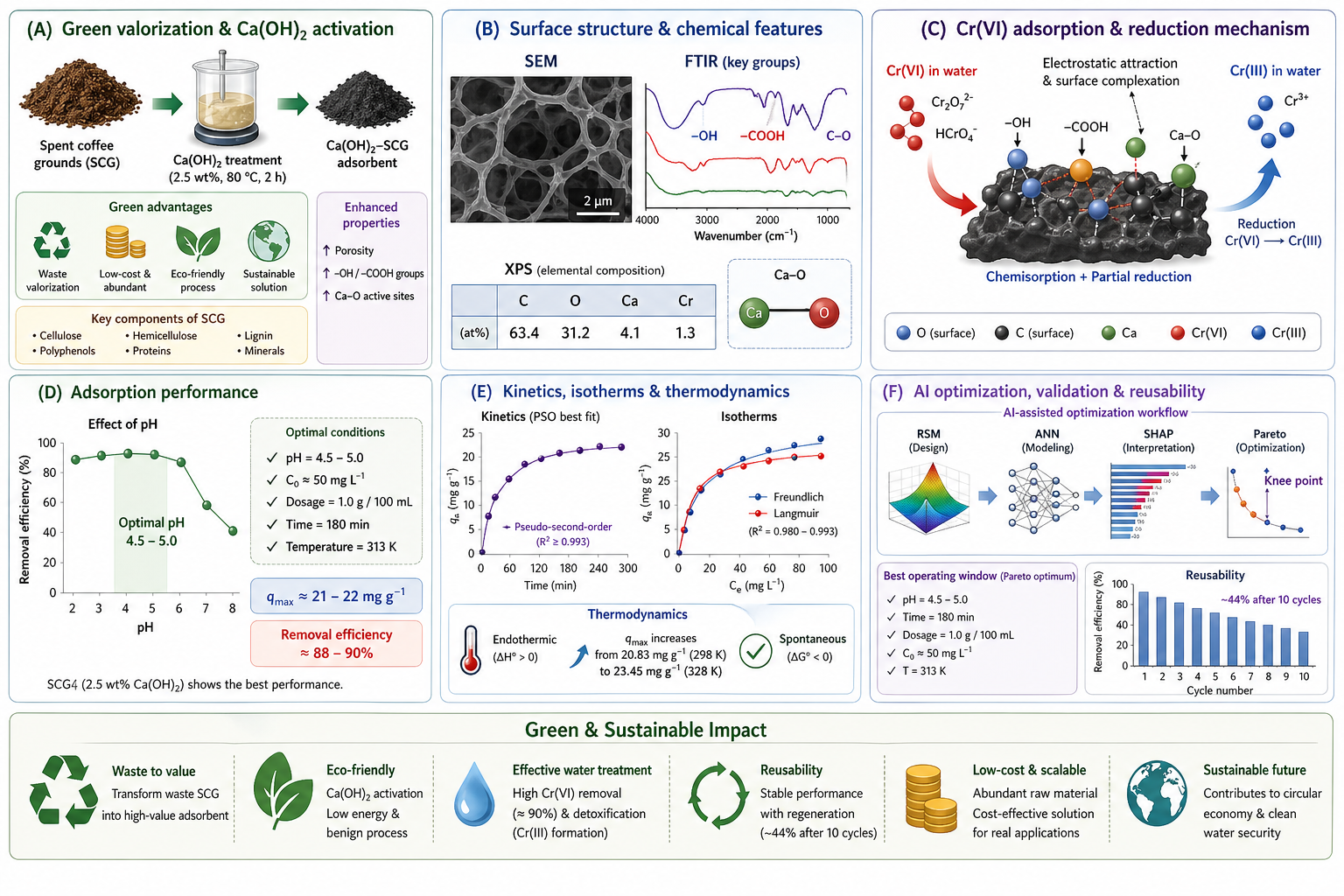
Downloads
References
I Loulidi, M Jabri, A Amar, A Kali, AA Alrashdi, C Hadey, M Ouchabi, PS Abdullah, H Lgaz, Y Cho and F Boukhlifi. Comparative study on adsorption of Crystal violet and Chromium (VI) by activated carbon derived from spent coffee grounds. Applied Sciences 2023; 13(2), 985.
A Kaur and S Sharma. Removal of heavy metals from waste water by using various adsorbents - a review. Indian Journal of Science and Technology 2017; 10(34), 117269.
W Cherdchoo, S Nithettham and J Charoenpanich. Removal of Cr(VI) from synthetic wastewater by adsorption onto coffee ground and mixed waste tea. Chemosphere 2019; 221, 758-767.
H Yazid, T Bouzid, EME Mouchtari, L Bahsis, ME Himri, S Rafqah and ME Haddad. Insights into the adsorption of Cr(VI) on activated carbon prepared from walnut shells: Combining response surface methodology with computational calculation. Clean Technologies 2024; 6(1), 199-220.
KZ Elwakeel, AM Elgarahy, ZA Khan, MS Almughamisi and AS Al-Bogami. Perspectives regarding metal/mineral-incorporating materials for water purification: With special focus on Cr(VI) removal. Materials Advances 2020; 1(6), 1546-1575.
I Loulidi, F Boukhlifi, M Ouchabi, A Amar, M Jabri, A Kali and C Hadey. Assessment of untreated coffee wastes for the removal of Chromium (VI) from aqueous medium. International Journal of Chemical Engineering 2021; 2021, 9977817.
K Mulani, S Daniels, K Rajdeo, S Tambe and N Chavan. Adsorption of Chromium(VI) from aqueous solutions by coffee polyphenol-formaldehyde/acetaldehyde resins. Journal of Polymers 2013; 2013, 798368.
BB Mathew, M Jaishankar, VG Biju and KN Beeregowda. Role of bioadsorbents in reducing toxic metals. Journal of Toxicology 2016; 2016, 4369604.
GVK Mohan, AN Babu, K Kalpana and K Ravindhranath. Removal of Chromium (VI) from water using adsorbent derived from spent coffee grounds. International Journal of Environmental Science and Technology 2019; 16, 101-112.
HB Mancilla, MR Cerrón, PG Aroni, JEP Paucar, CT Tovar, MK Jindal and G Gowrisankar. Effective removal of Cr(VI) ions using low-cost biomass leaves (Sambucus nigra L.) in aqueous solution. Environmental Science and Pollution Research 2023; 30, 106982-106995.
H Çelebi, G Gök and O Gök. Adsorption capability of brewed tea waste in waters containing toxic lead(II), cadmium(II), nickel(II), and zinc(II) heavy metal ions. Scientific Reports 2020; 10, 17570.
A Kebede, K Kedir, F Melak and TG Asere. Removal of Cr(VI) from aqueous solutions using biowastes: Tella residue and pea (Pisum sativum) seed shell. The Scientific World Journal 2022; 2022, 7554133.
M Tripathi, S Pathak, R Singh, P Singh, PK Singh, AK Shukla, S Maurya, S Kaur and B Thakur. A comprehensive review of lab-scale studies on removing hexavalent chromium from aqueous solutions by using unmodified and modified waste biomass as adsorbents. Toxics 2024; 12(9), 657.
Y Jiang, M Dai, F Yang, I Ali, I Naz and C Peng. Remediation of Chromium (VI) from groundwater by metal-based biochar under anaerobic conditions. Water 2022; 14(6), 894.
M Cheraghi, S Sobhanardakani, R Zandipak, B Lorestani and H Merrikhpour. Removal of Pb(II) from aqueous solutions using waste tea leaves. Iranian Journal of Toxicology 2015; 9(28), 1247-1253.
M Jalali and F Aboulghazi. Sunflower stalk, an agricultural waste, as an adsorbent for the removal of lead and cadmium from aqueous solutions. Journal of Material Cycles and Waste Management 2013; 15, 548-555.
DS Malik, CK Jain and AK Yadav. Removal of heavy metals from emerging cellulosic low-cost adsorbents: A review. Applied Water Science 2017; 7, 2113-2136.
DK Mondal, BK Nandi and MK Purkait. Removal of mercury(II) from aqueous solution using bamboo leaf powder: Equilibrium, thermodynamic and kinetic studies. Journal of Environmental Chemical Engineering 2013; 1(4), 891-898.
M Torab-Mostaedi, M Asadollahzadeh, A Hemmati and A Khosravi. Equilibrium, kinetic, and thermodynamic studies for biosorption of cadmium and nickel on grapefruit peel. Journal of the Taiwan Institute of Chemical Engineers 2013; 44(2), 295-302.
ZA Al-Othman, R Ali and M Naushad. Hexavalent chromium removal from aqueous medium by activated carbon prepared from peanut shell: Adsorption kinetics, equilibrium and thermodynamic studies. Chemical Engineering Journal 2012; 184, 238-247.
S Sugashini and KMMS Begum. Preparation of activated carbon from carbonized rice husk by ozone activation for Cr(VI) removal. New Carbon Materials 2015; 30(3), 252-261.
S Babel and TA Kurniawan. Cr(VI) removal from synthetic wastewater using coconut shell charcoal and commercial activated carbon modified with oxidizing agents and/or chitosan. Chemosphere 2004; 54(7), 951-967.
VK Gupta, A Rastogi and A Nayak. Adsorption studies on the removal of hexavalent chromium from aqueous solution using a low-cost fertilizer industry waste material. Journal of Colloid and Interface Science 2010; 342(1), 135-141.
EH Gora, SG Saldana, LM Casper, VC Sijercic, OA Giza and RL Sanders. Effect of exhausted coffee ground particle size on metal ion adsorption rates and capacities. ACS Omega 2022; 7(43), 38600-38612.
G Z Kyzas. Commercial coffee wastes as materials for adsorption of heavy metals from aqueous solutions. Materials 2012; 5, 1826–1840.
R Campbell, B Xiao and C Mangwandi. Production of activated carbon from spent coffee grounds (SCG) for removal of hexavalent chromium from synthetic wastewater solutions. Journal of Environmental Management 2024; 366, 121682.
I Loulidi, M Jabri, A Amar, A Kali, AA Alrashdi, C Hadey, M Ouchabi, PS Abdullah, H Lgaz, Y Cho and F Boukhlifi. Comparative study on adsorption of crystal violet and Chromium (VI) by activated carbon derived from spent coffee grounds. Applied Sciences 2023; 13(2), 985.
Y Hu, M Zhi, S Chen, W Lu, Y Lai and X Wang. Efficient removal of Cr(VI) by spent coffee grounds: Molecular adsorption and reduction mechanism. Korean Journal of Chemical Engineering 2022; 39(7), 1872-1879.
M Masuku, JF Nure, HI Atagana, N Hlongwa and TTI Nkambule. Pinecone biochar for the adsorption of Chromium (VI) from wastewater: Kinetics, thermodynamics, and adsorbent regeneration. Environmental Research 2024; 258, 119423.
H Wang, W Wang, S Zhou and X Gao. Adsorption mechanism of Cr(VI) on woody-activated carbons. Heliyon 2023; 9(2), 13267.
Y Fang, K Yang, Y Zhang, C Peng, A Robledo-Cabrera and A López-Valdivieso. Highly surface activated carbon to remove Cr(VI) from aqueous solution with adsorbent recycling. Environmental Research 2021; 197, 111151.
T Karthikeyan, S Rajgopal and LR Miranda. Chromium(VI) adsorption from aqueous solution by Hevea Brasiliensis sawdust activated carbon. Journal of Hazardous Materials 2005; 124(1-3), 192-199.
X Zhang, B Ren, X Wu, X Yan, Y Sun, H Gao and F Qu. Efficient removal of Chromium(VI) using a novel waste biomass chestnut shell-based carbon electrode by electrosorption. ACS Omega 2021; 6(39), 25389-25396.
H Liu, F Zhang and Z Peng. Adsorption mechanism of Cr(VI) onto GO/PAMAMs composites. Scientific Reports 2019; 9, 3663.
YS Ho and G McKay. Pseudo-second-order model for sorption processes. Process Biochemistry 1999; 34(5), 451-465.
I Langmuir. The adsorption of gases on plane surfaces of glass, mica and platinum. Journal of the American Chemical Society 1918; 40(9), 1361-1403.
H Patel. Fixed-bed column adsorption study: A comprehensive review. Applied Water Science 2019; 9, 45.
MMA Aslam, W Den and HW Kuo. Removal of hexavalent chromium by encapsulated chitosan-modified magnetic carbon nanotubes: Fixed-bed column study and modelling. Journal of Water Process Engineering 2021; 42, 102143.
M Kebir, H Tahraoui, M Chabani, M Trari, N Noureddine, AA Assadi, A Amrane, NB Hamadi and L Khezami. Water cleaning by a continuous fixed-bed column for Cr(VI) eco-adsorption with green adsorbent-based biomass: An experimental modeling study. Processes 2023; 11(2), 363.
X Guo, A Liu, J Lu, X Niu, M Jiang, Y Ma, X Liu and M Li. Adsorption mechanism of hexavalent chromium on biochar: Kinetic, thermodynamic, and characterization studies. ACS Omega 2020; 5(42), 27323-27331.
DK Nguyen, QB Ly-Tran, VP Dinh, BN Duong, TPT Nguyen and PNK Tuyen. Adsorption mechanism of aqueous Cr(vi) by Vietnamese corncob biochar: A spectroscopic study. RSC Advances 2024; 14(53), 39205-39218.
Tuan Anh Nguyen, Thi Huong Nguyen, Doan Thi Yen Oanh, Thi Thu Phuong Nguyen, Thi Thu Giang Pham, Minh Viet Nguyen, Ngoc Thanh Nguyen. Sustainable valorization of recycled coffee grounds into high-performance bio-adsorbents for efficient Cr(VI) removal. Vietnam Journal of Chemistry 2026; 2026.
Y Hu, M Zhi, S Chen, W Lu, Y Lai and X Wang. Efficient removal of Cr(VI) by spent coffee grounds: Molecular adsorption and reduction mechanism. Korean Journal of Chemical Engineering 2022; 39(7), 1872-1879.
Published
How to Cite
Issue
Section
License
Copyright (c) 2026 Walailak University

This work is licensed under a Creative Commons Attribution-NonCommercial-NoDerivatives 4.0 International License.





