
New AIE+ESIPT β-Naphthol Azine-based Chemosensor of Cu2+ ions, An Experimental and In Silico Analysis
DOI:
https://doi.org/10.48048/tis.2025.11063Keywords:
AIE, Chemosensor, DFT, ESIPT, Fluorescence, β-naphthol, AIE, Chemosensor, DFT, ESIPT, Fluorescence, β-naphtholAbstract
A straightforward imine condensation reaction successfully yielded a novel and promising fluorescent chemosensor for Cu2+ ions, derived from the β-naphthol azine moiety, with a 26% chemical yield of a yellowish solid. Subsequent spectroscopic analyses employing FTIR, ToF-HRMS, 1H-NMR, and 13C-NMR elucidated the structure as 1-((((4-bromothiophen-2-yl)methylene)hydrazono)methyl)naphthalen-2-ol (1). The photophysical properties of the compound were characterized by a maximum UV/Visible absorption in a DMF:H2O (1:9, v/v, c: 1.0×10⁻⁵ mol dm-3) at 414 nm (ε: 6.80×10³ mol-1 dm3 cm-1) and emission at 565 nm (λex 360 nm), exhibiting a significant Stokes shift of 151 nm. Furthermore, at elevated concentrations (1.0×10⁻⁴ mol dm-3), the compound exhibited aggregation-induced emission (AIE) in response to increased water content in the organic solvent mixtures. The compound functioned as a moderately reversible on-off chemosensor for Cu2+, demonstrating a 1:1 molar ratio binding mode and a 96% quenching efficiency ((ϕem of 1 = 0.252 ± 0.030; 1+Cu2+ = 0.012 ± 0.004), as determined by a sensing experiment of 1 against various cations in DMF:H2O (1:9, v/v). The Limits of Detection (LoD) and Quantification (LoQ) for 1 against Cu2+ ions were identified as 0.606 µM and 1.836 µM, respectively. Additionally, computational studies utilizing DFT and TD-DFT, accompanied by frontier molecular orbital (FMO) analysis, confirmed the presence of excited-state intramolecular proton transfer (ESIPT) in 1, which was further inhibited upon chelation with Cu2+ ions.
HIGHLIGHTS
- Aggregation-induced emission (AIE) of Schiff base b-naphthol azine
- A prominent Stokes shift probe (151 nm)
- Cu2+ ions chemosensor in an aqueous system
- ESIPT Inhibition of Cu2+ ions chemosensor
- Chelating quenched fluorescence (CHQF) chemosensor (Dϕem = 96%)
GRAPHICAL ABSTRACT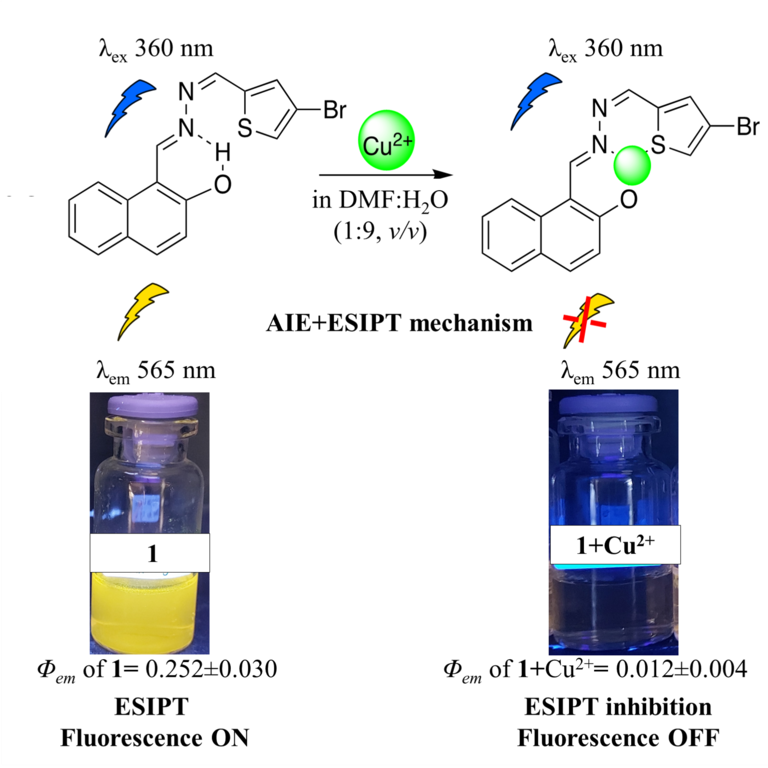
Downloads
References
NA Al-Rawashdeh. Current achievement and future potential of fluorescence spectroscopy. In: J Uddin (Ed.). Macro to nano spectroscopy. InTech, Rijeka, Croatia, 2012, pp. 209-250.
JMR Antoine, LAH Fung, CN Grant, HT Dennis and GC Lalor. Dietary intake of minerals and trace elements in rice on the Jamaican market. Journal of Food Composition and Analysis 2012; 26(1-2), 111-121.
YW Choi, GJ Park, YJ Na, HY Jo, SA Lee, GR You and C Kim. A single schiff base molecule for recognizing multiple metal ions: A fluorescence sensor for Zn(II) and Al(III) and colorimetric sensor for Fe(II) and Fe(III). Sensors & Actuators: B. Chemical 2014; 194, 343-352.
Y Jeong and J Yoon. Recent progress on fluorescent chemosensors for metal ions. Inorganica Chimica Acta 2012; 381, 2-14.
X Chen, T Pradhan, F Wang, JS Kim and J Yoon. Fluorescent chemosensors based on spiroring-opening of xanthenes and related derivatives. Chemical Reviews 2012; 112(3), 1910-1956.
MA Barakat. New trends in removing heavy metals from industrial wastewater. Arabian Journal of Chemistry 2011; 4(4), 361-377.
D Wu, A Sedgwick, T Gunnlaugsson, EU Akkaya, J Yoon and TD James. Fluorescent chemosensors: The past, present and future. Chemical Society Reviews 2017; 46(23), 7105-7123.
S Mitra, A Jyoti, A Montakim, T Bin, F Nainu, A Khusro, AM Idris, M Uddin, H Osman, FA Alhumaydhi and J Simal-gandara. Impact of heavy metals on the environment and human health: Novel therapeutic insights to counter the toxicity. Journal of King Saud University - Science 2022; 34(3), 101865.
S Sakunkaewkasem, A Petdum, W Panchan, J Sirirak, A Charoenpanich, T Sooksimuang and N Wanichacheva. Dual-Analyte fluorescent sensor based on [5]Helicene derivative with super large stokes shift for the selective determinations of Cu2+ or Zn2+ in buffer solutions and its application in a living cell. ACS Sensors 2018; 3(5), 1016-1023.
S Wang, Z Sheng, Z Yang, D Hu, X Long, G Feng, Y Liu, Z Yuan, J Zhang, H Zheng and X Zhang. Activatable small-molecule photoacoustic probes that cross the Blood-Brain barrier for visualization of Copper(II) in mice with alzheimer’s disease. Angewandte Chemie - International Edition 2019; 58(36), 12415-12419.
J Sackey, M Akbari, N Tandjigora, KJ Cloete, AKH Bashir, R Morad and M Maaza. Science Industrial textile removal using date pit assisted CuO-MgO nanocomposite: Molecular dynamics and biosynthesis analysis. Journal of King Saud University - Science 2022; 34(3), 101840.
PB Tchounwou, CG Yedjou, AK Patlolla and DJ Sutton. Heavy metal toxicity and the environment. Molecular, Clinical and Environmental Toxicology 2012; 101 133-164.
GK Kinuthia, V Ngure, D Beti, R Lugalia, A Wangila and L Kamau. Levels of heavy metals in wastewater and soil samples from open drainage channels in Nairobi, Kenya: Community health implication. Scientific Reports 2020; 10, 8434.
I Abdulazeez, C Basheer and AA Al-Saadi. A selective detection approach for Copper(II) ions using a hydrazone-based colorimetric sensor: Spectroscopic and DFT study. RSC Advances 2018; 8(70), 39983-39991.
Y Lu, X Liang, C Niyungeko, J Zhou, J Xu and G Tian. A review of the identification and detection of heavy metal ions in the environment by voltammetry. Talanta 2018; 178 324-338.
M Shaban, AGA Hady and M Serry. A new sensor for heavy metals detection in aqueous media. IEEE Sensors Journal 2014; 14(2), 436-441.
ZY Li, HK Su, K Zhou, BZ Yang, T Xiao, XQ Sun, J Jiang and L Wang. Oxo-spirocyclic structure bridged ditopic Schiff base: A turn-on fluorescent probe for selective recognition of Zn(II) and its application in biosensing. Dyes and Pigments 2018; 149, 921-926.
S Kim, H Lee, H So, H Lee, KT Kim and C Kim. A benzyl carbazate-based fluorescent chemosensor for detecting Zn2+: Application to zebrafish. Spectrochimica Acta - Part A: Molecular and Biomolecular Spectroscopy 2020; 228, 117787.
F Liu, C Fan, Y Tu and S Pu. A new fluorescent and colorimetric chemosensor for Al3+ and F−/CN− based on a julolidine unit and its bioimaging in living cells. RSC Advances 2018; 8(54), 31113-31120.
S Velmathi, V Reena, S Suganya and S Anandan. Pyrrole based schiff bases as colorimetric and fluorescent chemosensors for fluoride and hydroxide anions. Journal of Fluorescence 2012; 22(1), 155-162.
B Naskar, R Modak, Y Sikdar, DK Maiti, A Bauza, A Frontera, A Katarkar, K Chaudhuri and S Goswami. Fluorescent sensing of Al3+ by benzophenone based Schiff base chemosensor and live cell imaging applications: Impact of keto-enol tautomerism. Sensors and Actuators, B: Chemical 2017; 239, 1194-1204.
H Han and D Pan. Voltammetric methods for speciation analysis of trace metals in natural waters. Trends in Environmental Analytical Chemistry 2021; 29, 00119.
Y Guo, H Zhao, Y Han, X Liu, S Guan, Q Zhang and X Bian. Simultaneous spectrophotometric determination of trace copper, nickel, and cobalt ions in water samples using solid phase extraction coupled with partial least squares approaches. Spectrochimica Acta Part A: Molecular and Biomolecular Spectroscopy 2017; 173, 532-536.
B Fernandez, L Lobo and R Pereiro. Atomic ab-sorpton spectrometry | fundamentals, instrumen¬tation and capabilities. 3rd ed. Elsevier Inc, New York, 2019, p. 137-143.
SLC Ferreira, MA Bezerra, AS Santos, WNL dos Santos, CG Novaes, OMC de Oliveira, ML Oliveira and RL Garcia. Atomic absorption spectrometry - A multi element technique. TrAC - Trends in Analytical Chemistry 2018; 100, 1-6.
D Plausinaitis, B Knasiene, CA Vicent, P Aleksandr and N Evaldas. Simultaneous detection of Mn, Co, Ni, and Cu using ion chromatography coupled with ICP-MS with a special focus on the determination of 59Ni in corrosion deposits. Journal of Radioanalytical and Nuclear Chemistry 2018; 316(1), 257-265.
E Munoz and S Palmero. Determination of heavy metals in milk by potentiometric stripping analysis using a home-made flow cell. Food Control 2004; 15(8), 635-641.
J Zhang, L Xu and WY Wong. Energy materials based on metal Schiff base complexes. Coordination Chemistry Reviews 2018; 355, 180-198.
M Lin, MS Cho, WS Choe and Y Lee. Electrochemical analysis of copper ion using a Gly–Gly–His tripeptide modified poly(3-thiopheneacetic acid) biosensor. Biosensors and Bioelectronics 2009; 25(1), 28-33.
YZ Peng, YM Huang, DX Yuan, Y Li and ZB Gong. Rapid analysis of heavy metals in coastal seawater using preconcentration with precipitation/co-precipitation on membrane and detection with X-ray fluorescence. Chinese Journal of Analytical Chemistry 2012; 40(6), 877-882.
LA Hutton, GD O’Neil, TL Read, ZJ Ayres, ME Newton and JV Macpherson. Electrochemical X-ray fluorescence spectroscopy for trace heavy metal analysis: Enhancing X-ray fluorescence detection capabilities by four orders of magnitude. Analytical Chemistry 2014; 86(9), 4566-4572.
S Griesel, U Reus and A Prange. Electro-deposition as a sample preparation technique for total-reflection x-ray fluorescence analysis. Spectrochimica Acta Part B: Atomic Spectroscopy 2001; 56(11), 2107-2115.
Q Fan and Y Gohshi. Enhancement of total reflection X-Ray fluorescence spectroscopy with electrochemical deposition. Applied Spectroscopy 1993; 47(11), 1742-1746.
B Zawisza and R Sitko. Electrochemically assisted sorption on oxidized multiwalled carbon nanotubes for preconcentration of Cr, Mn, Co, Ni, Cu and Zn from water samples. Analyst 2013; 138(8), 2470-2476.
F Zhao, Z Chen, F Zhang, R Li and J Zhou. Ultra-sensitive detection of heavy metal ions in tap water by laser-induced breakdown spectroscopy with the assistance of electrical-deposition. Analytical Methods 2010; 2(4), 408-414.
Z Chen, H Li, F Zhao and R Li. Ultra-sensitive trace metal analysis of water by laser-induced breakdown spectroscopy after electrical-deposition of the analytes on an aluminium surface. Journal of Analytical Atomic Spectrometry 2008; 23(6), 871-875.
C Guo, J Wang, J Cheng and Z Dai. Determination of trace copper ions with ultrahigh sensitivity and selectivity utilizing CdTe quantum dots coupled with enzyme inhibition. Biosensors and Bioelectronics 2012; 36(1), 69-74.
PG Mahajan, NC Dige, BD Vanjare, E Kamaraj, SY Seo and KH Lee. Nano molar level chromogenic and fluorogenic sensing of heavy metal ions using multi-responsive novel Schiff base as a dual mode chemosensor. Journal of Photochemistry and Photobiology A: Chemistry 2019; 385, 112089.
A Kundu, PS Hariharan, K Prabakaran and SP Anthony. Synthesis of new colori/fluorimetric chemosensor for selective sensing of biologically important Fe3+, Cu2+ and Zn2+ metal ions. Spectrochimica Acta Part A: Molecular and Biomolecular Spectroscopy 2015; 151, 426-431.
YL Liu, L Yang, P Li, SJ Li, L Li, XX Pang, F Ye and Y Fu. A novel colorimetric and “turn-off” fluorescent probe based on catalyzed hydrolysis reaction for detection of Cu2+ in real water and in living cells. Spectrochimica Acta Part A: Molecular and Biomolecular Spectroscopy 2020; 227, 117540.
MAFA Manan and MF Mohammat. Synthesis, structural studies and antimicrobial evaluation of Nickel(II) bis-complex of schiff base of S-Benzyldithiocarbazate. Trends in Sciences 2022; 19(23), 1500.
J Wu, W Liu, J Ge, H Zhang and P Wang. New sensing mechanisms for design of fluorescent chemosensors emerging in recent years. Chemical Society Reviews 2011; 40(7), 3483-3495.
K Mohammadiannejad, R Ranjbar-karimi and F Haghighat. Synthesis of azine- and hydrazone-based triarylmethanes. Polycyclic Aromatic Compounds 2019; 41(3), 1-12.
MAFA Manan and DB Cordes. Cadmium(II) schiff base complex containing 5-Fluoroisatin moiety: Synthesis, Characterization, Antibacterial Activity and Structural Studies. Trends in Sciences 2022; 19(18), 5796.
A Gupta, N Kumar, A review of mechanisms for fluorescent “turn-on” probes to detect Al3+ ions. RSC Advances 2016; 6(108), 106413-106434.
R Kaur, R Kour, SS Marok and S Kaur. AIE+ESIPT active hydroxybenzothiazole for intracellular detection of Cu2+: anticancer and anticounterfeiting applications. Molecules 2022; 27(8), 7678.
X Wang, L Xu, H Gao and J Song. Construction of dehydroabietic acid triarylamine-based “ESIPT + AIE” type molecule for “On-Off” sensing of Cu2+ and anti-counterfeiting. Journal of Photochemistry and Photobiology A: Chemistry 2025; 469, 116565.
W Guo, Y Zhang, Y Wang, Z Hu, P Xu, J Cai, P Yu, S Chen, L Zhang, B Wei, J Zhang, S Li, H Wang and L Chen. A water-soluble fluorescent probe derived from fish collagen peptides for multi-targeted detection of Cu2+ and Zn2+ ions via AIE and ESIPT mechanisms. Microchemical Journal 2025; 215, 114313.
S Su and H Fang. Theoretical investigation on the ESIPT mechanism and fluorescent sensing mechanism of 2-(2′-hydroxyphenyl) thiazole-4-carboxaldeyde in methanol. Spectrochimica Acta - Part A: Molecular and Biomolecular Spectroscopy 2020; 233, 118214.
H Ibraheem, G El-Hiti, E Yousif, D Ahmed, B Kariuki, S Ismael and M Bufaroosha. Enhancing photostability of chemically modified Poly(Vinyl Chloride) through the incorporation of organotin moieties on the polymeric chains. Trends in Sciences 2025; 22(4), 9413.
J Al-Anshori, D Ismalah, AF Abror, A Zainuddin, IW Hidayat, M Yusuf, R Maharani and AT Hidayat. A new highly selective “off-on” typical chemosensor of Al3+, 1-((Z)-((E)-(3,5-dichloro-2-hydroxybenzylidene)hydrazono)methyl) naphthalene-2-ol, an experimental and in silico study. RSC Advances 2022; 12(5), 2972-2979.
J Jayabharathi, V Thanikachalam, M Vennila and K Jayamoorthy. Potential fluorescent chemosensor based on L-tryptophan derivative: DFT based ESIPT process. Spectrochimica Acta - Part A: Molecular and Biomolecular Spectroscopy 2012; 95, 446-451.
AA Jamaludin, M Aenal, HI Wiani, Z Achmad and HA Tatang. Synthesis and ESIPT phenomena of a new β-Naphthol derivative, an experimental and in silico study. Research Journal of Chemistry and Environment 2022; 26(8), 88-97.
MJ Frisch, GW Trucks, HB Schlegel, GE Scuseria, MA Robb, JR Cheeseman, G Scalmani, V Barone, GA Petersson, H Nakatsuji, X Li, M Caricato, AV Marenich, J Bloino, BG Janesko, R Gomperts, B Mennucci, HP Hratchian, JV Ortiz, AF Izmaylov, …, DJ Fox. Gaussian 16. Revision C.01. Expanding the limits of computational chemistry, United States, 2016.
YT Male, IW Sutapa, IB Kapelle and M Lopulalan. Qsar modeling and design of a new model of anti-hiv drug 1-aryl-tetrahydroisoquinoline derived using the PM3 semiempirical method. Rasayan Journal of Chemistry 2022; 15(1), 359-368.
Z Yu, Y Duan, L Cheng, Z Han, Z Zheng, H Zhou, J Wu and Y Tian. Aggregation induced emission in the rotatable molecules: The essential role of molecular interaction. Journal of Materials Chemistry 2012; 22(33), 16927-16932.
S Guieu, F Cardona, J Rocha and AMS Silva. Tunable color of aggregation-induced emission enhancement in a family of hydrogen-bonded azines and schiff bases samuel. Chemistry - A European Journal 2018; 24(65), 17262-17267.
J-S Chen, P-W Zhou, L Zhao and T-S Chu. A DFT/TDDFT study of the excited state intramolecular proton transfer based sensing mechanism for the aqueous fluoride chemosensor BTTPB. RSC Advances 2014; 4(1), 254-259.
YT Male, I Wayan Sutapa and OM Ranglalin. Computational study natural color essence (Dyes) as active material on organic solar cell with Density Functional Theory (DFT). Indonesian Journal of Chemical Research 2015; 2(2), 205-212.
R Hadanu, S Idris and IW Sutapa. QSAR analysis of benzothiazole derivatives of antimalarial compounds based on AM1 semi-empirical method. Indonesian Journal of Chemistry 2015; 15(1), 86-92.
R Hadanu, L Adelin and IW Sutapa. Qsar studies of nitrobenzothiazole derivatives as antimalarial agents. Makara Journal of Science 2018; 22(1), 35-41.
IW Sutapa, R Armunanto and K Wijaya. EFFECT of scandium on hidrogen dissociation energy at magnesium surface: Ab initio dft study. Indonesian Journal of Chemistry 2010; 10(2), 184-188.
PJ Hay and WR Wadt. Ab initio effective core potentials for molecular calculations. Potentials for K to Au including the outermost core orbitale. The Journal of Chemical Physics 1985; 82(1), 299-310.
PJ Hay and WR Wadt. Ab initio effective core potentials for molecular calculations. Potentials for the transition metal atoms Sc to Hg. The Journal of Chemical Physics 1985; 82(1), 270-283.
WR Wadt and PJ Hay. Ab initio effective core potentials for molecular calculations. Potentials for main group elements Na to Bi. The Journal of Chemical Physics 1985; 82(1), 284-298.
S Khan, M Muhammad, HM Al-Saidi, AA Hassanian, W Alharbi and KH Alharbi. Synthesis, characterization and applications of schiff base chemosensor for determination of Cu2+ ions. Journal of Saudi Chemical Society 2022; 26(4), 101503.
Y He, J Yin and G Wang. New selective “on-off” fluorescence chemosensor based on carbazole Schiff base for Fe3+ detection. Chemistry of Heterocyclic Compounds 2018; 54(2), 146-152.
KC Tayade, AS Kuwar, UA Fegade, H Sharma, N Singh, UD Patil and SB Attarde. Design and synthesis of a pyridine based chemosensor: Highly selective fluorescent probe for Pb2+. Journal of Fluorescence 2014; 24(1), 19-26.
A Kumar, Virender, N Kumar, A Chauhan and B Mohan. A reversible Schiff base chemosensor for the spectroscopic and colorimetric sensing of Eu3+ ions in solution and solid-state. Inorganica Chimica Acta 2024; 560, 121833.
P Yadav, S Gond, A Singh and VP Singh. Development of a reversible chromogenic sensor for Cu2+ in aqueous ethanol. Materials Letters 2021; 295, 129869.
A Kumar, Virender, B Mohan, AA Solovev, M Saini and HK Sharma. Development of 2-hydroxy-naphthaldehyde functionalized Schiff base chemosensor for spectroscopic and colorimetric detection of Cu2+ and Pd2+ ions. Microchemical Journal 2022; 180, 107561.
T Zhong, X Wang, C Li, J Xiu, Y Chen and G Wang. A single fluorescent chemosensor for detecting Ag+ ion in DMF and common trivalent metal ions in ethanol. Journal of Molecular Structure 2023; 1294, 136436.
A Brouwer. Standards for photoluminescence quantum yield measurements in solution (IUPAC Technical Report)*. Pure and Applied Chemistry 2011; 83, 2213-2228.
MP Andersson and P Uvdal. New scale factors for harmonic vibrational frequencies using the B3LYP density functional method with the triple-ζ basis Set 6-311+G(d,p). Journal of Physical Chemistry A 2005; 109(12), 2937-2941.
AA Benjamine, K Mawa, AL Laye, BA Lucie, K Soleymane, NB Robert, BEH Sawaliho and NY Thomas. Density functional theory (B3LYP/6-311+G(d, p)) study of stability, tautomerism and acidity of 2-Thioxanthine in gas and aqueous phases. International Journal of Computational and Theoretical Chemistry 2019; 7(1), 49.
C Chiter, A Bouchama, T Nardjes, H Allal, M Yahiaoui, I Warad, A Zarrouk and A Djedouani. Synthesis, crystal structure, spectroscopic and hirshfeld surface analysis, NCI-RDG, DFT computations and antibacterial activity of new asymmetrical azines. Journal of Molecular Structure 2020; 1217, 128376.
J Al-Anshori, AF Abror, J Juliandri, A Safari and AT Hidayat. In Silico DFT (Density Functional Theory) study of chemosensor selectivity of 3-Oxo-3H-Benzo[f]chromen-2-Carboxylic acid (ABKK) on sodium metal ion using FMO (Frontier Molecular Orbital) analysis. Jurnal Kimia Sains Dan Aplikasi 2023; 26(8), 318-323.
T Keawwangchai, N Morakot and B Wanno. Fluorescent sensors based on BODIPY derivatives for aluminium ion recognition: An experimental and theoretical study. Journal of Molecular Modeling 2013; 19(3), 1435-1444.
M Mathivanan, B Tharmalingam, CH Lin, BV Pandiyan, V Thiagarajan and B Murugesapandian. ESIPT-active multi-color aggregation-induced emission features of triphenylamine–salicylaldehyde-based unsymmetrical azine family. CrystEngComm 2019; 22(2), 213-228.
PE Hansen and J Spanget-Larsen. NMR and IR investigations of strong intramolecular hydrogen bonds. Molecules 2017; 22(4), 552.
P Charisiadis, VG Kontogianni, CG Tsiafoulis, AG Tzakos, M Siskos and IP Gerothanassis. 1H-NMR as a structural and analytical tool of intra- and intermolecular hydrogen bonds of phenol-containing natural products and model compounds. Molecules 2014; 19(9), 13643-13682.
A Mohammadi and J Jabbari. Simple naked-eye colorimetric chemosensors based on Schiff-base for selective sensing of cyanide and fluoride ions. Canadian Journal of Chemistry 2016; 94(7), 631-636.
S Kapoor, C Gopinathan, HS Mahal and RM Iyer. The fluorescence of tryptophan in N,N-dimethylformamide-water mixtures. Chemical Physics Letters 1989; 163(2), 135-139.
T Mudalige, H Qu, D Van Haute, SM Ansar, A Paredes and T Ingle. Chapter 11 - Characterization of nanomaterials: Tools and Challenges. Nanomaterials for Food Applications Micro and Nano Technologies 2019; 1, 313-353.
M Tajbakhsh, GB Chalmardi, A Bekhradnia, R Hosseinzadeh, N Hasani and MA Amiri. A new fluorene-based Schiff-base as fluorescent chemosensor for selective detection of Cr3+ and Al3+. Spectrochimica Acta - Part A: Molecular and Biomolecular Spectroscopy 2018; 189(15), 22-31.
MJ Kamlet, JL M Abboud, MH Abraham and RW Taft. Linear solvation energy relationships. 23. A comprehensive collection of the solvatochromic parameters, π.*, α, and β, and some methods for simplifying the generalized solvatochromic equation. The Journal of Organic Chemistry 1983; 48(17), 2877-2887.
VS Padalkar and S Seki. Excited-state intramolecular proton-transfer (ESIPT)-inspired solid state emitters. Chemical Society Reviews 2016; 45(1), 169-202.
J Zhao, S Ji, Y Chen, H Guo and P Yang. Excited state intramolecular proton transfer ( ESIPT ): from principal photophysics to the development of new chromophores and applications in fluorescent molecular probes and luminescent materials. Physical Chemistry Chemicsl Physics 2012; 14, 8803-8817.
P Piyanuch, S Wangngae, A Kamkaew, W Wattanathana, S Wannapaiboon, S Impeng, W Maneeprakorn, V Promarak and K Chansaenpak. Ultrasensitive fluorogenic chemosensor based on ESIPT phenomenon for selective determination of Cu2+ ion in aqueous system and its application in environmental samples and biological imaging. Dyes and Pigments 2022; 205, 110532.
J Mei, NLC Leung, RTK Kwok, JWY Lam and BZ Tang. Aggregation-Induced emission : Together we shine , united we soar ! 2015; 115(21), 11718-11940.
EM Santos, W Sheng, RE Salmani, ST Nick, A Ghanbarpour, H Gholami, C Vasileiou, JH Geiger and B Borhan. Design of large stokes shift fluorescent proteins based on excited state proton transfer of an engineered photobase. Journal of the American Chemical Society 2021; 143(37), 15091-15102.
F Kaspar. Quality data from messy spectra: How isometric points increase information content in highly overlapping spectra. ChemBioChem 2023; 24(7), 202200744.
B Pramanik and D Das. Aggregation-Induced emission or hydrolysis by water? The case of schiff bases in aqueous organic solvents. The Journal of Physical Chemistry C 2018; 122(6), 3655-3661.
VS Padalkar and S Seki. Excited-state intramolecular proton-transfer (ESIPT)-inspired solid state emitters. Chemical Society Reviews 2016; 45(1), 169-202.
KS Jagadhane, SR Bhosale, DB Gunjal, OS Nille, GB Kolekar, SS Kolekar, TD Dongale and PV Anbhule. Tetraphenylethene-based fluorescent chemosensor with mechanochromic and Aggregation-Induced Emission (AIE) properties for the selective and sensitive detection of Hg2+ and Ag+ ions in aqueous media: Application to environmental analysis. ACS Omega 2022; 7(39), 34888-34900.
H Wang, L Da, L Yang, S Chu, F Yang, S Yu and C Jiang. Colorimetric fluorescent paper strip with smartphone platform for quantitative detection of cadmium ions in real samples. Journal of Hazardous Materials 2020; 392, 122506.
A Samokhvalov. Analysis of various solid samples by synchronous fluorescence spectroscopy and related methods: A review. Talanta 2020; 216, 120944.
YK Zhang, N Wang, FT Wang, WF Zhou, YZ Zhang, M Yang, Z Li, L Geng, DS Zhang, S Zhuang and X Zhang. Solvent induced synthesis of fluorescence Zn(II)-based metal–organic frameworks with distinctive responsiveness to DMF stimuli. Polyhedron 2024; 258, 117057.
D Aydin. Sensing of aluminum and cyanide ions utilizing a novel bis-phenol a based fluorogenic probe: Applications in test stripts. Microchemical Journal 2020; 159, 105477.
J Cheng, Y Li, Z Zhu, H Guan, J Zhai, Y Xiang and M Wang. A simple and rapid “Turn-On” fluorescent probe based on binuclear schiff base for Zn2+ and its application in cell imaging and test strips. Molecules 2024; 29(24), 5850.
X Liu, J Zhao and Y Zheng. Insight into the excited-state double proton transfer mechanisms of doxorubicin in acetonitrile solvent. RSC Advances 2017; 7(81), 51318-51323.
B An, S Feng, K Wen, W Wu, H Yuan, Q Zhu, X Guo and J Zhang. Theoretical insights into the ultrafast excited-state intramolecular proton transfer (ESIPT) mechanism in a series of amide-based NH⋯N hydrogen-bonding compounds. Organic Electronics 2017; 45, 1-8.
G Yang, X Jin, K Chen and D Yang. Uncovering the excited state trends and ESIPT mechanism for 2-(hydroxy-3-dimethyl-phenyl)-benzooxazole-6-carboxylicacid. Chemical Physics Letters 2019; 736, 136815.
S Lee, J Lee and Y Pang. Excited state intramolecular proton transfer of 1,2-dihydroxyanthraquinone by femtosecond transient absorption spectroscopy. Current Applied Physics 2015; 15(11), 1492-1499.
B Gierczyk, SS Murphree, MF Rode and G Burdzinski. Blockade of persistent colored isomer formation in photochromic 3H-naphthopyrans by excited-state intramolecular proton transfer. Scientific Reports 2022; 12, 19159.
Published
How to Cite
Issue
Section
License
Copyright (c) 2025 Walailak University

This work is licensed under a Creative Commons Attribution-NonCommercial-NoDerivatives 4.0 International License.





