
Optimized Microencapsulation of Citrus aurantiifolia Peel Extract for Breast Cancer Therapy: In Silico-Supported Approach
DOI:
https://doi.org/10.48048/tis.2025.10929Keywords:
Citrus aurantiifolia, In silico, Optimization, Microencapsulation, Complex coacervation, Breast cancer, Adjuvant therapyAbstract
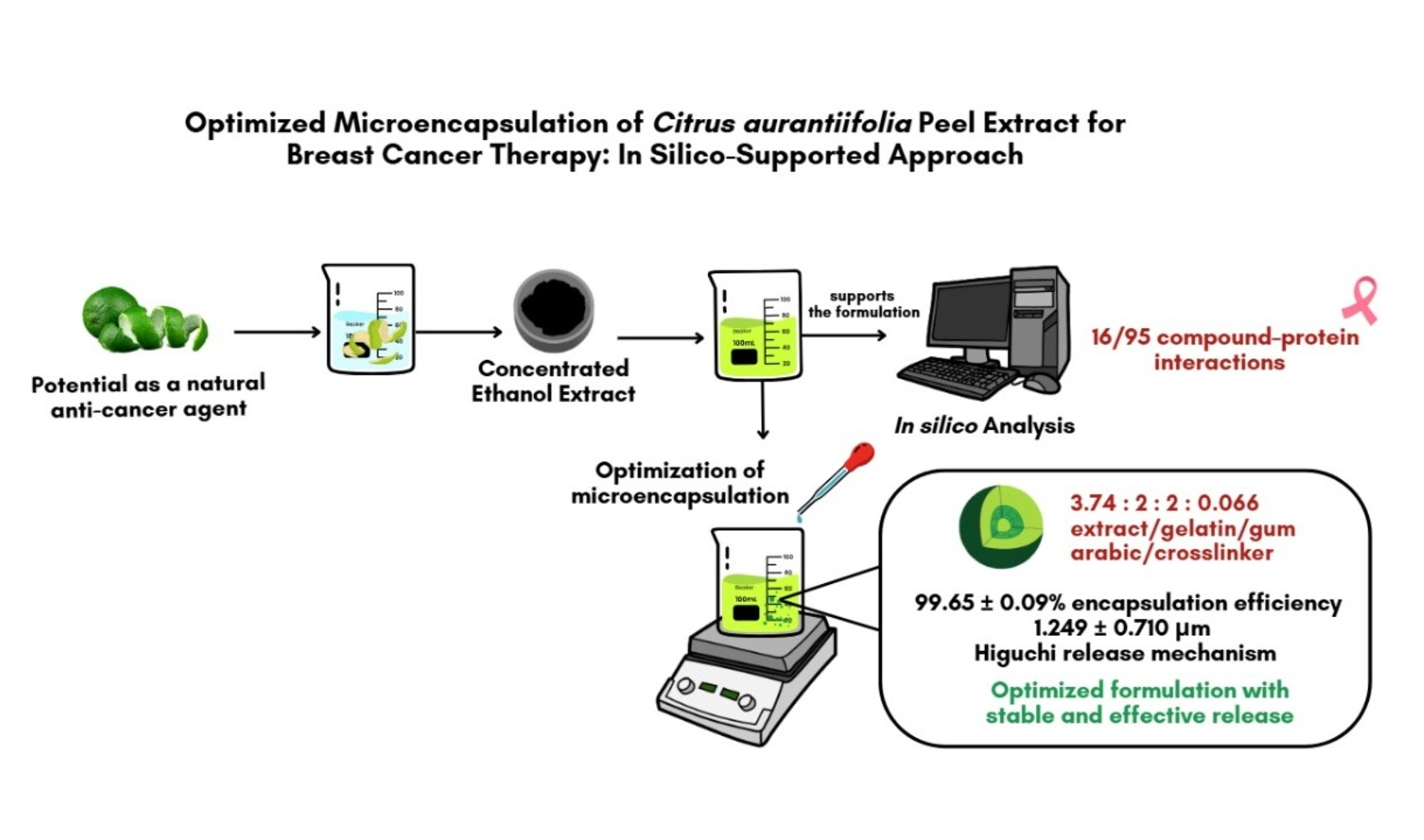
Breast cancer is the most prevalent cancer in Indonesia and is primarily treated by surgery or chemotherapy, often accompanied by adjuvant therapy. Citrus aurantiifolia peel extract exhibits potential as a natural anti-cancer compound. In silico screening identified 16 out of 95 candidate compound–protein interactions that demonstrated strong binding to key breast cancer-related targets (3ERT, 3PY0, 8I0M, 7PG6, and 1KV1), suggesting therapeutic relevance. Due to the extract’s environmental sensitivity, encapsulation is necessary to preserve its bioactivity. This study employed complex coacervation using a gelatin–gum arabic system crosslinked with glutaraldehyde, with formulation parameters optimized to improve encapsulation performance. The extract yield was 11.40%, and the optimal formulation ratios were 3.74:4 (extract/matrix), 0.066:4 (crosslinker/matrix), and 2:2 (gelatin/gum arabic). The resulting microcapsules achieved a yield of 54.21 ± 4.76%, an extract content of 3.67 ± 0.24%, and an encapsulation efficiency of 99.65 ± 0.09%, with spherical morphology and an average size of 1.249 ± 0.710 μm. Release studies followed Higuchi kinetics, indicating a controlled diffusion profile. These findings support the potential of C. aurantiifolia peel extract as a stable, encapsulated anti-cancer candidate for future therapeutic applications.
HIGHLIGHTS
- Citrus aurantiifolia peel extract was explored for its potential as a natural anti-cancer agent.
- In silico screening identified 16 key compound–protein interactions related to breast cancer pathways.
- Encapsulation using gelatin–gum arabic via complex coacervation preserved extract bioactivity.
- Optimized microcapsules achieved 99.65 ± 0.09% encapsulation efficiency and Higuchi release kinetics.
- The study supports the extract’s potential as a stable, encapsulated candidate for breast cancer therapy.
GRAPHICAL ABSTRACT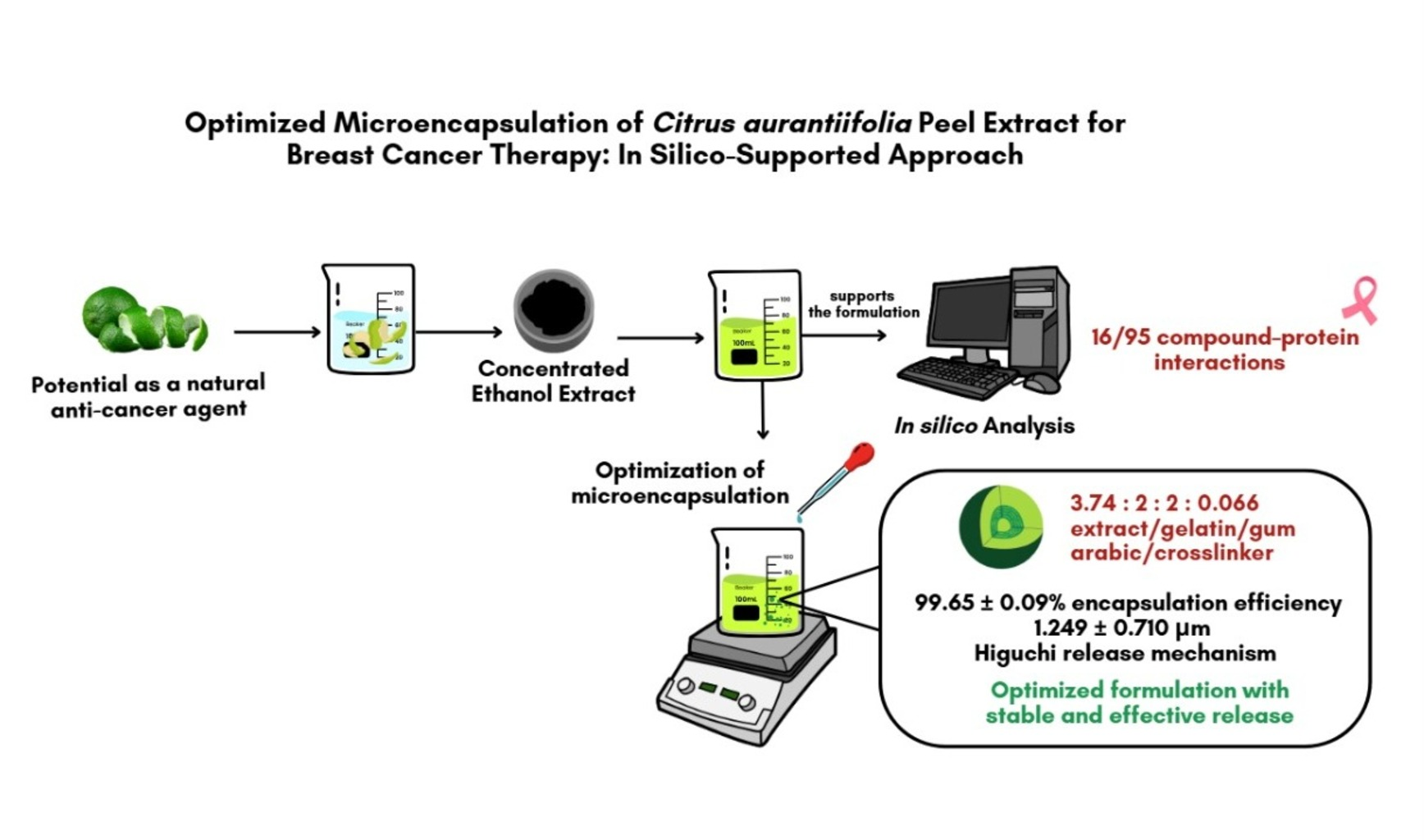
Downloads
References
F Melani and S Sulastri. Analisis perbandingan klasifikasi algoritma CART dengan algoritma C 4.5 pada kasus penderita kanker payudara. Jurnal Teknokompak 2023; 17(1), 171-183.
T Shien and H Iwata. Adjuvant and neoadjuvant therapy for breast cancer. Japanese Journal of Clinical Oncology 2020; 50(3), 225-229.
IK Kenyori, MS Alamsyah and CI Nurjanah. Studi in silico senyawa bioaktif kuersetin kulit jeruk nipis (citrus aurantifolia) sebagai agen antikanker payudara. Berkala Ilmiah Mahasiswa Farmasi Indonesia 2022; 9(1), 1-10.
AC Gomathi, SRX Rajarathinam, AM Sadiq and S Rajeshkumar. Anticancer activity of silver nanoparticles synthesized using aqueous fruit shell extract of Tamarindus indica on MCF-7 human breast cancer cell line. Journal of Drug Delivery Science and Technology 2020; 55, 101376.
E Julaeha, KS Dewi, M Nurzaman, T Wahyudi, T Herlina and A Hardianto. Chemical compositions and antioxidant activities of Indonesian citrus essential oils and their elucidation using principal component analysis. Preprints 2020. https://doi.org/10.20944/preprints202011.0586.v1
V Marcillo-Parra, DS Tupuna-Yerovi, Z Gonzalez and J Ruales. Encapsulation of bioactive compounds from fruit and vegetable by-products for food application - A review. Trends in Food Science & Technology 2021; 116, 11-23.
E Julaeha, S Puspita, DR Eddy, T Wahyudi, M Nurzaman, J Nugraha, T Herlina and JA Anshori. Microencapsulation of lime (Citrus aurantifolia) oil for antibacterial finishing of cotton fabric. RSC Advances 2021; 11(3), 1743-1749.
A Todorovic, L Sturm, A Salevic-Jelic, S Levic, IGO Crnivec, I Prislan, M Skrt, A Bjekovic, NP Ulrih and V Nedovic. Encapsulation of bilberry extract with maltodextrin and gum arabic by freeze-drying: Formulation, characterisation, and storage Stability. Processes 2022; 10(10), 1991.
X Luo, H Song, J Yang, B Han, Y Feng, Y Leng and Z Chen. Encapsulation of escherichia coli strain nissle 1917 in a chitosan - alginate matrix by combining layer-by-layer assembly with CaCl2 cross-linking for an effective treatment of inflammatory bowel diseases. Colloids and Surfaces B: Biointerfaces 2020; 189, 110818.
NN Indriyani, JA Anshori, N Permadi, S Nurjanah and E Julaeha. Bioactive components and their activities from different parts of Citrus aurantifolia (Christm.) swingle for food development. Foods 2023; 12(10), 2036.
E Julaeha, FE Mulyawan, FM Anwar, AWR Akili, N Permadi, Darwati, D Kurnia and T Herlina. Coumarins from citrus aurantiifolia (Christm.) Swingle Peel with Potential Cytotoxic Activity Against MCF-7 breast cancer cell line: In vitro and in silico studies. Onco Targets and Therapy 2025; 18, 441-452.
E Julaeha, WR Puspita, N Permadi, A Harja, S Nurjanah, T Wahyadi and J Al-Anshori. Optimization of citrus aurantifolia peel extract encapsulation in alginate-gelatin hydrogel microbeads for antibacterial wound dressing applications. Carbohydrate Polymer Technologies and Applications 2024; 7, 100406.
NS Pandiangan, L Pratiwi, DR Eddy, T Wahyudi, AS Mulywan and E Julaeha. Aktivitas anti nyamuk mikrokapsul minyak asiri Citrus aurantifolia Terhadap Aedes aegypti. Arena Tekstil 2021; 36(2), 73-82.
DE Gusungi, W Maarisit, H Hariyadi and NO Potalangi. Studi Aktivitas Antioksidan Dan Antikanker Payudara (MCF-7) Ekstrak Etanol Daun Benalu Langsat Dendrophthoe pentandra. The Tropical Journal of Biopharmaceutical 2020; 2020(1), 166-174.
A Lui, J New, J Ogony, S Thomas and J Lewis-Wambi. Everolimus downregulates estrogen receptor and induces autophagy in aromatase inhibitor-resistant breast cancer cells. BMC Cancer 2016; 16(1), 487.
X Luo, G Wang, Y Wang, M Wang, Z Tan, M Luo, L Zhang, Y Song, Y Jia, H Zhou and C Qing. Gibberellin derivative GA-13315 overcomes multidrug resistance in breast cancer by up-regulating BMP6 expression. Frontiers in Pharmacology 2022; 13, 1059365.
K Bajbouj, J Shafarin, MY Abdalla, IM Ahmad and M Hamad. 2017. Estrogen-induced disruption of intracellular iron metabolism leads to oxidative stress, membrane damage, and cell cycle arrest in MCF-7 cells. Tumor Biology 2017; 39(10), 101042831772618.
T Huang, L Tang, H Wang, L Lin and J Fu. Carbonic anhydrase 12 gene silencing reverses the sensitivity of paclitaxel in drug-resistant breast cancer cells. Bioengineered 2021; 12(2), 9806-9818.
MQ Abdullah. Therapeutic potential of tumor suppressors in treating breast cancer. International Journal of Cancer Studies & Research 2018; 6(3), 235-236.
Z Wang, L Li and Y Wang. Effects of Per2 overexpression on growth inhibition and metastasis, and on MTA1, nm23-H1 and the autophagy-associated PI3K/PKB signaling pathway in nude mice xenograft models of ovarian cancer. Molecular Medicine Reports 2016; 13(6), 4561-4568.
Z Pan, A Avila and L Gollahon. Paclitaxel induces apoptosis in breast cancer cells through different calcium - regulating mechanisms depending on external calcium conditions. International Journal of Molecular Sciences 2014; 15(2), 2672-2694.
J Feng, T Wen, Z Li, L Feng, L Zhou, Z Yang, L Xu, S Shi, K Hou, J Shen, X Han and Y Teng. Cross-talk between the ER pathway and the lncRNA MAFG-AS1/miR-339-5p/ CDK2 axis promotes progression of ER+ breast cancer and confers tamoxifen resistance. Aging 2020; 12(20), 20658-20683.
Z Hu, BL Kagan, EA Ariazi, DS Rosenthal, L Zhang, JV Li, H Huang, C Wu, VC Jordan, AT Riegel and A Wellstein. 2011. Proteomic analysis of pathways involved in estrogen-induced growth and apoptosis of breast cancer cells. PLoS One 2011; 6(6), e20410.
Y Di, S Cui and Y Gu. Preparation and characterization of a near-infrared light responsive microcapsule system for cancer therapy. Journal of Innovative Optical Health Sciences 2014; 07(01), 1350037.
JL Wilson and TC McDevitt. Stem cell microencapsulation for phenotypic control, bioprocessing, and transplantation. Biotechnology and Bioengineering 2013; 110(3), 667-682.
AH Elmaidomy, UR Abdelmohsen, AM Sayed, FH Altemani, NA Algehainy, D Soost, T Paululat, G Bringmann and EM Mohamed. Antiplasmodial potential of phytochemicals from Citrus aurantifolia peels: A comprehensive in vitro and in silico study. BMC Chemistry 2024; 18(1), 60.
N Permadi, M Nurzaman, F Doni and E Julaeha. Elucidation of the composition, antioxidant, and antimicrobial properties of essential oil and extract from Citrus aurantifolia (Christm.) Swingle peel. Saudi Journal of Biological Sciences 2024; 31(6), 103987.
E Sainz, MM Cavenagh, ND LopezJimenez, JC Gutierrez, JF Battey, JK Northup and SL Sullivan. The G‐protein coupling properties of the human sweet and amino acid taste receptors. Developmental Neurobiology 2007; 67(7), 948-959.
Y Ohshima, K Kaira, A Yamaguchi, N Oriuchi, H Tominaga, S Nagamori, Y Kanai, T Yokobori, T Miyazaki, T Asao, Y Tsushima, H Kuwano and NS Ishioka. Efficacy of system: Amino acid transporter 1 inhibition as a therapeutic target in esophageal squamous cell carcinoma. Cancer Science 2016; 107(10), 1499-1505.
G Ramshankar, R Liu and RJ Perry. The influence of the amino acid transporter lat1 on patient prognosis and the relationships between tumor immunometabolic and proliferative features depend on menopausal status in breast cancer. PLoS One 2023; 18(10), e0292678
Y Cormerais, M Pagnuzzi‐Boncompagni, S Schrotter, S Giuliano, E Tambutte, H Endou, MF Wempe, G Pages, J Pouyssegur and V Picco. Inhibition of the amino‐acid transporter LAT1 demonstrates anti‐neoplastic activity in medulloblastoma. Journal of Cellular and Molecular Medicine 2019; 23(4), 2711-2718.
K Kuriyama, T Higuchi, T Yokobori, H Saito, T Yoshida, K Hara, S Suzuki, M Sakai, M Sohda, T Higuchi, Y Tsushima, T Asao, K Kaira, H Kuwano, K Shirabe and H Saeki. Uptake of positron emission tomography tracers reflects the tumor immune status in esophageal squamous cell carcinoma. Cancer Science 2020; 111(6), 1969-1978.
C Barthelemy and B Andre. Ubiquitylation and endocytosis of the human LAT1/SLC7A5 amino acid transporter. Scientific Reports 2019; 9(1), 16760.
M Maimaiti, S Sakamoto, Y Yamada, M Sugiura, J Rii, N Takeuchi, Y Imamura, T Furihata, K Ando, K Higuchi, M Xu, T Sazuka, K Nakamura, A Kaneda, Y Kanai, N Kyprianou, Y Ikehara, N Anzai and T Ichikawa. Expression of L-type amino acid transporter 1 as a molecular target for prognostic and therapeutic indicators in bladder carcinoma. Scientific Reports 2020; 10(1), 1292.
BK Zhang, AM Moran, CG Bailey, JE Rasko, J Holst and Q Wang. EGF-activated PI3K/Akt signalling coordinates leucine uptake by regulating LAT3 expression in prostate cancer. Cell Communication and Signaling 2019; 17(1), 83.
CM Sevigny, S Sengupta, Z Luo, L Jin, D Pearce and R Clarke. The role of SLC7A5 (LAT1) in endocrine therapy-resistant breast cancer. Cancer Research 2019; 79(4S), P2-06-14.
M Sato, N Harada-Shoji, T Toyohara, T Soga, M Itoh, M Miyashita, H Tada, M Amari, N Anzai, S Furumoto, T Abe, T Suzuki, T Ishida and H Sasano. 2021. L-type amino acid transporter 1 is associated with chemoresistance in breast cancer via the promotion of amino acid metabolism. Scientific Reports 2021; 11(1), 589.
OM Ahmed, SF AbouZid, NA Ahmed, MY Zaky and H Liu. An Up-to-date review on citrus flavonoids: Chemistry and benefits in health and diseases. Current Pharmaceutical Design 2021; 27(4), 513-530.
PHC Campelo, VS Birchal, DA Botrel, GR Marques and SV Borges. Physicochemical and thermal stability of microcapsules of cinnamon essential oil by spray drying: Physicochemical and thermal stability. Journal of Food Processing and Preservation 2016; 41(3), e12919.
A Parikh and D Madamwar. Partial characterization of extracellular polysaccharides from cyanobacteria. Bioresource Technology 2006; 97(15), 1822-1827.
AP Putra, AA Rahmah, N Fitriana, SA Rohim, M Jannah and D Hikmawati. The effect of glutaraldehyde on hydroxyapatite-gelatin composite with addition of alendronate for bone filler application. Journal of Biomimetics, Biomaterials and Biomedical Engineering 2018; 37, 107-116.
AA Abd and Z Al-Khafaji. Gelatin and arabic gum-based food coating for food packaging. Kufa Journal of Engineering 2024; 15(3), 213-230.
SR Obireddy, C Madhavi, C Kashayi, KRKS Venkata and SMC Subbarao. Gelatin‐coated dual cross‐linked sodium alginate/magnetite nanoparticle microbeads for controlled release of doxorubicin. ChemistrySelect 2020; 5(33), 10276-10284.
S Caglar and DA Sahbaz. Ultrasonic-assisted synthesis, characterization, and release kinetics of Sweetgum (Liquidambar orientalis Miller) essential oil microcapsules as efficient antibacterial materials. Research Square 2023; 1, 1-20.
SR Derkach, NG Voron’ko, YA Kuchina and DS Kolotova. Modified fish gelatin as an alternative to mammalian gelatin in modern food technologies. Polymers 2020; 12(12), 3051.
F Menichini, MR Loizzo, M Bonesi, F Conforti, DD Luca, GA Statti, BD Cindio, F Menichini and R Tundis. Phytochemical profile, antioxidant, anti-inflammatory and hypoglycemic potential of hydroalcoholic extracts from Citrus medica L. cv Diamante flowers, leaves and fruits at two maturity stages. Food and Chemical Toxicology 2011; 49(7), 1549-1555.
A Maugeri, A Calderaro, GT Patane, M Navarra, D Barreca, S Cirmi and MR Felice. Targets involved in the anti-cancer activity of quercetin in breast, colorectal and liver neoplasms. International Journal of Molecular Sciences 2023; 24(3), 2952.
J Martinovic, R Ambrus, M Planinic, G Selo, A Klaric, G Perkovic and A Bucic-Kojic. Microencapsulation of grape pomace extracts with alginate-based coatings by freeze-drying: Release kinetics and in vitro bioaccessibility assessment of phenolic compounds. Gels 2024; 10(6), 353.
NDA Aceval, PMD Medeiros, ES Prudencio, CMO Muller and RDDMC Amboni. Encapsulation of aqueous leaf extract of Stevia rebaudiana Bertoni with sodium alginate and its impact on phenolic content. Food Bioscience 2016; 13, 32-40.
SAA Murtadza, NAM Zaki, J Jai, F Hamzah, NS Ashaari, DS Fardhyanti, Megawati and NAC Imani. 2024. Microencapsulation of citrus hystrix essential oil by gelatin B/Chitosan complex coacervation technique. Pertanika Journal of Science and Technology 2024; 32(2), 599-621.
Published
How to Cite
Issue
Section
License
Copyright (c) 2025 Walailak University

This work is licensed under a Creative Commons Attribution-NonCommercial-NoDerivatives 4.0 International License.





