
Total Synthesis and Anticancer Evaluation of BZR-cotoxin IV
DOI:
https://doi.org/10.48048/tis.2024.8370Keywords:
BZR-cotoxin IV, Anticancer peptides, Solid-phase peptide synthesis, Peptide cyclizationAbstract
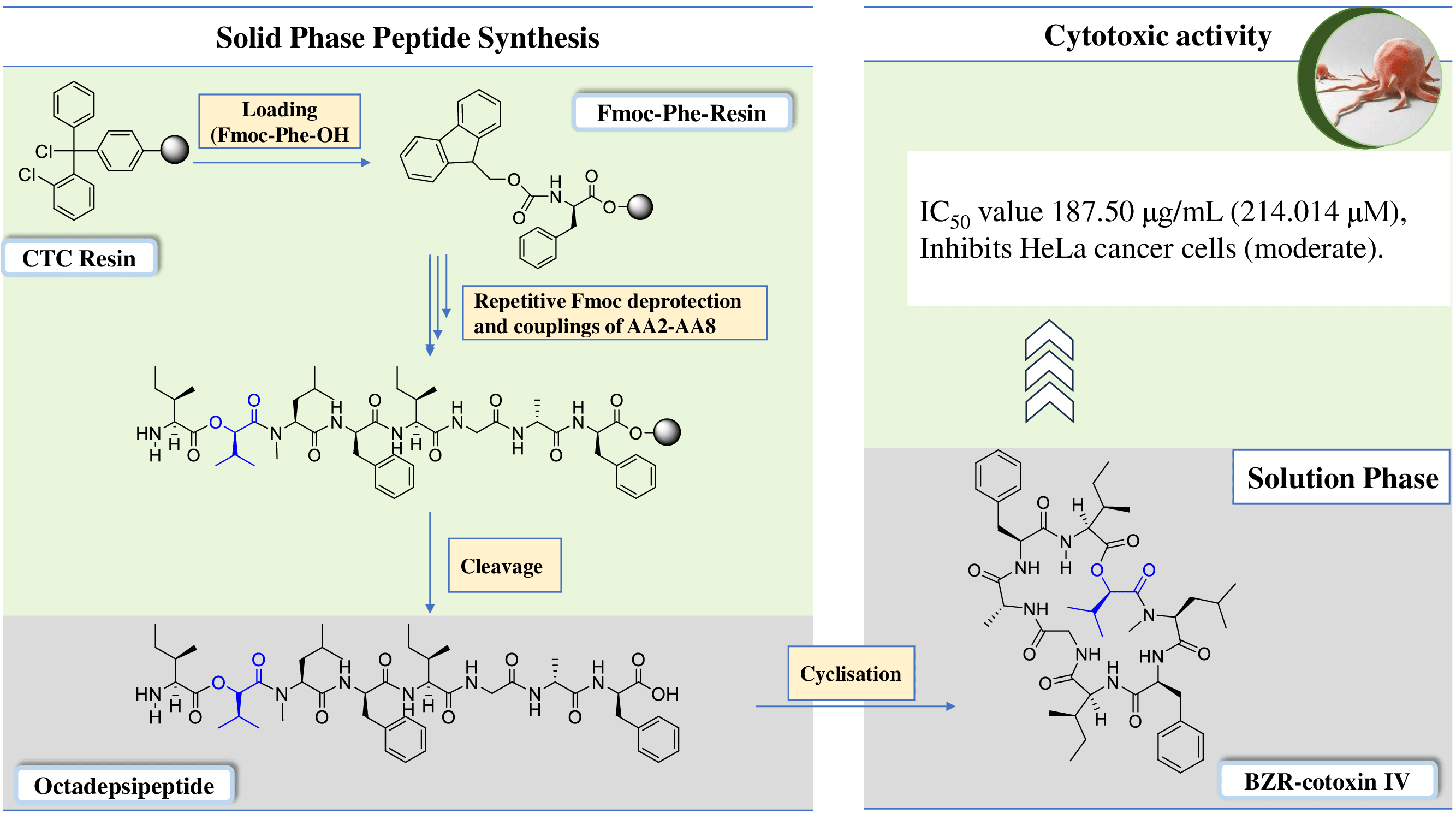
Anticancer peptides (ACPs) is a potential alternative for future cancer therapy. ACPs specifically inhibit cancer cells through a non-enzymatic membranolysis mechanism. One potential anticancer peptide worthy of investigation is BZR-cotoxin IV. Currently, research on BZR-cotoxin IV is limited to isolation, making it an interesting area for further development. One approach to developing BZR-cotoxin IV is through chemical synthesis techniques. This compound belongs to the group of cyclodepsipeptides that are naturally produced by the fungus Bipolaris zeicola Race 3. The synthesis of BZR cotoxin IV involves 3 steps: (1) Synthesis of the hydroxy acid precursor by conversion of L-valine amino acid to (2R)-hydroxyisovaleric acid, (2) synthesis of the linear depsipeptide using solid-phase peptide synthesis on 2-chlorotrityl chloride resin and (3) cyclization of the linear depsipeptide using solution phase synthesis to produce the BZR cotoxin IV compound with a purity of 11.7 %. BZR-cotoxin IV was characterized using HR-TOF-MS and 1H and 13C-NMR to validate the desired product. Anticancer activity testing was performed using the Resazurin assay on the HeLa cancer cell line, resulting in an IC50 of 187.50 μg/mL (214.014 μM) categorized as moderate.
HIGHLIGHTS
- The chemical synthesis of BZR-cotoxin IV compounds has not been firstly reported.
- The synthesis of BZR-cotoxin IV was accomplished through a combination of solid-phase and solution-phase peptide synthesis.
- The objective was to synthesize and evaluate BZR-cotoxin IV for its cancer properties.
GRAPHICAL ABSTRACT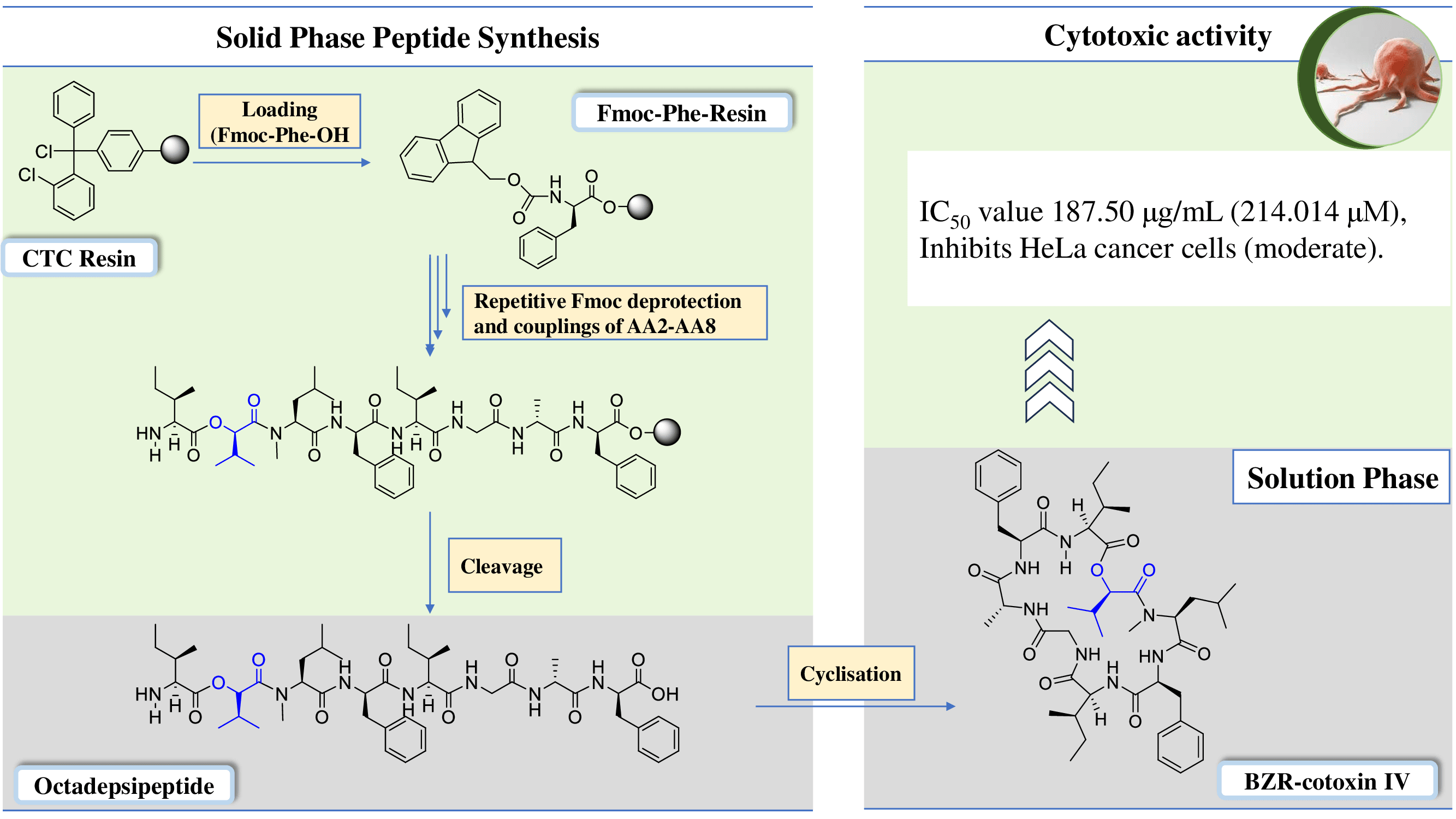
Downloads
References
J Ma, R Siegel and A Jemal. Pancreatic cancer death rates by race among us men and women, 1970-2009. J. Natl. Cancer Inst. 2013; 105, 1694-700.
T Haider, V Pandey, N Banjare, PN Gupta and V Soni. Drug resistance in cancer: Mechanisms and tackling strategies. Pharmacol. Rep. 2022; 72, 1125-51.
M Gholibeikian, A Bamoniri, M HoushdarTehrani, BBF Mirjalili and HR Bijanzadeh. Structure-activity relationship studies of Longicalcynin A analogues, as anticancer cyclopeptides. Chem. Biol. Interact. 2020; 315, 108902.
EV Rosca, B Lal, JE Koskimaki, AS Popel and J Laterra. Collagen IV and CXC chemokine-derived antiangiogenic peptides suppress glioma xenograft growth. Anti Cancer Drugs 2012; 23, 706-12.
A Tyagi, A Tuknait, P Anand, S Gupta, M Sharma, D Mathur, A Joshi, S Singh, A Gautam and GPS Raghava. CancerPPD: A database of anticancer peptides and proteins. Nucleic Acids Res. 2015; 43, D837-D843.
D Gaspar, AS Veiga and MARB Castanho. From antimicrobial to anticancer peptides. A review. Front. Microbiol. 2013; 4, 63880.
Y Wang, F Zhang, Y Zhang, JO Liu and D Ma. Synthesis and antitumor activity of cyclodepsipeptide zygosporamide and its analogues. Bioorg. Med. Chem. Lett. 2008; 18, 4385-7.
JN Zhang, YX Xia and HJ Zhang. Natural cyclopeptides as anticancer agents in the last 20 years. Int. J. Mol. Sci. 2021; 22, 3973.
JZ Xiao and N Dore. Structure of BZR-cotoxin III produced by Bipolaris zeicola race 3, the cause of leaf spot disease in corn. Nat. Prod. Lett. 1995; 6, 43-8.
L Ali, AL Khan, J Hussain, A Al-Harrasi, M Waqas, SM Kang, A Al-Rawahi and IJ Lee. Sorokiniol: A new enzymes inhibitory metabolite from fungal endophyte Bipolaris sorokiniana LK12. BMC Microbiol. 2016; 16, 103.
W Chiangjong, S Chutipongtanate and S Hongeng. Anticancer peptide: Physicochemical property, functional aspect and trend in clinical application (Review). Int. J. Oncol. 2020; 57, 678-96.
JS Yadav, B Suresh and P Srihari. Stereoselective total synthesis of the marine macrolide sanctolide A. Eur. J. Org. Chem. 2015; 2015, 5856-63.
I Coin, M Beyermann and M Bienert. Solid-phase peptide synthesis: From standard procedures to the synthesis of difficult sequences. Nat. Protoc. 2007; 2, 3247-56.
A Rahim, AT Hidayat, Nurlelasari, D Harneti, U Supratman and R Maharani. A total synthesis of cyclodepsipeptide [Leu]6-aureobasidin K using combination of solid-and solution-phase. Curr. Chem. Lett. 2020; 9, 97-104.
G Gabernet, AT Müller, JA Hiss and G Schneider. Membranolytic anticancer peptides. Medchemcomm 2016; 7, 2232-45.
JF Liang and VC Yang. Synthesis of doxorubicin-peptide conjugate with multidrug resistant tumor cell killing activity. Bioorg. Med. Chem. Lett. 2005; 15, 5071-5.
A Rahmadani, MA Masruhim, L Rijai, AT Hidayat, U Supratman and R Maharani. Total synthesis of cyclohexadepsipeptides exumolides A and B. Tetrahedron 2021; 83, 131987.
Y Yang. Peptide fragmentation/deletion side reactions. In: Y Yang (Ed.). Side reactions in peptide synthesis. Academic Press, Cambridge, Massachusetts, 2016.
Y Yang. Peptide racemization. In: Y Yang (Ed.). Side reactions in peptide synthesis. Academic Press, Cambridge, Massachusetts, 2016, p. 257-92.
J Petiti, L Revel and C Divieto. Standard operating procedure to optimize resazurin-based viability assays. Biosensors 2024; 14, 156.
SE Sajjadi, M Ghanadian, M Haghighi and L Mouhebat. Cytotoxic effect of Cousinia verbascifolia Bunge against OVCAR-3 and HT-29 cancer cells. J. Herbmed Pharmacol. 2015; 4, 15-9.
R Maharani, RTC Brownlee, AB Hughes and BM Abbott. A total synthesis of a highly N-methylated cyclodepsipeptide [2S,3S-Hmp]-aureobasidin L using solid-phase methods. Tetrahedron 2014; 70, 2351-8.
V Sarojini, AJ Cameron, KG Varnava, WA Denny and G Sanjayan. Cyclic tetrapeptides from nature and design: A review of synthetic methodologies, structure, and function. Chem. Rev. 2019; 119, 10318-59.
Downloads
Published
How to Cite
Issue
Section
License
Copyright (c) 2024 Walailak University

This work is licensed under a Creative Commons Attribution-NonCommercial-NoDerivatives 4.0 International License.





