
Improvement of Sensory Quality: Alteration of Physicochemical Characteristics and Antioxidant Activity of Immature Robusta Coffee Treated with Acetic Acid
DOI:
https://doi.org/10.48048/tis.2025.9912Keywords:
Antioxidant, Acetic acid, Coffee bean, Immature, Physicochemical, RobustaAbstract
Immature green coffee beans, which originate from green coffee cherries, are defective beans that are difficult to distinguish from mature green beans. Roasting these immature green beans produces quaker beans, which can reduce coffee quality. Acid treatment has been studied to improve the aroma quality of coffee. Acetic acid, an organic acid in coffee produced during fermentation and commonly used as vinegar, requires further study to determine its effects on immature coffee beans. This study investigated the effect of acetic acid treatment on the sensory, physicochemical and antioxidant properties of immature Robusta coffee beans. Immature green beans were soaked in acetic acid solutions of varying concentrations (0, 1, 2, and 3 %) and durations (30, 60, and 90 min) at 35 °C. Immature coffee beans had lighter brown color after roasted, and have higher chlorogenic acid (65.39 mg/g), caffeine (26.08 mg/g) and total soluble phenolic contents (65.70 mgGAE/g) than mature beans (p < 0.05). The roasted coffee of CI3-90 was the best acetic acid treatment sample with the highest cupping score (82.9) and the most intensely brown color, which resulted in decreased brightness (38.64 to 30.54) and yellowness (29.91 to 25.79). The acetic acid treatment significantly reduced total soluble phenolic content (61.58 to 45.26 mgGAE/g), chlorogenic acid content (20.10 to 14.64 mg/g) and trigonelline content (7.40 to 6.07 mg/g) of immature roasted coffee beans. Nevertheless, acetic acid treatment did not significantly influence caffeine content or antioxidant activity in either the green or roasted immature coffee beans (p > 0.05).
HIGHLIGHTS
- Acetic acid treatment can improve the sensory and color quality of roasted immature coffee beans.
- Treating immature coffee beans with 3 % acetic acid for 90 min is the best treatment, resulting in the highest cupping score and roasted bean colors that are close to the roasted color of mature coffee beans.
- The chlorogenic acid and trigonelline concentrations in green and roasted immature coffee exhibited a tendency to decrease with increasing acetic acid concentrations and treatment durations.
- The antioxidant activities of immature green and roasted coffee beans remained relatively stable after acetic acid treatment.
GRAPHICAL ABSTRACT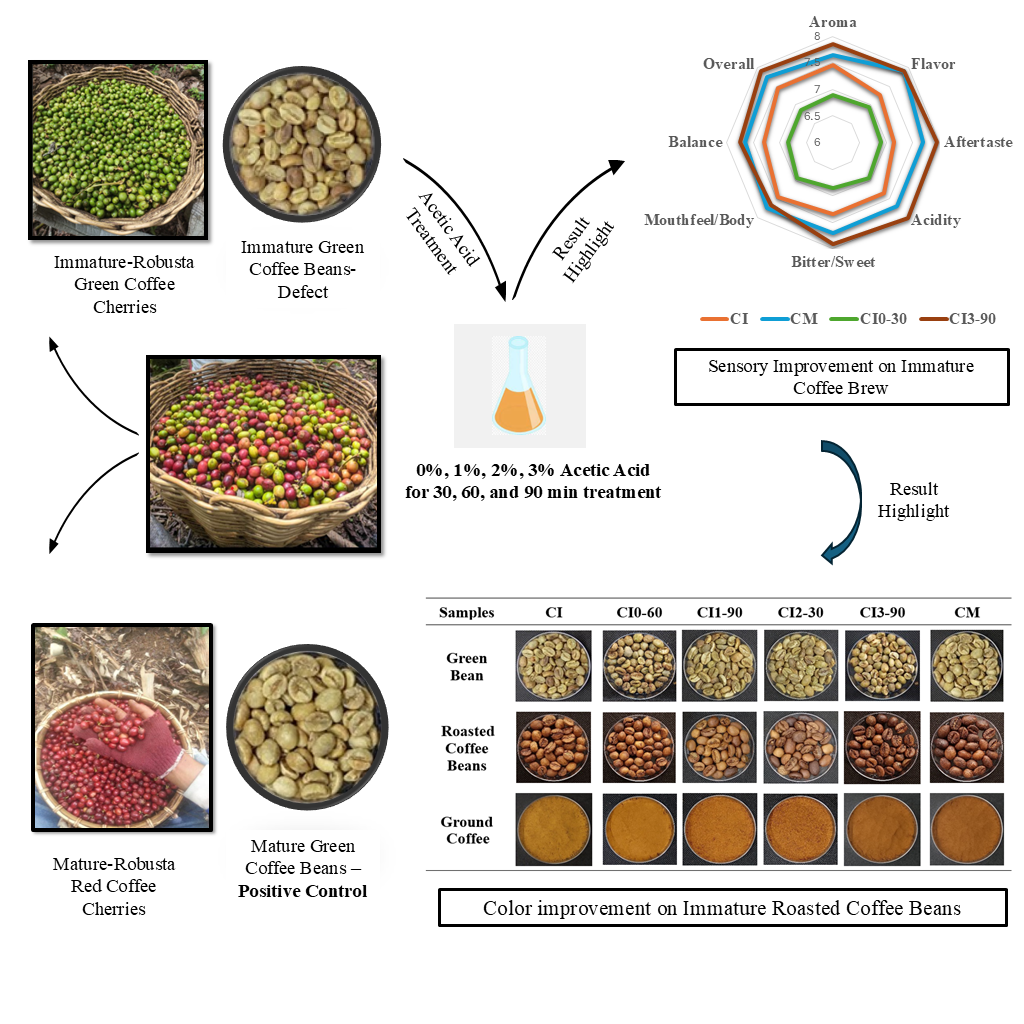
Downloads
References
Badan Pusat Statistik, Available at: https://www.bps.go.id/id/publication/2023/11/30/abde293e6c0fc5d45aaa9fe8/statistik-kopi-indonesia-2022.html, accessed May 2024.
F Fitriani, B Arifin and H Ismono. Indonesian coffee exports and its relation to global market integration. Journal of Socioeconomics and Development 2021; 4(1), 120.
D Suhandy and M Yulia. Classification of lampung robusta Specialty coffee according to differences in cherry processing methods using UV spectroscopy and chemometrics. Agriculture 2021; 11(2), 109.
D Herawati, PE Giriwono, FNA Dewi, T Kashiwagi and N Andarwulan. Critical roasting level determines bioactive content and antioxidant activity of Robusta coffee beans. Food Science Biotechnology 2019; 28(1), 7-14.
NLE Wahyuni, R Rispiandi and T Hariyadi. Effect of bean maturity and roasting temperature on chemical content of robusta coffee. IOP Conference Series Material Science and Engineering 2020; 830(2), 022019.
MHS Rabelo, FM Borem, RRD Lima, APDC Alves, ACM Pinheiro, DE Ribeiro, CMD Santos and RGFA Pereira. Impacts of quaker beans over sensory characteristics and volatile composition of specialty natural coffees. Food Chemistry 2021; 342, 128304.
S Velasquez, N Pena, JC Bohorquez, N Gutierrez and GL Sacks. Volatile and sensory characterization of roast coffees - effects of cherry maturity. Food Chemistry 2019; 274, 137-145.
A Afriliana, H Harada, PQ Khotijah and J Giyarto. Fermented technology of robusta coffee beans (canephora coffee) with kefir milk to produce specialty coffee. Advances in Engineering Research 2018; 172, 302-309.
DL Kalschne, MC Viegas, AJD Conti, MP Corso and MDT Benassi. Steam pressure treatment of defective Coffea canephora beans improves the volatile profile and sensory acceptance of roasted coffee blends. Food Research International 2019; 105, 393-402.
C Liu, Q Yang, R Linforth, ID Fisk and N Yang. modifying robusta coffee aroma by green bean chemical pre-treatment. Food Chemistry 2019; 272, 251-257.
C Liu, N Yang, Q Yang, C Ayed, R Linforth and ID Fisk. Enhancing Robusta coffee aroma by modifying flavour precursors in the green coffee bean. Food Chemistry 2019. 281, 8-17.
SE Yeager, ME Batali, JX Guinard and WD Ristenpart. Acids in coffee: A review of sensory measurements and meta-analysis of chemical composition. Critical Reviews in Food Science and Nutrition 2021; 63(8), 1010-1036.
CJB Rune, D Giacalone, I Steen, L Duelund, M Munchow and MP Clausen. Acids in brewed coffees: Chemical composition and sensory threshold. Current Researh in Food Science 2023; 6, 100485.
M Ginz, HH Balzer, AGW Brabury and HG Maier. Formation of aliphatic acids by carbohydrate degradation during roasting of coffee. European Food Research and Technology 2000; 211, 404-410.
WB Sunarharum, DJ Williams and HE Smyth. Complexity of coffee flavor: A compositional and sensory perspective. Food Research International 2014; 62, 315-325.
H Lee, J Yim, Y Lee and KG Lee. Effect of organic acid-soaking and sonication on the formation of volatile compounds and α-dicarbonyl compounds in Robusta coffee. Ultrasonic Sonochemistry 2023; 99, 106580.
G Galarza and JG Figueroa. Volatile compound characterization of coffee (coffea arabica) processed at different fermentation times using SPME-GC-MS. Molecules 2022, 27(6), 2004.
APP Bressani, NN Batista, G Ferreira, SJ Martinez, JBP Simao, DR Dias and RF Schwan. Characterization of bioactive, chemical, and sensory compounds from fermented coffees with different yeasts species. Food Research International 2021; 150(Part A), 110755.
DR Seninde and E Chambers. Coffee flavor: A review. Beverages 2020; 6(3), 44.
WB Sunarharum, DY Ali, T Mahatmanto, PI Nugroho, NE Asih, AP Mahardika and I Geofani. The Indonesian coffee consumers perception on coffee quality and the effect on consumption behavior. IOP Conference Series: Earth and Environmental Science 2021; 733, 012093.
F Bastian, OS Hutabarat, A Dirpan, F Nainu, H Harapan, TB Emran and JS Gandara. From plantation to cup: Changes in bioactive compounds during coffee processing. Foods 2021; 10(11), 2827.
JA Vignoli, MC Viegas, DG Bassoli and MDT Benassi. Roasting process affects differently the bioactive compounds and the antioxidant activity of arabica and robusta coffees. Food Research International 2014; 61, 279-285.
IA Ludwig, L Sanchez, MPD Pena and C Cid. Contribution of volatile compounds to the antioxidant capacity of coffee. Food Research International 2014; 61, 67-74.
OR Portillo and AC Arevalo. The coffee bean nitrogenous compounds. A critical review of contemporary scientific literature. In: Proceedings of the 22nd LACCEI international Multi-conference for Engineering, San-Jose, Costa Rica, 2024.
B Sritongtae, T Sangsukiam, MRA Morgan and K Duangmal. Effect of acid pretreatment and the germination period on the composition and antioxidant activity of rice bean (Vigna umbellata). Food Chemistry 2017. 227, 280-288.
AJ Javan, A Nikmanesh, K Keyhosrav, S Maftoon, MA Zare, M Bayani, M Parsaiemehr and M Raeisi. Effect of citric acid dipping treatment on bioactive components and antioxidant properties of sliced button mushroom (agaricus bisporus). Journal of Food Quality & Hazards Control 2015; 2, 20-25.
D Fardenan, DA Suroto and S Supriyadi. Effect of acetic acid immersion on the taste and aroma quality of immature Robusta coffee beans. Czech Journal of Food Sciences 2024; 42(6), 391-404.
SE Yeager, ME Batali, LX Lim, J Liang, J Han, AN Thompson, JX Guinard and WD Ristenpart. Roast level and brew temperature significantly affect the color of brewed coffee. Journal of Food Science 2022; 87(4), 1837-1850.
PA Setiadi, AD Saputro, Z Nurkholisa, YF Hardiyanto, N Bintoro and JNW Karyadi. Physical characteristic of instanised chocolate beverage powder produced with palm sugar and sucrose as sweeteners. IOP Conference Series: Earth and Environmental Science 2021; 653, 012038.
IM Perez-Hernandez, K Chavez-Quiroz, LA Medina-Juarez and NG Meza. Phenolic characterization, melanoidins, and antioxidant activity of some commercial coffees from coffea arabica and coffea canephora. Journal of the Mexican Chemical Society 2012; 56(4), 430-435.
A Bobkova, M Hudacek, S Jakabova, L Belej, M Capcarova, J Curlej, M Bobko, J Arvay, I Jakab, J Capla and A Demianova. The effect of roasting on the total polyphenols and antioxidant activity of coffee. Journal of Environmental Science and Health B 2020; 55(5), 495-500.
Specialty Coffee Association of America, Available at: https://www.scaa.org/PDF/resources/cupping-protocols.pdf, accessed November 2022.
MBDS Scholz, CSG Kitzberger, SH Prudencio and RSDSFD Silva. The typicity of coffees from different terroirs determined by groups of physico-chemical and sensory variables and multiple factor analysis. Food Research International 2018; 114, 72-80.
N Koca, F Karadeniz and HS Burdurlu. Effect of pH on chlorophyll degradation and colour loss in blanched green peas. Food Chemistry 2007; 100(2), 609-615.
WG Morais, TF Pacheco, PS Correa, AA Martins, TM Mata and NS Caetano. Acid pretreatment of sugarcane biomass to obtain hemicellulosic hydrolisate rich in fermentable sugar. Energy Reports 2020; 6(8), 18-23.
Y Yulianti, DR Adawiyah, D Herawati, D Indrasti and N Andarwulan. Detection of markers in green beans and roasted beans of kalosi-enrekang arabica coffee with different postharvest processing using LC-MS/MS. International Journal of Food Science 2023; 2023(1), 6696808.
FM Mehaya and AA Mohammad. Thermostability of bioactive compounds during roasting process of coffee beans. Heliyon 2020; 6(11), e05508.
P Mazzafera. Chemical composition of defective coffee beans. Food Chemistry 1999; 64(4), 547-554.
ALS Vasconcelos, AS Franca, MBA Gloria and JCF Mendonca. A comparative study of chemical attributes and levels of amines in defective green and roasted coffee beans. Food Chemistry 2007; 101(1), 26-32.
I Laukalja, Z Kruma and I Cinkmanis. Impact of the roast level on chemical composition of coffee from colombia. Proceedings of the Latvian Academy of Sciences, Section B: Natural, Exact, and Applied Sciences 2022; 76(1), 145-151.
P Divis, J Porizka and J Krikala. The effect of coffee beans roasting on its chemical composition. Potravinarstvo Slovak Journal of Food Sciences 2019; 13(1), 344-350.
SI Mussatto, EMS Machado, S Martins and JA Teixeira. Production, composition, and application of coffee and its industrial residues. Food and Bioprocess Technology 2011; 4, 661-672.
AS Franca, LS Oliveira, JCF Mendonca and XA Silva. Physical and chemical attributes of defective crude and roasted coffee beans. Food Chemistry 2005; 90(1-2), 89-94.
A Sualeh, K Tolessa and A Mohammed. Biochemical composition of green and roasted coffee beans and their association with coffee quality from different districts of southwest ethiopia. Heliyon 2020; 6(12), e05812.
S Awwad, R Issa, L Alnsour, D Albals and I Al-Momani. Quantification of caffeine and chlorogenic acid in green and roasted coffee samples using hplc-dad and evaluation of the effect of degree of roasting on their levels. Molecules 2021; 26(24), 7502.
RD Hall, F Trevisan and RCHD Vos. Coffee berry and green bean chemistry - Opportunities for improving cup quality and crop circularity. Food Research Intrnational 2022; 151,110825.
M Friedman and HS Jurgens. Effect of pH on the stability of plant phenolic compounds. Journal of Agriculture and Food Chemistry 2000; 48(6), 2101-2110.
Y Narita and K Inouye. Degradation kinetics of chlorogenic acid at various pH values and effects of ascorbic acid and epigallocatechin gallate on its stability under alkaline conditions. Journal of Agriculture and Food Chemistry 2013; 61(4), 966-972.
M Jeszka-Skowron, R Frankowski and A Zgola-Grzeskowiak. Comparison of methylxantines, trigonelline, nicotinic acid and nicotinamide contents in brews of green and processed Arabica and Robusta coffee beans - Influence of steaming, decaffeination and roasting processes on coffee beans. LWT 2020; 125, 109344.
AR Sulistyaningtyas, E Prihastanti and ED Hastuti. Potential of liquid tofu waste for decaffeination of robusta coffee (Coffea robusta Lindl.Ex De Will). Journal of Microbiology, Biotechnology and Food Sciences 2018; 8(1), 678-680.
M Sasaki, Y Nonoshita, T Kajiya, N Atsuchi, M Kido, D Chu, LR Juneja, Y Minami and K Kajiya. Characteristic analysis of trigonelline contained in raphanus sativus cv. Sakurajima daikon and results from the first trial examining its vasodilator properties in humans. Nutrients 2020; 12(6), 1872.
H. Park, E. Noh, M. Kim, and K. G. Lee. Analysis of volatile and nonvolatile compounds in decaffeinated and regular coffee prepared under various roasting conditions. Food Chemistry 2024; 435.
N Konstantinidis, H Franke, S Schwarz and DW Lachenmeier. Risk assessment of trigonelline in coffee and coffee By-Products. Molecules 2023; 28(8), 3460.
H Wu, P Lu, Z Liu, J Sharifi-Rad and HAR Suleria. Impact of roasting on the phenolic and volatile compounds in coffee beans. Food Science & Nutrition 2022; 10(7), 2408-2425.
Y Liao, T Kim, JL Silva, W Hu and B Chen. Effects of roasting degrees on phenolic compounds and antioxidant activity in coffee beans from different geographic origins. LWT 2022; 168, 113965.
L Alnsour, R Issa, S Awwad, D Albals and I Al-Momani. Quantification of total phenols and antioxidants in coffee samples of different origins and evaluation of the effect of degree of roasting on their levels. Molecules 2022; 27(5), 1591.
B Xu and SKC Chang. Effect of soaking, boiling, and steaming on total phenolic contentand antioxidant activities of cool season food legumes. Food Chemistry 2008; 110(1), 1-13.
C Thepthanee, H Li, H Wei, C Prakitchaiwattana and S Siriamornpun. Effect of soaking, germination, and roasting on phenolic composition, antioxidant activities, and fatty acid profile of sunflower (helianthus annuus L.) seeds. Horticulturae 2024; 10(4), 387.
PL Pasquet, D Julien-David, M Zhao, M Villain-Gambier and D Trebouet. Stability and preservation of phenolic compounds and related antioxidant capacity from agro-food matrix: Effect of pH and atmosphere. Food Bioscience 2024; 57(8), 103586.
MKA Kanan, T Nahar, N Islam, MJ Rahman, S Ahmed, MS Kabir and M Ahmed. Impact of soaking and cooking treatments on the physicochemical and antioxidant properties of parboiled and non-parboiled rice (Oryza sativa L.). Food Science and Technology International 2022; 30(2), 160-168.
F Kulapichitr, C Borompichaichartkul, S Pratontep, K Lopetcharat, S Boonbumrung and I Suppavorasatit. Differences in volatile compounds and antioxidant activity of ripe and unripe green coffee beans (Coffea arabica L. ‘Catimor’). Acta Horticulture 2017; 1179, 261-268.
WB Sunarharum, SS Yuwono and OF Aziza. Study on the effect of roasting temperature on antioxidant activity of early-roasted Java coffee powder (Arabica and Robusta). IOP Conference Series: Earth and Environmental Science 2019; 230, 012045.
M Varady, T Hruskova and P Popelka. Effect of preparation method and roasting temperature on total polyphenol content in coffee beverages. Czech Journal of Food Sciences 2020; 38(6), 417-421.

Published
How to Cite
Issue
Section
License
Copyright (c) 2025 Walailak University

This work is licensed under a Creative Commons Attribution-NonCommercial-NoDerivatives 4.0 International License.





