
Rapid Method for Simultaneous Determination of γ-Oryzanol Compounds in Rice (Oryza sativa) Grains using UV-Vis Spectroscopy and Chemometrics
DOI:
https://doi.org/10.48048/tis.2024.8550Keywords:
Rice, Bioactive compounds, Ferulic acid esters, Partial least square regression, Principal component analysisAbstract
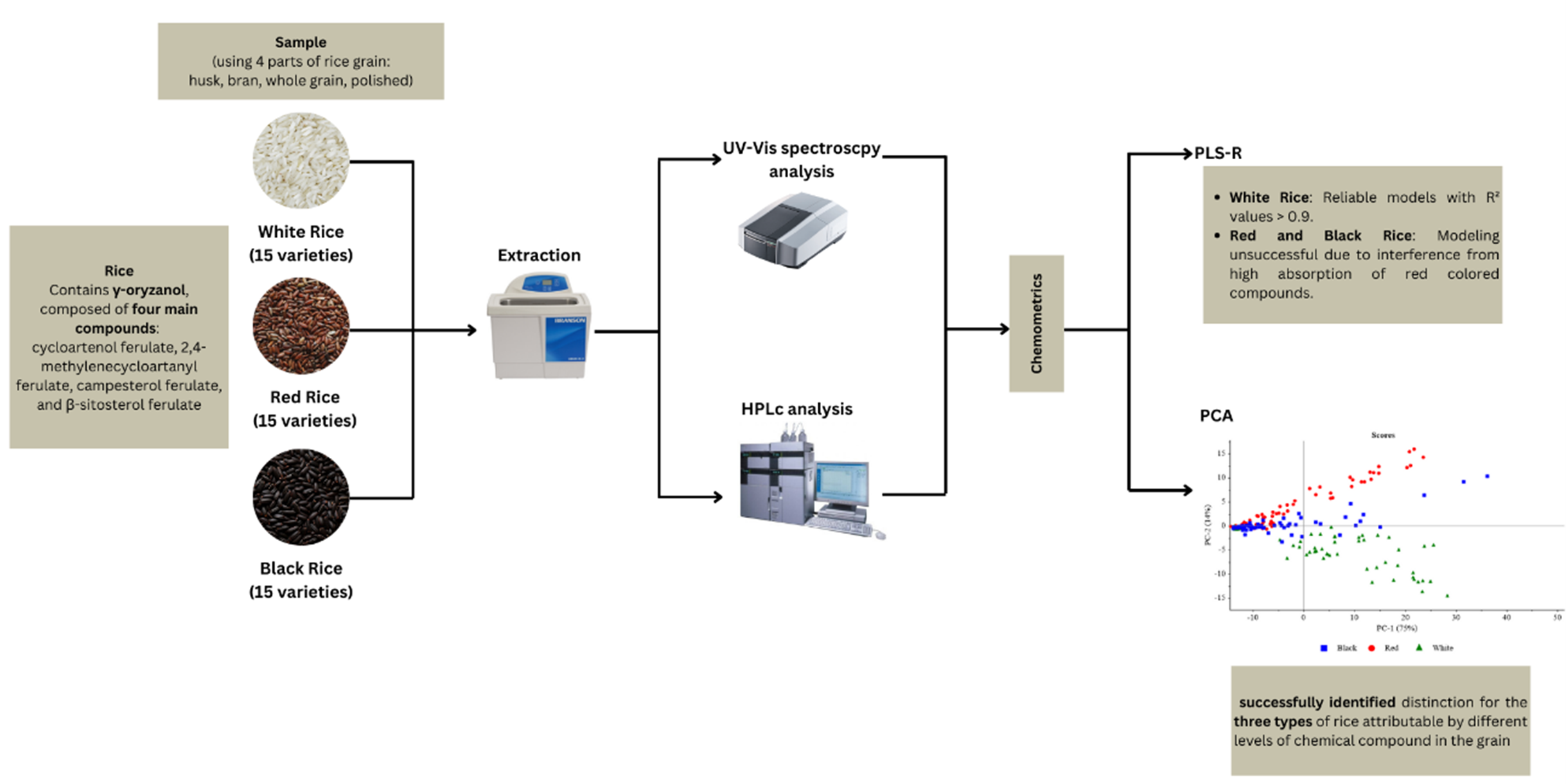
Rice (Oryza sativa) contains γ-oryzanol, which consists of 4 main compounds: Cycloartenol ferulate, 2,4-methylenecycloartanyl ferulate, campesterol ferulate, and β-sitosterol ferulate, that contribute to the health benefits of rice. This research aimed to develop a rapid method to determine the 4 major γ-oryzanol compounds in 45 varieties covering pigmented (black and red) and non-pigmented (white) rice grain. The method was developed by integrating UV-Vis spectroscopy with chemometrics, specifically principal component analysis (PCA) and partial least square (PLS) regression. Sampling was performed across the Indonesian archipelago collecting 180 samples, which comprises 60 samples for each type of rice in form of rice husk, bran, whole grain, and polished rice. The results of PCA on the spectroscopic data successfully identified distinction for the 3 types of rice attributable by different type and levels of chemical compound in the grain. White rice exhibited a characteristic absorption at 325 nm while in pigmented (red and black) rice showed a maximum absorbance at 280 nm, indicating the presence of different composition of chemical compounds. A reliable model to predict the 4 major γ-oryzanol compounds was established with R2 calibration, R2 cross-validation, and R2 prediction higher than 0.9 was obtained using the spectroscopic data in the range from 200 to 400 nm. However, the PLS modeling was unsuccessful for red and black rice samples most likely due to the interfering high absorption of red colored compounds. Compared to the existing techniques for analyzing individual compounds of the γ-oryzanol by high-performance liquid chromatography, the newly developed approach using UV-Vis spectroscopy combined with chemometrics is more practical, faster, and cost-efficient and mainly, solvent and residues free.
HIGHLIGHTS
- A rapid method was developed to determine 4 major γ-oryzanol compounds in rice.
- This method integrates UV-Vis spectroscopy with PCA and PLS regression chemometrics.
- PCA successfully identified the distinction among white, red, and black rice types.
- Reliable PLS models were established for white rice with R2 values above 0.9.
- The developed approach is more practical, faster, and residue-free than HPLC.
GRAPHICAL ABSTRACT
Downloads
References
PR Chaudari, N Tamrakar, L Singh, A Tandon and D Sharma. Rice nutritional and medicinal properties: A review article. J. Pharmacogn. Phytochem. 2018; 7, 150-6.
P Limtrakul, W Semmarath and S Mapoung. Anthocyanins and proanthocyanidins in natural pigmented rice and their bioactivities. In: A Rao, D Mans and L Rao (Eds.). Phytochemicals in human health. IntechOpen, London, 2019.
DK Verma and PP Srivastav. Bioactive compounds of rice (Oryza sativa L.): Review on paradigm and its potential benefit in human health. Trends Food Sci. Tech. 2020; 97, 355-65.
O Wang, J Liu, Q Cheng, X Guo, Y Wang, L Zhao, F Zhou and B Ji. Effects of ferulic acid and γ-oryzanol on high-fat and high-fructose diet-induced metabolic syndrome in rats. PLoS One 2015; 10, e0118135.
R Liu, Y Xu, M Chang, L Tang, M Lu and R Liu, G Jin and X Wang. Antioxidant interaction of α-tocopherol, γ-oryzanol and phytosterol in rice bran oil. Food Chem. 2021; 343, 128431.
L Mattei, FV Francisqueti-Ferron, JL Garcia, AJT Ferron, CCV Silva, CS Gregolin, ET Nakandakare-Maia, JDCP Silva, F Moreto, IO Minatel and CR Corrêa. Antioxidant and anti-inflammatory properties of gamma-oryzanol attenuates insulin resistance by increasing GLUT-4 expression in skeletal muscle of obese animals. Mol. Cell. Endocrinol. 2021; 537, 111423.
C Perez-Ternero, MAD Sotomayor and MD Herrera. Contribution of ferulic acid, γ-oryzanol and tocotrienols to the cardiometabolic protective effects of rice bran. J. Funct. Foods 2017; 32, 58-71.
S Babu and S Jayaraman. An update on β-sitosterol: A potential herbal nutraceutical for diabetic management. Biomed. Pharmacother. 2020; 131, 110702.
Z Xu, N Hua and JS Godber. Antioxidant activity of tocopherols, tocotrienols, and gamma-oryzanol components from rice bran against cholesterol oxidation accelerated by 2,2’-azobis(2-methylpropionamidine) dihydrochloride. J. Agric. Food Chem. 2001; 49, 2077-81.
S Yasuda, Y Sowa, H Hashimoto, T Nakagami, T Tsuno and T Sakai. Cycloartenyl ferulate and β-sitosteryl ferulate-steryl ferulates of γ-oryzanol-suppress intracellular reactive oxygen species in cell-based system. J. Oleo Sci. 2019; 68, 765-8.
L Lv, L Zhang, M Gao and F Ma. Simultaneous determination of γ-oryzanol in agriproducts by solid-phase extraction coupled with UHPLC-MS/MS. Agriculture 2023; 13, 531.
P Pokkanta, P Sookwong, M Tanang, S Setchaiyan, P Boontakham and S Mahatheeranont. Simultaneous determination of tocols, γ-oryzanols, phytosterols, squalene, cholecalciferol and phylloquinone in rice bran and vegetable oil samples. Food Chem. 2019; 271, 630-8.
R Bucci, AD Magrì, AL Magrì and F Marini. Comparison of three spectrophotometric methods for the determination of gamma-oryzanol in rice bran oil. Anal. Bioanal. Chem. 2003; 375, 1254-9.
S Yudthavorasit, K Wongravee and N Leepipatpiboon. Characteristic fingerprint based on gingerol derivative analysis for discrimination of ginger (Zingiber officinale) according to geographical origin using HPLC-DAD combined with chemometrics. Food Chem. 2014; 158, 101-11.
A Rohman, Irnawati and FDO Riswanto. Analisis farmasi dengan spektroskopi UV-Vis dan kemometrika (in Indonesian). UGM Press, Yogyakarta, Indonesia, 2023. p. 51-3.
W Tian, G Chen, Y Gui, G Zhang and Y Li. Rapid quantification of total phenolics and ferulic acid in whole wheat using UV-Vis spectrophotometry. Food Control 2021; 123, 107691.
K Kaewsorn and P Sirisomboon. Study on evaluation of gamma oryzanol of germinated brown rice by near infrared spectroscopy. J. Innovative Opt. Health Sci. 2014; 7, 1450002.
T Pungseeklao, T Opanasopit and P Khuwijitjaru. Development of a method for quantitative determination of γ-oryzanol using near infrared spectroscopy. Food Appl. Biosci. J. 2017; 4, 107-15.
A Sabir, M Rafi and LK Darusman. Discrimination of red and white rice bran from Indonesia using HPLC fingerprint analysis combined with chemometrics. Food Chem. 2017; 15, 1717-22.
C Chinvongamorn and S Sanseya. The γ-oryzanol content of thai rice cultivars and the effects of gamma irradiation on the γ-oryzanol content of germinated Thai market rice. Orient. J. Chem. 2020; 36, 812-8.
A Miller and KH Engel. Content of γ-oryzanol and composition of steryl ferulates in brown rice (Oryza sativa L.) of European origin. J. Agric. Food Chem. 2006; 54, 8127-33.
H Nakano, H Yoshida, S Yabe, E Fushimi, R Tanaka, M Yamasakil and H Nakagawa. γ‐Oryzanol concentrations in various rice genotypes ripened under different air temperatures. Cereal Chem. 2022; 99, 1362-72.
T Nurmi, AM Lampi, L.Nyström, M Turunen and V Piironen. Effects of genotype and environment on steryl ferulates in wheat and rye in the HEALTHGRAIN diversity screen. J. Agric. Food Chem. 2010; 58, 9332-40.
SH Huang and LT Ng. Quantification of tocopherols, tocotrienols, and γ-oryzanol contents and their distribution in some commercial rice varieties in Taiwan. J. Agric. Food Chem. 2011; 59, 11150-9.
P Khuwijitjaru, N Taengtieng and S Changprasit. Degradation of gamma-oryzanol in rice bran oil during heating: An analysis using derivative UV-spectrophotometry. Silpakorn Univ. Int. J. 2004; 4, 154-65.
A Sakunpak, J Suksaeree, C Monton, P Pathompak and K Kraisintu. Quantitative analysis of γ-oryzanol content in cold pressed rice bran oil by TLC-image analysis method. Asian Pac. J. Trop. Biomed. 2014; 4, 119-23.
W Setyaningsih, IE Saputro, CA Carrera, M Palma and C Garcia-Barosso. Fast determination of phenolic compounds in rice grains by ultraperformance liquid chromatography coupled to photodiode array detection: Method development and validation. J. Agric. Food Chem. 2019; 67, 3018-27.
W Setyaningsih, N Hidayatul, IE Saputro, M Palma and CG Barroso. Profile of phenolic compounds in Indonesian rice (Oryza sativa) varieties throughout post-harvest practices. J. Food Compos. Anal. 2016; 54, 55-62.
NM Faber and R Rajkó. How to avoid over-fitting in multivariate calibration - The conventional validation approach and an alternative. Analytica Chimica Acta 2007; 595, 98-106.
J Subramanian and R Simon. Overfitting in prediction models - is it a problem only in high dimensions? Contemp. Clin. Trials 2013; 36, 636-41.
R Augusti, ACC Fulgêncio, HM Nogueira, JCL Gomes, LBD Santos, AND Macedo, BLS Porto, MM Sena and MR Almeida. Enhancing food authentication screening through the integration of chemometrics and ambient ionization mass spectrometry: A comprehensive review. Trends Food Sci. Technol. 2024; 147, 104480.
Downloads
Published
How to Cite
Issue
Section
License
Copyright (c) 2024 Walailak University

This work is licensed under a Creative Commons Attribution-NonCommercial-NoDerivatives 4.0 International License.





