
Effect of Drying Time and Temperature to the Chemical Properties and Enzymatic Activities Related to the β-ocimene Production in Syzygium polyanthum Leaves
DOI:
https://doi.org/10.48048/tis.2022.1526Keywords:
Salam leaf, Drying process, Chemical properties, Enzyme activity, β-ocimeneAbstract
As a key volatile compound, the β-ocimene volatile compound in Salam leaves may change due to processing. Thus, this study aims to examine the effect of the drying process on the water activity, pH, total soluble protein values, 1-deoxy-D-xylulose-5-phosphate synthase, geranyl diphosphate synthase, and monoterpene synthase enzyme activities, and total β-ocimene due to variations in drying time (0, 1, 2, 3 and 4 days) and temperature (30, 40, 50 and 60 °C). The results showed that all parameters significantly decreased day by day, especially at higher temperatures. Meanwhile, for the temperatures of 40 and 50 °C, the enzyme activity parameters were increased until the 1st drying day. The drying process with a temperature of 40 °C gives the highest value of β-ocimene, reaching 139.62 µg/mL Salam leaves essential oil. These results were entirely satisfactory, and research conditions can be a reference for 4 days drying process of Salam leaves.
HIGHLIGHTS
- Salam leaves are one of the essential spices in Indonesian cuisine. Its potential is as a source of fresh aroma due to β-ocimene in its essential oil. The drying of Salam leaves before cooking has not been widely studied
- So, the contents of this research are scientific data and analysis results about the effect of the drying process on chemical parameters and enzyme activity related to the production of volatile β-ocimene production in Salam leaves
- The conclusion can prove the effects of the drying process on Salam leaves’ aroma function. This research is a continuation of research on the mechanism pathway of β-ocimene production. The study’s whole end goal is to support the use and industry of Salam leaf essential oil
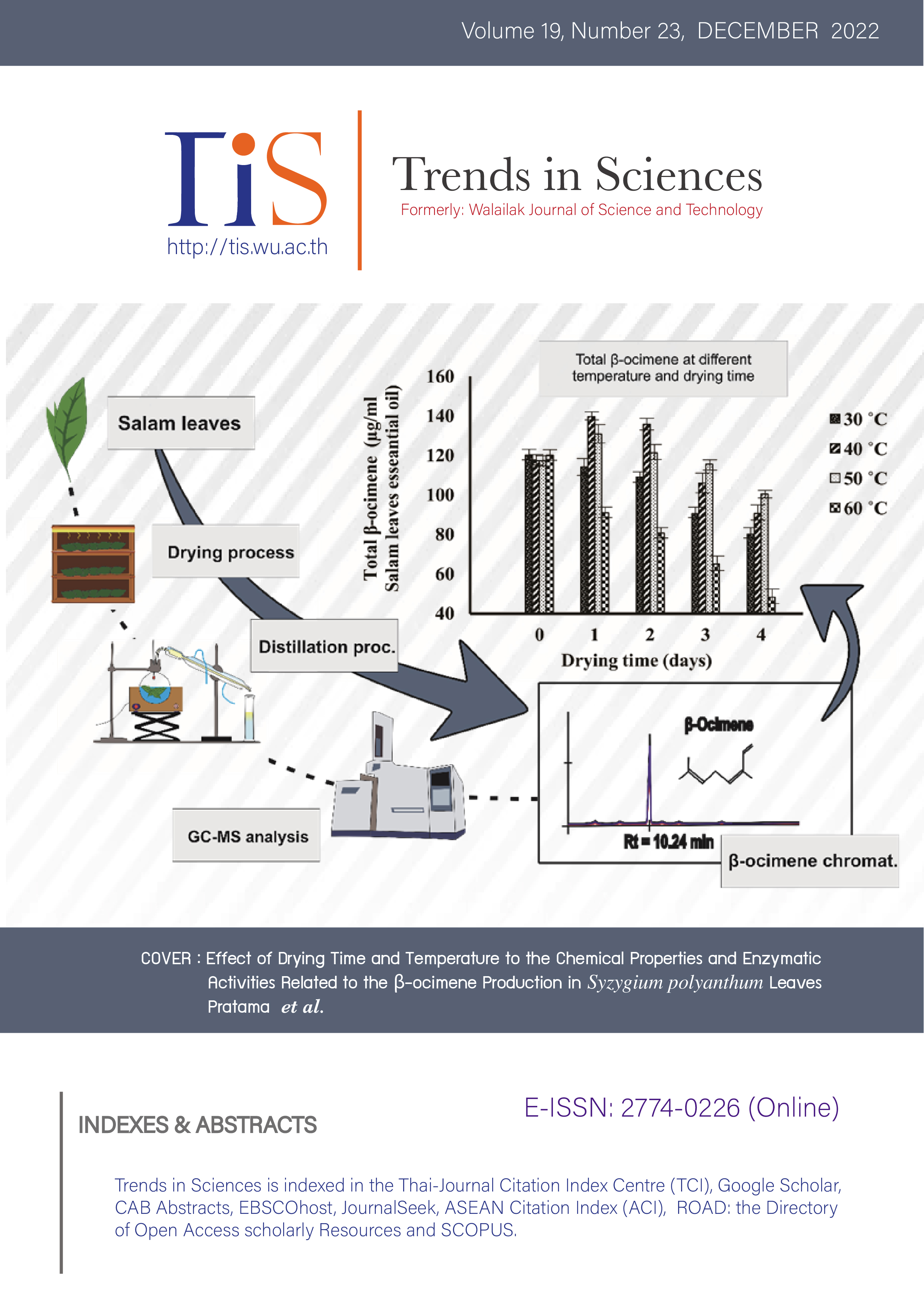
GRAPHICAL ABSTRACT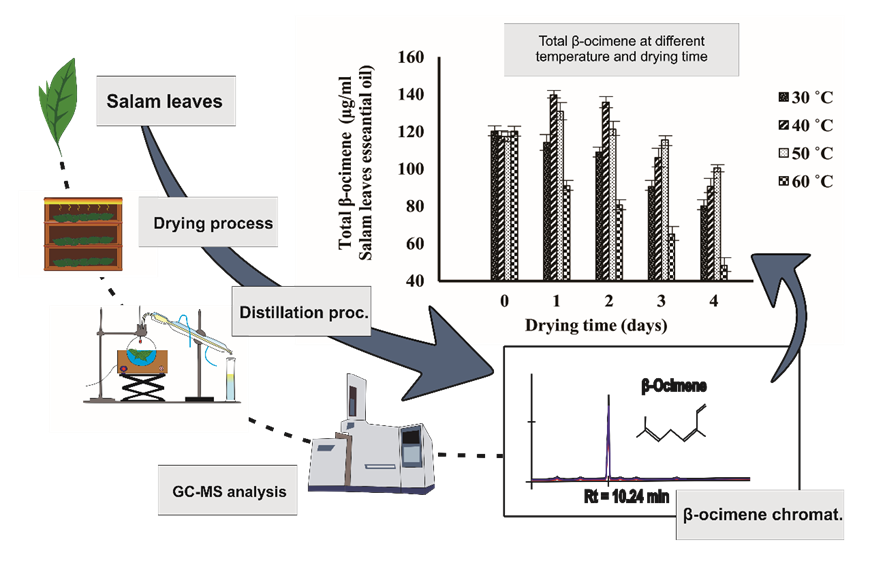
Downloads
References
ID Dewijanti, W Mangunwardoyo, N Artanti and M Hanafi. Bioactivities of Salam leaf (Syzygium polyanthum (Wight) Walp). AIP Conf. Proc. 2019; 2168, 020072.
AD Mahmoud, AM Ali, MM Khandaker, HNN Fatihah, NA Awang and N Mat. Discrimination of Syzygium polyanthum cultivars (Wight) Walp based on essential oil composition. J. Agrobiotech. 2019; 10, 1-9.
NM Wartini, PT Ina and GPG Putra. Perbedaan kandungan senyawa volatil daun Salam (Eugenia polyantha Wight) pada beberapa proses curing. J. Agritech. 2010; 30, 231-6.
B Avula, YH Wang, Z Ali, TJ Smillie, V Filion, A Cuerrier, JT Arnason and IA Khan. RP-HPLC determination of phenylalkanoids and monoterpenoids in Rhodiola rosea and identification by LC-ESI-TOF. Biomed. Chromatogr. 2010; 24, 682.
LM Bomfim, LRA Menezes, ACBC Rodrigues, RB Dias, CAG Rocha, MBP Soares, AFS Neto, MP Nascimento, AF Campos, LCRCE Silva, EV Costa and DP Bezerra. Antitumour activity of the microencapsulation of annona vepretorum essential oil. Basic Clin. Pharmacol. Toxicol. 2016; 188, 208-13.
M Sayyah, L Nadjafnia and M Kamalinejad. Anticonvulsant activity and chemical composition of Artemisia dracunculus L. essential oil. J. Ethnopharmacol. 2004; 94, 283-7.
J Valente, M Zuzarte, MJ Gonçalves, MC Lopes, C Cavaleiro, L Salgueiro and MT Cruz. Antifungal, antioxidant and anti-inflammatory activities of Oenanthe crocata L. essential oil. Food Chem. Toxicol. 2013; 62, 349-54.
P Cascone, L Iodice, ME Maffei, S Bossi, GI Arimura and E Guerrieri. Tobacco overexpressing β-ocimene induces direct and indirect responses against aphids in receiver tomato plants. J. Plant Physiol. 2015; 173, 28-32.
M Schott, B Klein and A Vilcinskas. Detection of illicit drugs by trained honeybees (Apis mellifera). PLoS One 2015; 10, e0128528.
D Tritsch, A Hemmerlin, TJ Bach and M Rohmer. Plant isoprenoid biosynthesis via the MEP pathway: In vivo IPP/DMAPP ratio produced by (E)-4-hydroxy-3-methylbut-2-enyl diphosphate reductase in tobacco BY-2 cell cultures. FEBS Lett. 2010; 584, 129-34.
F Zhou and E Pichersky. More is better: The diversity of terpene metabolism in plants. Curr. Opin. Plant Biol. 2020; 55, 1-10.
C Külheim, SH Yeoh, J Maintz, WJ Foley and GF Moran. Comparative SNP diversity among four Eucalyptus species for genes from secondary metabolite biosynthetic pathways. BMC Genomics 2009; 10, 452.
R Zheng, C Liu, Y Wang, J Luo, X Zeng, H Ding, W Xiao, J Gan and C Wang. Expression of mep pathway genes and non-volatile sequestration are associated with circadian rhythm of dominant terpenoids emission in Osmanthus fragrans Lour. flowers. Front. Plant Sci. 2017; 8, 1869.
R Jutamongkon and S Charoenrein. Effect of temperature on the stability of fruit bromelain from smooth cayenne pineapple. Kasetsart J. Nat. Sci. 2010; 44, 943-8.
KS Raja, FS Taip, MMZ Azmi and MRI Shishir. Effect of pre-treatment and different drying methods on the physicochemical properties of Carica papaya L. leaf powder. J. Saudi Soc. Agric. Sci. 2019; 18, 150-6.
ZH Loh and YY Lim. Drying effects on antioxidant activity, enzyme activity, and phytochemicals of avocado (Persea americana) leaves. J. Food Process. Preserv. 2018; 42, e13667.
BP Pratama, Supriyadi, RT Swasono and Y Pranoto. Different leaf maturities and withering durations affect the antioxidant potential and aroma compound of Indonesian bay leaf [Syzygium polyanthum (Wight) Walp.]. Int. Food Res. J. 2021; 28, 1196-203.
AR Sloan, ML Dunn, LK Jefferies, OA Pike, SEN Barrows and FM Steele. Effect of water activity and packaging material on the quality of dehydrated taro (Colocasia esculenta (L.) Schott) slices during accelerated storage. Int. J. Food Sci. 2016; 2016, 9860139.
FI Abdullah, LS Chua and Z Rahmat. Comparison of protein extraction methods for the leaves of Ficus deltoidea. J. Fundam. Appl. Sci. 2017; 9, 908-24.
HU Kosegarten, B Hoffmann and K Mengel. Apoplastic pH and Fe3+ reduction in intact sunflower leaves. Plant Physiol. 1999; 121, 1069-79.
GE Lester, DM Hodges, RD Meyer and KD Munro. Pre-extraction preparation (fresh, frozen, freeze-dried, or acetone powdered) and long-term storage of fruit and vegetable tissues: Effects on antioxidant enzyme activity. J. Agric. Food Chem. 2004; 52, 216-73.
LP Wright and MA Phillips. Measuring the activity of 1-deoxy-D-xylulose 5-phosphate synthase, the first enzyme in the MEP pathway, in plant extracts. Methods Mol. Biol. 2014; 1153, 9-20.
TH Chang, FL Hsieh, TP Ko, KH Teng, PH Liang and AHJ Wang. Structure of a heterotetrameric geranyl pyrophosphate synthase from mint (Mentha piperita) reveals intersubunit regulation. Plant Cell 2010; 22, 454-67.
N Dudareva, D Martin, CM Kish, N Kolosova, N Gorenstein, J Fäldt, B Miller and J Bohlmann. (E)-β-ocimene and myrcene synthase genes of floral scent biosynthesis in snapdragon: Function and expression of three terpene synthase genes of a new terpene synthase subfamily. Plant Cell 2003; 15, 1227-41.
EJ Gomez, JA Delgado and JM Gonzalez. Influence of water availability and temperature on estimates of microbial extracellular enzyme activity. PeerJ 2021; 9, e10994.
S Mujaffar and S Bynoe. Investigations into hot air and microwave drying of the west. In: Proceedings of the 7th European Drying Conference, Torino, Itali. 2019, p. 23.
TP Labuza, ND Heidelbaugh, M Silver and M Karel. Oxidation at intermediate moisture contents. J. Am. Oil Chem. Soc. 1971; 48, 86-90.
Z Ai, B Zhang, Y Chen, Z Yu, H Chen and D Ni. Impact of light irradiation on black tea quality during withering. J. Food Sci. Technol. 2017; 54, 1212-27.
RF Mechlouch, W Elfalleh, M Ziadi, H Hannachi, M Chwikhi, AB Aoun, I Elakesh and F Cheour. Effect of different drying methods on the physico-chemical properties of tomato variety 'Rio Grande'. Int. J. Food Eng. 2012; 8, 4.
AB Ninfa. Fundamental laboratory approaches for biochemistry and biotechnology. 2nd eds. John Wiley, Hoboken, New Jersey, 2010.
LCAD Silva, TL Honorato, RS Cavalcante, TT Franco and S Rodrigues. Effect of pH and temperature on enzyme activity of chitosanase produced under solid stated fermentation by Trichoderma spp. Indian J. Microbiol. 2012; 52, 60-5.
S Handa, D Ramamoorthy, TJ Spradling, WC Guida, JH Adams, KG Bendinskas and DJ Merkler. Production of recombinant 1-deoxy-d-xylulose-5-phosphate synthase from Plasmodium vivax in Escherichia coli. FEBS Open Bio 2013; 3, 124-9.
ZA Demissie, LAE Erland, MR Rheault and SS Mahmoud. The biosynthetic origin of irregular monoterpenes in Lavandula: Isolation and biochemical characterization of a novel cis-prenyl diphosphate synthase gene, lavandulyl diphosphate synthase. J. Biol. Chem. 2013; 288, 6333-41.
D Andres-Montaner. 2008, Study of gene regulation and function of monoterpene synthases in Holm oak (Quercus ilex L.) and transgenic birch (Betula pendula Roth) (in German). Ph. D. Thesis. Albert Ludwig University of Freiburg, Freiburg, Germany.
R Rehman, MA Hanif, Z Mushtaq and AM Al-Sadi. Biosynthesis of essential oils in aromatic plants. Food Rev. Int. 2016; 32, 117-60.
Downloads
Published
How to Cite
Issue
Section
License
Copyright (c) 2022 Walailak University

This work is licensed under a Creative Commons Attribution-NonCommercial-NoDerivatives 4.0 International License.





