
The Improvement of Phenolic Contents, Antioxidant Activity, and the Appearance of Black Tea Extract by Combination Viscozyme and Tyrosinase Addition
DOI:
https://doi.org/10.48048/tis.2025.8656Keywords:
Antioxidant activity, Phenolic contents, Ready-to-drink tea, Tyrosinase, ViscozymeAbstract
The problem with ready-to-drink (RTD) black tea is a long manufacturing process and contains phenolic compounds and low antioxidant activity due to the enzymatic oxidation process. Viscozyme is an enzyme that degrades plant cell walls during extraction so that it releases active components from the cell wall, such as phenolic contents and antioxidant activity. Meanwhile, tyrosinase includes the polyphenol oxidase enzyme, which can take advantage of catechins conversion into theaflavins and thearubigins. This study aimed to determine the addition of viscozyme and tyrosinase combination to increase the content of phenolic compounds, antioxidant activity, and improve the appearance of black tea (color). The study used young leaves that had their enzymes inactivated was added with viscozyme to fresh tea leaves extract. The tea extract that had been given viscozyme was then added with tyrosinase, and the incubation was carried out. The addition of tyrosinase with higher concentrations (3,571 U/mL) and longer incubation times (40 min) decreased total phenolic contents, antioxidant activity using DPPH free radical scavenging method, increased tea cream formation (precipitation that forms as the tea cools), the compound of theaflavins, thearubigins, and TF:TR ratio (comparison of theaflavins and thearubigins contents) in tea extracts that had been treated with viscozyme. The combination of viscozyme and tyrosinase gave higher total phenolic compounds, antioxidant activity, theaflavins, thearubigins content, and TF:TR ratio compared to control and could prevent the formation of tea cream. The use of viscozyme 250 µL and tyrosinase 3,571 U/mL for 20 min on ready-to-drink black tea gave the best effects in this study.
HIGHLIGHTS
- RTD tea has an extensive manufacturing procedure and contains phenolic components. However, its antioxidant efficacy is minimal because of the enzymatic oxidation process.
- Viscozyme is an enzyme that breaks down the cell walls of plants during extraction to liberate active components, such as phenolic contents and antioxidant activity, from the cell wall.
- Tyrosinase contains the polyphenol oxidase enzyme, which can utilise catechins to produce theaflavins and thearubigins.
- Increasing the quantity and incubation duration of tyrosinase resulted in a reduction in both total phenolic contents and antioxidant activity as measured by DPPH. However, the concentration of theaflavins and thearubigins was elevated.
- The utilisation of viscozyme and tyrosinase resulted in an enhanced antioxidant profile.
GRAPHICAL ABSTRACT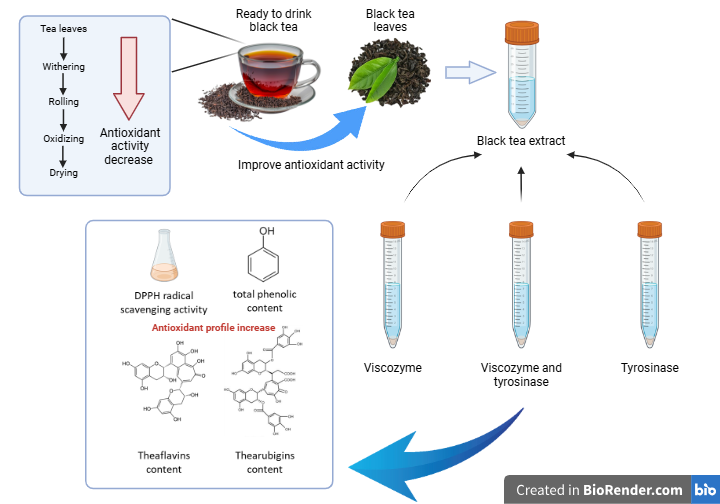
Downloads
References
VR Preedy. Tea in health and disease prevention. Elsevier Science, Amsterdam, Netherlands, 2013.
CD Wu and G Wei. Tea as a functional food for oral health. Nuttrition 2002; 18(5), 443-444.
A Ghosh, B Tudu, P Tamuly, N Bhattacharyy and R Bandyopadhyay. Prediction of theaflavin and thearubigin content in black tea using a voltammetric electronic tongue. Chemometrics and Intelligent Laboratory Systems 2012; 116, 57-66.
N Kuhnert, JW Drynan, J Obuchowicz, MN Clifford and M Witt. Mass spectrometric characterization of black tea thearubigins leading to an oxidative cascade hypothesis for thearubigin formation. Rapid Communications in Mass Spectrometry 2010; 24(23), 3387-3404.
UW Stodt, N Blauth, S Niemann, J Stark, V Pawar, S Jayaraman, J Koek and UH Engelhardt. Investigation of processes in black tea manufacture through model fermentation (Oxidation) experiments. Journal of Agricultural and Food Chemistry 2014; 62(31), 7854-7861.
J Park and K Na. Effect of RTD tea drinks selection attributes on the purchase satisfaction and repurchase intention: Evidence in Korea. Indian Journal of Science and Technology 2015; 8(S8), 242.
KK Dubey, M Janve, A Ray and RS Singhal. Ready-to-drink tea. Elsevier Science, Amsterdam, Netherlands, 2020.
HN Fadlillah, HS Ramadhan, J Hermanianto and L Felanesa. Study on sweetener selection in Rtd tea beverages. Jurnal Teknologi dan Industri Pangan 2020; 31(1), 1-8.
A Nugraha, U Sumarwan and M Simanjuntak. Faktor determinan preferensi dan perilaku konsumsi teh hitam dan hijau. Jurnal Manajemen & Agribisnis 2017; 14(3), 198-208.
F Meriza, DAH Lestari and A Soelaiman. Sikap dan kepuasan rumah tangga konsumen teh celup sariwangi dan sosro di bandar lampung. Jurnal Ilmu Ilmu Agribisnis 2016; 4(1), 67-75.
DR Faustina, R Gunadi, A Fitriani and S Supriyadi. Alteration of phenolic and volatile compounds of tea leaf extract by tyrosinase and β -glucosidase during preparation of ready-to-drink tea on farm. International Journal of Food Science 2022; 2022, 1977762.
AJW Verloop, H Gruppen, R Bisschop and J Vincken. Altering the phenolics profile of a green tea leaves extract using exogenous oxidases. Food Chemistry 2016; 196, 1197-1206.
HTT Hang, PLT Anh, TTC Phuong and TC Hai. A study on the antioxidant compounds extraction from the old tea leaves with supporting of viscozyme enzyme. Process Science Seminars 2017; 3, 147-155.
Y Hong, EY Jung, Y Park, K Shin, TY Kim, K Yu, UJ Chang and J Suh. Enzymatic improvement in the polyphenol extractability and antioxidant activity of green tea extracts. Bioscience, Biotechnology, and Biochemistry 2013; 77(1), 22-29.
C Yabuki, K Yagi and F Nanjo. Highly efficient synthesis of theaflavins by tyrosinase from mushroom and its application to theaflavin related compounds. Process Biochemistry 2017; 55, 61-69.
Stellenbosch University, Available at: http://hdl.handle.net/10019.1/50343, accessed April 2024.
A Narai-kanayama, A Kawashima, Y Uchida, M Kawamura and T Nakayama. Specificity of tyrosinase-catalyzed synthesis of theaflavins. Journal of Molecular Catalysis B: Enzymatic 2017; 133(1), S425-S428.
A Narai-kanayama, Y Uchida, A Kawashima and T Nakayama. Elimination of hydrogen peroxide enhances tyrosinase-catalyzed synthesis of theaflavins. Process Biochemistry 2019; 85, 19-28.
R Cleverdon, Y Elhalaby, MD McAlpine W Gittings and WE Ward. Total polyphenol content and antioxidant capacity of tea bags: Comparison of black, green, red rooibos, chamomile and peppermint over different steep times. Beverages 2018; 4(1), 15.
A Zaiter, L Becker, M Karam and A Dicko. Effect of particle size on antioxidant activity and catechin content of green tea powders. Journal of Food Science and Technology 2016; 53(4), 2025-2032.
S Raghuwanshi, S Misra and S Saxena. Enzimatic treatment of black tea (CTC and kangra orthodox) using penicillium charlesii tannase to improve the quality of tea. Journal of Food Processing and Preservation 2012; 37(5), 855-863.
MR Ullah, N Gogoi and D Baruah. The effect of withering on fermentation of tea leaf and development of liquor characters of black teas. Journal of the Science of Food and Agriculture 1984; 35, 1142-1147.
VSP Chaturvedula and I Prakash. The aroma, taste, color and bioactive constituents of tea. Journal of Medicinal Plants Research 2011; 5(11), 2110-2124.
H Deka, PP Sarmah, A Devi, P Tamuly and T Karak. Changes in major catechins, caffeine, and antioxidant activity during CTC processing of black tea from North East India. RSC Advances 2021; 11, 11457-11467.
P Carloni, L Tiano, L Padella, T Bacchetti, C Customu, A Kay and E Damiani. Antioxidant activity of white, green and black tea obtained from the same tea cultivar. Food Research International 2013; 53(2), 900-908.
Y Xu, H Zhao, M Zhang, C Li, X Lin, J Sheng and W Shi. Variations of antioxidant properties and NO scavenging abilities during fermentation of tea. International Journal of Molecular Sciences 2011; 12(7), 4574-4590.
Y Liang, J Lu and L Zhang. Comparative study of cream in infusions of black tea and green tea [Camellia sinensis ( L.) O. Kuntze]. International Journal of Food Science & Technology 2002; 37(6), 627-634.
E Jobstl, JPA Fairclough, AP Davies and MP Williamson. Creaming in black tea. Journal of Agricultural and Food Chemistry 2005; 53(20), 7997-8002.
AJ Charlton, AL Davis, DP Jones, JR Lewis, AP Davies, E Haslam and MP Williamson. The self-association of the black tea polyphenol thea fl avin and its complexation with caffeine. Journal of the Chemical Society, Perkin Transactions 2 2000; 2, 317-322.
SK Sinha and SK Ghaskadbi. Thearubigins rich black tea fraction reveals strong antioxidant activity. International Journal of Green Pharmacy 2013; 7(4), 336-344.
S Seo, VK Sharma and N Sharma. Mushroom tyrosinase: Recent prospects. Journal of Agricultural and Food Chemistry 2003; 51(10), 2837-2853.
FM Ngure, JK Wanyoko, SM Mahungu and AA Shitandi. Catechins depletion patterns in relation to theaflavin and thearubigins formation. Food Chemistry 2009; 115(1), 8-14.
BB Borse and LJM Rao. Novel bio-chemical profiling of indian black teas with reference to quality parameters bioequivalence & bioavailability. Journal of Bioequivalence & Bioavailability 2012; S14, 1-16.
LK Leung, Y Su, R Chen, Z Zhang, Y Huang and ZY Chen. Theaflavins in black tea and catechins in green tea are equally. Journal of Nutrition 2001; 131(9), 2248-2251.
S Shabri and H Maulana. Synthesis and isolation of theaflavin from fresh tea leaves as bioactive ingredient of antioxidant supplements. urnal Penelitian Teh dan Kina 2017; 20(1), 1-12.
A Imran, MU Arshad, MS Arshad, M Imran, F Saeed and M Sohaib. Lipid peroxidation diminishing perspective of isolated theaflavins and thearubigins from black tea in arginine induced renal malfunctional rats. Lipids in Health and Disease 2018; 17(1), 157.
CMSC Chandrasekara, VGG Chandrajith and I Wickramasinghe. Analysis of the effect dosage of the enzyme pretreatment on different physicochemical characteristics of black tea extract. European Journal of Biotechnology and Bioscience 2018; 6(3), 45-47.
N Subramanian, P Venkatesh, S Ganguli and VP Sinkar. Role of polyphenol oxidase and peroxidase in the generation of black tea theaflavins. Journal of Agricultural and Food Chemistry 1999; 47(7), 2571-2578.
T Samanta, V Cheeni, S Das, AB Roy, BC Ghosh and A Mitra. Assessing biochemical changes during standardization of fermentation time and temperature for manufacturing quality black tea. Journal of Food Science and Technology 2015; 52(4), 2387-2393.

Downloads
Published
How to Cite
Issue
Section
License
Copyright (c) 2024 Walailak University

This work is licensed under a Creative Commons Attribution-NonCommercial-NoDerivatives 4.0 International License.





