
Anti-Allergy Effect of Probiotic Goat Milk Yogurt with Indonesian Indigenous Bacteria Streptococcus thermophilus Dad-11 and Lactiplantibacillus plantarum subsp. plantarum Dad-13
DOI:
https://doi.org/10.48048/tis.2025.9780Keywords:
Yogurt, Goat milk, Anti-allergy, RBL-2H3 cells, Probiotic, Lactiplantibacillus plantarum subsp. Plantarum Dad-13, Streptococcus thermophilus Dad-11Abstract
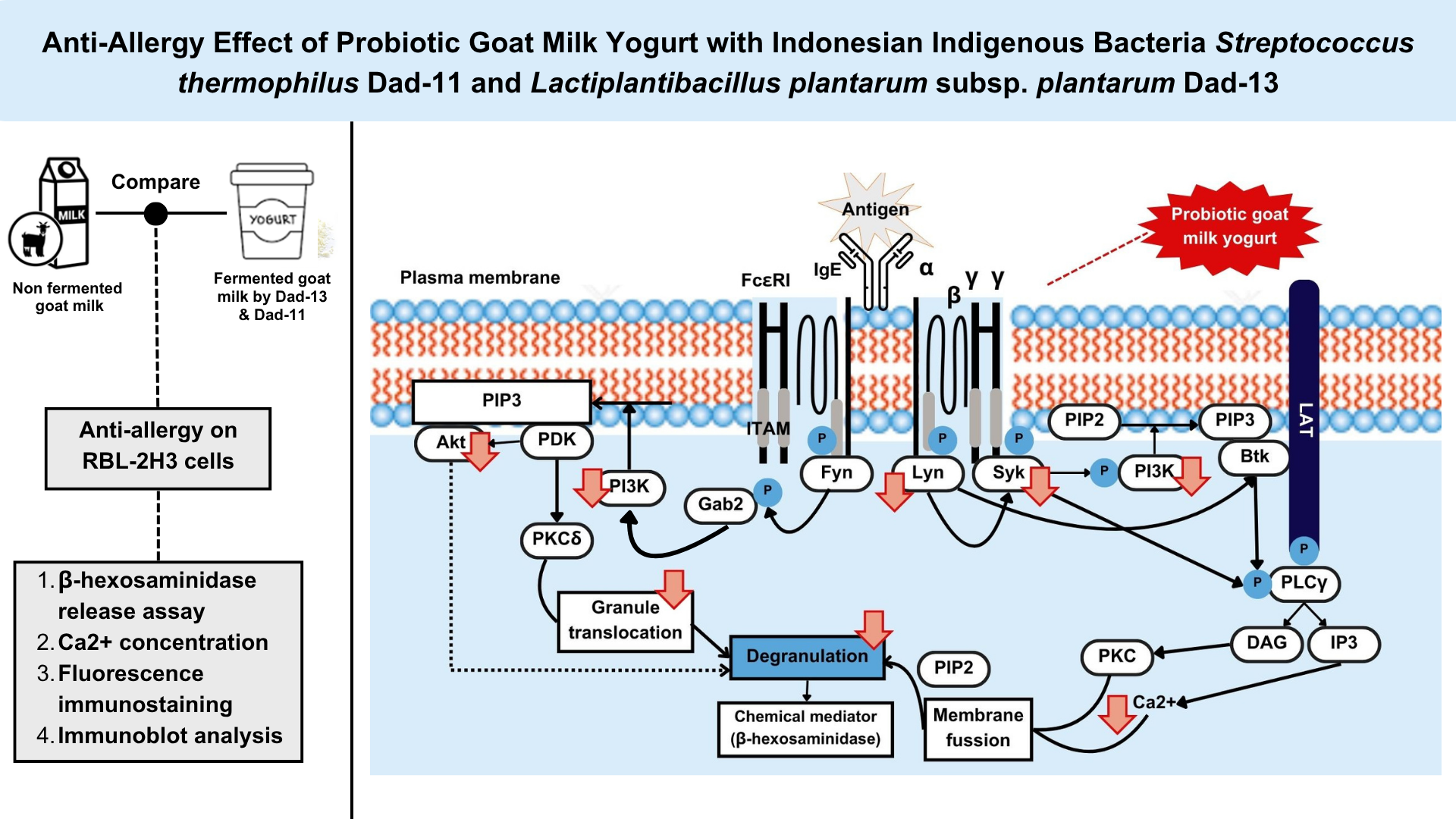
Goat milk yogurt produced by an alternate culture of Indonesian Indigenous bacteria S. thermophilus Dad-11 and Lactiplantibacillus plantarum subsp. plantarum Dad-13 was made for the diversification of local goat milk products. The functionality of the product was evaluated to increase its value, which added to the probiotic properties. The study aimed to assess the anti-allergic properties of goat milk yogurt by identification of β-hexosaminidase release, intracellular Ca2+ concentration, microtubule formation, and western blotting in RBL-2H3 cells system. The GABA of goat milk yogurt was 97.9 ppm and no cytotoxicity was observed in the yogurt against RBL-2H3 cells. The yogurt water extract showed a more substantial anti-degranulation effect on RBL-2H3 cells than that of goat milk by suppressing the influx of Ca2+ into the cytosol and inhibiting microtubule formation. As further identification, the yogurt showed suppressive effects on the phosphorylation of Syk and PI3K, while slightly suppressing the phosphorylation of Akt and Lyn signaling pathways involved in degranulation. It can be concluded that goat milk yogurt fermented by Streptococcus thermophilus Dad-11 and Lactiplantibacillus plantarum subsp. plantarum Dad-13 have potential health benefits due to GABA content and anti-allergic effects.
HIGHLIGHTS
- Probiotic goat milk yogurt effectively produced by the mixture fermentation of Lactiplantibacillus plantarum plantarum Dad-13 and Streptococcus thermophilus Dad-11.
- Probiotic goat milk yogurt fermented by Lactiplantibacillus plantarum plantarum Dad-13 and Streptococcus thermophilus Dad-11 have better activity in producing GABA and performing anti-allergy properties than non-fermented goat milk.
- The effect of anti-allergy on probiotic goat milk yogurt was performed by suppressing the influx of Ca2+ into the cytosol and inhibiting microtubule formation.
GRAPHICAL ABSTRACT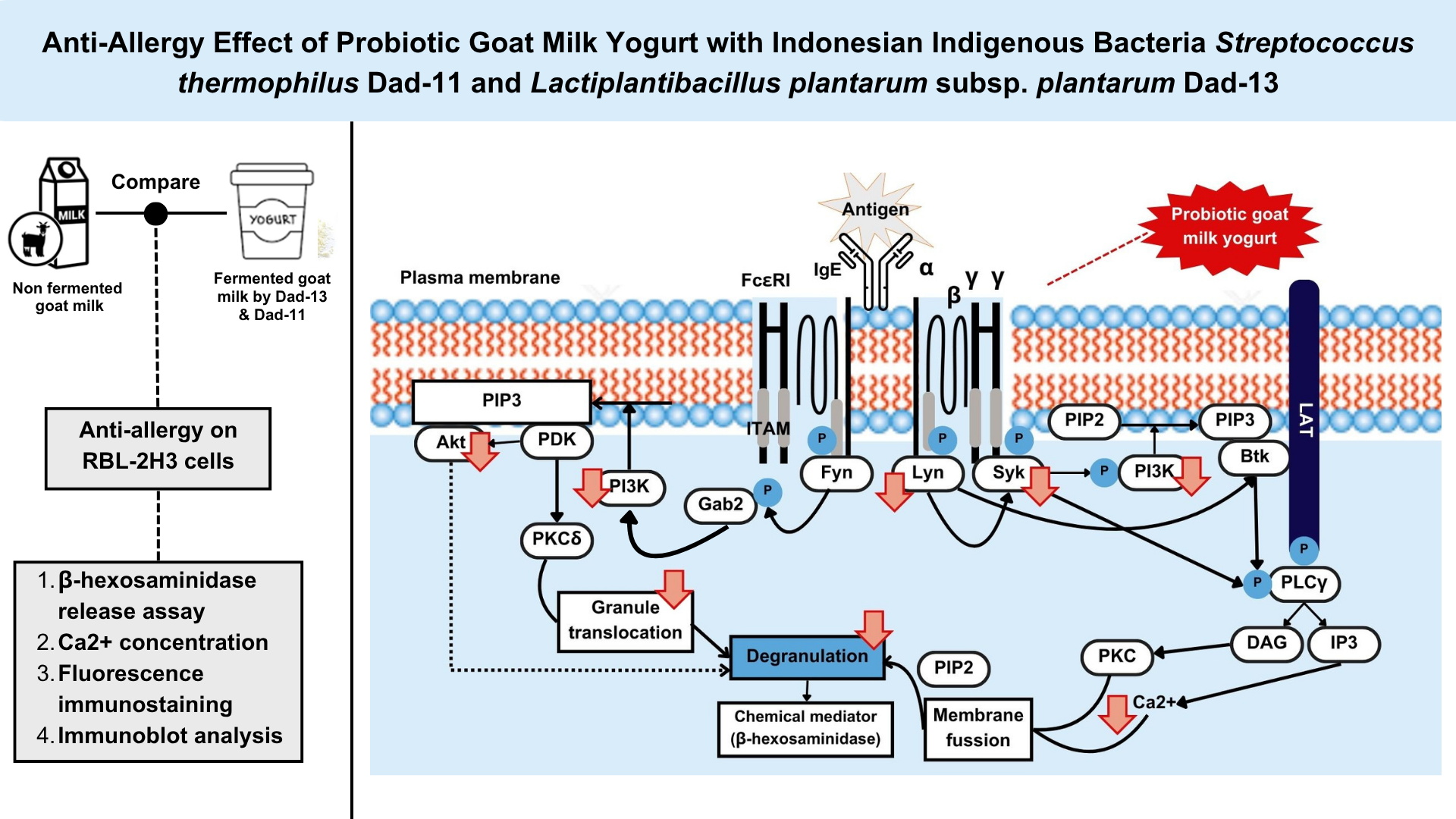
Downloads
References
D Lendvai-Emmert, V Emmert, A Makai, K Fusz, V Premusz, K Eklics, P Sarlos, P Toth, K Amrein and G Toth. Fecal calprotectin levels in pediatric cow’s milk protein allergy. Frontiers in Pediatrics 2022; 9(10), 945212.
OI Guney. Consumer attitudes towards goat milk and goat milk products: A pilot survey in south east of turkey. Turkish Journal of Agriculture - Food Science and Technology. 2019; 7(2), 314.
TB Bedir and H Kuleasan. Determination of microbial properties of freeze dried traditional cheese. Turkish Journal of Agriculture - Food Science and Technology 2019; 7(4), 688.
AB Shori and AS Baba. Fermented milk derives bioactive peptides with antihypertensive effects. Integrative Food, Nutrition and Metabolism 2015; 2(3), 180-183.
B Foligne, S Parayre, R Cheddani, MH Famelart, MN Madec, C Plé, J Breton, J Dewulf, G Jan and SM Deutsch. Immunomodulation properties of multi-species fermented milks. Food Microbiology 2016; 53, 60-69.
S Saito, A Okuno, Z Peng, DY Cao and NM Tsuji. Probiotic lactic acid bacteria promote anti-tumor immunity through enhanced major histocompatibility complex class I-restricted antigen presentation machinery in dendritic cells. Frontiers in Immunology 2024; 15, 1335975.
JY Jung, JS Shin, SG Lee, YK Rhee, CW Cho, HD Hong and KT Lee. Lactobacillus sakei K040706 evokes immunostimulatory effects on macrophages through TLR 2-mediated activation. International Immunopharmacology 2015; 28(1), 88-96.
JY Kim, JY Kim, H Kim, EC Moon, K Heo, JJ Shim and JL Lee. Immunostimulatory effects of dairy probiotic strains Bifidobacterium animalis ssp. lactis HY8002 and Lactobacillus plantarum HY7717. Journal of Animal Science and Technology 2022; 64(6), 1117-1131.
SH Son, SJ Yang, HL Jeon, HS Yu, NK Lee, YS Park and HD Paik. Antioxidant and immunostimulatory effect of potential probiotic Lactobacillus paraplantarum SC61 isolated from Korean traditional fermented food, jangajji. Microbial Pathogenesis 2018; 125, 486-492.
CS Ranadheera, CA Evans, MC Adams and SK Baines. Probiotic viability and physico-chemical and sensory properties of plain and stirred fruit yogurts made from goat’s milk. Food Chemistry 2012; 135(3), 1411-1418.
ES Rahayu, MN Cahyanto, Mariyatun, MA Sarwoko, P Haryono and L Windiarti. Effects of consumption of fermented milk containing indigenous probiotic lactobacillus plantarum dad-13 on the fecal microbiota of healthy Indonesian volunteers. International Journal of Probiotics & Prebiotics. 2016; 11(2), 99.
T Utami, A Cindarbhumi, MC Khuangga, ES Rahayu, MN Cahyanto, S Nurfiyani and E Zulaichah. Preparation of Indigenous Lactic Acid Bacteria Starter Cultures for Large Scale Production of Fermented Milk. Digital Press Life Sciences 2020; 2, 00010.
TW Kusuma. 2023, Produksi Asam Gamma-Aminobutirat (GABA) dari Isolat Lokal Bakteri Asam Laktat. Master Thesis. University of Gadjah Mada, Bulaksumur, Indonesia.
H Yoshioka, M Ishida, K Nishi, H Oda, H Toyohara and T Sugahara. Studies on anti-allergic activity of Sargassum horneri extract. Journal of Functional Foods 2014; 10, 154-160.
Y Kitamura, K Nishi, M Ishida, S Nishimoto and T Sugahara. Anti-Allergic effect of aqueous extract of coriander (Coriandrum sativum L.) leaf in RBL-2H3 cells and cedar pollinosis model mice. Nutraceuticals 2022; 2(3),
-180.
J Woraratphoka, S INNOK, P Soisungnoen, V Tanamool and W Soemphol. γ-Aminobutyric acid production and antioxidant activities in fresh cheese by Lactobacillus plantarum L10-11. Food Science and Technology 2021; 42, 03121.
A Kawasaki, T Hara and T Joh. Inhibitory Effect of γ-Aminobutyric Acid (GABA) on histamine release from rat basophilic leukemia RBL-2H3 cells and rat peritoneal exudate cells. Nippon Shokuhin Kagaku Kogaku Kaishi 2014; 61(8), 362-366.
F Minervini, MT Bilancia, S Siragusa, M Gobbetti and F Caponio. Fermented goats’ milk produced with selected multiple starters as a potentially functional food. Food Microbiology 2009; 26(6), 559-564.
R Cohen, DA Holowka and BA Baird. Real-time imaging of Ca(2+) mobilization and degranulation in mast cells. Methods in Molecular Biology 2015; 1220, 347-363.
EFSA Panel on Dietetic Products and Nutrition and Allergies (NDA). Scientific opinion on the substantiation of health claims related to live yoghurt cultures and improved lactose digestion (ID 1143, 2976) pursuant to article 13(1) of Regulation (EC) No 1924/2006. EFSA Journal 2010; 8(10), 1763.
ER Vedamuthu. Starter cultures for yogurt and fermented milks. Manufacturing Yogurt and Fermented Milks 2006. https://doi.org/10.1002/9780470277812.ch6
T Vasiljevic and NP Shah. Probiotics-from metchnikoff to bioactives. International Dairy Journal 2008; 18(7), 714-728.
L Yu, X Han, S Chen, G Duaan, S Feng, Y Xue, F Tian, J Zhao, H Zhang, Q Zhai and W Chen. Beneficial effect of GABA-rich fermented milk on insomnia involving regulation of gut microbiota. Microbiological Research 2020; 233, 126409.
IBA Yogeswara, S Maneerat and D Haltrich. Glutamate decarboxylase from lactic acid bacteria-a key enzyme in GABA synthesis. Microorganisms 2020; 8(12), 1923.
A Elshemy and M Abobakr. Allergic reaction: Symptoms, diagnosis, treatment and management. Journal of Scientific & Innovative Research 2013; 2(1), 123-144.
Y Wang, B Zhao, Y Ding, N Liu, C Yang and Y Sun. Improved anti-oxidant and Anti-Bacterial capacities of skim milk fermented by Lactobacillus plantarum. Molecules 2024; 29(16), 3800.
J Sha, J Song, Y Huang, Y Zhang, H Wang, Y Zhang and H Suo. Inhibitory effect and potential mechanism of lactobacillus plantarum YE4 against dipeptidyl peptidase-4. Foods 2022; 11(1), 80.
JL Sebastian-Nicolas, E Contreras-Lopez, J Ramirez-Godinez, AE Cruz-Guerrero, GM Rodriguez-Serrano, J Anorve-Morga, J Jaimez-Ordaz, A Castaneda-Ovando, E Perez-Escalante, A Ayala-Nino and LG Gonzalez-Olivares. Milk Fermentation by Lacticaseibacillus rhamnosus GG and Streptococcus thermophilus SY-102: Proteolytic profile and ACE-Inhibitory activity. Fermentation 2021; 7(4), 215.
B Bianchi-Salvadori, P Camaschella and S Cislaghi. Rapid enzymatic method for biotyping and control of lactic acid bacteria used in the production of yogurt and some cheeses. International Journal of Food Microbiology 1995; 27(2-3), 253-261.
C Bertrand-Harb, IV Ivanova, M Dalgalarrondo and T Haertlle. Evolution of β-lactoglobulin and α-lactalbumin content during yoghurt fermentation. International Dairy Journal 2003; 13(1), 39-45.
E Fuc, D Zlotkowska and B Wroblewska. Milk and Meat Allergens from Bos taurus β-Lactoglobulin, α-Casein, and bovine serum albumin: An in-vivo study of the immune response in mice. Nutrients 2019; 11(9), 2095.
J Shi, Y Luo, Y Xiao, Z Li, Q Xu and M Yao. Effects of fermentation by Lactobacillus casei on the antigenicity and allergenicity of four bovine milk proteins. International Dairy Journal 2014; 35(1), 75-80.
RP Siraganian, ROD Castro, EA Barbu and J Zhang. Mast cell signaling: The role of protein tyrosine kinase Syk, its activation and screening methods for new pathway participants. FEBS Lett 2010; 584(24), 4933-4940.
R Sibilano, B Frossi and CE Pucillo. Mast cell activation: A complex interplay of positive and negative signaling pathway. European Journal of Immunology 2014; 44(9), 2558-2566.
WK Kanagy, C Cleyrat, M Fazel, SR Lucero, MP Bruchez, KA Lidke, BS Wilson and DS Lidke. Docking of Syk to FcεRI is enhanced by Lyn but limited in duration by SHIP1. Molecular Biology of the Cell 2022; 33(10), 89.
KH Sim, E Lee, P Shrestha, BH Choi, J Hong and YJ Lee. Isobavachin attenuates FcεRI-mediated inflammatory allergic responses by regulating SHP-1-dependent Fyn/Lyn/Syk/Lck signaling. Biochemical Pharmacology 2025; 232, 116698.
J Zhong, N Tang, B Asadzadeh and W Yan. Measurement and correlation of solubility of theobromine, theophylline, and caffeine in water and organic solvents at various temperatures. Journal of Chemical and Engineering Data 2017; 62(9), 2570-2577.
S Kraft and N Novak. Fc receptors as determinants of allergic reactions. Trends Immunol 2006; 27(2), 88-95.
AM Gilfillan and J Rivera. The tyrosine kinase network regulating mast cell activation. Immunological Reviews 2009; 228(1), 149-169.
ROD Castro. Regulation and function of Syk tyrosine kinase in mast cell signaling and beyond. Journal of Signal Transduction 2011; 2011, 507291.
K Nishida, S Yamasaki, Y Ito, K Kabu, K Hattori, T Tezuka, H Nishizumi, D Kitamura, R Goitsuka, RS Geha, T Yamamoto, T Yagi and T Hirano. FcεRI-mediated mast cell degranulation requires calcium-independent microtubule-dependent translocation of granules to the plasma membrane. Journal of Cell Biology 2005; 170(1), 115-126.
Y He, MM Sun, GG Zhang, J Yang, KS Chen, WW Xu and B Li. Targeting PI3K/Akt signal transduction for cancer therapy. Signal Transduction and Targeted Therapy 2021; 6, 425.
Y Xu, D Nan, J Fan, JS Bogan and D Toomre. Optogenetic activation reveals distinct roles of PIP3 and Akt in adipocyte insulin action. Journal of Cell Science 2016; 129(10), 2085-2095.
Published
How to Cite
Issue
Section
License
Copyright (c) 2025 Walailak University

This work is licensed under a Creative Commons Attribution-NonCommercial-NoDerivatives 4.0 International License.





