
Development of Fermented Etawa Goat Milk Containing Gamma-Aminobutyric Acid (GABA) by Indigenous Lactiplantibacillus plantarum subsp. plantarum T-3
DOI:
https://doi.org/10.48048/tis.2025.9067Keywords:
Lactiplantibacillus, Fermentation, Goat milk, Gamma-aminobutyric acidAbstract
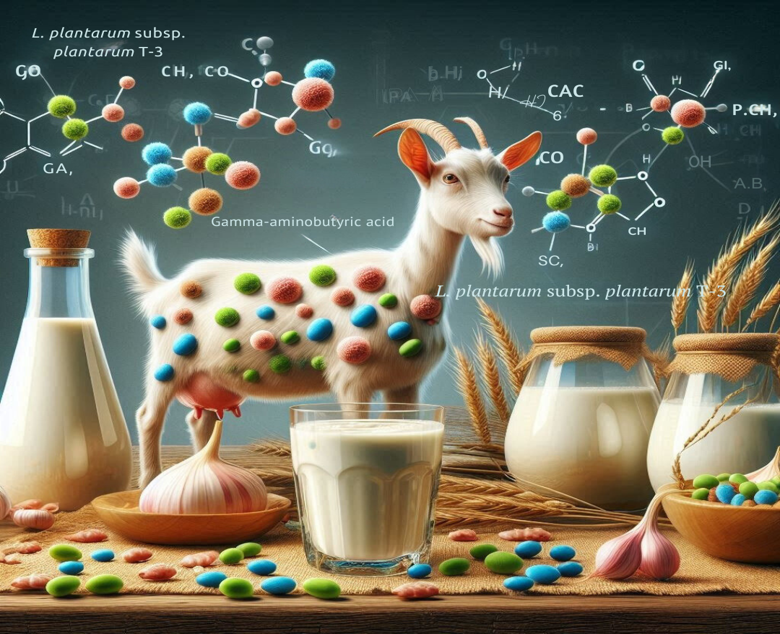
This research presents the use of an indigenous Lactiplantibacillus plantarum subsp. plantarum T-3 strain as a starter culture to produce fermented goat milk containing gamma-aminobutyric acid (GABA). The fermented goat milk drink was produced by inoculating Etawa goat milk with a 2 % (w/v) skim and 3 sugar treatments: No added sugar, 8 % (w/v) sucrose, and 8 % (w/v) glucose. The inoculum was a 1 % (v/v) culture of L. plantarum T-3 at a concentration of 107 colony-forming units (CFU) per milliliter. The concentration of GABA, the pH, titratable acidity, physicochemical properties of the fermented milk, including syneresis, water-holding capacity (WHC), viscosity, and sensory properties, were also evaluated. The product was stored for 5 weeks to ascertain its stability. The concentration of GABA increased significantly during the 24-h fermentation period. At the completion of the process, the treatment involving glucose exhibited the highest GABA concentration, reaching 164.95 mg/L, while the treatment without added sugar demonstrated the lowest concentration, at 132.68 mg/L. The organoleptic test revealed that the panelists preferred the fermented goat milk drink with added sucrose for color, aroma, viscosity, sour taste, and sweet taste. After a period of 5 weeks at a temperature of 4 °C resulted in a notable decline in GABA levels across all treatment groups. The concentration of GABA in the treatment with no added sugar was 105.34 mg/L, followed by the sucrose treatment (77.39 mg/L) and the glucose treatment, which exhibited the lowest concentration (71.33 mg/L). The total lactic acid bacteria (LAB) remained stable at a level of 109 CFU/mL, which continues to comply with the requirements of SNI 2981:2009 for yogurt quality, which stipulates a minimum of 107 CFU/mL. To further enhance sensory acceptance and GABA concentration, a more comprehensive study is necessary.
HIGHLIGHTS
- In silico analysis has demonstrated that Lactiplantibacillus plantarum plantarum T-3 possesses the genes necessary for GABA biosynthesis. This includes the genes encoding GDH and GAD.
- The findings of this study demonstrate that GABA is produced from fermented Etawa goat milk inoculated with Lactiplantibacillus plantarum plantarum T-3. The GABA produced in this study is of a higher quantity than that previously observed in studies on GABA in fermented milk with no added MSG.
- The results of the organoleptic test demonstrated that the panelists exhibited a clear preference for the fermented Etawa goat milk drink that had been treated with sucrose sugar. This preference was attributed to the fact that the drink was perceived as containing a higher level of sweetness than the other types of sugar treatment.
GRAPHICAL ABSTRACT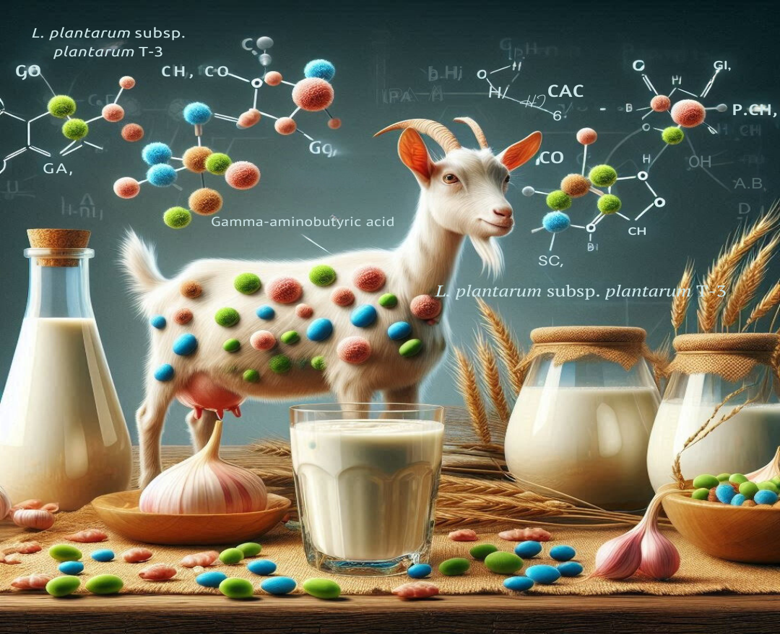
Downloads
References
SM Ameen and G Caruso. Lactic acid in the food industry. Springer, Cham, Switzerland, 2020.
A Ricci, A Allende, D Bolton, M Chemaly, R Davies, R Girones, K Koutsoumanis, L Herman, R Lindqvist, B Nørrung, L Robertson, G Ru, M Sanaa, M Simmons, P Skandamis, E Snary, N Speybroeck, BT Kuile, J Threlfall, H Wahlström, PSF Escámez. Update of the list of QPS-recommended biological agents intentionally added to food or feed as notified to EFSA 5: Suitability of taxonomic units notified to EFSA until September 2016. EFSA Journal 2017; 15(3), e04663.
K Angmo, A Kumari, Savitri and TC Bhalla. Probiotic characterization of lactic acid bacteria isolated from fermented foods and beverage of Ladakh. LWT - Food Science and Technology 2016; 66, 428-435.
L Diez-Gutiérrez, LS Vicente, LJR Barrón, MDC Villarán and M Chávarri. Gamma-aminobutyric acid and probiotics: Multiple health benefits and their future in the global functional food and nutraceuticals market. Journal of Functional Foods 2020; 64, 103669.
NRM Sahab, E Subroto, RL Balia and GL Utama. γ-Aminobutyric acid found in fermented foods and beverages: Current trends. Heliyon 2020; 6(11), e05526.
F Falah, A Vasiee, BA Behbahani, FT Yazdi and SA Mortazavi. Optimization of gamma‐aminobutyric acid production by Lactobacillus brevis PML1 in dairy sludge-based culture medium through response surface methodology. Food Science & Nutrition 2021; 9(6), 3317-3326.
Y Cui, K Miao, S Niyaphorn and X Qu. Production of gamma-aminobutyric acid from lactic acid bacteria: A systematic review. International Journal of Molecular Scieces 2020; 21(3), 995.
IBA Yogeswara, S Kittibunchakul, ES Rahayu, KJ Domig, D Haltrich and TH Nguyen. Microbial production and enzymatic biosynthesis of γ-aminobutyric acid (GABA) using Lactobacillus plantarum FNCC 260 isolated from Indonesian fermented foods. Processes 2021; 9(1), 22.
X Wang, Y Wang, B Nan, Y Cao, C Piao, X Li and Y Wang. Optimization of fermentation for gamma-aminobutyric acid (GABA) production by Lactiplantibacillus plantarum Lp3 and the development of fermented soymilk. LWT - Food Science and Technology 2023; 195, 115841.
D Ly, S Mayrhofer, IBA Yogeswara, TH Nguyen and KJ Domig. Identification, classification and screening for γ-amino-butyric acid production in lactic acid bacteria from cambodian fermented foods. Biomolecules 2019; 9(12), 768.
ES Rahayu. Lctic acid bacteria in fermented food of Indonesian origin. Agritech 2003; 23(2), 75-84.
A Batubara, S Nasution, I Subandriyo, B Inounu, Tiesnamurti and A Anggraeni. Kambing peranakan etawa, Available at: https://medium.com/@arifwicaksanaa/pengertian-use-case-a7e576e1b6bf, accessed June 2024.
DB Prajapati, DB Kapadiya, AK Jain, BM Mehta, VB Darji and KD Aparnathi. Comparison of Surti goat milk with cow and buffalo milk for physicochemical characteristics, selected processing-related parameters and activity of selected enzymes. Veterinary World 2017; 10(5), 477-484.
LS Ceballos, ER Morales, GDLT Adarve, JD Castro, LP Martínez and MRS Sampelayo. Composition of goat and cow milk produced under similar conditions and analyzed by identical methodology. Journal of Food Composition and Analysis 2009; 22(4), 322-329.
FS Hussin, SY Chay, ASM Hussin, WAW Ibadullah, BJ Muhialdin, MSA Ghani and N Saari. GABA enhancement by simple carbohydrates in yoghurt fermented using novel, self-cloned Lactobacillus plantarum Taj-Apis362 and metabolomics profiling. Scientific Reports 2021; 11, 9417.
AOAC International. Official methods of analysis of AOAC interntaional. AOAC International, Washington DC, 2005.
A Oraç and N Akın. How do different cooling temperatures affect the characteristics of set-type yoghurt gel? International Dairy Journal 2019; 97, 49-56.
TW Kusuma, DA Suroto, P Magister, I Dan, T Pangan, FT Pertanian and UG Mada. 2023, Produksi asam gamma-aminobutirat (GABA) dari isolat lokal bakteri asam laktat (in Indonesian). Ph. D. Dissertation. Universitas Gadjah Mada, Yogyakarta, Indonesia.
HD Sa, JY Park, SJ Jeong, KW Lee and JH Kim. Characterization of glutamate decarboxylase (GAD) from Lactobacillus sakei A156 isolated from jeot-gal. Journal of Microbiology and Biotechnology 2015; 25(5), 696-703.
Q Wang, X Zhang, X Huang, G Shi, C Zhang, L Jiang, K Li, C Xie, X Li and Y Wang. Discovery of an effective processing method for edible rhizome to enhance the gamma-aminobutyric acid content. Food Chemistry 2021; 375, 131862.
SJ Quillin, P Tran and A Prindle. Potential roles for gamma-aminobutyric acid signaling in bacterial communities. Bioelectricity 2021; 3(2), 120-125.
M Iorizzo, G Paventi and CD Martino. Biosynthesis of Gamma-Aminobutyric Acid (GABA) by Lactiplantibacillus plantarum in fermented food production. Current Issues in Molecular Biology 2024; 46(1), 200-220.
X Li, L Dai, H Liu, W Liu, B Pan, X Wang, J Deng, C Wang, D Zhang and Z Li. Molecular mechanisms of furanone production through the EMP and PP pathways in Zygosaccharomyces rouxii with D-fructose addition. Food Research International 2020; 133, 109137.
V Galli, M Venturi, E Mari, S Guerrini and L Granchi. Gamma-aminobutyric acid (GABA) production in fermented milk by lactic acid bacteria isolated from spontaneous raw milk fermentation. International Dairy Journal 2022; 127, 105284.
IBA Yogeswara, IGAW Kusumawati, NW Nursini, M Mariyatun, ES Rahayu and D Haltrich. Health-promoting role of fermented pigeon pea (Cajanus cajan L (Mill)) milk enriched with γ-aminobutyric acid (GABA) using probiotic Lactiplantibacillus plantarum Dad-13. Fermentation 2023; 9(7), 587.
Y Shan, CX Man, X Han, L Li, Y Guo, Y Deng, T Li, LW Zhang and YJ Jiang. Evaluation of improved γ-aminobutyric acid production in yogurt using Lactobacillus plantarum NDC75017. Journal of Dairy Science 2015; 98(4), 2138-2149.
K Zhuang, Y Jiang, X Feng, L Li, F Dang, W Zhang and C Man. Transcriptomic response to GABA-producing Lactobacillus plantarum CGMCC 1.2437T induced by L-MSG. PLoS One 2018; 13(6), e0199021.
L Anggraini, Y Marlida, W Wizna, J Jamsari and M Mirzah. Optimization of nutrient medium for Pediococcus acidilactici DS15 to produce GABA. Journal of World’s Poultry Research 2019; 9(3), 139-146.
MF Kennedi. 2021, Potensi bakteri probiotik lokal sebagai Starter susu fermentasi disusun (in Indonesian). Ph. D. Dissertation. Universitas Gadjah Mada, Yogyagarta, Indonesia.
J Yang, J Lu, Q Zhu, Y Tao, Q Zhu, C Guo, Y Fang, L Chen, AK Koyande, S Wang and PL Show. Isolation and characterization of a novel Lactobacillus plantarum MMB-07 from traditional Suanyu for Acanthogobius hasta fermentation. Journal of Bioscience and Bioengineering 2021; 132(2), 161-166.
Suharman, A Sutakwa and LS Nadia. Effects of sucrose addition to lactic acid concentrations and lactic acid bacteria population of butterfly pea (Clitoria Ternatea L.) yogurt. Journal of Physics: Conference Series 2021; 1823, 12038.
Food and Agriculture Organization of the United Nations. Standard for fermented milks. Food and Agriculture Organization of the United Nations, Rome, Italy, 2022.
X Zhang, QY Tong and F Ren. Manuscript title: Influence of glucose, sucrose and trehalose on the freeze-thaw stability of tapioca starch gels. Advance Journal Food Science and Technology 2012; 4(4), 225-230.
FAD Morais, MT Cavalcanti, LS Olegario, TQ Santos, MEM Evangelista, GBD Oliveira, AG Santana, MV Souto, SBD Fonseca and MC Gonçalves. Impact of sugar reduction on physicochemical and nutritional quality of yogurt and sensory response with label stimulation. Journal of Food Processing and Preservation 2023; 2023(1), 1439953.
M Arab, M Yousefi, E Khanniri, M Azari, V Ghasemzadeh-Mohammadi and N Mollakhalili-Meybodi. A comprehensive review on yogurt syneresis: Effect of processing conditions and added additives. Journal of Food Science and Technology 2023; 60(6), 1656-1665.
Yurliasni, Z Hanum and H Khairunnisa. Syneresis, and acidity value of fermented goat milk added with beet (Beta vulgaris L.) juice using Lactobacillus rhamnosus. IOP Conference Series: Earth and Environmental Science 2022; 951(1), 12053.
MA Ridhani, IP Vidyaningrum, NN Akmala, R Fatihatunisa, S Azzarhro and N Aini. Potensi penambahan berbagai jenis gula terhadap sifat sensori dan fisikokimia roti manis: Review (in Indonesian). Pasundan Food Technology Journal 2021; 8(3), 61-68.
X Fan, L Yu, Z Shi, C Li, X Zeng, Z Wu and D Pan. Characterization of a novel flavored yogurt enriched in γ-aminobutyric acid fermented by Levilactobacillus brevis CGMCC1.5954. Journal of Dairy Science 2023; 106(2), 852-867.
Ruvodo. Penjelasan ilmiah mengapa gula pasir grade 2 lebih manis dari grade 1. PG Rajawali 1. 2019, Available at: https://pgrajawali1.co.id/2019/02/15/penjelasan-ilmiah-mengapa-gula-pasir-grade-2-lebih-manis-dari-grade-1, accessed June 2024.
D Li, Y Cui, X Wu, J Li, F Min, T Zhao, J Zhang and J Zhang. Graduate Student Literature Review: Network of flavor compounds formation and influence factors in yogurt. Journal of Dairy Science 2024; 107(11), 8874-8886.
HA Oketch-Rabah, EF Madden, AL Roe and JM Betz. United States Pharmacopeia (USP) safety review of gamma-aminobutyric acid (GABA). Nutrients 2021; 13(8), 2742.
A El-Fattah, S Sakr, S El-Dieb and H Elkashef. Developing functional yogurt rich in bioactive peptides and gamma-aminobutyric acid related to cardiovascular health. LWT 2018; 98, 390-397.
BE Jewett and S Sharma. Physiology, GABA. StatPearls, Florida, 2018.
SB Sarasa, R Mahendran, G Muthusamy, B Thankappan, DRF Selta and J Angayarkanni. A brief review on the non-protein amino acid, gamma-amino butyric acid (GABA): Its production and role in microbes. Current Microbiology 2020; 77(4), 534-544.
M Servili, CG Rizzello, A Taticchi, S Esposto, S Urbani, F Mazzacane, ID Maio, R Selvaggini, M Gobbetti and RD Cagno. Functional milk beverage fortified with phenolic compounds extracted from olive vegetation water, and fermented with functional lactic acid bacteria. International Journal Food Microbiology 2011; 147(1), 45-52.
MS Maia, MM Domingos and JFBDS José. Viability of probiotic microorganisms and the effect of their addition to fruit and vegetable juices. Microorganisms 2023; 11(5), 1335.
E Rossi, F Restuhadi, R Efendi and YK Dewi. Physicochemical and microbiological properties of yogurt made with microencapsulation probiotic starter during cold storage. Biodiversitas 2021; 22(4), 2012-2018.
S Melia, I Juliyarsi, YF Kurnia, YE Pratama and DR Pratama. The quality of fermented goat milk produced by pediococcus acidilactici bk01 on refrigerator temperature. Biodiversitas 2020; 21(10), 4591-4596.
Y Yang, R Zhang, F Zhang, B Wang and Y Liu. Storage stability of texture, organoleptic, and biological properties of goat milk yogurt fermented with probiotic bacteria. Frontiers in Nutrition 2023; 9, 1093654.
AB Shori, GS Aljohani, AJ Al-zahrani, OS Al-sulbi and AS Baba. Viability of probiotics and antioxidant activity of cashew milk-based yogurt fermented with selected strains of probiotic Lactobacillus spp. LWT - Food Science and Technology 2021; 153, 112482.
ER Gomes, LCM Carneiro, R Stephani, AFD Carvalho, IRT Renhe, AF Wolfschoon-Pombo and IT Perrone. Effect of sugar reduction and addition of corn fibre and polydextrose on pore size and syneresis of yoghurt. International Dairy Journal 2022; 129, 105298.
HTH Nguyen, S Afsar and L Day. Differences in the microstructure and rheological properties of low-fat yoghurts from goat, sheep and cow milk. Food Research International 2018; 108, 423-429.
XX Lim, WY Koh, U Uthumporn, M Maizura and WIW Rosli. The development of legume-based yogurt by using water kefir as starter culture. International Food Research Journal 2019; 26(4), 1219-1228.
F Zhu, S Hu and L Mei. Production and quality evaluation of a novel γ-aminobutyric acid-enriched yogurt. Frontiers in Nutrition 2024; 11, 1404743.
Downloads
Published
How to Cite
Issue
Section
License
Copyright (c) 2024 Walailak University

This work is licensed under a Creative Commons Attribution-NonCommercial-NoDerivatives 4.0 International License.





