
Influence of Wet and Dry Sourdough from Pigeon Pea (Cajanus cajan L. Huth) on the Characteristics of Wheat Bread
DOI:
https://doi.org/10.48048/tis.2025.10468Keywords:
Drying, Gluten-free, Lactic acid bacteria, Pigeon pea, Sourdough, Wheat bread, YeastAbstract
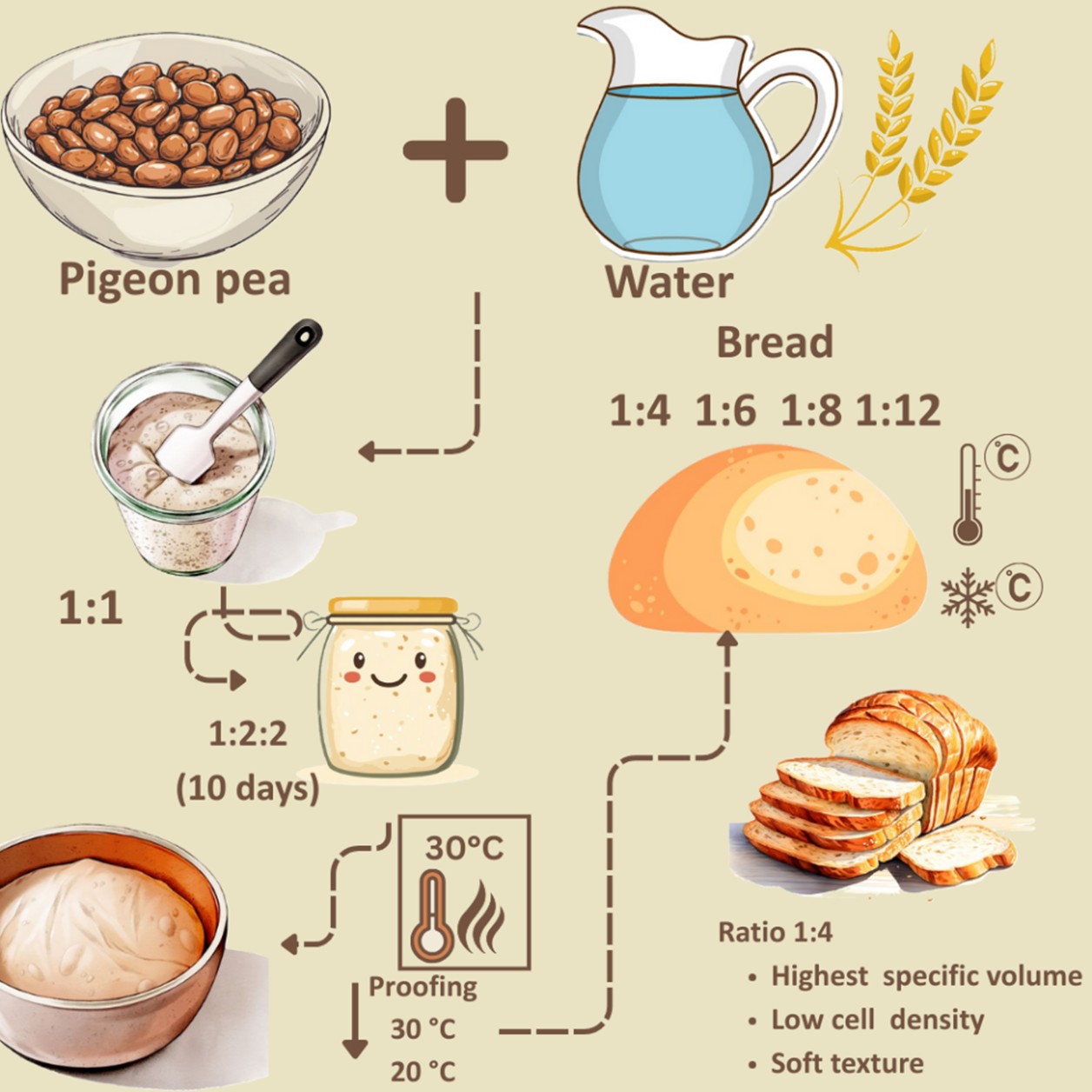
This study investigates the potential of pigeon pea as a gluten-free alternative in sourdough production. Sourdough was prepared by mixing ground pigeon pea and water at a 1:1 ratio, followed by daily feeding with a ratio of 1:2:2 (g/g) (water:sourdough:pigeon pea flour) for 10 days and dried at 30 °C for 24 h. Wet sourdough was used to make wheat bread with sourdough:wheat flour ratios of 1:4, 1:6, 1:8, 1:10, and 1:12 (g/g) and proofing temperature variations at room (30 °C) and cool temperature (20 °C). The results showed that the bread with ratio 1:4 using a wet sourdough had a high specific volume with low cell density and texture among all ratios. Thus, a ratio of 1:4 was chosen to produce bread using dry sourdough. Bread made with dry sourdough showed lower specific volume, higher cell density and increased hardness. Furthermore, various unique volatile compound profiles have been developed, with the pigeon-pea-sourdough dough (PS-dough) 1:4 having the highest alcohol, acid, and hydrocarbons; pigeon-pea-sourdough bread (PS-bread) 1:4 having the highest isovaleraldehyde; and fresh pigeon-pea-sourdough (Fresh-PS) having the highest ethyl acetate. These results indicate that wet PS has potential as a functional ingredient in wheat bread production. The study also suggests that pigeon pea could be a promising alternative for gluten-free sourdough production.
HIGHLIGHTS
- Pigeon pea sourdough as a viable gluten-free alternative in sourdough production.
- Achieved optimal bread characteristics (high specific volume, low cell density, and texture) at a 1:4 (g/g) sourdough to wheat flour ratio.
- Identified a significant impact of proofing temperature on bread quality, showing notable variations between 20 and 30 °C.
- Dry sourdough with ratio 1:4 resulting in lower specific volume, higher cell density, and increased hardness.
GRAPHICAL ABSTRACT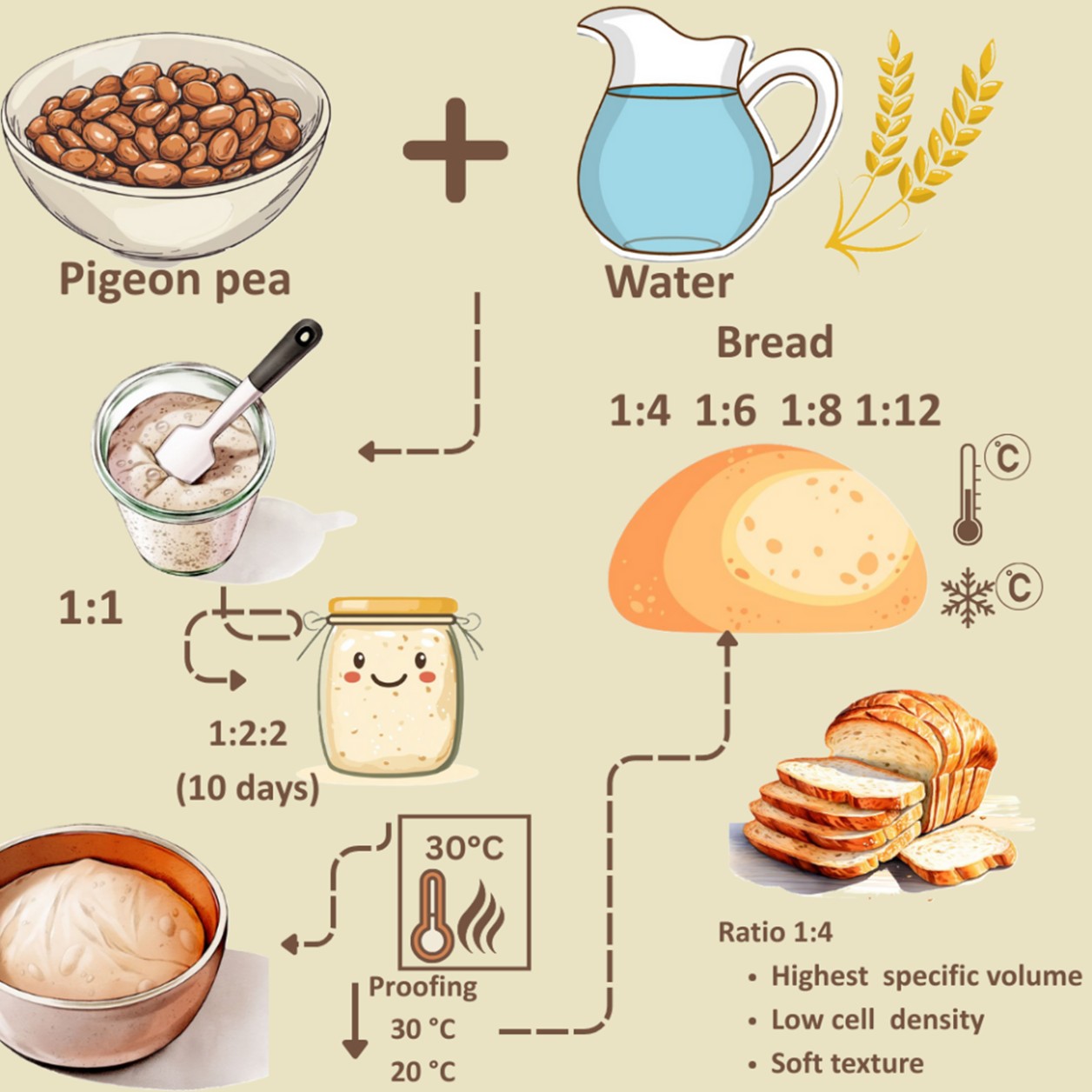
Downloads
References
MA Halim, SA Alharbi, AA Alarfaj, MI Almansour, MJ Ansari, MJ Nessa, FNA Kabir and AA Khatun. Improvement and quality evaluation of gluten-free cake supplemented with sweet potato flour and carrot powder. Applied Food Research 2024; 4(2), 100543.
B Lebwohl, PDS Sanders and PHR Green. Coeliac disease. The Lancet 2018; 391(10115), 70-81.
H Eraslan, J Wehbeh and E Ermis. Effect of sourdough prepared with the combination of chickpea and carob on bread properties. International Journal of Gastronomy and Food Science 2023; 32, 100753.
R Penalver and G Nieto. Developing a functional gluten-free sourdough bread by incorporating quinoa, amaranth, rice and spirulina. 2024; 201, 116162.
C Huang, B Zhang, J Huang, Y Liu, C Chen, JO Omedi, L Liang, Z Zhou, W Huang and N Li. The effects of single- or mixed-strain fermentation of red bean sourdough, with or without wheat bran, on bread making performance and its potential health benefits in mice model. Foods 2024; 13(17), 2856.
SS Sobowale, DT Otolowo, OT Kayode and JI Agbawodike. Effect of germination and solid-state fermentation on the chemical, functional and nutritional composition of pigeon pea flour and the sensory properties of the resultant cookies. Food Chemistry Advances 2024; 5, 100837.
OT Bolaji, MA Kamoru and SAO Adeyeye. Quality evaluation and physico-chemical properties of blends of fermented cassava flour (lafun) and pigeon pea flour. Scientific African 2021; 12, e00833.
IR Danila, R Yanti and DA Suroto. Microbiota properties and texture of rice flour bread with pineapple starter. Journal of Applied Agricultural Science and Technology 2023; 7(3), 225-235.
MD Calvert, AA Madden, LM Nichols, NM Haddad, J Lahne, RR Dunn and EA McKenney. A review of sourdough starters: Ecology, practices, and sensory quality with applications for baking and recommendations for future research. PeerJ 2021; 9, e11389.
Y Yu, L Wang, H Qian, H Zhang and X Qi. Contribution of spontaneously-fermented sourdoughs with pear and navel orange for the bread-making. Food Science and Technology 2018; 89, 336-343.
H Zhou, Y Jin, T Hong, N Yang, B Cui, X Xu and Z Jin. Effect of static magnetic field on the quality of frozen bread dough. LWT 2022; 154, 112670.
V Ripari, T Cecchi and E Berardi. Microbiological characterisation and volatiles profile of model, ex-novo, and traditional Italian white wheat sourdoughs. Food Chemistry 2016; 205, 297-307.
M Verni, A Torreggiani, A Patriarca, E Brasili, F Sciubba and CG Rizzello. Sourdough fermentation for the valorization of sorghum flour: Microbiota characterization and metabolome profiling. International Journal of Food Microbiology 2024; 421, 110805.
KS Aplevicz, JZ Mazo, NKDS Neto, FS Nalevaiko and ESS Anna. Evaluation of sourdoughs for the production of bread using spontaneous fermentation technique. Acta Scientiarum Technology 2014; 36(4), 713-719.
A Raaf, N Suriaini, F Djafar, Y Syamsuddin and M Supardan. Effect of drying temperature on the moisture loss, acidity and characteristics of Amla fruit. IOP Conference Series: Earth and Environmental Science 2021; 667(1), 012047.
JP Tamang, K Watanabe and WH Holzapfel. Review: Diversity of microorganisms in global fermented foods and beverages. Frontiers in Microbiology 2016; 7, 377.
M Dandadzi, R Musundire, A Muriithi and RT Ngadze. Effects of drying on the nutritional, sensory and microbiological quality of edible stinkbug (Encosternum delgorguei). Heliyon 2023; 9(8), e18642.
J Ng’ang’a, S Imathiu, F Fombong, M Ayieko, JV Broeck and J Kinyuru. Microbial quality of edible grasshoppers Ruspolia differens (Orthoptera: Tettigoniidae): From wild harvesting to fork in the Kagera Region, Tanzania. Journal of Food Safety 2019; 39(1), e12549.
RMO Elawad, TA Yang and AM Easa. Chemical composition, volume and specific volume of superheated steam and conventional oven baked bread. International Journal of Food Science and Nutrition 2017; 2(6), 91-94.
FG Santos, C Fratelli, DG Muniz and VD Capriles. The impact of dough hydration level on gluten-free bread quality: A case study with chickpea flour. International Journal of Gastronomy and Food Science 2021; 26, 100434.
M Gobbetti, MD Angelis, RD Cagno, M Calasso, G Archetti and CG Rizzello. Novel insights on the functional/nutritional features of the sourdough fermentation. International Journal of Food Microbiology 2019; 302, 103-113.
S Arslan-Tontul, H Cetin-Babaoglu, M Aslan and I Tontul. Evaluation of refractance window-dried type 3 sourdough as an alternative to liquid sourdough in bread production. Journal of Cereal Science 2024; 116, 103882.
MG Ganzle. Enzymatic and bacterial conversions during sourdough fermentation. Food Microbiology 2014; 37, 2-10.
D Atudorei, O Atudorei and GG Codina. Dough rheological properties, microstructure and bread quality of wheat-germinated bean composite flour. Foods 2021; 10(7), 1542.
J Gao, Y Wang, Z Dong and W Zhou. Structural and mechanical characteristics of bread and their impact on oral processing: A review. International Journal of Food Science & Technology 2018; 53(4), 858-872.
C Di, W Jinshui, J Feng and Z Changfu. Effects of sourdough addition on the quality and shelf life of chinese steamed bread. Grain & Oil Science and Technology 2018; 1(2), 85-90.
RH Hernandez-Figueroa, E Mani-Lopez, E Palou and A Lopez-Malo. Sourdoughs as natural enhancers of bread quality and shelf life: A review. 2024; 10(1), 7.
GM Walker. Yeast physiology and biotechnology. John Wiley & Sons, New Jersey, 1998.
Flavornet, Available at: https://www.flavornet.org/flavornet.html, accessed january 2024.
C Petel, B Onno and C Prost. Sourdough volatile compounds and their contribution to bread: A review. Trends in Food Science & Technology 2017; 59, 105-123.
H Gao, M Liu, L Zheng, T Zhang, X Chang, H Liu, S Zhou, Z Zhang, S Li and J Sun. Comparative analysis of key odorants and aroma characteristics in hot-pressed yellow horn (xanthoceras sorbifolia bunge) seed oil via gas chromatography–ion mobility spectrometry and gas chromatography–olfactory-mass spectrometry. Foods 2023; 12(17), 3174.
Published
How to Cite
Issue
Section
License
Copyright (c) 2025 Walailak University

This work is licensed under a Creative Commons Attribution-NonCommercial-NoDerivatives 4.0 International License.





