
Effect of Hydrocolloid and Red Palm Oil Oleogel Concentrations on Biphasic Gel Properties and Their Application in Chocolate Spread Formulation
DOI:
https://doi.org/10.48048/tis.2025.10482Keywords:
β-carotene, Biphasic gel, Red palm oil, Chocolate spread, Soy protein, AlginateAbstract
In this study, red palm oil (RPO) rich in b-carotene was structured into biphasic gel to improve its application in the food system. The RPO biphasic gel was evaluated for its physicochemical properties and ability to replace cacao butter in chocolate spread. RPO biphasic gels were prepared at 5%, 7.5% and 10% total hydrocolloids (TH) and 30%, 40% and 50% oleogel concentrations. The results showed that both TH and oleogel concentrations significantly affected the physicochemical properties and stability of the biphasic gels. At TH 7.5% and 10%, adding 50% of oleogel could not produce stable biphasic gels. Higher TH concentration led to higher hardness and G’. Soft gels with hardness ranging from 0.46 - 0.98, water and oil holding capacity ranging from 91% - 99%, and b-carotene concentrations in the range of 140 - 170 ppm were obtained. The biphasic gels with the best physicochemical properties were obtained at 7.5% TH and 30% oleogel concentration. The biphasic gel had minimal influence on the texture of the chocolate spreads. However, the chocolate spread with 100% biphasic gels had high Casson yield stress and low viscosity, i.e.,: 68.59 ± 11.43 and 0.56 ± 0.14 Pa·s, respectively. Overall, the hedonic test revealed that the panelist’s acceptance of the chocolate spread prepared with biphasic gel was comparable to that of the control. RPO was successfully used in chocolate spread by transforming it into a semisolid consistency using biphasic gelation.
HIGHLIGHTS
- The biphasic gels were influenced by % total hydrocolloids and oleogel
- The selected biphasic gel was successfully applied to the chocolate spread
- Biphasic gels influenced the physicochemical properties of the chocolate spread
- Chocolate spread with biphasic gels had comparable acceptance by the panelists.
GRAPHICAL ABSTRACT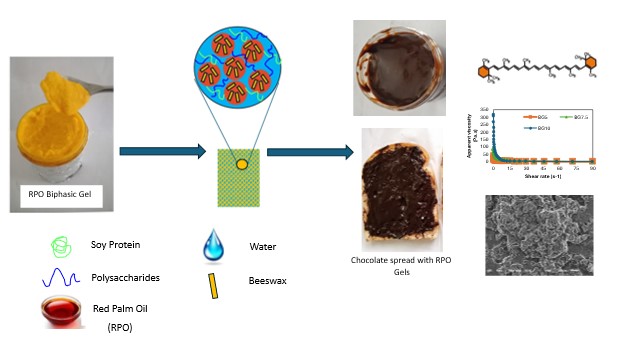
Downloads
References
K Gul, A Tak, AK Singh, P Singh, B Yousuf and AA Wani. Chemistry, encapsulation, and health benefits of β-carotene-A review. Cogent Food & Agriculture 2015; 1(1), 1018696.
DF Ayu, N Andarwulan, P Hariyadi and EH Purnomo. Effect of tocopherols, tocotrienols, β-carotene, and chlorophyll on the photo-oxidative stability of red palm oil. Food Science and Biotechnology 2016; 25, 401-407.
F Jimenez-Colmenero, L Salcedo-Sandoval, R Bou, S Cofrades, AM Herrero and C Ruiz-Capillas. Novel applications of oil-structuring methods as a strategy to improve the fat content of meat products. Trends in Food Science & Technology 2015; 44(2), 177-188.
Q Du, M Tu, J Liu, Y Ding, X Zeng and D Pan. Plant-based meat analogs and fat substitutes, structuring technology and protein digestion: A review. Food Research International 2023; 170, 112959.
M Scharfe and E Flöter. Oleogelation: From scientific feasibility to applicability in food products. European Journal of Lipid Science and Technology 2020; 122(12), 2000213.
X Zhao, B Chen, T Liu, Y Cai, L Huang, M Zhao and Q Zhao. The formation, structural and rheological properties of emulsion gels stabilized by egg white protein-insoluble soybean fiber complex. Food Hydrocolloids 2023; 134, 108035.
B Tirgarian, H Yadegari, A Bagheri, E Neshagaran, M Mardani and J Farmani. Reduced-fat chocolate spreads developed by water-in-oleogel emulsions. Journal of Food Engineering 2023; 337, 111233.
ND Kibler, NC Acevedo, K Cho, EA Zuber-McQuillen, YB Carvajal and R Tarté. Novel biphasic gels can mimic and replace animal fat in fully-cooked coarse-ground sausage. Meat Science 2022; 194, 108984.
K Zampouni, D Dimakopoulou-Papazoglou and E Katsanidis. Food-grade bigel systems: Formulation, characterization, and applications for novel food product development. Gels 2024; 10(11), 712.
K Zampouni, N Sideris, E Tsavdaris and E Katsanidis. On the structural and mechanical properties of mixed coconut and olive oil oleogels and bigels. International Journal of Biological Macromolecules 2024; 268, 131942.
J Yang, H Zheng, Y Mo, Y Gao and L Mao. Structural characterization of hydrogel-oleogel biphasic systems as affected by oleogelators. Food Research International 2022; 158, 111536.
S Bascuas, M Espert, E Llorca, A Quiles, A Salvador and I Hernando. Structural and sensory studies on chocolate spreads with hydrocolloid-based oleogels as a fat alternative. LWT 2021; 135, 110228.
M Lingiardi, M Galante and D Spelzini. Emulsion gels based on quinoa protein hydrolysates, alginate, and high-oleic sunflower oil: Evaluation of their physicochemical and textural properties. Food Biophysics 2024; 19(2), 298-309.
L Mitrea, BE Teleky, LF Leopold, SA Nemes, D Plamada, FV Dulf, ID Pop and DC Vodnar. The physicochemical properties of five vegetable oils exposed at high temperature for a short-time-interval. Journal of Food Composition and Analysis 2022; 106, 104305.
Association of Official Analytical Chemists International. Official methods of analysis. 18th ed. Association of Official Analytical Chemists International, Maryland, United States, 2005.
AK Biswas, J Sahoo and MK Chatli. A simple UV-Vis spectrophotometric method for determination of β-carotene content in raw carrot, sweet potato and supplemented chicken meat nuggets. LWT-Food Science and Technology 2011; 44(8), 1809-1813.
X Zhang, X Chen, Y Gong, Z Li, Y Guo, D Yu and M Pan. Emulsion gels stabilized by soybean protein isolate and pectin: Effects of high intensity ultrasound on the gel properties, stability and β-carotene digestive characteristics. Ultrasonics Sonochemistry 2021; 79, 105756.
AD Saputro, D Van de Walle, S Kadivar, MD Bin Sintang, P Van der Meeren and K Dewettinck. Investigating the rheological, microstructural and textural properties of chocolates sweetened with palm sap-based sugar by partial replacement. European Food Research and Technology 2017; 243, 1729-1738.
B Hashemi, M Varidi and SM Jafari. Fabrication and characterization of novel whey protein-based bigels as structured materials with high-mechanical properties. Food Hydrocolloids 2023; 145, 109082.
AJ Martins, A Guimaraes, P Fuciños, P Sousa, A Venâncio, LM Pastrana and MA Cerqueira. Food-grade bigels: Evaluation of hydrogel:oleogel ratio and gelator concentration on their physicochemical properties. Food Hydrocolloids 2023; 143, 108893.
K Zampouni, CK Mouzakitis, A Lazaridou, T Moschakis and E Katsanidis. Physicochemical properties and microstructure of bigels formed with gelatin and κ-carrageenan hydrogels and monoglycerides in olive oil oleogels. Food Hydrocolloids 2023; 140, 108636.
Q Wang, Y Zhu, Z Ji and J Chen. Lubrication and sensory properties of emulsion systems and effects of droplet size distribution. Foods 2021; 10(12), 3024.
AC Saffold and NC Acevedo. Development of novel rice bran wax/gelatin-based biphasic edible gels and characterization of their microstructural, thermal, and mechanical properties. Food and Bioprocess Technology 2021; 14, 2219-2230.
N Afdhaliah, A Ningrum and AD Setiowati. Red palm oil gelled emulsion stabilized by spirulina (arthrospira platensis) protein and carrageenan as fat replacer in beef patty. Food and Bioprocess Technology 2024; 18(4), 3538-3552.
P Guerrero, JP Kerry and K de la Caba. FTIR characterization of protein-polysaccharide interactions in extruded blends. Carbohydrate Polymers 2014; 111, 598-605.
LR Amado, K de Souza Silva and MA Mauro. Alginate and pH improve properties of soy protein-based films. Food Biophysics 2024; 19(2), 256-268.
M Pang, L Xu, Y Ge, J Cheng, Z Zhang and L Cao. Fabrication of beeswax/plant sterol ester-gelatin/whey protein isolate bigels with dual gelation effects as substitutes for traditional solid fats. Food Hydrocolloids 2024; 157, 110458.
M Rezaei, S Naji-Tabasi, B Ghorani and B Emadzadeh. Studying the impact of zein microfibers on the physicochemical and microstructural properties of bi-gels based on ι-carrageenan hydrogels and beeswax oleogels. Current Research in Food Science 2025; 10, 100985.
J Cao, X Tong, M Wang, T Tian, S Yang, M Sun, B Lyu, X Cao, H Wang and L Jiang. Soy protein isolate/sodium alginate microparticles under different ph conditions: Formation mechanism and physicochemical properties. Foods 2022; 11(6), 790.
B Behera, VK Singh, S Kulanthaivel, MK Bhattacharya, K Paramanik, I Banerjee and K Pal. Physical and mechanical properties of sunflower oil and synthetic polymers based bigels for the delivery of nitroimidazole antibiotic - A therapeutic approach for controlled drug delivery. European Polymer Journal 2015; 64, 253-264.
L Alves Barroso, GB Karatay and MD Hubinger. Effect of potato starch hydrogel:glycerol monostearate oleogel ratio on the physico-rheological properties of bigels. Gels 2022; 8(11), 694.
A Shakeel, U Farooq, T Iqbal, S Yasin, FR Lupi and D Gabriele. Key characteristics and modelling of bigels systems: A review. Materials Science and Engineering: C 2019; 97, 932-953.
K Behera, K Pramanik and K Pal. Ultrasonication-assisted preparation and characterization of emulsions and emulsion gels for topical drug delivery. Journal of Pharmaceutical Sciences 2015; 104(3), 1035-1044.
AC Saffold and NC Acevedo. Development of novel rice bran wax/gelatin-based biphasic edible gels and characterization of their microstructural, thermal, and mechanical properties. Food and Bioprocess Technology 2021; 14(12), 2219-2230.
SS Smuda, AT Mohammed, E Tsakali, JFM Van Impe and AM Marie. Preparation and evaluation of functional cocoa‐free spread alternatives from different sources. Food Science & Nutrition 2024; 12(6), 4299-4310.
P Glibowski, P Zarzycki and M Krzepkowska. The rheological and instrumental textural properties of selected table fats. International Journal of Food Properties 2008; 11(3), 678-686.
ME van Stuijvenberg, JD Kvalsvig, M Faber, K Diane and BAJ Spinnler. Effect of iron-, iodine-, and β-carotene-fortified biscuits on the micronutrient status of primary school children: a randomized controlled trial. The American Journal of Clinical Nutrition 1999; 69(3), 497-503.
N Yu, W Zuo, L Ma, J Yang and H Katas. Tailoring oleogel-in-hydrogel pickering emulsion fluid gels as an oral delivery system for different levels of dysphagia: From microstructure to rheological properties. Food Hydrocolloids 2024; 156, 110265.
FP Francis and R Chidambaram. Hybrid hydrogel dispersed low fat and heat resistant chocolate. Journal of Food Engineering 2019; 256, 9-17.
A Homayouni Rad and H Rasouli Pirouzian. Optimization of prebiotic sucrose-free milk chocolate formulation by mixture design. Journal of Food Science and Technology 2021; 58(1), 244-254.
L Principato, D Carullo, A Gruppi, G Duserm Garrido, G Giuberti, M Lambri, G Spigno and A Bassani. A potentially ecosustainable hazelnut/carob-based spread. International Journal of Food Science 2024; 2024(1), 4863035.
M Alam, BN Dar and V Nanda. Development and characterisation of nutritionally enriched honey filling as novel alternative to commercial fat-based filling for bakery applications. Food and Humanity 2024; 3, 100361.
J Cropotova, U Tylewicz, P Rocculi, S Popel and MD Rosa. Thermal properties of fruit fillings as a function of different formulations. Food Structure 2017; 14, 85-94.
R Januszewska, E Giret, F Clement, I Van Leuven, C Goncalves, E Vladislavleva, P Pradal, R Nåbo, A Landuyt, G Heer, S Frommenwiler and H Haefliger. Impact of vanilla origins on sensory characteristics of chocolate. Food Research International 2020; 137, 109313.
E Galvagni, AA Fritzen, AM Graboski, SC Ballen, J Steffens and C Steffens. Detection of volatiles in dark chocolate flavored with orange essential oil by electronic nose. Food Analytical Methods 2020; 13(7), 1421-1432.
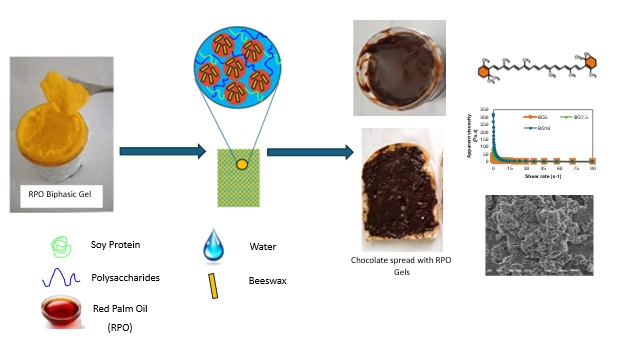
Published
How to Cite
Issue
Section
License
Copyright (c) 2025 Walailak University

This work is licensed under a Creative Commons Attribution-NonCommercial-NoDerivatives 4.0 International License.





