
Texture Improvement of Filamentous Fungi Burger Derived from Biomass of Rhizopus oligosporus: Impact of Binding Agent on Physical, Sensory, and Microstructure
DOI:
https://doi.org/10.48048/tis.2025.8731Keywords:
Filamentous fungi, Burger patty, Rhizopus oligosporus, Modified tapioca starchAbstract
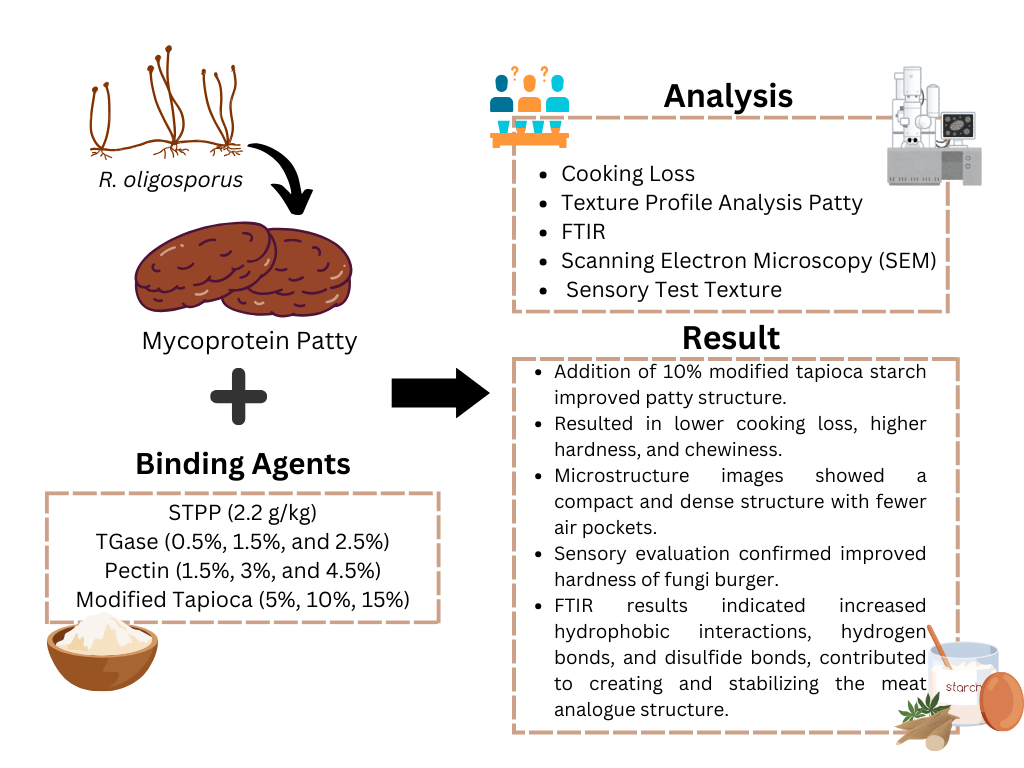
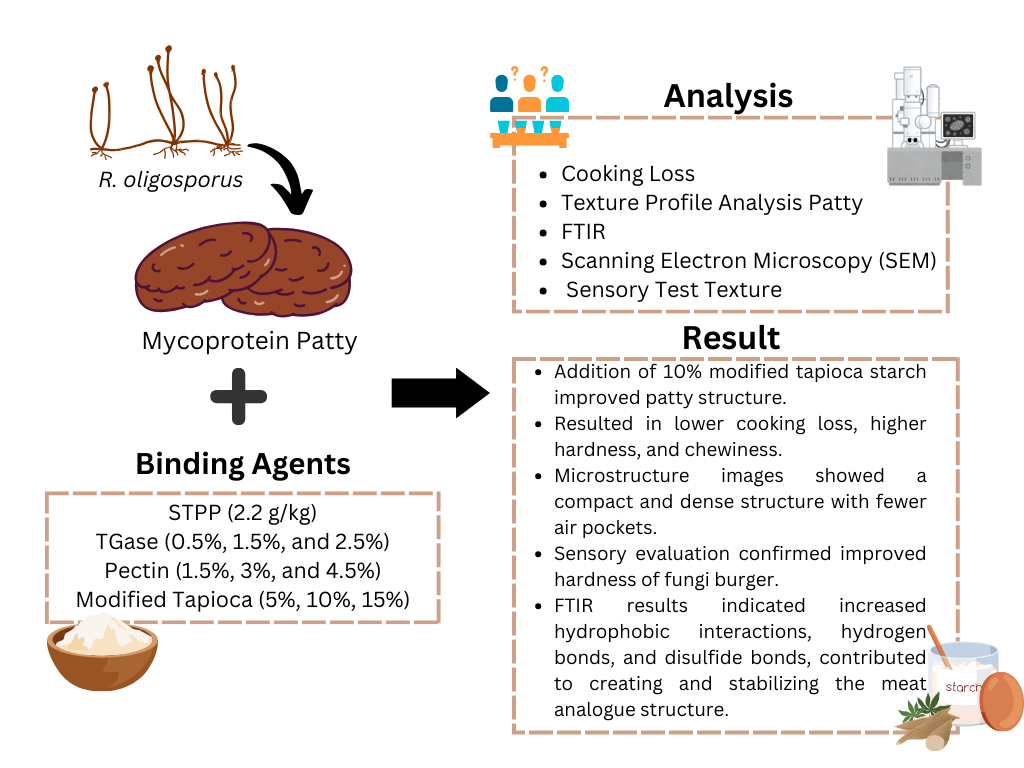
Despite its high nutritional value and low environmental impact, the nature of filamentous fungal hyphae might resemble the appearance of meat fibers. These properties make filamentous fungi as a promising protein alternative in the future. However, the texture of the mycelium is too weak to resemble meat fibers. This study was aimed to obtain non-animal binding agent to improve the texture of burger patty produced by fungal biomass of Rhizopus oligosporus. Different binding agents including sodium tripolyphosphate, transglutaminase, pectin, and modified tapioca were added to the fungi burger patty. The texture was analyzed by texture profile analyzer and sensory test. The texture profile analysis (TPA) showed that the addition of 10 % modified tapioca starch improved the patty structure, decreasing cooking loss by 46.05 %, while increasing hardness by 105.15 %, and chewiness by 83.55 %. Microstructure images confirm this finding by showing a compact and dense structure with discernible reduce in air pockets. This finding is in line to sensory evaluation result, in which the panels confirmed the improvement of fungi burger hardness. The Fourier Transform Infrared Spectroscopy (FTIR) result showed that the improvement might be due to the increase in hydrophobic interactions, hydrogen bonds, and disulfide bonds. These bonds were responsible for creating and stabilizing the structure of meat analogue. Overall, modified tapioca is a low-cost binding agent for texture improvement of fungi burger made from R. oligosporus biomass.
HIGHLIGHTS
- Addition of binding agent improved the texture of mycoprotein burger.
- Addition of 10 % modified tapioca starch showed the best texture properties.
- Addition of modified tapioca starch increased the compactness of fungal mycelium.
- Hydrophobic interactions, hydrogen, and disulfide bonds contributed to texture.
GRAPHICAL ABSTRACT
Downloads
References
United Nations. World population prospects 2019: The 2019 revision. United Nations, New York, 2019.
HCJ Godfray, JR Beddington, IR Crute, L Haddad, D Lawrence, JF Muir, J Pretty, S Robinson, SM Thomas and C Toulmin. Food security: The challenge of feeding 9 billion people. Science 2010; 327(5967), 812-818.
J Poore and T Nemecek. Reducing food’s environmental impacts through producers and consumers. Science 2018; 360(6392), 987-992.
L Sha and YL Xiong. Plant protein-based alternatives of reconstructed meat: Science, technology, and challenges. Trends Food Science & Technology 2020; 102, 51-61.
PFS Filho, D Andersson, JA Ferreira and MJ Taherzadeh. Mycoprotein: Environmental impact and health aspects. World Journal of Microbiology and Biotechnology 2019; 35(10), 147.
TJA Finnigan, BT Wall, PJ Wilde, FB Stephens, SL Taylor and MR Freedman. Mycoprotein: The future of nutritious nonmeat protein, a symposium review. Current Developments in Nutrition 20219; 3(6), nzz021.
MV Dunlop, SP Kilroe, JL Bowtell, TJA Finnigan, DL Salmon and BT Wall. Mycoprotein represents a bioavailable and insulinotropic non-animal-derived dietary protein source: A dose-response study. British Journal of Nutrition 2017; 118(9), 673-685.
V Meyer, EY Basenko, JP Benz, GH Braus, MX Caddick, M Csukai, RPD Vries, D Endy, JC Frisvad, N Gunde-Cimerman, T Haarmann, Y Hadar, K Hansen, RI Johnson, NP Keller, N Kraševec, UH Mortensen, R Perez, AFJ Ram, E Record, P Ross, V Shapaval, C Steiniger, HVD Brink, JV Munster, O Yarden and HAB Wösten. Growing a circular economy with fungal biotechnology: A white paper. Fungal Biology and Biotechnology 2020; 7(1), 5.
P Kalač. A review of chemical composition and nutritional value of wild-growing and cultivated mushrooms. Journal of the Science of Food and Agriculture 2013; 93(2), 209-218.
S Wainaina, AD Kisworini, M Fanani, R Wikandari, R Millati, C Niklasson and MJ Taherzadeh. Utilization of food waste-derived volatile fatty acids for production of edible Rhizopus oligosporus fungal biomass. Bioresource Technology 2020; 310, 123444.
WK Wijono and T Estiasih. The effect of lesser yam tuber flour (Dioscorea esculenta) and cooking methods on meat analogue chemical and textural properties. Advances in Food Science, Sustainable Agriculture and Agroindustrial Engineering 2021; 4(2), 162-170.
M Wiebe. Myco-protein from Fusarium venenatum: A well-established product for human consumption. Applied Microbiology and Biotechnology 2002; 58(4), 421-427.
S Mabrouki, K Abid, H Kaihara, SG Patrucco, S Tassone and S Barbera. Assessing texture profile analysis in natural state versus texture profile analysis with back extrusion post-homogenization of cooked pea protein-based and meat patties: A comparative study. Future Foods 2024; 9, 100345.
RD Bhumkar and VB Pokharkar. Studies on effect of pH on cross-linking of chitosan with sodium tripolyphosphate: A technical note. AAPS PharmSciTech 2006; 7(2), E138-E143.
N Rousta, C Hellwig, S Wainaina, L Lukitawesa, S Agnihotri, K Rousta and MJ Taherzadeh. Filamentous fungus aspergillus oryzae for food: From submerged cultivation to fungal burgers and their sensory evaluation - A pilot study. Foods 2021; 10(11), 2774.
T Sar, K Larsson, R Fristedt, I Undeland and MJ Taherzadeh. Demo-scale production of protein-rich fungal biomass from potato protein liquor for use as innovative food and feed products. Food Bioscience 2022; 47, 101637.
I Gómez, FC Ibañez and MJ Beriain. Physicochemical and sensory properties of sous vide meat and meat analog products marinated and cooked at different temperature-time combinations. International Journal of Food Properties 2019; 22(1), 1693-1708.
M Wu, J Wang, J Hu, Z Li, R Liu, Y Liu, Y Cao, Q Ge and H Yu. Effect of typical starch on the rheological properties and NMR characterization of myofibrillar protein gel. Journal of the Science of Food and Agriculture 2020; 100(1), 258-267.
MFE Osman, AA Mohamed, MS Alamri, IAM Ahmed, S Hussain, MI Ibraheem and AA Qasem. Quality characteristics of beef patties prepared with octenyl-succinylated (Osan) starch. Foods 2021; 10(6), 1157.
M Han and HC Bertram. Designing healthier comminuted meat products: Effect of dietary fibers on water distribution and texture of a fat-reduced meat model system. Meat Science 2017; 133, 159-165.
S Mandliya and HN Mishra. Effect of different drying methods on quality attributes and microstructure of mycelium (Pleurotus eryngii). Biology and Life Sciences Forum 2021; 6(1), 10.
L Day and M Golding. Food structure, rheology, and texture. Elsevier, Amsterdam, 2018, p. 125-129.
K Nishinari and Y Fang. Perception and measurement of food texture: Solid foods. Journal of Texture Studies 2018; 49(2), 160-201.
Z Pietrasik and OP Soladoye. Use of native pea starches as an alternative to modified corn starch in low-fat bologna. Meat Science 2021; 171, 108283.
K Kyriakopoulou, B Dekkers and AJVD Goot. Plant-based meat analogues. In: Galanakis (Ed.). Sustainable meat production and processing. Academic Press, Cambridge, 2019, p. 103-126.
I Fraeye, T Duvetter, E Doungla, AV Loey and M Hendrickx. Fine-tuning the properties of pectin-calcium gels by control of pectin fine structure, gel composition and environmental conditions. Trends in Food Science & Technology 2010; 21(5), 219-228.
MV Chandra and BA Shamasundar. Texture profile analysis and functional properties of gelatin from the skin of three species of fresh water fish. International Journal of Food Properties 2015; 18(3), 572-584.
HW Choi, M Choi, J Hahn and YJ Choi. The technical potential of a sous-vide processing method for developing high-moisture textured soy protein. Food Chemistry 2024; 430, 136978.
L Godschalk-Broers, G Sala and E Scholten. Meat analogues: Relating structure to texture and sensory perception. Foods 2022; 11(15), 2227.
P Duma-Kocan, M Rudy, M Gil and R Stanisławczyk. The influence of temperature differences in smoking chamber and furnace and smoking time on the quality of medium-ground sausages. Molecules 2020; 25(23), 5515.
S Mandliya, A Pratap-Singh, S Vishwakarma, CG Dalbhagat and HN Mishra. Incorporation of mycelium (Pleurotus eryngii) in pea protein based low moisture meat analogue: Effect on its physicochemical, rehydration and structural properties. Foods 2022; 11(16), 2476.
Y Xie, L Cai, D Zhao, H Liu, X Xu, G Zhou and C Li. Real meat and plant-based meat analogues have different in vitro protein digestibility properties. Food Chemistry 2021; 387, 132917.
Z Zhang, Y Yang, P Zhou, X Zhang and J Wang. Effects of high pressure modification on conformation and gelation properties of myofibrillar protein. Food Chemistry 2017; 217, 678-686.
Downloads
Published
How to Cite
Issue
Section
License
Copyright (c) 2024 Walailak University

This work is licensed under a Creative Commons Attribution-NonCommercial-NoDerivatives 4.0 International License.





