
Impact of Pineapple (Ananas comosus L. Merr) Stem Extract (PSE) on Ovarian Dysfunction in A Polycystic Ovary Syndrome Rat Model: Insights into Molecular Interactions and Biological Pathways
DOI:
https://doi.org/10.48048/tis.2025.11165Keywords:
Ananas comosus L. Merr, Polycystic ovary syndrome (PCOS), Folliculogenesis, Antiandrogenic activity, AGEs, OvulationAbstract
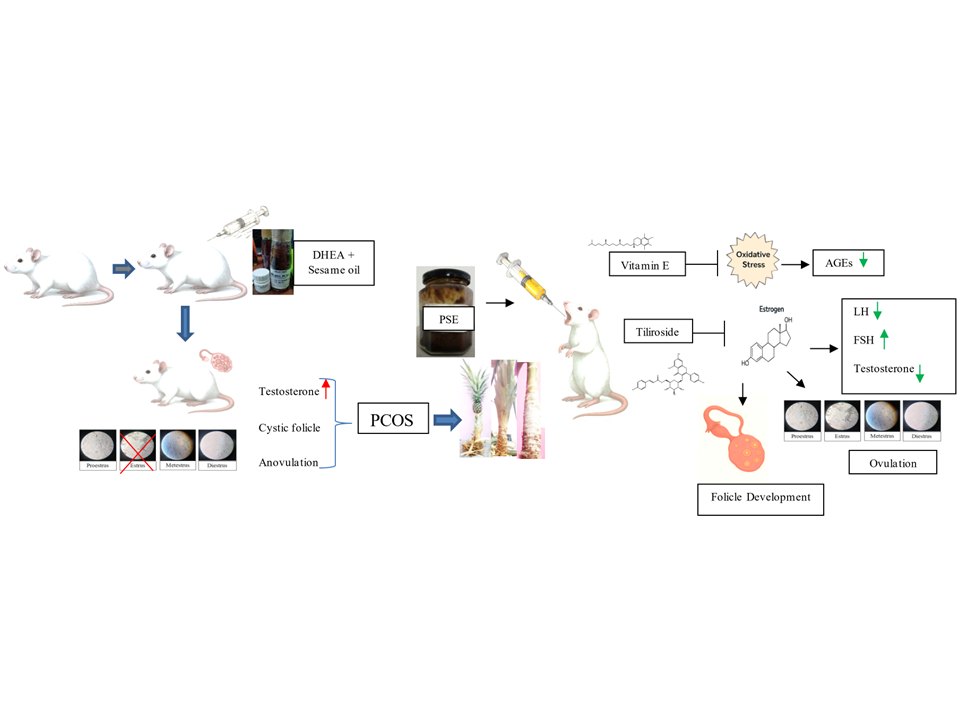
Polycystic ovary syndrome (PCOS) is a prevalent endocrine disorder characterized by hyperandrogenism, anovulation, and polycystic ovarian morphology. This study evaluated the therapeutic effects of Pineapple (Ananas comosus L. Merr) stem extract (PSE) in a DHEA-induced PCOS rat model. Thirty-six female Sprague-Dawley rats were randomly divided into 6 groups, including a negative control group. Following 7-day acclimatization and PCOS induction with DHEA, treatments were administered from day 43 (H0) to day 70 (H27). Serum levels of LH, FSH, testosterone, and AGEs were measured by ELISA, while ovarian morphology was assessed through H&E staining. The 500 mg/kg BW PSE treatment significantly reduced LH (p < 0.001), testosterone (p < 0.001), and AGEs (p < 0.001) levels while increasing FSH (p = 0.017). Furthermore, histopathological examination using hematoxylin-eosin (H&E) staining revealed that PSE administration (500 mg/kg BW) improved follicular development and ovulation compared to the negative control group, as evidenced by a reduction in cystic follicle count and an increase in corpus luteum formation. In conclusion, PSE exhibits potential therapeutic effects in ameliorating PCOS-like symptoms by modulating reproductive hormones and promoting ovarian follicular maturation.
HIGHLIGHTS
- PCOS was successfully induced in Sprague Dawley rats through 42-day DHEA administration, resulting in characteristic conditions of the syndrome including hyperandrogenism and polycystic ovaries.
- Treatment with 500 mg/kg BW PSE significantly restored hormonal profiles by reducing LH, testosterone, and AGEs levels, while increasing FSH levels.
- Histopathological examination confirmed that the improved hormonal profiles directly correlated with ovarian structural restoration, as evidenced by enhanced follicular maturation.
GRAPHICAL ABSTRACT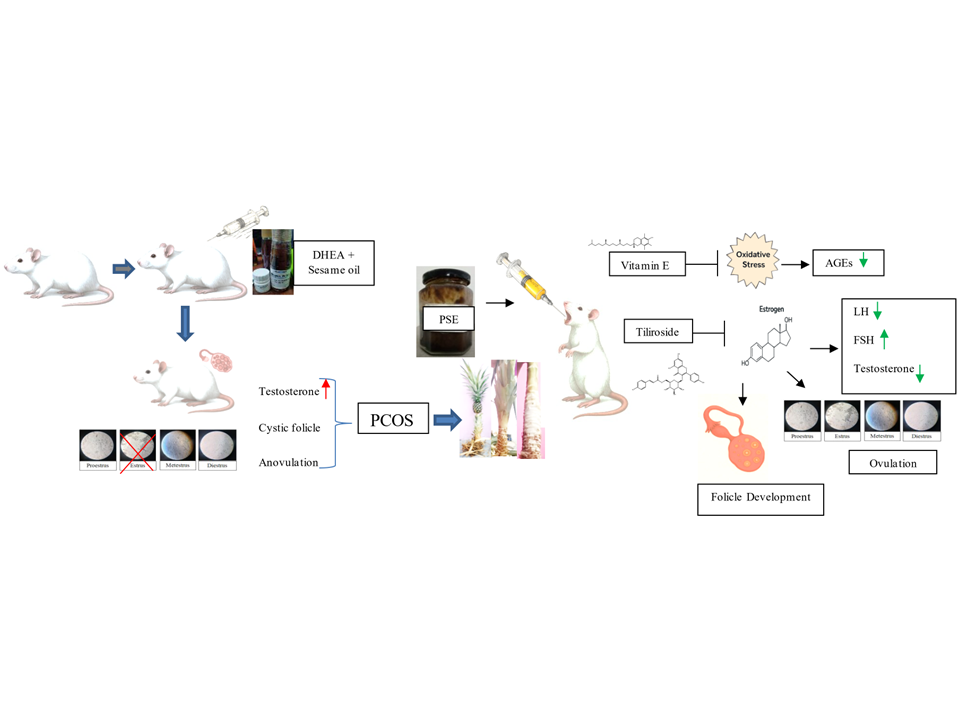
Downloads
References
S Amanat, F Ashkar, MH Eftekhari, N Tanideh, S Doaei, M Gholamalizadeh, F Koohpeyma and M Mokhtari. The effect of genistein on insulin resistance, inflammatory factors, lipid profile, and histopathologic indices in rats with polycystic ovary syndrome. Clinical and Experimental Reproductive Medicine 2021; 48(3), 236.
R Rani, YA Hajam, R Kumar, RA Bhat, S Rai and MA Rather. A landscape analysis of the potential role of polyphenols for the treatment of Polycystic Ovarian Syndrome (PCOS). Phytomedicine Plus 2022; 2(1), 100161.
H Said, RW Fedre, S Hernandez, SL Rodriguez, F Mursyid and I Nettles. The prevalence and risk factors for Polycystic Ovary Syndrome (PCOS) among adolescents in indonesia: Implications for early intervention. Sriwijaya Journal of Obstetrics and Gynecology 2024; 2(1), 34-47.
CZ Pei, L Jin and KH Baek. Pathogenetic analysis of polycystic ovary syndrome from the perspective of omics. Biomedicine & Pharmacotherapy 2021; 142, 112031.
M Rostamtabar, S Esmaeilzadeh, M Tourani, A Rahmani, M Baee, F Shirafkan, K Saleki, SS Mirzababayi, S Ebrahimpour and HR Nouri. Pathophysiological roles of chronic low-grade inflammation mediators in polycystic ovary syndrome. Journal of Cellular Physiology 2021; 236(2), 824-838.
E Rudnicka, AM Duszewska, M Kucharski, P Tyczyński and R Smolarczyk. Oxidative stress and reproductive function: Oxidative stress in polycystic ovary syndrome. Reproduction 2022; 164(6), F145-F154.
K Eskandar, JA Oliveira, SA Ribeiro, MP Chavez, AIA Zotti, YJM Dias and AMM Novellino. Review article Letrozole and clomiphene versus letrozole alone for ovulation induction in women with PCOS: A systematic review and meta-analysis. Revista Brasileira de Ginecologia e Obstetrícia 2025; 47, e-rbgo21.
WM Hikal, AA Mahmoud, HAH Said-Al Ahl, A Bratovcic, KG Tkachenko, M Kačániová and RM Rodriguez. Pineapple (Ananas comosus L. Merr.), waste streams, characterisation and valorisation: An overview. Open Journal of Ecology 2021; 11(9), 610-634.
N Istiqomah, AH Ramadhani, RS Ningrum and E Purwati. Ethanol extract analysis of steam pineapple (Ananas comosus. L) and its application as antibacterial agent: In vitro and silico studies. IOP Conference Series: Earth and Environmental Science 2021; 886(1), 012019.
Y Öztürkler and A Güven. The role of exogenous antioxidants in enhancing reproductive. Livre de Lyon, Lyon, France, 2022.
A Unar, M Imtiaz, TT Trung, M Rafiq, MQ Fatmi and TH Jafar. Structural and functional analyses of SARS COV-2 RNA-dependent RNA Polymerase protein and complementary vs. synthetic drugs against COVID-19 and the exploration of binding sites for docking, molecular dynamics simulation, and density functional theory studies. Current Bioinformatics 2022; 17(7), 632-656.
LJ Chen, Y Liu, L Zhang, JY Li, WQ Xiong, T Li, H Ding and BJ Li. Sequential 2.5 mg letrozole/FSH therapy is more effective for promoting pregnancy in infertile women with PCOS: A pragmatic randomized controlled trial. Frontiers in Endocrinology 2024; 14, 1294339.
AB Nair and S Jacob. A simple practice guide for dose conversion between animals and human. Journal of Basic and Clinical Pharmacy 2016; 7(2), 27.
ZEU Korun, SS Gocmez, S Furat, KK Sarihan, FC Eraldemir, HA Akpulat, D Sahin and S Yildiz. Beneficial effects of Alchemilla vulgaris in DHEA ‑ induced rat model of polycystic ovary syndrome. Reproductive Sciences 2025; 32, 2453-2466.
S Koçak. PCOS animal models: An approach induced by dehydroepiandrosterone. Experimental and Applied Medical Science 2021; 2(1), 136-145.
J Rudic, V Jakovljevic, N Jovic, M Nikolic, J Sretenovic, S Mitrovi, S Bolevich, S Bolevich, M Mitrovic, S Raicevic, K Andric, AD Milenkovic, D Rakic and JJ Jovic. Antioxidative effects of standardized Aronia melanocarpa extract on reproductive and metabolic disturbances in a rat model of polycystic ovary syndrome. Antioxidants 2022; 11(6), 1099.
D Rakic, J Joksimovic Jovic, V Jakovljevic, V Zivkovic, M Nikolic, J Sretenovic, M Nikolic, N Jovic, MB Ilic, P Arsenijevic, A Dimitrijevic, T Vulovic, N Ristic, K Bulatovic, S Bolevich, L Stijak and S Pantovic. High fat diet exaggerate metabolic and reproductive PCOS features by promoting oxidative stress: An improved EV model in rats. Medicina 2023; 59(6), 1104.
AF Ajayi and RE Akhigbe. Staging of the estrous cycle and induction of estrus in experimental rodents: An update. Fertility Research and Practice 2020; 6(1), 5.
YF Chiang, IC Lin, KC Huang, HY Chen, M Ali, YJ Huang and SM Hsia. Caffeic acid’s role in mitigating polycystic ovary syndrome by countering apoptosis and ER stress triggered by oxidative stress. Biomedicine & Pharmacotherapy 2023; 166, 115327.
AA Muhammed Saeed, S Noreen, FH Awlqadr, MI Farooq, M Qadeer, N Rai, HA Farag and MN Saeed. Nutritional and herbal interventions for polycystic ovary syndrome (PCOS): A comprehensive review of dietary approaches, macronutrient impact, and herbal medicine in management. Journal of Health, Population and Nutrition 2025; 44(1), 143.
I Adam-Dima, AA Olteanu, OT Olaru, DE Popa and C Purdel. Methods of analysis of phytoestrogenic compounds: An up-to-date of the present state. Separations 2024; 11(7), 205.
L Hu, Y Luo, J Yang and C Cheng. Botanical flavonoids: Efficacy, absorption, metabolism and advanced pharmaceutical technology for improving bioavailability. Molecules 2025; 30(5), 1184.
S Ahmad, F Ahsan, JA Ansari, T Mahmood, A Shamim, S Bano, R Tiwari, VA Ansari, Shafiurrahman and M Kesari. A review on daidzein as food supplement: Exploring its phytopharmacological and preclinical status. EFood 2024; 5(5), e70008.
M Vagos, IGMV Herck, J Sundnes, HJ Arevalo, AG Edwards and JT Koivumäki. Computational modeling of electrophysiology and pharmacotherapy of atrial fibrillation: Recent advances and future challenges. Frontiers in Physiology 2018; 9, 1221.
NV Mohamad. Strategies to enhance the solubility and bioavailability of tocotrienols using self-emulsifying drug delivery system. Pharmaceuticals 2023; 16(10), 1403.
AS Mohd Zaffarin, SF Ng, MH Ng, H Hassan and E Alias. Pharmacology and pharmacokinetics of vitamin E: Nanoformulations to enhance bioavailability. International Journal of Nanomedicine 2020; 15, 9961-9974.
CN Wong, SK Lee, YM Lim, SB Yang, YL Chew, AL Chua and KB Liew. Recent advances in vitamin E TPGS-based organic nanocarriers for enhancing the oral bioavailability of active compounds: A systematic review. Pharmaceutics 2025; 17(4), 485.
KJ Chang, JH Chen and KH Chen. The pathophysiological mechanism and clinical treatment of polycystic ovary syndrome: A molecular and cellular review of the literature. International Journal of Molecular Sciences 2024; 25(16), 9037.
S Singh, N Pal, S Shubham, DK Sarma, V Verma, F Marotta and M Kumar. Polycystic ovary syndrome: Etiology, current management, and future therapeutics. Journal of Clinical Medicine 2023; 12(4), 1454.
E Günalan, A Yaba and B Yılmaz. The effect of nutrient supplementation in the management of polycystic ovary syndrome-associated metabolic dysfunctions: A critical review. Journal of the Turkish German Gynecological Association 2018; 19(4), 220-232.
OT Olaniyan, A Dare, CO Adetunji, GE Okotie, JB Dare, BM Adigun and F Adebayo. Vitamin E modulates androgen receptor gene expression to attenuate ovarian dysfunctions in a rat model of dehydroepiandrosterone-induced polycystic ovary. Asian Pacific Journal of Reproduction 2023; 12, 81-89.
YA Hajam, HA Rather, R Kumar, M Basheer and MS Reshi. A review on critical appraisal and pathogenesis of polycystic ovarian syndrome. Endocrine and Metabolic Science 2024; 14, 100162.
X Ma, X Li, LL Ma, Y Chen and S He. Soy isoflavones alleviate polycystic ovary syndrome in rats by regulating NF- κB signaling pathway. Bioengineered 2021; 12(1), 7204-7212.
VP Chavda, AZ Chaudhari, PC Balar, A Gholap and LK Vora. Phytoestrogens: Chemistry, potential health benefits, and their medicinal importance. Phytotherapy Research 2024; 38(6), 3060-3079.
A Bushell and BJ Crespi. The evolutionary basis of elevated testosterone in women with polycystic ovary syndrome: An overview of systematic reviews of the evidence. Frontiers in Reproductive Health 2024; 6, 1475132.
G Tefagh, M Payab, M Qorbani, F Sharifi, Y Sharifi, MS Ebrahimnegad Shirvani, F Pourghazi, R Atlasi, Z Shadman, N Rezaei, E Mohammadi-Vajari, B Larijani and M Ebrahimpur. Effect of vitamin E supplementation on cardiometabolic risk factors, inflammatory and oxidative markers and hormonal functions in PCOS (polycystic ovary syndrome): A systematic review and meta ‐ analysis. Scientific Reports 2022; 12(1), 5770.
FF Torshizi, M Chamani, HR Khodaei, AA Sadeghi, SH Hejazi and RM Heravi. Therapeutic effects of organic zinc on reproductive hormones, insulin resistance and mTOR expression, as a novel component, in a rat model of Polycystic ovary syndrome. Iranian Journal of Basic Medical Sciences 2020; 23(1), 36-45.
R Ahmad, R Shaju, A Atfi and MS Razzaque. Zinc and diabetes: A Connection between micronutrient and metabolism. 2024; 13(16), 1359.
X Luo, WY Cai, HL Ma, J Cong, H Chang, JS Gao, WJ Shen, Y Wang, XM Yang and XK Wu. Associations of serum magnesium with insulin resistance and testosterone in women with polycystic ovary syndrome. Frontiers in Endocrinology 2021; 12, 683040.
J Chaudhuri, Y Bains, S Guha, A Kahn, D Hall, N Bose, A Gugliucci and P Kapahi. The role of advanced glycation end products in aging and metabolic diseases: Bridging association and causality. Cell Metabolism 2019; 28(3), 337-352.
AV Sirotkin and AH Harrath. Apigenin as a promising agent for enhancing female reproductive function and treating associated disorders. Biomedicines 2024; 12(10), 2405.
H Abrahamse and BP George. Flavonoids: Antioxidant powerhouses and their role in nanomedicine. Antioxidants 2024; 13(8), 922.
S Alesi, C Ee, LJ Moran, V Rao and A Mousa. Nutritional supplements and complementary therapies in polycystic ovary syndrome. Advances in Nutrition 2022; 13(4), 1243-1266.
N Zeber-Lubecka, M Ciebiera and EE Hennig. Polycystic ovary syndrome and oxidative stress - from bench to bedside. International Journal of Molecular Sciences 2023; 24(18), 14126.
E Gershon and N Dekel. Newly identified regulators of ovarian folliculogenesis and ovulation. International Journal of Molecular Sciences 2020; 21(12), 4565.
S Longobardi, FG Klinger, W Zheng, MR Campitiello, T D’Hooghe and A La Marca. Gonadotropin activity during early folliculogenesis and implications for polycystic ovarian syndrome and premature ovarian insufficiency: A narrative review. International Journal of Molecular Sciences 2024; 25(14), 7520.
ASK Jones and A Shikanov. Follicle development as an orchestrated signaling network in a 3D organoid. Journal of Biological Engineering 2019; 13(1), 2.
LA Owens, SG Kristensen, A Lerner, G Christopoulos, S Lavery, AC Hanyaloglu, K Hardy, CY Andersen and S Franks. Gene expression in granulosa cells from small antral follicles from women with or without polycystic ovaries. The Journal of Clinical Endocrinology & Metabolism 2019; 104(12), 6182-6192.
V Calcaterra, E Verduci, H Cena, VC Magenes, CF Todisco, E Tenuta, C Gregorio, R De Giuseppe, A Bosetti, E Di Profio and G Zuccotti. Polycystic ovary syndrome in insulin-resistant adolescents with obesity: The role of nutrition therapy and food supplements as a strategy to protect fertility. Nutrients 2021; 13(6), 1848.
SM Aburawi, SA Treesh, HA El Jaafari, MT El Ghedamsi, NA Nafati, OA Benmahmoud, M Almajry and N Shebani. Effect of vitamin E on polycystic ovary syndrome induced by dehydroepiandrosterone in female albino mice: Histological study. Malaysian Journal of Pharmaceutical Sciences 2021; 19(2), 111-130.
C Kapper, P Oppelt, C Ganhör, AA Gyunesh, B Arbeithuber, P Stelzl and M Rezk-Füreder. Minerals and the menstrual cycle: Impacts on ovulation and endometrial health. Nutrients 2024; 16(7), 1008.
Published
How to Cite
Issue
Section
License
Copyright (c) 2025 Walailak University

This work is licensed under a Creative Commons Attribution-NonCommercial-NoDerivatives 4.0 International License.





