
Optimization of Ultrasound-Assisted Extraction of Anthocyanin from Erythrina crista-galli Flowers
DOI:
https://doi.org/10.48048/tis.2025.10076Keywords:
Erythrina crista-galli, Anthocyanins, Ultrasound-assisted extraction, Response surface methodology, Green extractionAbstract
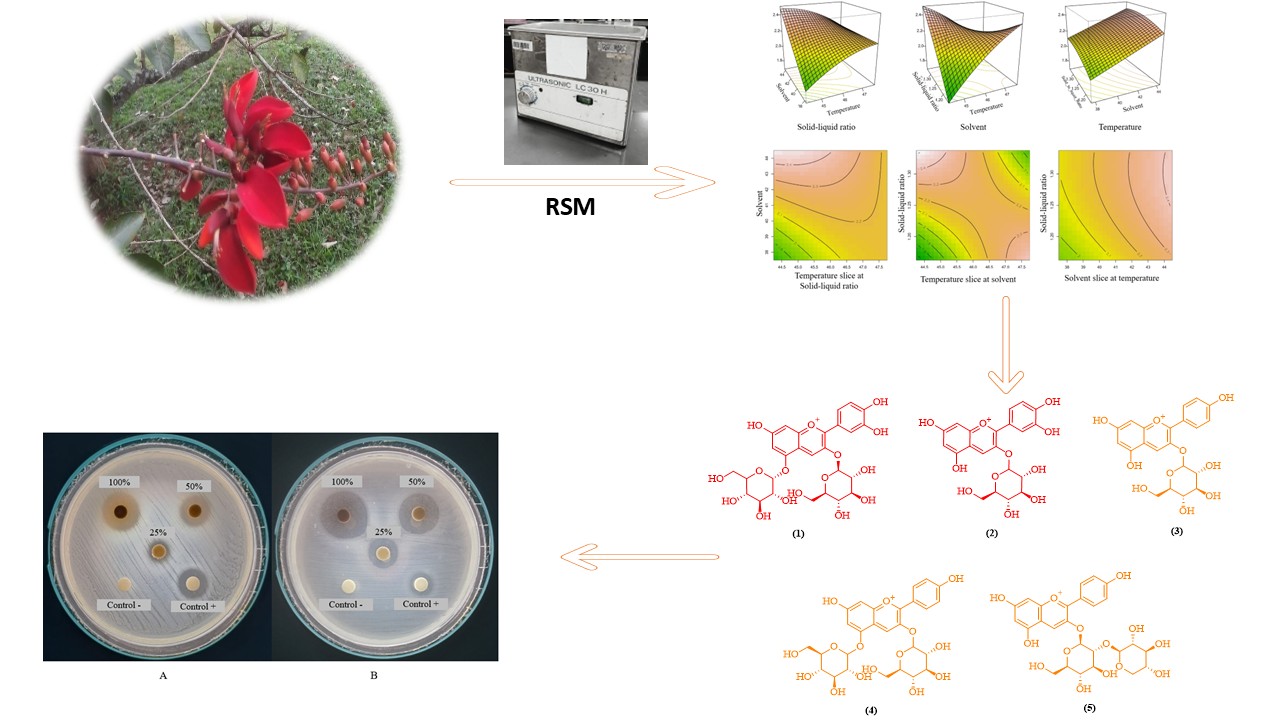
Anthocyanins are hydrophilic plant pigments from the flavonoid group that offer health benefits. Erythrina crista-galli is one such anthocyanin-containing plant. The ultrasound-assisted extraction (UAE) technique enhances anthocyanin extraction efficiency while reducing solvent use (e.g. ethanol or methanol) and extraction time compared to conventional methods. The effectiveness of UAE for anthocyanin extraction depends on factors such as temperature, solvent concentration, and solid-liquid ratio. This study aims to optimize the extraction of anthocyanins from E. crista-galli using UAE with RSM. The optimized UAE conditions were obtained using 68.71 % ethanol acidified with 1 % citric acid, an extraction time of 30 min, a temperature of 48.15 °C, and a solid-liquid ratio of 0.0435 g/mL. LC-MS/MS-based metabolite profiling identified five anthocyanins in E. crista-galli flowers, namely cyanidin-3-glucoside, cyanidin-3,5-diglucoside, pelargonidin 3,5-diglucoside, pelargonidin 3-glucoside, and pelargonidin-3-sambubioside. The in vitro antioxidant assay showed that E. crista-galli extract exhibited an IC₅₀ value 380.44 ± 4.13 ppm. Additionally, the extract demonstrated significant antibacterial activity against E. coli and S. typhimurium.
HIGHLIGHTS
- It is the first to explore Optimization of Ultrasound-Assisted Extraction of Anthocyanin from Erythrina crista-galli
- We employed a LC-MS/MS to identify the presence of anthocyanin in the extract of crista-galli flowers.
- The anthocyanin extract from crista-galli flowers exhibited antioxidant activity with an IC50 value of 380.44 ± 4.13 ppm. On the other hand, the anthocyanin extracts exhibited significant antibacterial activity against E. coli and Salmonella thypimurium.
GRAPHICAL ABSTRACT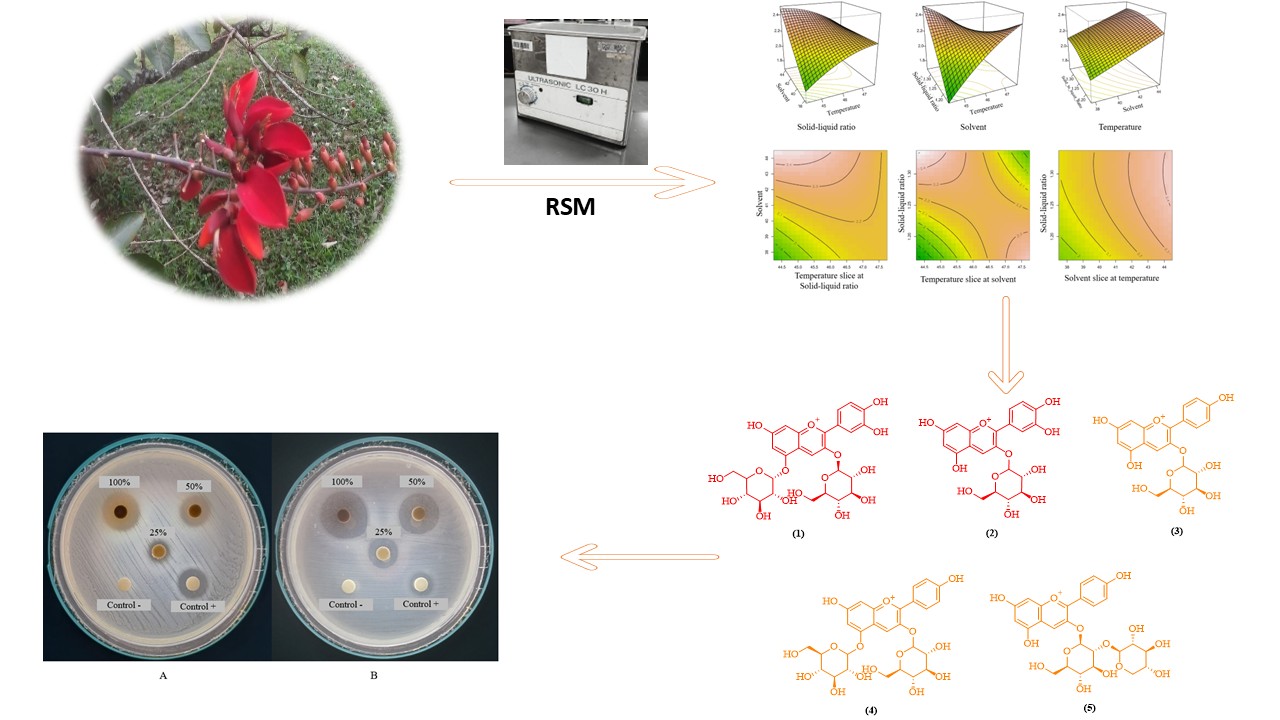
Downloads
References
GCP Goncalves, ALG Rosas, RCD Sousa, TRR Vieira, TCDA Sousa, T Ramires, TFFD Silveira, L Barros, WPD Silva, ARG Dias, EDR Zavareze and AD Meinhart. A green method for anthocyanin extraction from Clitoria ternatea flowers cultivated in southern Brazil: Characterization, in vivo toxicity, and biological activity. Food Chemistry 2024; 435, 137575.
F Zheng, Y Wang, Y Wu, M Zhang, F Li, Y He, L Wen and H Yue. Effect of stabilization malvids anthocyanins on the gut microbiota in mice with oxidative stress. Journal of Food Biochemistry 2021; 45(12), 4892-4902.
EJ Jeyaraj, GCV Gamage, JC Cintrat and WS Choo. Acylated and non-acylated anthocyanins as antibacterial and antibiofilm agents. Discover Food 2023; 3, 21.
H Deng, X Meng, B Xue and L Li. Unveiling the antibacterial potential of anthocyanins – a comprehensive review on this natural plant extract. Taylor & Francis, Oxford, 2024.
T Arita, S Miyazaki, S Teramoto and K Yoshitama. Major anthocyanin biosynthesis in the brilliant crimson petals from Erythrina crista-galli L. Scientia Horticulturae 2014; 168, 272-280.
X Li, F Zhu and Z Zeng. Effects of different extraction methods on antioxidant properties of blueberry anthocyanins. Open Chemistry 2021; 19, 138-148.
L Shen, S Pang, M Zhong, Y Sun, A Qayum, Y Liu, A Rashid, B Xu, Q Liang, H Ma and X Ren. A comprehensive review of ultrasonic assisted extraction (UAE) for bioactive components: Principles, advantages, equipment, and combined technologies. Ultrasonics Sonochemistry 2023; 101, 106646.
Z Kobus, A Pecyna, A Buczaj, M Krzywicka, A Przywara and R Nadulski. Optimization of the ultrasound-assisted extraction of bioactive compounds from cannabis sativa L. leaves and inflorescences using response surface methodology. Applied Sciences 2022; 12(13), 6747.
C Carrera, MJ Aliano-Gonzalez, J Rodriguez-Lopez, M Ferreiro-Gonzalez, F Ojeda-Copete, GF Barbero and M Palma. Optimization of an ultrasound-assisted extraction method for the analysis of major anthocyanin content in erica australis flowers. Molecules 2021; 26(10), 2884.
A Weremfo, F Adulley and M Adarkwah-Yiadom. Simultaneous optimization of microwave-assisted extraction of phenolic compounds and antioxidant activity of avocado (Persea americana Mill.) seeds using response surface methodology. Journal of Analytical Methods in Chemistry 2020; 2020(1), 7541927.
M Kopsel, T Kostka, S Niesen, P Winterhalter and T Esatbeyoglu. Influence of fractionation of polyphenols by membrane chromatography on antioxidant, antimicrobial and proliferation-inhibiting effects of red fruit juices. Food Chemistry 2025; 463(2), 141216.
R Mattioli, A Francioso, L Mosca and P Silva. Anthocyanins: A comprehensive review of their chemical properties and health effects on cardiovascular and neurodegenerative diseases. Molecules 2020; 25(17), 3809.
LS Sunarti. Bacterial contamination in food: Sources, risks, and prevention strategies. International Journal of Pathogen Research 2024; 13(6), 90-100.
F Stoica, OE Constantin, N Stanciuc, I Aprodu, GE Bahrim and G Rapeanu. Optimization of the parameters influencing the antioxidant activity and concentration of anthocyanins extracted from red onion skins using a central composite design. Inventions 2022; 7(4), 89.
U Gromping. An algorithm for blocking regular fractional factorial 2-level designs with clear two-factor interactions. Computational Statistics & Data Analysis 2021; 153, 107059.
CN Njoku and SK Otisi. Application of central composite design with design expert v13 in process optimization, in: Response surface methodology. IntechOpen, London, 2023.
FDO Riswanto, A Desra, RM Sari, V Thomas, A Rohman, S Pramono and S Martono. Employing an R software package rsm for optimizing of genistein, daidzein, and glycitein separation and its application for soy milk analysis by HPLC method. Indonesian Journal of Chemistry 2020; 20(5), 1184-1198.
N Tena and AG Asuero. Up-To-Date analysis of the extraction methods for anthocyanins: Principles of the techniques, optimization, technical progress, and industrial application. Antioxidants 2022; 11(2), 286.
HS Arruda, EK Silva, NMP Araujo, GA Pereira, GM Pastore and MRM Junior. Anthocyanins recovered from agri-food by-products using innovative processes: Trends, challenges, and perspectives for their application in food systems Molecules 2021; 26(9), 2632.
ID Larasati, C Carrera, HN Lioe, T Estiasih, ND Yuliana, Manikharda, HR Daniel Ray, M Palma and W Setyaningsih. Anthocyanin extraction from roselle (Hibiscus sabdariffa L.) calyces: A microwave-assisted approach using Box-Behnken design. Journal of Agriculture and Food Research 2024; 18, 101480.
T Taghavi, H Patel and R Rafie. Extraction solvents affect anthocyanin yield, color, and profile of strawberries. Plants 2023; 12(9), 1833.
GN Mattos, MCPDA Santiago, ACSD Chaves, A Rosenthal, RV Tonon and LMC Cabral. Anthocyanin extraction from jaboticaba skin (Myrciaria cauliflora Berg.) using conventional and non-conventional methods. Foods 2022; 11(6), 885.
R Scogin. Anthocyanins of the genus erythrina (fabaceae). Biochemical Systematics and Ecology 1991; 19(4), 329-332.
J Qiao, L Guo, J Yang, R Gao, Y Ni, J Huo, D Huang, X Sui and Y Zhang. Unveiling the polyphenol profile and bioactive potential of kiwi berry (Actinidia arguta): Antioxidant capacity and enzyme inhibition activities. Food Chemistry 2025; 471, 142839.
KG Kamble and KS Laddha. Extraction, isolation, and characterization of pelargonidin 3,5-o-diglucoside salt from pomegranate flowers. International Journal of Drug Delivery Technology 2023; 13(2), 494-500.
T Iwashina, S Rahayu, K Sugahara, T Mizuno, C Tsutsumi and D Widyatmoko. Acylated pelargonidin and cyanidin 3-sambubiosides from the flowers of Aeschynanthus species and cultivars. Phytochemistry 2021; 192, 112956.
Y Jia, C Wu, A Rivera-Piza, Y Kim, J Lee and S Lee. Mechanism of action of cyanidin 3-o-glucoside in gluconeogenesis and oxidative stress-induced cancer cell senescence. Antioxidants 2022; 11(4), 749.
N Karim, M R I Shishir, Y Li, OY Zineb, J Mo, J Tangpong and W Chen. Pelargonidin-3-o-glucoside encapsulated pectin-chitosan-nanoliposomes recovers palmitic acid-induced hepatocytes injury. Antioxidants 2022; 11(4), 623.
B Enaru, G Drețcanu, TD Pop, A Stanila and Z Diaconeasa. Anthocyanins: Factors affecting their stability and degradation. Antioxidants 2021; 10(12), 1967.
J Flieger, W Flieger, J Baj and R Maciejewski. Antioxidants: Classification, natural sources, activity/capacity measurements, and usefulness for the synthesis of nanoparticles. Materials 2021; 14(15), 4135.
V Deviani, A Hardianto, K Farabi and T Herlina. Flavanones from Erythrina crista-galli twigs and their antioxidant properties determined through in silico and in vitro studies. Molecules 2022; 27(18), 6018.
MT Reetz and G Konig. n-Butanol: An ecologically and economically viable extraction solvent for isolating polar products from aqueous solutions. European Journal of Organic Chemistry 2021; 2021(46), 6224-6228.
D Kim, J Lee and J Yoon. Accurate estimation of the inhibition zone of antibiotics based on laser speckle imaging and multiple random speckle illumination. Computers in Biology and Medicine 2024; 174, 108417.
A Huttner, J Bielicki, MN Clements, N Frimodt-Moller, AE Muller, JP Paccaud and JW Mouton. Oral amoxicillin and amoxicillin–clavulanic acid: Properties, indications and usage. Clinical Microbiology and Infection 2020; 26(7), 871-879.
Published
How to Cite
Issue
Section
License
Copyright (c) 2025 Walailak University

This work is licensed under a Creative Commons Attribution-NonCommercial-NoDerivatives 4.0 International License.





