
Carbon Capture at the Point Source: CO2 Gas Bubbling vs. Bicarbonate Supplementation in Microalgal Cultivation
DOI:
https://doi.org/10.48048/tis.2025.10991Keywords:
Carbon capture, CO2, CCUS, GHG emission, Microalgae, Cultivation, Bicarbonate, Bubbling, Carbon capture, CO2, CCUS, GHG emission, Microalgae, Cultivation, Bicarbonate, BubblingAbstract
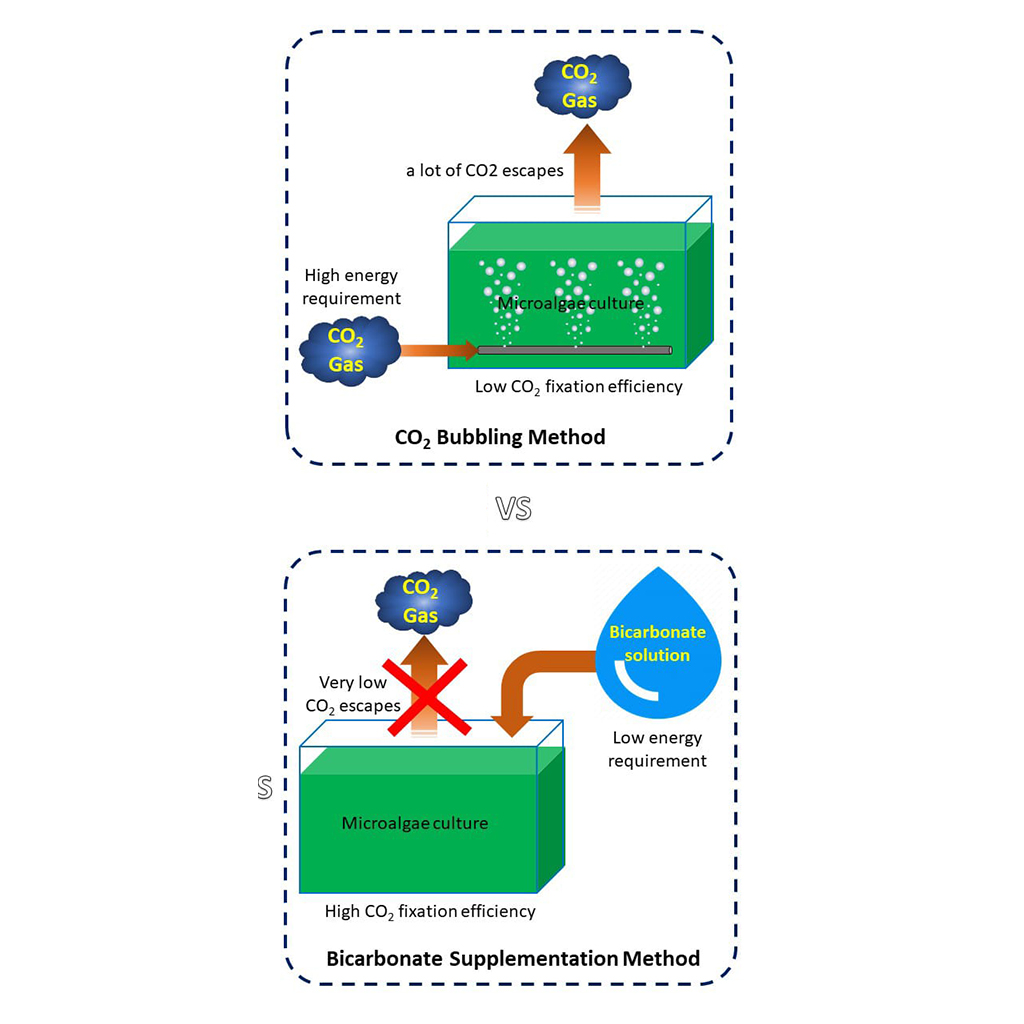
Mitigating greenhouse gas (GHG) emissions from industrial point sources is a key challenge for effective climate action. Among emerging carbon capture, utilization, and storage (CCUS) technologies, large-scale microalgal cultivation offers a sustainable pathway to converting carbon emissions into valuable biomass. This review evaluates 2 practical carbon supply strategies for microalgal systems - CO2-based and bicarbonate-based approaches - highlighting their respective technical performance and operational requirements. By comparing these systems in the context of practical integration with industrial emitters, we aim to clarify key trade-offs and operational considerations. This assessment provides a framework for optimizing microalgae-based carbon capture technologies and informs future design and deployment of emission-integrated microalgal cultivation systems. In comparison to the CO2-based system, the bicarbonate-based carbon supply system is a more effective choice for microalgae cultivation system in carbon capture project, according to the study’s findings. The Net energy Ratio (NER) of this bicarbonate-based cultivation system is 7.29, significantly greater than that of the CO2-based bubbling system, which only has a NER value of 0.85. This extremely high value can contribute to the project’s overall financial viability.
HIGHLIGHTS
- This review compares two carbon supply strategies for microalgal cultivation: CO₂ bubbling and bicarbonate supplementation.
- Bicarbonate supplementation achieves higher CO₂ fixation efficiency and significantly reduces energy demand compared to CO₂ bubbling.
- The bicarbonate-based system shows a Net Energy Ratio (NER) of 7.29, far exceeding the CO₂ bubbling method (NER = 0.85).
- Findings provide guidance for optimizing emission-integrated microalgal carbon capture and improving project financial viability.
GRAPHICAL ABSTRACT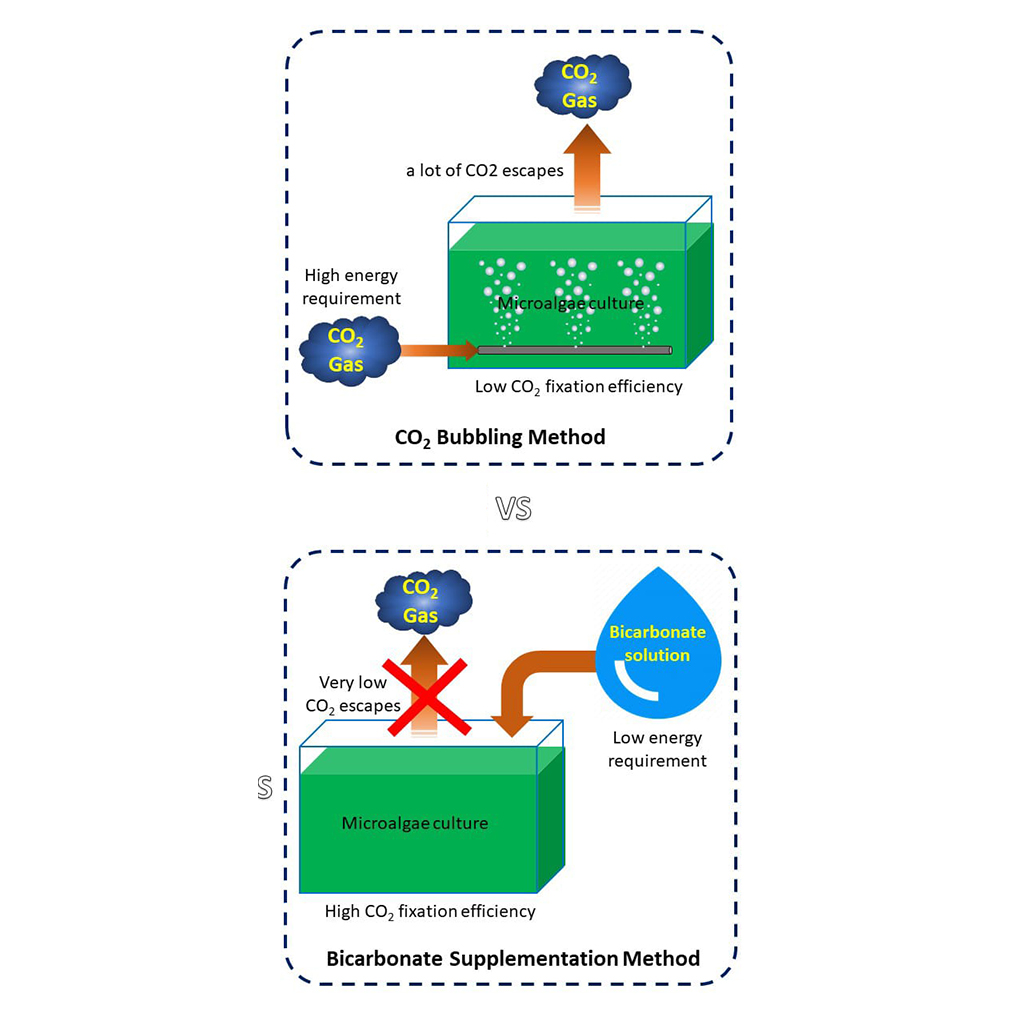
Downloads
References
A Valavanidis. Global warming and climate change. Fossil fuels and anthropogenic activities have warmed the. Scientific Reviews 2022. https://www.researchgate.net/publication/358498680
V Foster and D Bedrosyan. Understanding CO2 emissions from the global energy sector. World Bank, Washington DC, 2014.
L Bruhwiler and AM Michalak. Overview of the global carbon cycle. national oceanic and atmospheric administration. Annual Greenhouse Gas Index 2018; 7(15), 1-29.
R Sayre. Microalgae: The potential for carbon capture. Bioscience 2010; 60(9), 722-727.
B Clément-Larosière, F Lopes, A Gonçalves, B Taidi, M Benedetti, M Minier and D Pareau. Carbon dioxide biofixation by Chlorella vulgaris at different CO2 concentrations and light intensities. Engineering in Life Sciences 2014; 14(5), 509-519.
JCM Pires and AL Gonçalves. Microalgae cultures: Environmental tool and bioenergy. Energies 2022; 5(16), 5809.
W Wu, L Tan, H Chang, C Zhang, X Tan, Q Liao, N Zhong, X Zhang, Y Zhang and SH Ho. Advancements on process regulation for microalgae-based carbon neutrality and biodiesel production. Renewable and Sustainable Energy Reviews 2023; 171, 112969.
Q Zheng, X Xu, GJO Martin and SE Kentish. Critical review of strategies for CO2 delivery to large-scale microalgae cultures. Chinese Journal of Chemical Engineering 2018; 26(11), 2219-2228.
CVT Do, NTT Nguyen, TD Tran, MHT Pham and TYT Pham. Capability of carbon fixation in bicarbonate-based and carbon dioxide-based systems by Scenedesmus acuminatus TH04. Biochemical Engineering Journal 2021; 166, 107858.
MK Lam and KT Lee. Effect of carbon source towards the growth of Chlorella vulgaris for CO2 bio-mitigation and biodiesel production. International Journal of Greenhouse Gas Control 2013; 14, 169-176.
C Zhu, Y Xi, X Zhai, J Wang, F Kong and Z Chi. Pilot outdoor cultivation of an extreme alkalihalophilic Trebouxiophyte in a floating photobioreactor using bicarbonate as carbon source. Journal of Cleaner Production 2021; 283, 124648.
KE Achyuthan, JC Harper, RP Manginell and MW Moorman. Volatile metabolites emission by in vivo microalgae - an overlooked opportunity? Metabolites 2017; 7, 39.
MF de Souza, E Meers and S Mangini. The potential of microalgae for carbon capture and sequestration. EFB Bioeconomy Journal 2024; 4, 100067.
UB Singh and AS Ahluwalia. Microalgae: A promising tool for carbon sequestration. Mitigation and Adaptation Strategies for Global Change 2013; 18(1), 73-95.
A Rinanti, E Kardena, DI Astuti and K Dewi. Improvement of carbon dioxide removal through artificial light intensity and temperature by constructed green microalgae consortium in a vertical bubble column photobioreactor. Malaysian Journal of Microbiology 2014; 10, 29-37.
MP Johnson. Photosynthesis. Essays in Biochemistry 2016; 60(3), 255-273.
BS Yu, S Pyo, J Lee and K Han. Microalgae: A multifaceted catalyst for sustainable solutions in renewable energy, food security, and environmental management. Microbial Cell Factories 2024; 23(1), 308.
G Li, W Xiao, T Yang and T Lyu. Optimization and process effect for microalgae carbon dioxide fixation technology applications based on carbon capture: A comprehensive review. C-Journal of Carbon Research 2023; 9(1), 35.
PM Doran. Bioprocess engineering principles. Academic Press, New York, 1995.
P Pal, A Kioka, S Maurya and RA Doong. Innovative nanobubble technology: Fuelling the future of bioenergy and carbon mitigation. Renewable and Sustainable Energy Reviews 2025; 209, 115118.
C Kim, J Kim, S Joo, Y Bu, M Liu, J Cho and G Kim. Efficient CO2 utilization via a hybrid Na-CO2 system based on CO2 dissolution. IScience 2018; 9, 278-285.
W Klinthong, YH Yang, CH Huang and CS Tan. A review: Microalgae and their applications in CO2 capture and renewable energy. Aerosol and Air Quality Research 2015; 15, 712-742.
R Prasad, SK Gupta, N Shabnam, CYB Oliveira, AK Nema, FA Ansari and F Bux. Role of microalgae in global CO2 sequestration: Physiological mechanism, recent development, challenges, and future prospective. Sustainability 2021; 13(23), 13061.
D Shimamura, T Ikeuchi, A Matsuda, Y Tsuji, H Fukuzawa, K Mochida and T Yamano. Periplasmic carbonic anhydrase CAH1 contributes to high inorganic carbon affinity in Chlamydomonas reinhardtii. Plant Physiology 2024; 196, 2395-2404.
K Mallikarjuna, K Narendra, R Ragalatha and BJ Rao. Elucidation and genetic intervention of CO2 concentration mechanism in Chlamydomonas reinhardtii for increased plant primary productivity. Journal of Biosciences 2020; 45(1), 115.
KH Chowdury, N Nahar and UK Deb. The growth factors involved in microalgae cultivation for biofuel production: A review. Computational Water, Energy, and Environmental Engineering 2020; 9(4), 185-215.
R Qiu, S Gao, PA Lopez and KL Ogden. Effects of pH on cell growth, lipid production and CO2 addition of microalgae Chlorella sorokiniana. Algal Research 2017; 28, 192-199.
SV Mohan, MV Rohit, P Chiranjeevi, R Chandra and B Navaneeth. Heterotrophic microalgae cultivation to synergize biodiesel production with waste remediation: Progress and perspectives. Bioresource Technology 2015; 184, 169-178.
FG Acién, JM Fernández, JJ Magán and E Molina. Production cost of a real microalgae production plant and strategies to reduce it. Biotechnology Advances 2012; 30(6), 1344-1353.
R Pourjamshidian, H Abolghasemi, M Esmaili, HD Amrei, M Parsa and S Rezaei. Carbon dioxide biofixation by Chlorella sp. In a bubble column reactor at different flow rates and CO2 concentrations. Brazilian Journal of Chemical Engineering 2019; 36(2), 639-645.
JS Tan, SY Lee, KW Chew, MK Lam, JW Lim, SH Ho and PL Show. A review on microalgae cultivation and harvesting, and their biomass extraction processing using ionic liquids. Bioengineered 2020; 11(1), 116-129.
SA Razzak, K Bahar, KMO Islam, AK Haniffa, MO Faruque, SMZ Hossain and MM Hossain. Microalgae cultivation in photobioreactors: Sustainable solutions for a greener future. Green Chemical Engineering 2024; 5, 418-439.
TJ Johnson, S Katuwal, GA Anderson, L Gu, R Zhou and WR Gibbons. Photobioreactor cultivation strategies for microalgae and cyanobacteria. Biotechnology Progress 2018; 34, 811-827.
C Zhu, S Chen, Y Ji, U Schwaneberg and Z Chi. Progress toward a bicarbonate-based microalgae production system. Trends in Biotechnology 2022; 40(2), 180-193.
YJ Sung, JS Lee, HK Yoon, H Ko and SJ Sim. Outdoor cultivation of microalgae in a coal-fired power plant for conversion of flue gas CO2 into microalgal direct combustion fuels. Systems Microbiology and Biomanufacturing 2021; 1(1), 90-99.
I Umetani, E Janka, M Sposób, CJ Hulatt, S Kleiven and R Bakke. Bicarbonate for microalgae cultivation: A case study in a chlorophyte, Tetradesmus wisconsinensis isolated from a Norwegian lake. Journal of Applied Phycology 2021; 33(3), 1341-1352.
C Zhu, R Zhang, L Cheng and Z Chi. A recycling culture of Neochloris oleoabundans in a bicarbonate-based integrated carbon capture and algae production system with harvesting by auto-flocculation. Biotechnology for Biofuels 2018; 11(1), 204.
MJD Latagan, D Nagarajan, WM Huang, MDG de Luna, JH Chen, AP Rollon, IS Ng, DJ Lee and JS Chang. Bicarbonate-based microalgal cultivation technologies: Mechanisms, critical strategies, and future perspectives. Chemical Engineering Journal 2024; 502, 157998.
B Muthu, A Kamalanathan and S Janarthanan. Effect of pH on Arthrospira platensis production. Alochana Chakra Journal 2020; 9(5), 2297-2235.
B Huang, G Qu, Y He, J Zhang, J Fan and T Tang. Study on high-CO2 tolerant Dunaliella salina and its mechanism via transcriptomic analysis. Frontiers in Bioengineering and Biotechnology 2022; 10, 1086357.
SR Chae, EJ Hwang and HS Shin. Single cell protein production of Euglena gracilis and carbon dioxide fixation in an innovative photo-bioreactor. Frontiers in Bioengineering and Biotechnology 2006; 97, 322-329.
Spinola MP, Mendes AR, Prates JAM. Chemical composition, bioactivities, and applications of Spirulina (Limnospira platensis) in food, feed, and medicine. Foods 2024; 13(22), 3656.
RK Goswami, S Mehariya and P Verma. Advances in microalgae-based carbon sequestration: Current status and future perspectives. Environmental Research 2024; 249, 118397.
PA Kusi, D McGee, S Tabraiz and A Ahmed. Bicarbonate concentration influences carbon utilization rates and biochemical profiles of freshwater and marine microalgae. Biotechnology Journal 2024; 19(8), 2400361.
O Jorquera, A Kiperstok, EA Sales, M Embiruçu and ML Ghirard. Comparative energy life-cycle analyses of microalgal biomass production in open ponds and photobioreactors. Bioresource Technology 2010; 101(4), 1406-1413.
R Slade and A Bauen. Micro-algae cultivation for biofuels: Cost, energy balance, environmental impacts and future prospects. Biomass and Bioenergy 2013; 53, 29-38.
G Fekete, S Klátyik, A Sebők, AB Dálnoki, A Takács, M Gulyás, I Czinkota, A Székács, C Gyuricza and L Aleksza. Optimization of a Chlorella vulgaris-based carbon sequestration technique using an alkaline medium of wood biomass ash extract. Water 2024; 16(24), 3696.
YK Dasan, MK Lam, S Yusup, JW Lim, PL Show, IS Tan and KT Lee. Cultivation of Chlorella vulgaris using sequential-flow bubble column photobioreactor: A stress-inducing strategy for lipid accumulation and carbon dioxide fixation. Journal of CO2 Utilization 2020; 41, 101226.
J Fu, Y Huang, Q Liao, X Zhu, A Xia, X Zhu and JS Chang. Boosting photo-biochemical conversion and carbon dioxide bio-fixation of Chlorella vulgaris in an optimized photobioreactor with airfoil-shaped deflectors. Bioresource Technology 2021; 337, 125355.
KE Dickinson, K Stemmler, T Bermarija, SM Tibbetts, SP MacQuarrie, S Bhatti, C Kozera, SJB O’Leary and PJ McGinn. Photosynthetic conversion of carbon dioxide from cement production to microalgae biomass. Applied Microbiology and Biotechnology 2023; 107, 7375-7390.
U Ojaniemi, A Tamminen, J Syrjänen and D Barth. CFD modeling of CO2 fixation by microalgae cultivated in a lab scale photobioreactor. Bioresource Technology 2025; 415, 131715.
K Kumari, S Samantaray, D Sahoo and BC Tripathy. Modulation of photosynthesis, biomass and lipid production by sulfur and CO2 supplementation in Chlorella vulgaris. Journal of Applied Phycology 2024; 37(1), 135-150.
IA Lawal. Analyzing CO2 capture using sodium hydroxide in a spray column: Operational influences on absorption efficiency and regeneration. Digitala Vetenskapliga Arkivet 2024; 313, 1-69.
A Raheem, S Sivasangar, WW Azlina, YHT Yap, MK Danquah and R Harun. Thermogravimetric study of Chlorella vulgaris for syngas production. Algal Research 2015; 12, 52-59.
AM Youssef, M Gomaa, AKSH Mohamed and ARA El-Shanawany. Enhancement of biomass productivity and biochemical composition of alkaliphilic microalgae by mixotrophic cultivation using cheese whey for biofuel production. Environmental Science and Pollution Research 2024; 31(30), 42875-4288.
M Chen, Y Chen and Q Zhang. A review of energy consumption in the acquisition of bio-feedstock for microalgae biofuel production. Sustainability 2021; 13(16), 8873.
P Xu, J Li, J Qian, B Wang, J Liu, R Xu, P Chen and W Zhou. Recent advances in CO2 fixation by microalgae and its potential contribution to carbon neutrality. Chemosphere 2023; 319, 137987.
V Lukyanov, S Gorbunova and A Avsiyan. Biotechnological and economic assessment of the productivity of Chlorella vulgaris IBSS-19 microalgae under different cultivation regimes. Bioresource Technology Reports 2024; 27, 101907.
P Ratomski, M Hawrot-Paw and A Koniuszy. Utilisation of CO2 from sodium bicarbonate to produce chlorella vulgaris biomass in tubular photobioreactors for biofuel purposes. Sustainability 2021; 13(16), 9118.
M Cordoba-Perez and H de Lasa. CO2-derived carbon capture using microalgae and sodium bicarbonate in a photobioCREC unit: Kinetic modeling. Processes 2021; 9(8), 1296.
P Zhang, Q Sun, Y Dong and S Lian. Effects of different bicarbonate on spirulina in CO2 absorption and microalgae conversion hybrid system. Frontiers in Bioengineering and Biotechnology 2023; 10, 1119111.
WM Huang, YK Leong, JH Chen, MJD Latagan, CY Chen, DJ Lee and JS Chang. Bicarbonate-based cultivation of Chlorella sorokiniana SU-1: Optimizing culture conditions and utilizing bicarbonate from flue gas chemical absorption. Chemical Engineering Journal 2025; 503, 158651.
A Ughetti, F Roncaglia, B Anderlini, V D’Eusanio, AL Russo and L Forti. Integrated carbonate-based CO2 capture-biofixation through Cyanobacteria. Applied Sciences 2023; 13(19), 10779.
HPS Alarde, KJC Bartolabac, DP Acut, JFA Cane and JR Magsayo. Development of an Arduino-based photobioreactor to investigate algae growth rate and CO2 removal efficiency. IAES International Journal of Robotics and Automation 2022; 11(2), 141.
G Penloglou, A Pavlou and C Kiparissides. Recent advancements in photo-bioreactors for microalgae cultivation: A brief overview. Processes 2024; 12(6), 1104.
X Yu, W Guo, Z Hu, P Li, Z Zhang, J Cheng, C Song and Q Ye. Flue gas CO2 supply methods for microalgae utilization: A review. Clean Energy Science and Technology 2023; 1(2), 78.
Y Yang, S Tang and JP Chen. Carbon capture and utilization by algae with high concentration CO2 or bicarbonate as carbon source. Science of the Total Environment 2024; 918, 170325.
M Hanifzadeh, MH Sarrafzadeh, Z Nabati, O Tavakoli and H Feyzizarnagh. Technical, economic and energy assessment of an alternative strategy for mass production of biomass and lipid from microalgae. Journal of Environmental Chemical Engineering 2018; 6(1), 866-873.
H Leflay, J Pandhal and S Brown. Direct measurements of CO2 capture are essential to assess the technical and economic potential of algal-CCUS. Journal of CO2 Utilization 2021; 52, 101657.
MD Somers and JC Quinn. Sustainability of carbon delivery to an algal biorefinery: A techno-economic and life-cycle assessment. Journal of CO2 Utilization 2019; 30, 193-204.
Published
How to Cite
Issue
Section
License
Copyright (c) 2025 Walailak University

This work is licensed under a Creative Commons Attribution-NonCommercial-NoDerivatives 4.0 International License.





