
Comparison of Microalgae Harvesting Methods: Technical Efficiency and Economic Feasibility for Scalable Biofuel Production
DOI:
https://doi.org/10.48048/tis.2026.12702Keywords:
Biofuel, BioCCU, Cost, Energy efficiency, Feasibility, Harvesting, Microalgae, Biofuel, BioCCU, Cost, Energy efficiency, Feasibility, Harvesting, MicroalgaeAbstract
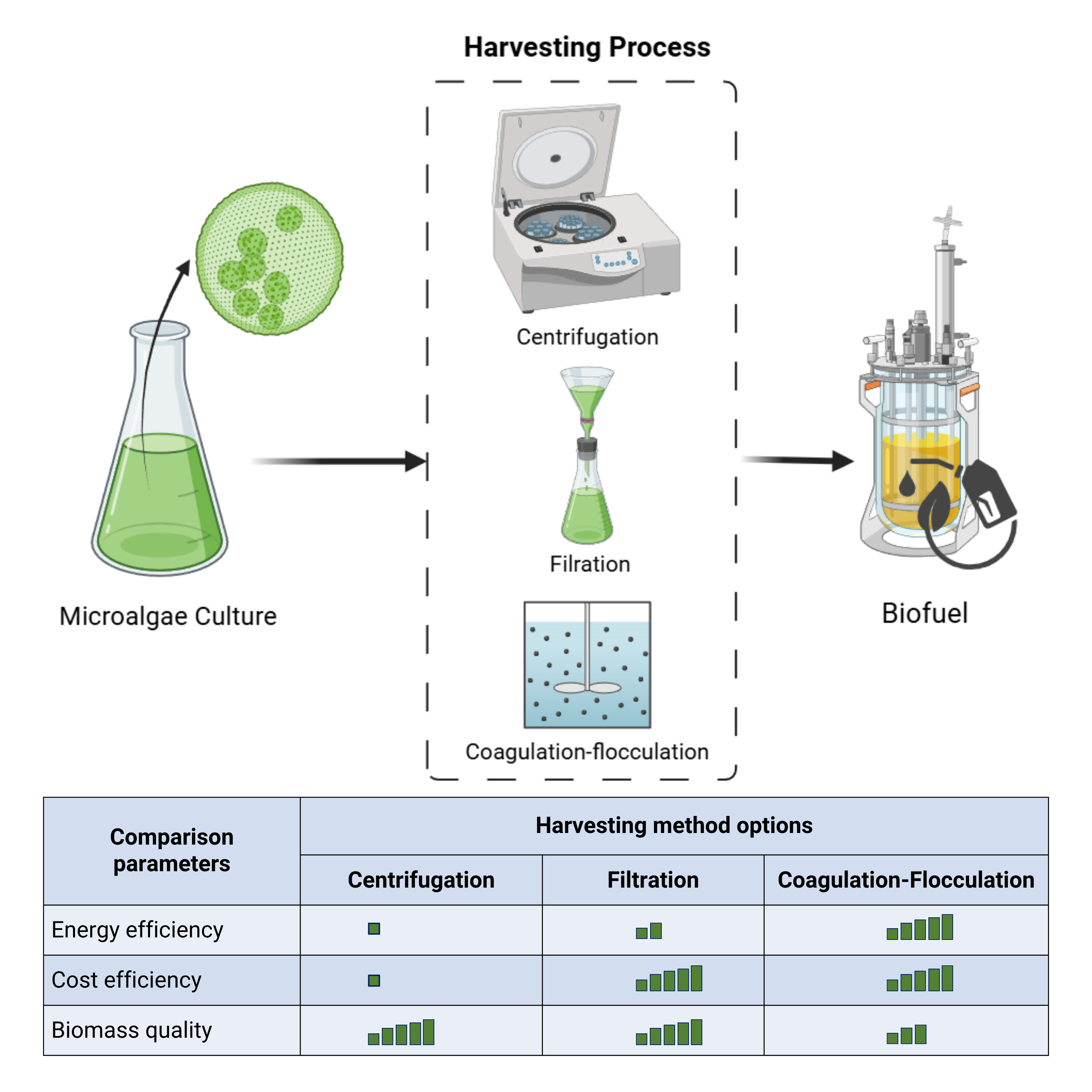
Global warming is a critical global challenge that has accelerated the development of carbon mitigation strategies. Microalgae-based systems have emerged as a promising carbon capture and utilization (CCU) approach, often referred to as BioCCU, due to their ability to convert captured captured carbon into valuable biomass. In the energy sector, algal biomass can be converted into diverse biofuels such as high-calorie biomass, biodiesel, bioethanol, and hydrogen. Despite this potential, large-scale deployment of microalgae-based CCU systems is still constrained by the harvesting stage, which remains one of the most energy- and cost-intensive processes. This review provides a comparative assessment of microalgae harvesting techniques such as centrifugation, filtration, and coagulation/flocculation, focusing on energy consumption, operational cost, biomass quality, and technical feasibility for BioCCU applications. The analysis is based on laboratory- and pilot-scale data obtained from BioCCU unit at Paiton Power Plant Units 5 & 6, Indonesia, complemented by relevant literature. The results shows that centrifugation produces high-quality, contamination-free biomass but requires extremely high energy input, resulting in a low net energy ratio (NER) of 1.20 and a high operational cost of approximately USD 0.51/kg of dry biomass. Filtration shows improved energy performance (NER = 5.22) and low operational cost (USD 0.16/kg of dry biomass), but its application is limited by membrane fouling, operational complexity, and high moisture content of the harvested biomass. In contrast, coagulation–flocculation demonstrates the most favorable energy performance, achieving a high NER value of 21.34 with a relatively low operational cost of USD 0.21/kg of dry biomass, while offering simpler operation and more energy-efficient downstream drying. The main contribution of this review lies in quantifying the trade-offs among harvesting methods and identifying coagulation–flocculation as the most promising option for large-scale BioCCU systems targeting biofuel production, provided that future developments address the environmental impacts of chemical usage.
HIGHLIGHTS
- This review evaluates three major microalgae harvesting techniques, such as centrifugation, filtration, and coagulation/flocculation for biofuel-oriented BioCCU applications.
- Compares methods based on technical efficiency, energy demand, and cost-effectiveness within sustainable energy frameworks.
- Identifies trade-offs between recovery efficiency and operational scalability for each harvesting approach.
- Provides insights for optimizing microalgae harvesting strategies to enhance BioCCU process integration and biofuel production sustainability.
GRAPHICAL ABSTRACT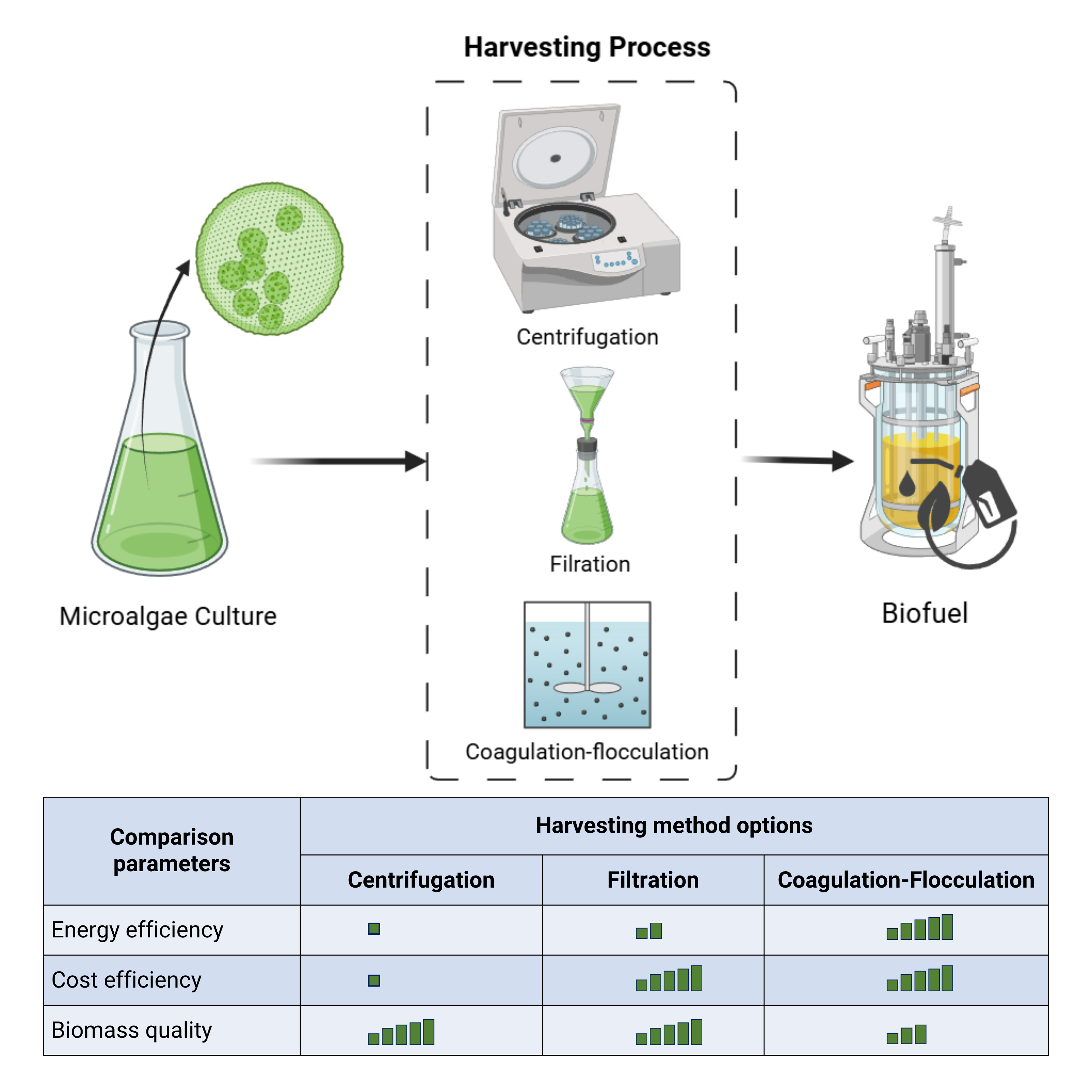
Downloads
References
S Fawzy, AI Osman, J Doran and DW Rooney. Strategies for mitigation of climate change: A review. Environental Chemistry Letters 2020; 18(6), 2069-2094.
D Wongsodiharjo and YI Masjud. Utlize microalgae in order to lowering green house emission by using carbon capture. Sustainable Urban Development Environmental Impact Journal 2024; 1(1), 1-10.
IPCC. Global Warming of 1.5 °C. The Intergovermental Panel on Climate Change 2018. Available at: https://www.ipcc.ch/sr15/, accesed January 2024.
F Graciela. The impact of global warming on Earth’s ecosystems and future sustainability. International Journal of Science Review 2023; 5(2), 461-469.
P Xu, Jun Li, J Qian, B Wang, J Liu, R Xu, P Chen and W Zhou. Recent advances in CO2 fixation by microalgae and its potential contribution to carbon neutrality. Chemosphere 2023; 319(1), 137987.
H Onyeaka, T Miri, KC Obileke, A Hart, C Anumudu and ZT Al-Sharify. Minimizing carbon footprint via microalgae as a biological capture. Carbon Capture Science Technology 2021; 1(9), 100007.
KS Khoo. Recent advances in downstream processing of microalgae lipid recovery for biofuel production. Bioresource Technology 2020; 304, 122996.
X Xiao, W Li, M Jin, L Zhang, L Qin and W Geng. Responses and tolerance mechanisms of microalgae to heavy metal stress: A review. Marine Environmental Research 2022; 183(10), 105805.
JS Tan. A review on microalgae cultivation and harvesting, and their biomass extraction processing using ionic liquids. Bioengineered 2020; 11(1), 116-129.
G Singh and SK Patidar. Microalgae harvesting techniques: A review. Journal of Environmental Managemenet 2018; 217, 499-508.
A Kucmanová and K Gerulová. Microalgae harvesting: A review. Research Papers Faculty of Materials Science and Technology Slovak University of Technology 2019; 27(44), 129-143.
SAI Mze, AS Azmi, NIM Puad, F Ahmad, FA Wahab and SNFSA Rahman. Microalgae cultivation: From CO2 fixation to single-cell protein production. IOP Conference Series: Earth and Environmental Science 2023; 1281(1), 12-49.
M Ashour, AT Mansour, YA Alkhamis and M Elshobary. Usage of chlorella and diverse microalgae for CO(2) capture - towards a bioenergy revolution. Frontiers in Bioengineering and Biotechnology 2024; 12, 1387519.
ML Calijuri. Bioproducts from microalgae biomass: Technology, sustainability, challenges and opportunities. Chemosphere 2022; 305, 135508.
S Wang, L Zheng, X Han, B Yang, J Li and C Sun. Lipid accumulation and CO2 utilization of two marine oil-rich microalgal strains in response to CO2 aeration. Acta Oceanoogica Sinica 2018; 37(2), 119-126.
M Wang, X Ye, H Bi and Z Shen. Microalgae biofuels: Illuminating the path to a sustainable future amidst challenges and opportunities. Biotechnology for Biofuels and Bioproducts 2024; 17(1), 10.
YT Nugroho. Carbon capture at the Point Source : CO 2 Gas Bubbling vs . Bicarbonate Supplementation in Microalgal Cultivation. Trends in Sciences 2025; 22(11), 10991.
S Cao, J Liang, M Chen, C Xu, X Wang, L Qiu, X Zhao, X Zhao and W Hu. Comparative analysis of extraction technologies for plant extracts and absolutes. Frontiers in Chemistry 2025; 13, 1536590.
P Deepa, K Sowndhararajan and S Kim. A review of the harvesting techniques of microalgae. Water (Switzerland) 2023; 15(17), 3074.
YSH Najjar and A Abu-Shamleh. Harvesting of microalgae by centrifugation for biodiesel production: A review. Algal Research 2020; 51(8), 102046.
AS Japar, NM Azis, MS Takriff, N Haiza and M Yasin. Application of different techniques to harvest microalgae. Transactions of Science and Technology 2017; 4(2), 98-108.
F Javed, M Aslam, N Rashid, Z Shamair, AL Khan, M Yasin, T Fazal, A Hafeez, F Rehman, MSU Rehman, Z Khan, J Iqbal and AA Bazmi. Microalgae-based biofuels, resource recovery and wastewater treatment: A pathway towards sustainable biorefinery. Fuel 2019; 255, 115826.
MGD Morais, GMD Rosa, L Moraes, TD Santos and JAV Costa. Microalgae biotechnology and chemical absorption as merged techniques to decrease carbon dioxide in the atmosphere BT - Sustainable utilization of carbon dioxide: From waste to product. Springer Nature Singapore 2023. https://doi.org/10.1007/978-981-99-2890-3_4
MA hattab. Microalgae harvesting methods for industrial production of biodiesel: Critical review and comparative analysis. Journal of Fundamental of Renewable Energy and Applications 2015; 5(2), 1-26.
JA Liber, AE Bryson, G Bonito and ZY Du. Harvesting microalgae for food and energy products. Small Methods 2020; 4(10), 2000349.
S Rakesh, J TharunKumar, B Sri, K Jothibasu and S Karthikeyan. Sustainable Cost-effective microalgae harvesting strategies for the production of biofuel and oleochemicals. Highlights Biosciences 2020; 3(7), 1-8.
N Rossignol, L Vandanjon, P Jaouen and F Quéméneur. Membrane technology for the continuous separation microalgae/culture medium: Compared performances of cross-flow microfiltration and ultrafiltration. Aquacultural Engineering 1999; 20(3), 191-208.
S Babel and S Takizawa. Chemical pretreatment for reduction of membrane fouling caused by algae. Desalination 2011; 274(1), 171-176.
IA Matter, VKH Bui, M Jung, JY Seo, YE Kim, YC Lee and YK Oh. Flocculation harvesting techniques for microalgae: A review. Applied Sciences 2019; 9(15), 3069.
AJ Dassey and CS Theegala. Harvesting economics and strategies using centrifugation for cost effective separation of microalgae cells for biodiesel applications. Bioresource Technology 2013; 128, 241-245.
S Lama, K Muylaert, TB Karki, I Foubert, RK Henderson and D Vandamme. Flocculation properties of several microalgae and a cyanobacterium species during ferric chloride, chitosan and alkaline flocculation. Bioresource Technology 2016; 220, 464-470.
MK Danquah, R Harun, R Halim and GM Forde. Cultivation medium design via elemental balancing for tetraselmis suecica. Chemical and Biochemical Engineering Quarterly 2012; 24(3), 361-369.
R Bhave, T Kuritz, L Powell and D Adcock. Membrane-based energy efficient dewatering of microalgae in biofuels production and recovery of value added Co-products. Environmental Science & Technology 2012; 46(10), 5599-5606.
S Khalatbari. Optimisation of chemical harvesting of microalgae from fish processing wastewater and economic assessment based on process modelling. Chemical Engineering Journal 2025; 524, 169036.
U. Kuzhiumparambil. Effects of harvesting on morphological and biochemical characteristics of microalgal biomass harvested by polyacrylamide addition, pH-induced flocculation, and centrifugation. Bioresource Technology 2022; 359, 127433.
VO Mkpuma, M Najafi, J Farahbakhsh, M Zargar, NR Moheimani and H Ennaceri. Membrane fouling dynamics and flux optimization in the ultrafiltration of Chlorella sp. MUR 269 and Dunaliella salina CS 744/01. Journal of Water Process Engineering 2025; 78, 108808.
HJ Yoon, JS Lee, KH Min, DH Kim, SJ Sim and SP Pack. Economic and demonstrative pilot-scale harvesting of microalgae biomass via novel combined process of dissolved air flotation and screw-press filtration. Bioresource Technology 2024; 418, 131892.
Z Hashmi. Cultivation of indigenous Chlorococcum sp. in aquaculture wastewater under various light color and biomass harvesting using membrane filtration: A simultaneous wastewater treatment and biomass production. Clean Waste Systems 2025; 10, 100209.
EGD Morais, ICF Sampaio, E Gonzalez-Flo, I Ferrer, E Uggetti and J García. Microalgae harvesting for wastewater treatment and resources recovery: A review. Nature Biotechnology 2023; 78, 84-94.
Y Li. Synergistic enhancement of chitosan-diatomite composite in microalgae flocculation: Mechanistic insights into extracellular polymeric substances-mediated harvesting. International Journal of Biological Macromolecules 2025; 325, 147368.
N Thi and D Phuong. harvesting chlorella vulgaris by natural increase in ph - a new aspect of the culture in wastewater medium. Journal of Science and Technology 2014; 12(85), 66-69.
JF Mora-Sánchez, J González-Camejo, G Noriega-Hevia, A Seco and MV Ruano. Ultrafiltration harvesting of microalgae culture cultivated in a WRRF: Long-term performance and techno-economic and carbon footprint assessment. Sustainable 2024; 16(1), 369.
L Wang, B Pan, Y Gao, C Li, J Ye and L Yang. Ef fi cient membrane microalgal harvesting : Pilot-scale performance and techno-economic analysis. Journal of Cleaner Production 2019; 218, 83-95.
RH Olcay. Industrial-scale application of polymer dewatering for fine tailings disposal. Materials 2025; 18(16), 3872.
A Raheem, P Prinsen, AK Vuppaladadiyam, M Zhao and R Luque. A review on sustainable microalgae based biofuel and bioenergy production: Recent developments. Journal of Cleaner Production 2018; 181, 42-59.
O Jorquera, A Kiperstok, EA Sales, M Embiruçu and ML Ghirardi. Comparative energy life-cycle analyses of microalgal biomass production in open ponds and photobioreactors. Bioresource Technology 2009; 101(4), 1406-1413.
F Fasaei, JH Bitter, PM Slegers and AJBV Boxtel. Techno-economic evaluation of microalgae harvesting and dewatering systems. Algal Research 2017; 31, 347-362.
Published
How to Cite
Issue
Section
License
Copyright (c) 2025 Walailak University

This work is licensed under a Creative Commons Attribution-NonCommercial-NoDerivatives 4.0 International License.





