
Effect of Fiber Drink Consumption Containing Glucomannan and Isomaltooligosaccharide on Digesta Profile and Gut Microbiota
DOI:
https://doi.org/10.48048/tis.2025.8642Keywords:
Porang Glucomannan, Isomaltooligosaccharide, fiber drink, digesta profile, sIgA, gut microbiota, Digesta profile, GIFD, Gut microbiota, Porang Glucomannan, sIgAAbstract
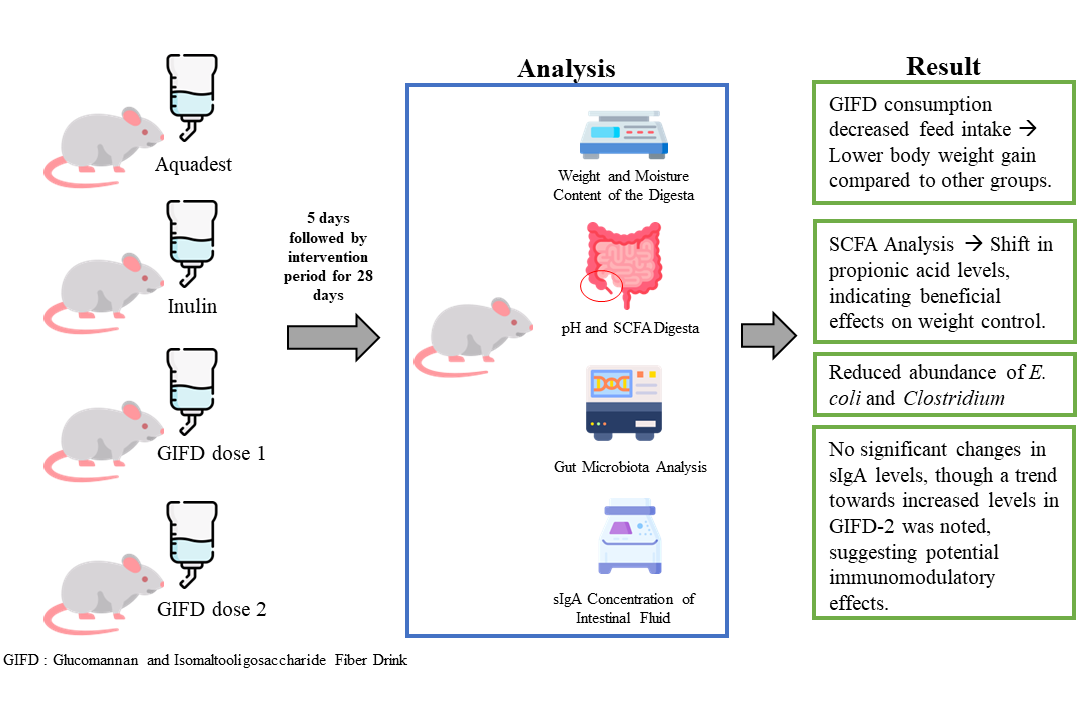
Dietary fibers have long been recognized for their numerous health benefits, including supporting gut health, aiding in weight management, and reducing the risk of cardiovascular disease. Glucomannan, derived from konjac and porang tubers, has gained attention for its diverse health-promoting properties. However, its application in beverages is limited due to its high viscosity. Combining glucomannan with isomaltooligosaccharide (IMO) is suggested to synergistically enhance functionality, particularly improving gastrointestinal health. This study investigates the functional effects of porang glucomannan and isomaltooligosaccharide-containing fiber drinks (GIFD) on body weight, feed intake, digesta profiles (digesta weight, moisture content, pH) and gut microbiota using in vivo method. Twenty-four male Sprague Dawley rats were divided into 4 groups, including control, inulin, and 2 doses of glucomannan and isomaltooligosaccharide fiber drink (GIFD). Rats were fed with AIN-93M. Adaptation was carried out for 5 days followed by 28 days of intervention. Results indicate that GIFD consumption led to reduced feed intake, likely due to increased satiety effects and glucomannan’s gel-forming ability, resulting in lower body weight gain compared to other groups. While GIFD did not significantly alter digesta weight and moisture contents, it significantly decreased pH values. Analysis of short-chain fatty acids (SCFAs) showed a shift in propionic acid levels, suggesting a beneficial effect on weight control. Moreover, GIFD treatment reduced abundance percentages of enteric bacteria like E. coli and Clostridium, possibly due to increased SCFA production. However, GIFD consumption did not significantly alter sIgA concentration, although there was a trend towards increased levels in GIFD-2, suggesting potential immunomodulatory effects. Overall, it was indicated that porang glucomannan and IMO-containing fiber drinks has the potential to be used as beverages to support body weight regulation and to help maintaining digestive tract health.
HIGHLIGHTS
- Glucomannan and isomaltooligosaccharide-containing fiber drinks (GIFD) reduced feed intake.
- Consumption of GIFD induced the shift of molar proportion of SCFAs suggesting beneficial health effect.
- GIFD treated groups showed lower abundance percentages of coli and Clostridium compared to control.
- GIFD is potential to be developed as weight management product.
GRAPHICAL ABSTRACT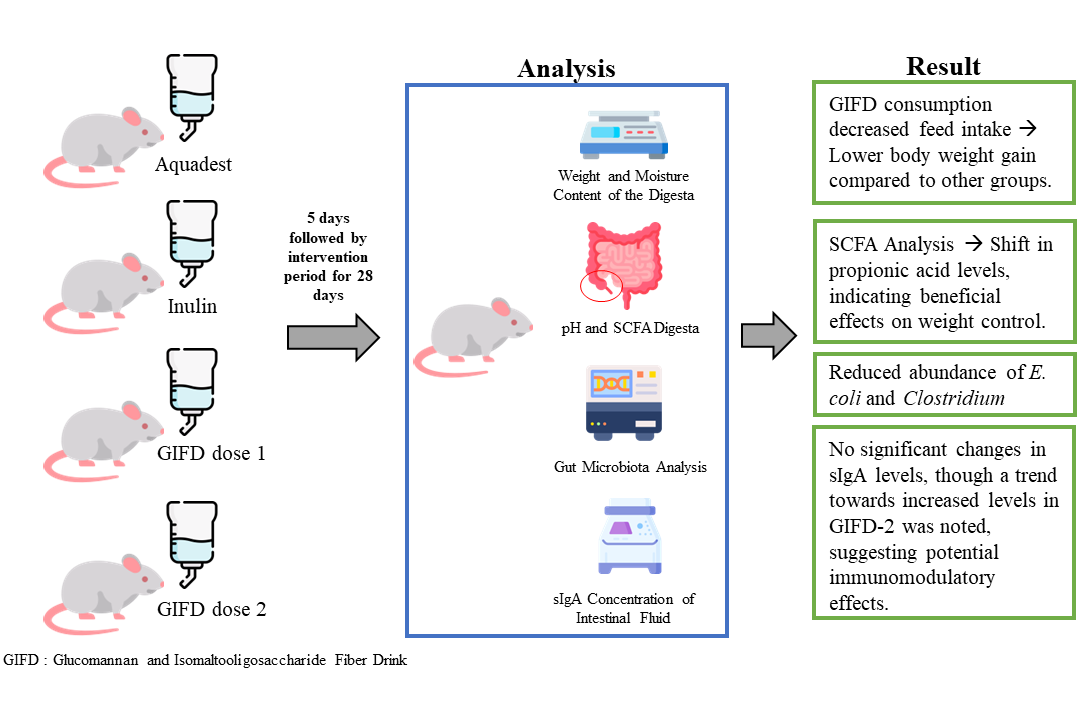
Downloads
References
TM Barber, S Kabisch, AFH Pfeiffer and MO Weickert. The health benefits of dietary fibre. Nutrients 2022; 12(10), 3209.
W Luo, F Liu, X Qi and G Dong. Research progress of konjac dietary fibre in the prevention and treatment of diabetes. Food Science and Technology 2022; 42, e23322.
L Guo, W Yokoyama, M Chen and F Zhong. Konjac glucomannan molecular and rheological properties that delay gastric emptying and improve the regulation of appetite. Food Hydrocolloids 2021; 120, 106894.
L Shang, Y Wang, Y Ren, T Ai, P Zhou, L Hu, L Wang, J Li and B Li. In vitro gastric emptying characteristics of konjac glucomannan with different viscosity and its effects on appetite regulation. Food & Function 2020; 11, 7596-7610.
SS Behera and RC Ray. Konjac glucomannan, a promising polysaccharide of Amorphophallus konjac K. Koch in health care. International Journal of Biological Macromolecules 2016; 92, 942-956.
E Harmayani, V Aprilia and Y Marsono. Characterization of glucomannan from Amorphophallus oncophyllus and its prebiotic activity in vivo. Carbohydrate Polymers 2014; 112, 475-479.
Imarch. Dietary fiber market report by type (soluble dietary fiber, insoluble dietary fiber), source (fruits and vegetables, cereals and grains, legumes, nuts and seeds), application (functional foods and beverages, pharmaceuticals, animal feed, and others), Available at: https://www.imarcgroup. com/dietary-fibre-market, accessed July 2024.
S Adams, CT Sello, GX Qin, D Che and R Han. Does dietary fiber affect the levels of nutritional components after feed formulation? Fibers 2018; 6(2), 29.
J Slavin. Fiber and prebiotics: Mechanisms and health benefits. Nutrients 2013; 5(4), 1417-1435.
Y Sun, X Xu, Q Zhang, D Zhang, X Xie, H Zhou, Z Wu, R Liu and J Pang. Review of konjac glucomannan structure, properties, gelation mechanism, and application in medical biology. Polymer 2023; 15(8), 1852.
CH Yen, YH Tseng, YW Kuo, MC Lee and HL Chen. Long-term supplementation of isomalto-oligosaccharides improved colonic microflora profile, bowel function, and blood cholesterol levels in constipated elderly people - A placebo-controlled, diet-controlled trial. Nutrition 2011; 27(4), 445-450.
DL Michelle and R Indrawanto. Effects of isomalto-oligosaccharide, inulin, and polydextrose on the development of sugar-free pineapple jam. IOP Conference Series: Earth and Environmental Science 2022; 1114, 12021.
H Wijaya, Y Hirata, LH Tjan, Y Tjahjono, K Foe, Caroline, DA Setiadi, H Wihadmadyatami, BD Novita, FHH Jong and WC Khudrati. The combination of isomalto-oligosaccharides (IMO)-based dietary fiber and hypocaloric high-protein diet could improve the anthropometric profile and fasting plasma glucose of healthy adults: A repeated single-arm clinical trial. Contemporary Clinical Trials Communications 2022; 30, 101049.
PG Reeves, FH Nielsen and GC Fahey. AIN-93 purified diets for laboratory rodents: Final report of the American Institute of Nutrition ad hoc writing committee on the reformulation of the AIN-76A rodent diet. Journal of Nutrition 1993; 123(11), 1939-1951.
AOAC International. Official methods of analysis. 18th eds. Washington, DC: Association of Official Analytical Chemists. 2005.
A Abreu, JE Carulla, CE Lascano, TE Díaz, M Kreuzer and HD Hess. Effects of Sapindus saponaria fruits on ruminal fermentation and duodenal nitrogen flow of sheep fed a tropical grass diet with and without legume. Journal of Animal Science 2004; 82(5), 1392-1400.
V Cleusix, C Lacroix, G Dasen, M Leo and GL Blay. Comparative study of a new quantitative real‐time PCR targeting the xylulose‐5‐phosphate/fructose‐6‐phosphate phosphoketolase bifidobacterial gene (xfp) in faecal samples with two fluorescence in situ hybridization methods. Journal of Applied Microbiology 2010; 108(1), 181-193.
DN Frank, ALS Amand, RA Feldman, EC Boedeker, N Harpaz and NR Pace. Molecular-phylogenetic characterization of microbial community imbalances in human inflammatory bowel diseases. Proceedings of the National Academy of Sciences of the United States of America 2007; 104(34), 13780-13785.
SM Lee, MO Cho, Y Um and BI Sang. Development of real-time PCR primer and probe sets for detecting degenerated and non-degenerated forms of the Butanol-producing bacterium clostridium acetobutylicum ATCC 824. Applied Biochemistry and Biotechnology 2010; 161, 75-83.
DPR Herlemann, M Labrenz, K Jürgens, S Bertilsson, JJ Waniek and AF Andersson. Transitions in bacterial communities along the 2000 km salinity gradient of the Baltic Sea. The ISME Journal 2011; 5(10), 1571-1579.
N Zijlstra, M Mars, RA de Wijk, MS Westerterp-Plantenga, JJ Holst and C de Graaf. Effect of viscosity on appetite and gastro-intestinal hormones. Physiology & Behavior 2009; 97(1), 68-75.
Y Cui, SK Okyere, P Gao, J Wen, S Cao, Y Wang, J Deng and Y Hu. Ageratina adenophora disrupts the intestinal structure and immune barrier integrity in rats. Toxins 2021; 13(9), 651.
YA Salmean. Acute fiber supplementation with inulin-type fructans curbs appetite sensations: A randomized, double-blind, placebo-controlled study. Food & Nutrition Research 2017; 61(1), 1341808.
QK Liu. Mechanisms of action and therapeutic applications of GLP-1 and dual GIP/GLP-1 receptor agonists. Frontiers in Endocrinology 2024; 15, 1431292.
DB Maselli and M Camilleri. Effects of GLP-1 and its analogs on gastric physiology in diabetes mellitus and obesity. Advances in Experimental Medicine and Biology 2021; 1307, 171-192.
V Vuksan, AL Jenkins, AL Rogovik, CD Fairgrieve, E Jovanovski and LA Leiter. Viscosity rather than quantity of dietary fibre predicts cholesterol-lowering effect in healthy individuals. British Journal of Nutrition 2011; 106(9), 1349-1352.
Z Zhang, Y Zhang, X Tao, Y Wang, B Rao and H Shi. Effects of glucomannan supplementation on type II diabetes mellitus in humans: A meta-analysis. Nutrients 2023; 15(3), 601.
EB Giuntini, FAH Sardá and EWD Menezes. The effects of soluble dietary fibers on glycemic response: An overview and futures perspectives. Foods 2022; 11(23), 3934.
JM Koolhaas. The laboratory rat. UFAW handbook on care managagement of laboratory and other research animals. Academic Press, London, 2010, p. 311-326.
C Xu, C Yu, S Yang, L Deng, C Zhang, J Xiang and L Shang. Effects of physical properties of konjac glucomannan on appetite response of rats. Foods 2023; 12(4), 743.
R Saputri, RQ A’yun, E Huriyati, LA Lestari, S Rahayoe, Y Yusmiati, OH Sulistyo and E Harmayani. Effect of feeding jelly containing porang (Amorphophalus oncophyllus) glucomannan and inulin as a distraction food on body weight, BMI, body fat, total cholesterol, and triglyceride levels in obese adults (in Indonesian). Jurnal Gizi Klinik Indonesia 2021; 17, 166.
JM Lattimer and MD Haub. Effects of dietary fiber and its components on metabolic health. Nutrients 2010; 2(12), 1266-1289.
LA Tucker and KS Thomas. Increasing total fiber intake reduces risk of weight and fat gains in women. Journal of Nutrition 2009; 139(3), 576-581.
SE Lazic, E Semenova and DP Williams. Determining organ weight toxicity with Bayesian causal models: Improving on the analysis of relative organ weights. Scientific Reports 2020; 10, 6625.
SB Wahjuningsih, Y Marsono and Z Noor. Soybean fibre concentrate: Preparation and effect on physical and chemical properties of digesta in rats. Agritech 2005; 25(2), 90-95.
RT Ruhee and K Suzuki. Dietary fiber and its effect on obesity: A review article. Advance Medical Research 2018, https://doi.org/10.35248/2564-8942.2018.1.2.
M Astawan, T Wresdiyati and AB Hartanta. The utilization of seaweed as a source of dietary fiber to decrease the serum cholesterol in rats. HAYATI Journal of Biosciences 2005; 12(1), 23-27.
YP Silva, A Bernardi and RL Frozza. The role of short-chain fatty acids from gut microbiota in gut-brain communication. Frontiers in Endocrinology 2020; 11, 25.
J Fu, Y Zheng, Y Gao and W Xu. Dietary fiber intake and gut microbiota in human health. Microorganisms 2022; 10, 2507.
WT Wu, LC Yang and HL Chen. Effects of konjac glucomannan, inulin and cellulose on acute colonic responses to genotoxic azoxymethane. Food Chemistry 2014; 155, 304-310.
XH Zhao and Q Geng. Acid production and conversion of konjac glucomannan during in vitro colonic fermentation affected by exogenous microorganisms and tea polyphenols. International Journal of Food Sciences and Nutrition 2016; 67(3), 274-282.
SS Cho and T Finocchiaro. Handbook of prebiotics and probiotics ingredients: Health benefits and food applications. CRC Press, Boca Raton, Florida, 2009.
DL Topping and PM Clifton. Short-chain fatty acids and human colonic function: Roles of resistant starch and nonstarch polysaccharides. Physiological Reviews 2021; 81(3), 1031-1064.
MM Kaczmarczyk, MJ Miller and GG Freund. The health benefits of dietary fiber: Beyond the usual suspects of type 2 diabetes, cardiovascular disease and colon cancer. Metabolism 2012; 61(8), 1058-1066.
M Beylot. Effects of inulin-type fructans on lipid metabolism in man and in animal models. British Journal of Nutrition 2005; 93, S163-S168.
N Kaur and AK Gupta. Applications of inulin and oligofructose in health and nutrition. Journal of Biosciences 2002; 27(7), 703-714.
GD Besten, KV Eunen, AK Groen, K Venema, DJ Reijngoud and BM Bakker. The role of short-chain fatty acids in the interplay between diet, gut microbiota, and host energy metabolism. Journal of Lipid Research 2013; 54(9), 2325-2340.
A Koh, FD Vadder, P Kovatcheva-Datchary and F Bäckhed. From dietary fiber to host physiology: Short-chain fatty acids as key bacterial metabolites. Cell 2016; 165(2), 1332-1345.
Y Wu, Y Gong, Y Zhang, S Li, C Wang, Y Yuan, X Lv, Y Liu, F Chen, S Chen, F Zhang, X Guo, X Wang, Y Ning and H Zhao. Comparative analysis of gut microbiota from rats induced by Se deficiency and T-2 toxin. Nutrients 2023; 15(24), 5027.
D Charalampopoulos and RA Rastall. Prebiotics in foods. Current Opinion in Biotechnology 2012; 23(2), 187-191.
K Prajapati, K Bisani, H Prajapati, S Prajapati, D Agrawal, S Singh, M Saraf and D Goswami. Advances in probiotics research: Mechanisms of action, health benefits, and limitations in applications. Systems Microbiology and Biomanufacturing 2024; 4, 386-406.
GR Gibson and RA Rastall. Prebiotics: Development & application. John Wiley & Sons, 2006.
L Krismiyanto, N Suthama and I Wahyuni. Bacterial presence and caecum development due to inulin supplementation from Dahlia tuber (Dahlia variabilis) in starter period crossbred native chickens. Indonesian Journal of Animal Science 2014; 24(3), 54-60.
E Harmayani, ID Kumalasari and Y Marsono. Effect of arrowroot (Maranta arundinacea L.) diet on the selected bacterial population and chemical properties of caecal digesta of Sprague Dawley rats. International Research Journal of Microbiology 2011; 2(8), 278-284.
T Eklund. The antimicrobial effect of dissociated and undissociated sorbic acid at different pH levels. Journal of Applied Bacteriology 1983; 54(3), 383-389.
WF Zhang, DF Li, WQ Lu and GF Yi. Effects of isomalto-oligosaccharides on broiler performance and intestinal microflora. Poultry Science 2003; 82, 657-663.
WS Wangko. Aspek fisiologik short chain fatty acid (SCFA). Medical Scope Journal 2020; 2(1), 26-35.
EH Anggela, W Setyaningsih and S Wichienchot. Prebiotic effect of porang oligo-glucomannan using fecal batch culture fermentation. Food Science and Technology 2021; 42, e06321.
N Hayek. Chocolate, gut microbiota, and human health. Frontiers in Pharmacology 2013; 4, 11.
BF Putera, N Nurliyani and S Soeparno. Effect of fermented milk supplementation on cecum bacterial counts and intestinal rib levels in normal and dinitrochlorobenzene allergen-sensitised rats. Buletin Peternakan 2012, https://doi.org/10.21059/BULETINPETERNAK.V36I1.1273.
KA Kelly-Quagliana, PD Nelson and RK Buddington. Dietary oligofructose and inulin modulate immune functions in mice. Nutrition Research 2003; 23(2), 257-267.
JM Lecerf, F Dépeint, E Clerc, Y Dugenet, CN Niamba, L Rhazi, A Cayzeele, G Abdelnour, A Jaruga, H Younes, H Jacobs, G Lambrey, AM Abdelnour and PR Pouillart. Xylo-oligosaccharide (XOS) in combination with inulin modulates both the intestinal environment and immune status in healthy subjects, while XOS alone only shows prebiotic properties. British Journal of Nutrition 2012; 108(10), 1847-1858.
JK Triantafillidis, M Tzouvala and E Triantafyllidi. Enteral nutrition supplemented with transforming growth factor-β, colostrum, probiotics, and other nutritional compounds in the treatment of patients with inflammatory bowel disease. Nutrients 2020; 12(4), 1048.
Downloads
Published
How to Cite
Issue
Section
License
Copyright (c) 2024 Walailak University

This work is licensed under a Creative Commons Attribution-NonCommercial-NoDerivatives 4.0 International License.





