
Brazilin Content, Color Stability, and Antioxidant Activity of Sappan Wood (Caesalpinia Sappan L.) Traditional Drink by Different Blanching and Drying Methods
DOI:
https://doi.org/10.48048/tis.2024.8535Keywords:
Caesalpinia sappan L., Brazilin, Antioxidant activity, Color stability, Mixed herbal drinkAbstract
Caesalpinia sappan L (CS) heartwood is used as a natural red colorant in several Asian ethnic traditional drinks both as sole ingredient or mixed with other herbs. However, the pigment is unstable and easily degraded during storage which affects consumer acceptance. This research aimed to investigate the effect of different blanching and drying methods on the color stability, brazilin content, and antioxidant activity of CS heartwood drinks. Steam blanching, water blanching, sun drying and cabinet drying were examined in this study. The most common method applied in traditional production, without blanching and sun drying, was used as a control. The experimental design used was complete randomized design with triplicates. Data are presented as mean ± standard deviation and analyzed by SPSS statistics version 20.
The results showed that blanching and drying methods affected the color intensity. For a pure CS heartwood herbal drink, the sample prepared with water blanching and cabinet drying (BCD) showed the highest red value, leading to a 48 % improvement compared to the control. This red value is in accordance with the brazilin content. Sample BCD showed the highest brazilin content, which was 376 % higher than that of the control. Similarly, the BCD sample had the highest antioxidant activity and total phenolic content, with IC50 values of 98.99 ppm and 213.12 mg GAE g–1, respectively. This result revealed that brazilin might act as an antioxidant. Similar to the pure CS drink, the highest quality of mixed herbal drink was obtained by BCD sample. The results suggest that the combination of water blanching and cabinet drying (BCD) was the best method to improves the quality of CS heartwood drink both in pure and mixed herbal drinks as a functional drink.
HIGHLIGHTS
- Samples treated with blanching and drying had higher brazilin content of Sappan heartwood drink
- There is a correlation between brazilin content and color intensity as well as antioxidant activity
- Blanching and cabinet drying improved the color stability of Sappan heartwood drink
- Blanching and cabinet drying increased the total phenolic and flavonoid content of Sappan heartwood drink
GRAPHICAL ABSTRACT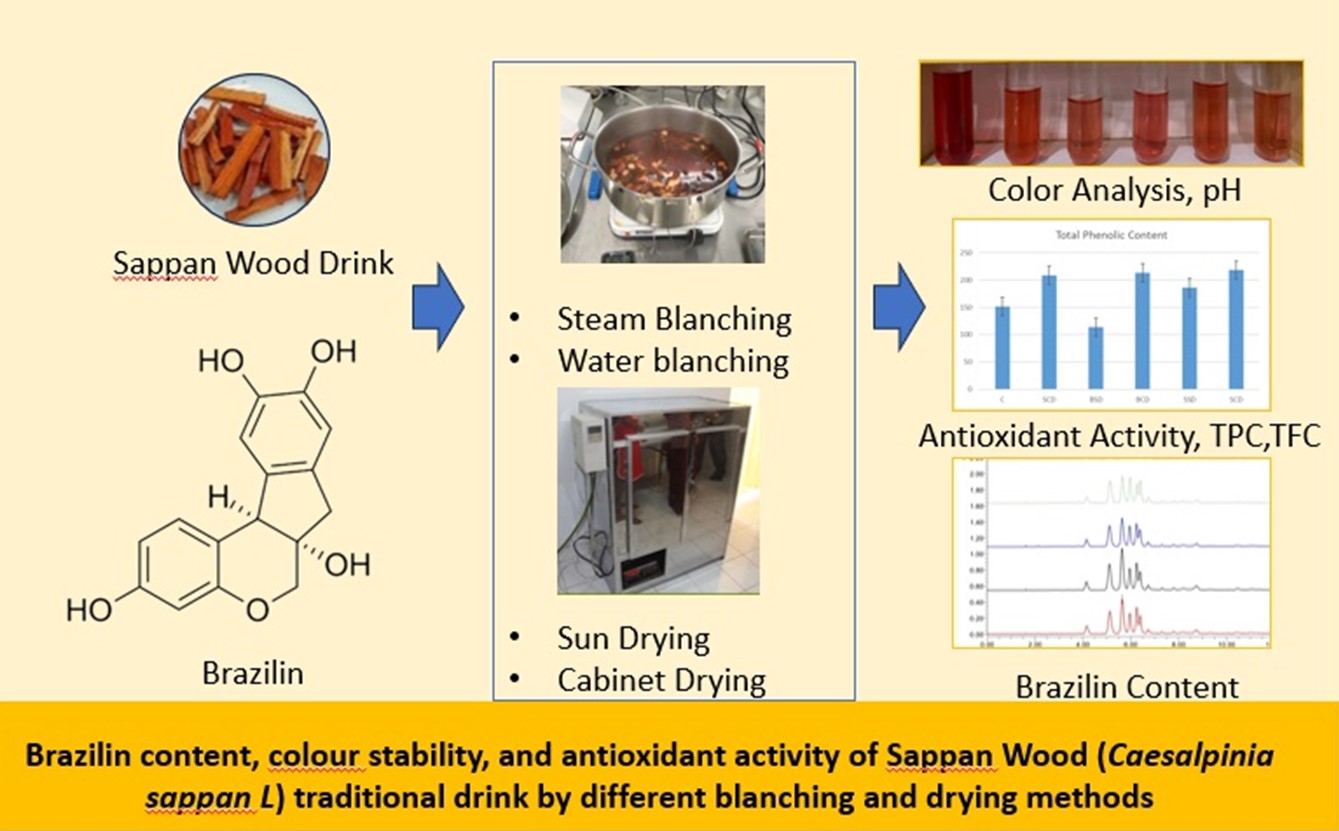
Downloads
References
MS Rajput, NP Nirmal, SJ Nirmal and C Santivarangkna. Bio-actives from Caesalpinia sappan L.: Recent advancements in phytochemistry and pharmacology. S. Afr. J. Bot. 2022; 151, 60-74.
N Setyowati, Masyhuri, JH Mulyo, Irham and B Yudhistira. The hidden treasure of wedang uwuh, an ethnic traditional drink from Java, Indonesia: Its benefits and innovations. Int. J. Gastron. Food Sci. 2023; 31, 100688.
L Ngamwonglumlert, S Devahastin, N Chiewchan and GSV Raghavan. Color and molecular structure alterations of brazilein extracted from Caesalpinia sappan L. under different pH and heating conditions. Sci. Rep. 2020; 10, 12386.
ME Heras-Ramírez, D Ying, J Yu, L Sanguansri and MA Augustin. Effect of blanching and drying temperature on polyphenolic compound stability and antioxidant capacity of apple pomace. Food Bioproc. Tech. 2012; 5, 2201-10
H Gan, E Charters, R Driscoll and G Srzednicki. Effects of drying and blanching on the retention of bioactive compounds in ginger and turmeric. Horticulturae 2017; 3, 13.
HA Kamble, AA Gatade, AK Sahoo and US Annapure. Effect of blanching treatment on antioxidant activity and color values of sugarcane juice. Mater. Today Proc. 2021; 47, 5663-7.
M Junsi and S Siripongvutikorn. Development of herbal juice from Centella asiatica: Antioxidant property, nutritional value and shelf life of product. Food Sci. Tech. 2022; 42, e93722.
J Piepiórka-Stepuk, I Wojtasik-Kalinowska, M Sterczyńska, S Mierzejewska, M Stachnik and M Jakubowski. The effect of heat treatment on bioactive compounds and color of selected pumpkin cultivars. LWT 2023; 175, 114469.
OR Aderibigbe, OF Kareem and SG Akinwumi. Comparative evaluation of the effects of pretreatments on the nutritional and chemical properties of ginger leaf-based herbal tea. Afr. J. Food Agr. Nutr. Dev. 2023; 23, 22548-67.
MZ Deylami, RA Rahman, CP Tan, J Bakar and L Olusegun. Effect of blanching on enzyme activity, color changes, anthocyanin stability and extractability of mangosteen pericarp: A kinetic study. J. Food Eng. 2016; 178, 12-9.
R ElGamal, C Song, AM Rayan, C Liu, S Al-Rejaie and G ElMasry. Thermal degradation of bioactive compounds during drying process of horticultural and agronomic products: A comprehensive overview. Agronomy 2023; 13, 1580.
Á Calín-Sánchez, L Lipan, M Cano-Lamadrid, A Kharaghani, K Masztalerz, ÁA Carbonell-Barrachina and A Figiel. Comparison of traditional and novel drying techniques and its effect on quality of fruits, vegetables and aromatic herbs. Foods 2020; 9, 1261.
EA Putri, SN Rahmadhia and R Septiyani. Estimation of the shelf life of wedang uwuh ready to drink with blanching and non blanching treatments. Jurnal Al-Azhar Indonesia Seri Sains Dan Teknologi 2024; 9, 16-24.
L Ngamwonglumlert and S Devahastin. Brazilein as an alternative pigment: Isolation, characterization, stability enhancement and food applications. Food Chem. 2023; 398, 133898.
BM Agusthi and MF Romadhan. Characteristics of secang jelly drink as functional drink with the addition of red ginger extract for antioxidant source. Jurnal Teknik Pertanian Lampung 2024; 13, 449.
Sumartini. Pengembangan produk jelly drink berbasis kayu secang (Caesalpinia sappan L.) dengan variasi konsentrasi sukrosa dan konsentrasi karagenan. Pasundan Food Tech. J. 2021; 8, 121-8.
TM Fadhilah, AN Utami, A Puspitadewi, AM Ermawan and AP Dariani. The addition of beetroot (Beta Vulgaris L.) to dawet ayu sappan wood (Caesalpinia Sappan L.) as a functional drink containing anthocyanins. Sainstek Jurnal Sains Dan Teknologi 2022; 14, 51.
R Septiyani, WM Rahayu and A Permadi. Stabilitas warna dan perubahan pH wedang uwuh. J. Ilm. Teknosains 2024; 10, 43-50.
S Baliyan, R Mukherjee, A Priyadarshini, A Vibhuti, A Gupta, RP Pandey and CM Chang. Determination of antioxidants by DPPH radical scavenging activity and quantitative phytochemical analysis of Ficus religiosa. Molecules 2022; 27, 1326.
B Kulczyński, A Gramza-Michałowska and JB Królczyk. Optimization of extraction conditions for the antioxidant potential of different pumpkin varieties (Cucurbita maxima). Sustainability 2020; 12, 1305.
Y Velioglu, G Mazza, L Gao and BD Oomah. Antioxidant activity and total phenolics in selected fruits, vegetables, and grain products. J. Agr. Food Chem. 1998; 46, 4113-17.
CC Chang, MH Yang, HM Wen and JC Chern. Estimation of total flavonoid content in propolis by two complementary colorimetric methods. J. Food Drug Anal. 2002; 10, 178-82.
R Septiyani and E Rahmawati. Perbedaan aktivitas antioksidan pada minuman tradisional wedang uwuh original, seduh, celup, instan dan sirup. CHEMICA Jurnal Teknik Kimia 2019; 6, 23-9.
Z Ulma, E Rahayuningsih and TD Wahyuningsih. Methylation of brazilein on secang (Caesalpinia sappan Linn) wood extract for maintain color stability to the changes of pH. IOP Conf. Ser. Mater. Sci. Eng. 2018; 299, 012075.
AD Permana, RN Utami, A Ramadhani, M Dewy and B Sugara. Formulation and evaluation microcapsules of Caesalpinia Sappan Linn. using emulsion solvent evaporation method. Int. J. Tech. Enhanc. Emerg. Eng. Res. 2015; 3, 121-5.
P Singhal, S Satya and SN Naik. Blanching: A sustainable and effective treatment for extending shelf life of bamboo shoots. Food Chem. Adv. 2023; 2, 100179.
KTL Phan, S Chittrakorn, HP Tai and K Ruttarattanamongkol. Effects of cooking methods on the changes of total anthocyanins, phenolics content and physical characteristics of purple-fleshed sweet potato (Ipomoea batatas L.) grown in Vietnam. Int. J. Adv. Sci. Eng. Inf. Tech. 2018; 8, 227-33.
W Nansu, S Ross, A Waisarikit, GM Ross, P Charoensit, N Suphrom and S Mahasaranon. Exploring the potential of roselle calyx and sappan heartwood extracts as natural colorants in poly(butylene succinate) for biodegradable packaging films. Polymers 2023; 15, 4193.
E Masaenah, B Elya, H Setiawan, Z Fadhilah and V Arianti. Quantification of andrographolide in Andrographis paniculata (Burm.f.) nees, myricetin in Syzygium cumini (L.) skeels, and Brazilin in Caesalpinia sappan L. By HPLC method. Pharmacogn. J. 2021; 13, 1437-44.
IS Arsiningtyas. Antioxidant profile of heartwood and sapwood of Caesalpinia sappan L. tree’s part grown in imogiri nature preserve, Yogyakarta. IOP Conf. Ser. Earth Environ. 2021; 810, 012040.
F Setiawan, O Yunita and A Kurniawan. Uji aktivitas antioksidan ekstrak etanol kayu secang (Caesalpinia sappan) menggunakan metode DPPH, ABTS, dan FRAP. Media Pharm. Indones. 2018; 2, 82-9.
S Jamaddar, C Sarkar, S Akter, MS Mubarak, HAS El-Nashar, M El-Shazly and MT Islam. Brazilin: An updated literature-based review on its promising therapeutic approaches and toxicological studies. S. Afr. J. Bot. 2023; 158, 118-32.
DA Nava-Tapia, L Cayetano-Salazar, LD Herrera-Zúñiga, J Bello-Martínez, MA Mendoza-Catalán, and N Navarro-Tito. Brazilin: Biological activities and therapeutic potential in chronic degenerative diseases and cancer. Pharmacol. Res. 2022; 175, 106023.
NP Nirmal, MS Rajput, RGSV Prasad and M Ahmad. Brazilin from Caesalpinia sappan heartwood and its pharmacological activities: A review. Asian Pac. J. Trop. Med. 2015; 8, 421-30.
E Yildiz, A Yilmaz, O Gurbuz and I Alibas. Effect of drying methods and pre-treatments on bioactive potential of persimmon (Diospyros kaki L.). J. Food Meas. Charact. 2024; 18, 2014-29.
AY Tadesse, HH Mohammed and KN Andersa. Proximate composition and selected phytochemical component of Dawrach (Raphanus raphanistrum L.) as affected by blanching temperature. Heliyon 2023; 9, e19240.
U Laila, D Ariani, NHE Rahayu, R Nurhayati, Y Khasanah, IA Wheni and B Juligani. Chemical characteristics of Moringa oleifera leaf powder under different pretreatment and drying temperatures. AIP Conf. Proc. 2024; 2957, 060034.
R Udayakumar, S Kasthurirengan, A Vasudevan, TS Mariashibu, JJS Rayan, CW Choi, A Ganapathi and SC Kim. Antioxidant effect of dietary supplement Withania somnifera L. reduce blood glucose levels in alloxan-induced diabetic rats. Plant Foods Hum. Nutr. 2010; 65, 91-8.
VB Nguyen, BD Vu, GK Pham, BQ Le, VC Nguyen, CV Men and VT Nguyen. Phenolic compounds from Caesalpinia sappan. Pharmacogn. J. 2020; 12, 410-4.
L Kurniasari, M Djaeni and A Kumoro. Ultrasound-assisted extraction (UAE) of sappan wood (Caesalpinia sappan L.): Effect of solvent concentration and kinetic studies. Brazilian J. Food Tech. 2023; 26, e2022140.
M Leopoldini, T Marino, N Russo and M Toscano. Antioxidant properties of phenolic compounds: H-atom versus electron transfer mechanism. J. Phys. Chem. A 2004; 108, 4916-22.
RB Semwal, DK Semwal, S Combrinck and AM Viljoen. Gingerols and shogaols: Important nutraceutical principles from ginger. Phytochemistry 2015; 117, 554-68.
C Garza-Cadena, DM Ortega-Rivera, G Machorro-García, EM Gonzalez-Zermeño, D Homma-Dueñas, M Plata-Gryl and R Castro-Muñoz. A comprehensive review on Ginger (Zingiber officinale) as a potential source of nutraceuticals for food formulations: Towards the polishing of gingerol and other present biomolecules. Food Chem. 2023; 413, 135629.
QQ Mao, XY Xu, SY Cao, RY Gan, H Corke, T Beta and HB Li. Bioactive compounds and bioactivities of ginger (Zingiber officinale Roscoe). Foods 185, 2019; 8, 185.
RR Dalsasso, GA Valencia and AR Monteiro. Improving ginger’s bioactive composition by combining innovative drying and extraction technologies. Plant Foods Hum. Nutr. 2023; 78, 755-61.
SA Anwar, RI Astuti and DD Solihin. Activity of ethanol-derived fraction of clove leaves and eugenol compound as antiaging agent in the yeast model organism Schizosaccharomyces pombe. Adv. Biol. Sci. Res. 2021; 14, 515-22.
K Ashokkumar, J Simal‐Gandara, M Murugan, MK Dhanya and A Pandian. Nutmeg (Myristica fragrans Houtt.) essential oil: A review on its composition, biological, and pharmacological activities. Phyther. Res. 2022; 36, 2839-51.

Downloads
Published
How to Cite
Issue
Section
License
Copyright (c) 2024 Walailak University

This work is licensed under a Creative Commons Attribution-NonCommercial-NoDerivatives 4.0 International License.





