
The Steroids produced by Cladosporium anthropophilum, an endophytic fungus Isolated from Avicennia marina (Forssk.) Vierh and Their Antibacterial Activity
DOI:
https://doi.org/10.48048/tis.2024.8498Keywords:
Steroid, Endophytic fungi, Cladosporium anthropophilum, Avicennia marina, Antibacterial activityAbstract
This work was conducted to isolate the steroid compounds from an endophytic fungus Cladosporium anthropophilum and determine their effects against 4 strains of bacteria. The fungi were afforded from a mangrove plant Avicennia marina (Forssk.) Vierh of Acanthaceae family, growing in West Java, Indonesia. The fermentation and isolation of C. anthropophilum yielded 3 ergostane-type steroids including a highly oxidized one, identified as penicisteroid A (1), ergosterol (2), and ergosterol-5,8-peroxide (3), together with 2 stigmastanes, characterized as stigmasterol (4), and stigmasterol-5,8-peroxide (5). The elucidation structure of all isolated steroids was performed by extensive spectroscopic measurements (MS, IR, 1D, and 2D NMR) and supported by a comparison of previously reported spectral data. Subsequently, the potential of the 5 steroids as well as methanol, n-hexane, and ethyl acetate extracts were evaluated against 2 Gram-positive bacteria, Staphylococcus aureus ATCC 29213 and Enterococcus faecalis ATCC 29212 and 2 Gram-negative bacteria, Vibrio harveyi ATCC 5339 and Escherichia coli ATCC 25922. The results showed that none of the isolated steroids were active, while the 3 extracts exhibited significant inhibition against all the tested bacteria’s growth and enabled us to propose the synergistic effects between active compounds in these extracts and their antibacterial activity.
HIGHLIGHTS
- An isolated and identified endophytic fungus, Cladosporium anthropophilum, from a mangrove plant Avicennia marina (Forssk.) Vierh yielded five steroids.
- A chromatography technique and spectroscopic method were utilized for separation processes and structure determination, respectively.
- An antibacterial assay against two Gram-positive bacteria ( aureus and E. faecalis) and two Gram-negative bacteria (V. harveyi and E. coli) implied the synergistic effects between five isolated steroids and their parent extracts.
- A further investigation is highly recommended to explore the possibility of these five steroids as a potential source of active compounds.
GRAPHICAL ABSTRACT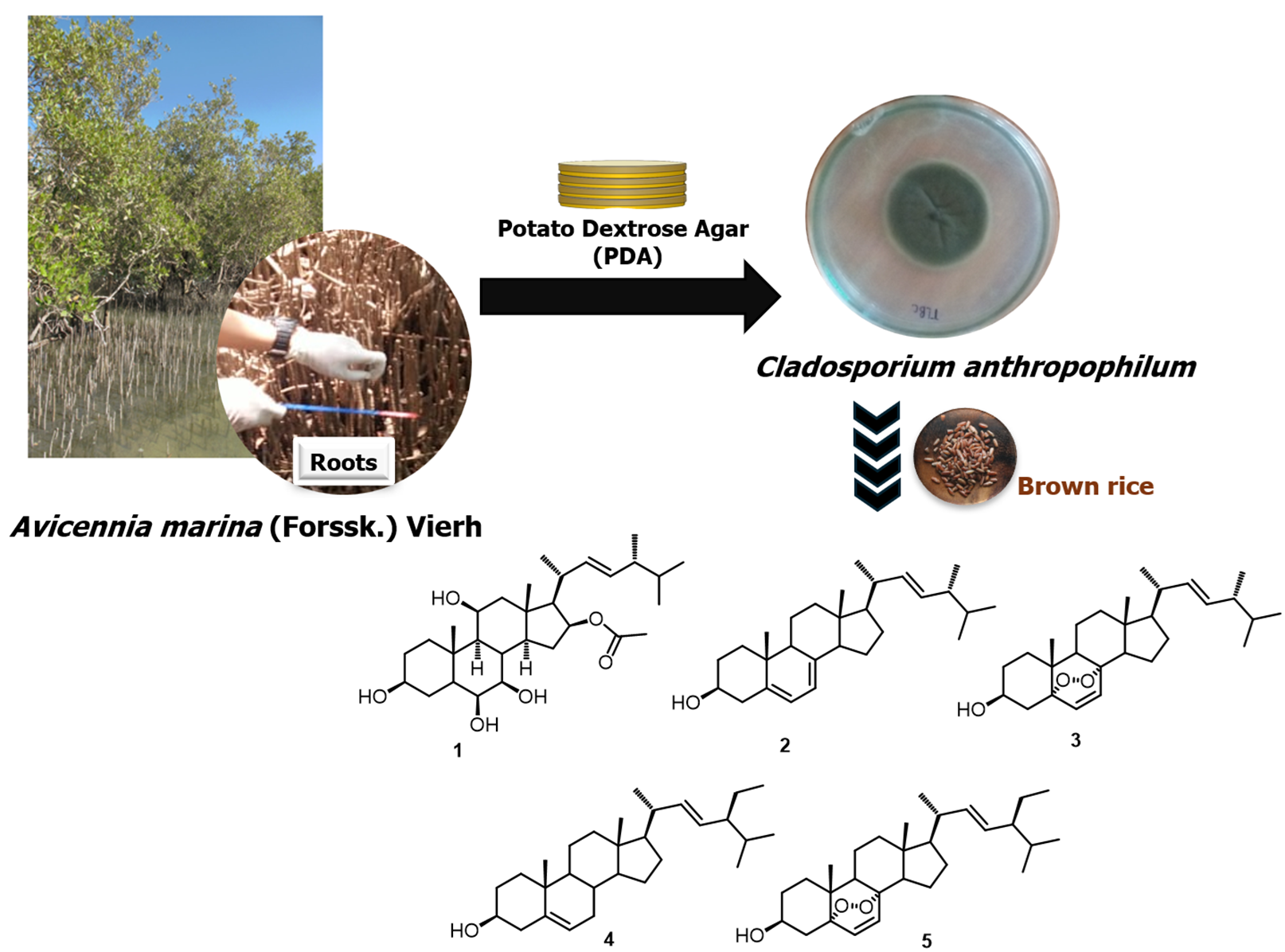
Downloads
References
HN Bhatti and RA Khera. Biological transformations of steroidal compounds: A review. Steroids 2012; 77, 1267-90.
AG Mensah-Nyagan, L Meyer, V Schaeffer, C Kibaly and C Patte-Mensah. Evidence for a key role of steroids in the modulation of pain. Psychoneuroendocrinology 2009; 34, S169-S177.
Ericson-Neilsen, William and AD Kaye. Steroids: Pharmacology, complications, and practice delivery issues. Ochsner J. 2014; 14, 203-7.
J Xu, Winkler and H Derendorf. A pharmacokinetic/pharmacodynamic approach to predict total prednisolone concentrations in human plasma. J. Pharmacokinet. Pharmacodyn. 2007; 34, 355-72.
ARM Coates and Y Hu. Novel approaches to developing new antibiotics for bacterial infections. Br. J. Pharmacol. 2007; 152, 1147-54.
B Spellberg, J Bartlett, R Wunderink and DN Gilbert. Novel approaches are needed to develop tomorrow’s antibacterial therapies. Am. J. Respir. Crit. Care Med. 2015; 191, 135-40.
MA Cataldo, G Granata and N Petrosillo. Clostridium difficile infection: New approaches to prevention, non-antimicrobial treatment, and stewardship. Expert Rev. Anti. Infect. Ther. 2017; 15, 1027-40.
NS Nadaraia, LS Amiranashvili, M Merlani, ML Kakhabrishvili, NN Barbakadze, A Geronikaki, A Petrou, V Poroikov, A Ciric, J Glamoclija and M Sokovic. Novel antimicrobial agents’ discovery among the steroid derivatives. Steroids 2019; 144, 52-65.
SN Bibi, Z Gokhan, J Rajesh and MF Mahomoodally. Fungal endophytes associated with mangroves - Chemistry and biopharmaceutical potential. S Afr. J. Bot. 2020; 134, 187-212.
J Wu, Q Xiao, J Xu, M Li, JY Pan and MHYang. Natural products from true mangrove flora: Source, chemistry and bioactivities. Nat. Prod. Rep. 2008; 25, 955-81.
A Rege, RY Ambaye and R Deshmukh. In-vitro testing of anti-HIV activity of some medicinal plants. Indian J. Nat. Prod. Resour. 2010; 1, 193-9.
M Shafie, A Forghani and J Moshtaghiyan. Anti-inflammatory effects of hydro-alcoholic of mangrove (Avicennia marina) and vitamin C on arthritic rats. Bull Environ. Pharmacol. Life Sci. 2013; 2, 32-7.
H Thatoi, D Samantaray and SK Das. The genus Avicennia, a pioneer group of dominant mangrove plant species with potential medicinal values: A review. Front Life Sci. 2016; 9, 267-91.
MN Sharief, A Srinivasulu, B Chittibabu and UM Rao. Identification of bioactive principles of Avicennia officinalis fruit extract in methanol and screening for antibacterial activity. Int. J. Pharm. Sci. Drug Res. 2015; 7, 73-7.
M Sumithra, J Anbu, S Nithya and R Velayutham. Anticancer activity of methanolic leaves extract of Avicennia officinalis on Ehrlich ascitis carcinoma cell lines in rodents. Int. J. Pharmtech. Res. 2011; 3, 1290-2.
CA Shearer, E Descals, B Kohlmeyer, J Kohlmeyer, L Marvanová, D Padgett, D Porter, HA Raja, JP Schmit, HA Thorton and H Voglymayr. Fungal biodiversity in aquatic habitats. Biodivers. Conserv. 2007; 16, 49-67.
ZF Zhou, XH Yang, HL Liu, YC Gu, BP Ye and YW Guo. A new cyclic peptide and a new steroid from the fungus Penicillium sp. GD6 isolated from the mangrove Bruguiera gymnorrhiza. Helv. Chim. Acta 2014; 97, 1564-70.
T Suzuki, NR Ariefta, T Koseki, H Furuno, E Kwon, H Momma, D Harneti, R Maharani, U Supratman, K Kimura and Y Shio. New polyketides, paralactonic acids A-E produced by Paraconiothyrium sp. SW-B-1, an endophytic fungus associated with a seaweed, Chondrus ocellatus Holmes. Fitoterapia 2019; 132, 75-81.
S Das, D Kumar, D Samantaray, JK Patra, L Samanta and H Thatoi. Antidiabetic potential of mangrove plants: A review. Front. Life Sci. 2016; 9, 75-88.
Azhari A and Supratman U. The chemistry and pharmacology of fungal genus Periconia: a review. Sci. Pharm. 2021; 89, 34.
GL Maria, KR Sridhar and RN Seetharam. Antimicrobial and enzyme activity of mangrove endophytic fungi of southwest coast of India. J. Agr. Tech. 2005; 1, 67-80.
S Purbaya, D Harneti, W Safriansyah, Rahmawati, AP Wulandari, Y Mulyani and U Supratman. Secondary metabolites of biscogniauxia: Distribution, chemical diversity, bioactivity, and implications of the occurrence. Toxins 2023; 15, 686.
L Wang, X Han, G Zhu, Y Wang, A Chairoungdua, P Piyachaturawat and W Zhu. Polyketides from the endophytic fungus Cladosporium sp. isolated from the mangrove plant Excoecaria agallocha. Front. Chem. 2018; 6, 344.
HM Manjunath and CG Joshi. Characterization, antioxidant and antimicrobial activity of silver nanoparticles synthesized using marine endophytic fungus-Cladosporium cladosporioides. Process Biochem. 2019; 82, 199-204.
MM Salvatore, A Andolfi and R Nicoletti. The genus Cladosporium: A rich source of diverse and bioactive natural compounds. Molecules 2021; 26, 3959.
X Han, XF Bao, CX Wang, J Xie, XJ Song, P Dai, GD Chen, D Hu, XS Yao and H Gao. Cladosporine A, a new indole diterpenoid alkaloid with antimicrobial activities from Cladosporium sp. Nat. Prod. Res. 2021; 35, 1115-21.
Y Mulyani, AP Wulandari, SE Sinaga, W Safriansyah, A Azhari, S Purbaya, FF Abdullah, K Farabi, Y Shiono and U Supratman. Antibacterial activities and molecular identification of endophytic fungi isolated from mangrove Avicennia marina. Biodivers. J. 2023; 24, 6923-33.
SE Sinaga, M Fajar, T Mayanti and U Supratman. Bioactivities screening and elucidation of terpenoid from the stembark extracts of Lansium domesticum Corr. cv. Kokosan (Meliaceae). Sustainability 2023; 15, 2140.
Y Yaoita, K Amemiya, H Ohnuma, K Furumura, A Masaki, T Matsuki and M Kikuchi. Sterol constituents from five edible mushrooms. Chem. Pharm. Bull. 1998; 46, 944-50.
RQ Mei, FJ Zuo, XY Duan, YN Wang, JR Li, CZ Qian and JP Xiao. Ergosterols from Ganoderma sinense and their anti-inflammatory activities by inhibiting NO production. Phytochem. Lett. 2019; 32, 177-80.
S Gao, X Li, C Li, P Proksch and B Wang. Penicisteroids A and B, antifungal and cytotoxic polyoxygenated steroids from the marine alga-derived endophytic fungus Penicillium chrysogenum QEN-24S. Bioorg. Med. Chem. Lett. 2011; 21, 1, 2894-7.
M Martinez, ST Alvarez, MG Campi, JA Bravo and JL Vila. Ergosterol from the mushroom Laetiporus sp.: Isolation and structural characterization. Rev. Boliv. Quim. 2015; 32, 90-4.
M Kobori, M Yoshida, M Ohnishi-Kameyama, T Takei and H Shinmoto. 5α, 8α-Epidioxy-22E-ergosta-6, 9 (11), 22-trien-3β-ol from an edible mushroom suppresses growth of HL60 leukemia and HT29 colon adenocarcinoma cells. Biol. Pharm. Bull. 2006; 29, 4, 755-9.
JM Carvalho, LKO da Paixão, MF Dolabela, PSB Marinho and AMR Marinho. Phytosterols isolated from endophytic fungus Colletotrichum gloeosporioides (Melanconiaceae). Acta Amazonica 2016; 46, 69-72.
E Ioannou, AF Abdel-Razik, M Zervou, D Christofidis, X Alexi, C Vagias, MN Alexis and V Roussis. 5α,8α-Epidioxysterols from the gorgonian Eunicella cavolini and the ascidian Trididemnum inarmatum: Isolation and evaluation of their antiproliferative activity. Steroids 2009; 74, 73-80.
U Supratman, AP Sari, N Nurlelasari, R Maharani, A Azhari, D Harneti, R Maharani, T Mayanti, K Farabi, D Darwati, S Fajriah, MN Azmi and Y Shiono. New Ergostane-type sterol produced by an endophytic fungus Fusarium phaseoli isolated from Chisocheton macrophyllus (Meliaceae). Rec. Nat. Prod. 2022; 16, 1-8.

Downloads
Additional Files
Published
How to Cite
Issue
Section
License
Copyright (c) 2024 Walailak University

This work is licensed under a Creative Commons Attribution-NonCommercial-NoDerivatives 4.0 International License.





