
Anti-Cholesterol Activity, LC-MS/MS Compound Profiling, and In Silico Analysis of Menteng (Baccaurea racemosa Muell. Arg.) Leaves Extracts
DOI:
https://doi.org/10.48048/tis.2025.10003Keywords:
Anti-cholesterol, Baccaurea racemosa, Fractionation, In Vitro, Menteng leaves, Anti-cholesterol, Baccaurea racemosa, Fractionation, In vitro, Menteng leavesAbstract
Hypercholesterolemia is recognized as a major risk factor for cardiovascular diseases and was commonly treated with long-term synthetic drugs, which were costly and associated with side effects. Medicinal plants, such as menteng (Baccaurea racemosa) leaves, have been explored as potential natural alternatives. This study investigated the anti-cholesterol activity of different menteng leaf extract fractions in vitro, identified the bioactive compounds in the most active fraction using LC-MS/MS, and assessed their potential as drug candidates through an in-silico approach. The research involved stepwise fractionation with n-hexane, ethyl acetate, and n-butanol solvents. Cholesterol level was evaluated in-vitro using the Liebermann-Burchard method by reacting with acetic anhydride and sulfuric acid, and bioactive compounds were identified through LC-MS/MS analysis. Molecular docking, biological activity prediction, and toxicity analysis were also performed. The results showed that the n-butanol fraction exhibited the highest in vitro anti-cholesterol activity (EC50 = 45.16 mg/L), surpassing the ethanol extract and other fractions. LC-MS/MS analysis revealed 7 bioactive compounds, including flavonoids (quercitrin, apiin and vitexin), phenolics (nicotiflorin), alkaloids (indole), phenylpropanoids (umbelliferone), and coumarins. The in-silico study demonstrated that these compounds had strong binding affinities compared to control drugs. These findings suggested that menteng leaf extracts, particularly the n-butanol fraction, could serve as a natural anti-cholesterol agent. Further in vivo studies and clinical trials are needed to confirm their therapeutic efficacy.
HIGHLIGHTS
- Menteng (Baccaurea racemosa) leaves exhibit strong anti-cholesterol activity, with the n-butanol fraction showing the highest effectiveness, achieving an EC50 value of 45.16 mg/L. This suggests its potential as a natural alternative for managing hypercholesterolemia.
- LC-MS/MS analysis identified seven bioactive compounds, including flavonoids (nicotiflorin, quercitrin, apiin, vitexin), alkaloids (indole), and phenylpropanoids (umbelliferone, coumarin). These compounds demonstrated strong binding affinity in molecular docking studies, comparable to standard cholesterol-lowering drugs.
- In silico studies revealed that menteng leaf bioactive compounds could effectively target HMG-CoA reductase, a key enzyme in cholesterol biosynthesis. The findings highlight the potential of these compounds as natural anti-cholesterol drug candidates, warranting further in vivo and clinical investigation.
GRAPHICAL ABSTRACT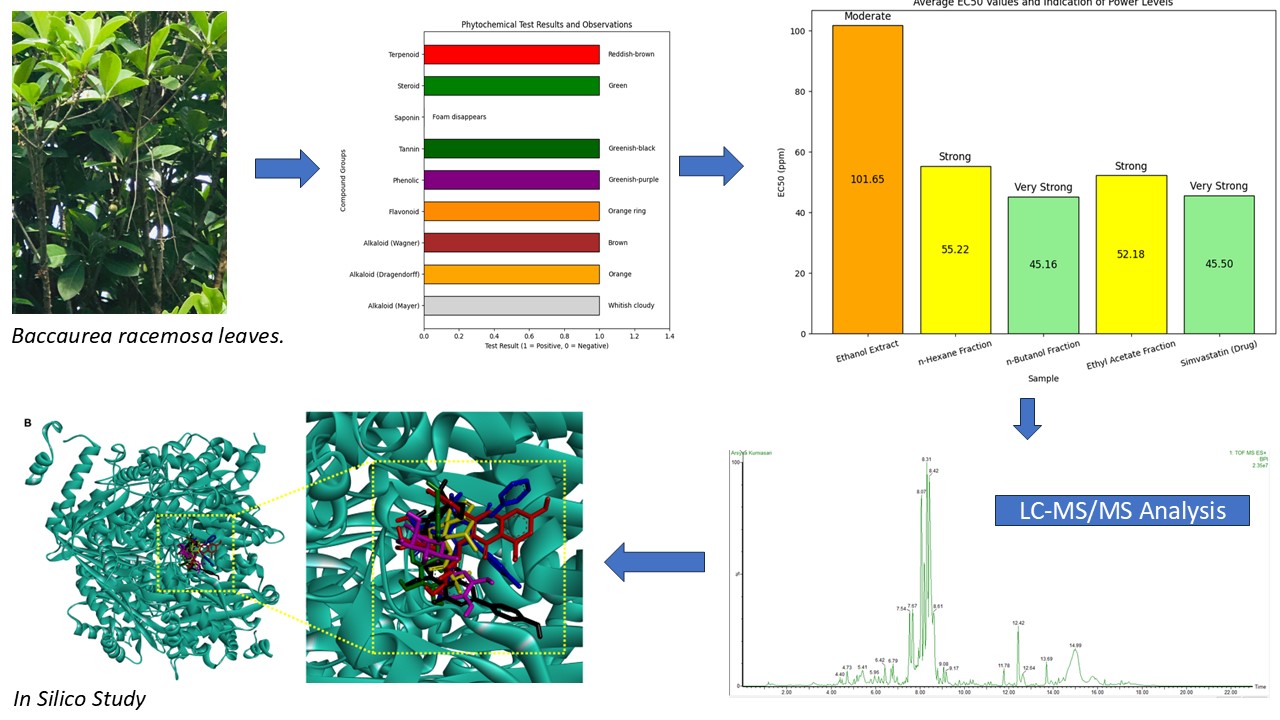
Downloads
References
TA Gaziano, A Bitton, S Anand, S Abrahams-Gessel and A Murphy. Growing epidemic of coronary heart disease in low- and middle-income countries. Current Problems in Cardiology 2010; 35(2), 72-115.
I Angeles-Agdeppa, Y Sun and KV Tanda. Dietary pattern and nutrient intakes in association with non-communicable disease risk factors among Filipino adults: A cross-sectional study. Nutrition Journal 2020; 19(1), 79.
A Yudawijaya and FRW Suling. Comparison of hypertension risk factors in hemorric stroke with non-hemorric stroke in UKI General Hospital, East Jakarta. International Journal of Medical and Health Research 2022; 8(3), 40-48.
AODL Lima, VG Ballester, JFS Sánchez, A Matas Hoces, J González-Outón and EJAD Rey. Cost-effectiveness and budget impact of treatment with evolocumab versus statins and ezetimibe for hypercholesterolemia in Spain. Revista Española de Cardiología 2018; 71(12), 1027-1035.
A Hussain, J Kaler, SD Ray and S Ray. The benefits outweigh the risks of treating hypercholesterolemia: The statin dilemma. Cureus 2023; 15(1), e33648.
J Pang, DC Chan and GF Watts. The knowns and unknowns of contemporary statin therapy for familial hypercholesterolemia. Current Atherosclerosis Reports 2020; 22, 64.
T Mayanti, SE Sinaga and U Supratman. Phytochemistry and biological activity of Lansium domesticum Corr. species: A review. Journal of Pharmacy and Pharmacology 2022; 74(11), 1568-1587.
Y Mulyani, SE Sinaga and U Supratman. Phytochemistry and biological activities of endophytic fungi from the Meliaceae family. Molecules 2023; 28(2), 778.
D Widiastuti, S Warnasih, AH Mulyati, S Sutanto, T Triastinurmiatiningsih, SE Sinaga, S Salam, D Harneti, R Lesmana, U Supratman, Susianti, D Agustine and R Mulyani. Steroid compounds of Manihot Esculenta Crantz Var. Sao Pedro Petro (Tuber) and their cytotoxic effects on melanoma cancer cells (B16-F10). Trends in Sciences 2024; 21(4), 7591.
SE Sinaga, M Fajar, T Mayanti and U Supratman. Bioactivities screening and elucidation of terpenoid from the stembark extracts of Lansium domesticum Corr. cv. Kokosan (Meliaceae). Sustainability 2023; 15(3), 2140.
HR Putri, A Maddu, S Nurulita, F Kurniawati and TA Damayanti. Green synthesis of Cu2O nanoparticles: Characterization and application to control tobacco mosaic virus infection. Journal of General Plant Pathology 2024; 91(1), 51-61.
S Hidayat, EAM Zuhud, D Widyatmoko, B Bahruni and I Batubara. The commercial potential of forest trees as medicinal and health ingredients. Biodiversitas Journal of Biological Diversity 2021; 22(7), 2795-2804.
J Istiqamah, L Permatasari and NI Hanifa. Antioxidant activity testing of fractions resulting from gravity column chromatography of methanol extract of Kepundung Leaves (Baccaurea racemosa) using the DPPH method. Jurnal Biologi Tropis 2024; 24(4), 1060-1068.
L Permatasari, S Riyanto and A Rohman. The review of Baccaurea racemosa: Neglected plants, but potential to be developed. Atlantis Press, Dordrecht, Netherlands, 2022, p. 383-389.
SI Ahmed, MM El-Sheekh, FMA Akl, MEM Makhlof and SE Abo-Neima. The brown seaweed Sargassum latifolium combined with low-level laser irradiation reduces hypercholesterolemia in rats by alleviating oxidative stress and inflammation. South African Journal of Botany 2024; 172, 686-700.
D Widiastuti, S Salam, D Haneti, R Lesmana, D Haneti, MA Nafiah and U Supratman. Flavonoid from the Sao Pedro Petro of tubers of cassava (Manihot esculenta Crantz). Research Journal of Chemistry and Environment 2019; 23, 111-113.
AH Mulyati, H Alawiyah, MF Marom and S Warnasih. Antioxidant testing and identification of bioactive compounds in ethanol extract of propolis from various locations in Indonesia using LCMS-QTOF. Chimica et Natura Acta 2024; 12, 193-203.
SE Sinaga, T Mayanti, D Harneti, N Nurlelasari, R Maharani, K Farabi, U Supratman, S Fajriah and MN Azmi. Sesquiterpenoids from the stem bark of Lansium domesticum Corr. Cv. Kokossan and their cytotoxic activity against MCF-7 breast cancer cell lines. Indonesian Journal of Chemistry 2022; 22(4), 1035-1042.
MA Mir, K Parihar, U Tabasum and E Kumari. Estimation of alkaloid, saponin and flavonoid, content in various extracts of Crocus sativa. Journal of Medicinal Plants Studies 2016; 4(5), 171-174.
L Maheshwaran, L Nadarajah, SPNN Senadeera, CB Ranaweera, AK Chandana and RN Pathirana. Phytochemical testing methodologies and principles for preliminary screening/ qualitative testing. Asian Plant Research Journal 2024; 12(5), 11-38.
EN Sembiring, B Elya and R Sauriasari. Phytochemical screening, total flavonoid and total phenolic content and antioxidant activity of different parts of Caesalpinia bonduc (L.) Roxb. Pharmacognosy Journal 2018; 10(1), 123-127.
WJA Musa, B Situmeang and J Sianturi. Anti-cholesterol triterpenoid acids from Saurauia vulcani Korth. (Actinidiaceae). International Journal of Food Properties 2019; 22(1), 1439-1444.
D Widiastuti, SE Sinaga, S Warnasih, E Pujiyawati, S Salam and WE Putra. Identification of active compounds from Averrhoa bilimbi L. (Belimbing Wuluh) flower using LC-MS and antidiabetic activity test using in vitro and in silico approaches. Trends in Sciences 2023; 20(8), 6761.
A Hidayatullah, WE Putra, S Sustiprijatno, D Widiastuti, WO Salma and MF Heikal. Molecular docking and molecular dynamics simulation-based identification of natural inhibitors against druggable human Papilloma virus type 16 target. Trends in Sciences 2023; 20(4), 4891.
SC Bondy and SX Guo. Lead potentiates iron-induced formation of reactive oxygen species. Toxicology Letters 1996; 87(2-3), 109-112.
T Chen, T Wu, Y Hu, Z Zhu, J Wu, D Lin, X Sun, Z Wu and YP Li. Evaluation of enrichment approaches for the study of the viromes in Mollusk species. Food and Environmental Virology 2025; 17(1), 18.
N Ponroy, A Taveira, NJ Mueller and AL Millard. Statins demonstrate a broad anti‐cytomegalovirus activity in vitro in ganciclovir‐susceptible and resistant strains. Journal of Medical Virology 2015; 87(1), 141-153.
H Deng and Y Xiong. Effect of pravastatin on impaired endothelium-dependent relaxation induced by lysophosphatidylcholine in rat aorta. Acta Pharmacologica Sinica 2005; 26(1), 92-98.
K Bjune, PS Halvorsen, H Wangensteen, TP Leren, MP Bogsrud and TB Strøm. Flavonoids regulate LDLR through different mechanisms tied to their specific structures. Journal of Lipid Research 2024; 65(5), 100539.
L Toma, GM Sanda, LS Niculescu, M Deleanu, AV Sima and CS Stancu. Phenolic compounds exerting lipid-regulatory, anti-inflammatory and epigenetic effects as complementary treatments in cardiovascular diseases. Biomolecules 2020; 10(4), 641.
MT Reetz and G König. n-butanol: An ecologically and economically viable extraction solvent for isolating polar products from aqueous solutions. European Journal of Organic Chemistry 2021; 2021(46), 6224-6228.
B Gunasekaran and M Shukor. HMG - CoA reductase as target for drug development. In: N Labrou (Ed.). Targeting enzymes for pharmaceutical development. Humana, New York, 2019, p. 245-250.
SY Jiang, H Li, JJ Tang, J Wang, J Luo, B Liu, JK Wang, XJ Shi, HW Cui, J Tang, F Yang, W Qi, WW Qiu and BL Song. Discovery of a potent HMG-CoA reductase degrader that eliminates statin-induced reductase accumulation and lowers cholesterol. Nature Communications 2018; 9, 5138.
YV Il’Ichev, JL Perry, F Rüker, M Dockal and JD Simon. Interaction of ochratoxin A with human serum albumin. Binding sites localized by competitive interactions with the native protein and its recombinant fragments. Chemico-Biological Interactions 2002; 141(3), 275-293.
RE Hubbard and MK Haider. Hydrogen bonds in proteins: Role and strength. John Wiley & Sons, Chichester, England, 2010.
DK Patel. Medicinal importance, pharmacological activities and analytical aspects of a flavonoid glycoside ‘Nicotiflorin’ in medicine. Drug Metabolism and Bioanalysis Letters Formerly: Drug Metabolism Letters 2022; 15(1), 2-11.
W Li, Z Deng, S Xiao, Q Du, M Zhang, H Song, C Zhao and L Zheng. Protective effect of vitexin against high fat-induced vascular endothelial inflammation through inhibiting trimethylamine N-oxide-mediated RNA m6A modification. Food & Function 2024; 15(13), 6988-7002.
N Liang, YM Li, Z He, W Hao, Y Zhao, J Liu, H Zhu, E Kwek, KY Ma, WS He and ZY Chen. Rutin and quercetin decrease cholesterol in HepG2 cells but not plasma cholesterol in hamsters by oral administration. Molecules 2021; 26(12), 3766.
AMB Amorim, LF Piochi, AT Gaspar, AJ Preto, N Rosário-Ferreira and IS Moreira. Advancing drug safety in drug development: Bridging computational predictions for enhanced toxicity prediction. Chemical Research in Toxicology 2024; 37(6), 827-849.
M Igel, T Sudhop and K VonBergmann. Metabolism and drug interactions of 3-hydroxy-3-methylglutaryl coenzyme A-reductase inhibitors (statins). European Journal of Clinical Pharmacology 2001; 57, 357-364.
DS Lin and WE Connor. The long-term effects of dietary cholesterol upon the plasma lipids, lipoproteins, cholesterol absorption, and the sterol balance in man: The demonstration of feedback inhibition of cholesterol biosynthesis and increased bile acid excretion. Journal of Lipid Research 1980; 21(8), 1042-1052.
Y Wang and JA Zidichouski. Update on the benefits and mechanisms of action of the bioactive vegetal alkaloid berberine on lipid metabolism and homeostasis. Cholesterol 2018; 2018(1), 7173920.
N Anwar, NZ Ahmed, AP Ansari and AF Fathima. Role of Delphinium denudatum (Jadwar) and Carthamus tinctorius (Qurtum/Safflower), their traditional knowledge, chemical derivatives, and potential benefits in the management of neurodegenerative diseases in the elderly. CRC Press, Boca Raton, 2024.
A Irfan, M Imran, M Khalid, MS Ullah, N Khalid, MA Assiri, R Thomas, S Muthu, MAR Basra, M Hussein, AG Al-Sehemi and M Shahzad. Phenolic and flavonoid contents in Malva sylvestris and exploration of active drugs as antioxidant and anti-COVID-19 by quantum chemical and molecular docking studies. Journal of Saudi Chemical Society 2021; 25(8), 101277.
RI Adeoye, EB Joel, A Igunnu, RO Arise and SO Malomo. A review of some common African spices with antihypertensive potential. Journal of Food Biochemistry 2022; 46(1), e14003.
F Babaei, A Moafizad, Z Darvishvand, M Mirzababaei, H Hosseinzadeh and M Nassiri-Asl. Review of the effects of vitexin in oxidative stress-related diseases. Food Science & Nutrition 2020; 8(6), 2569-2580.
X Lei and Y Yang. Vitexin and an HMG-CoA reductase inhibitor prevent the risks of atherosclerosis in high-fat atherogenic diet-fed rats. Journal of King Saud University-Science 2020; 32, 2088-2095.
Y Zhu, J Zhao, L Luo, Y Gao, H Bao, P Li and H Zhang. Research progress of indole compounds with potential antidiabetic activity. European Journal of Medicinal Chemistry 2021; 223, 113665.
A Kornicka, Ł Balewski, M Lahutta and J Kokoszka. Umbelliferone and its synthetic derivatives as suitable molecules for the development of agents with biological activities: A review of their pharmacological and therapeutic potential. Pharmaceuticals 2023; 16(12), 1732.
SM Yu, DH Hu and JJ Zhang. Umbelliferone exhibits anticancer activity via the induction of apoptosis and cell cycle arrest in HepG2 hepatocellular carcinoma cells. Molecular Medicine Reports 2015; 12(3), 3869-3873.
Published
How to Cite
Issue
Section
License
Copyright (c) 2025 Walailak University

This work is licensed under a Creative Commons Attribution-NonCommercial-NoDerivatives 4.0 International License.





