
Total Phenolic and Flavonoid Contents, Antioxidant, Antibacterial and Anti-Inflammatory Activities and Toxicities of Ethanol Extracts from Curcuma Mangga, Zingiber Officinale and Zingiber Montanum
DOI:
https://doi.org/10.48048/tis.2024.8086Keywords:
Curcuma mangga, Zingiber officinale, Zingiber montanum, Antioxidant, Antibacterial, Anti-inflammation, ToxicitiesAbstract
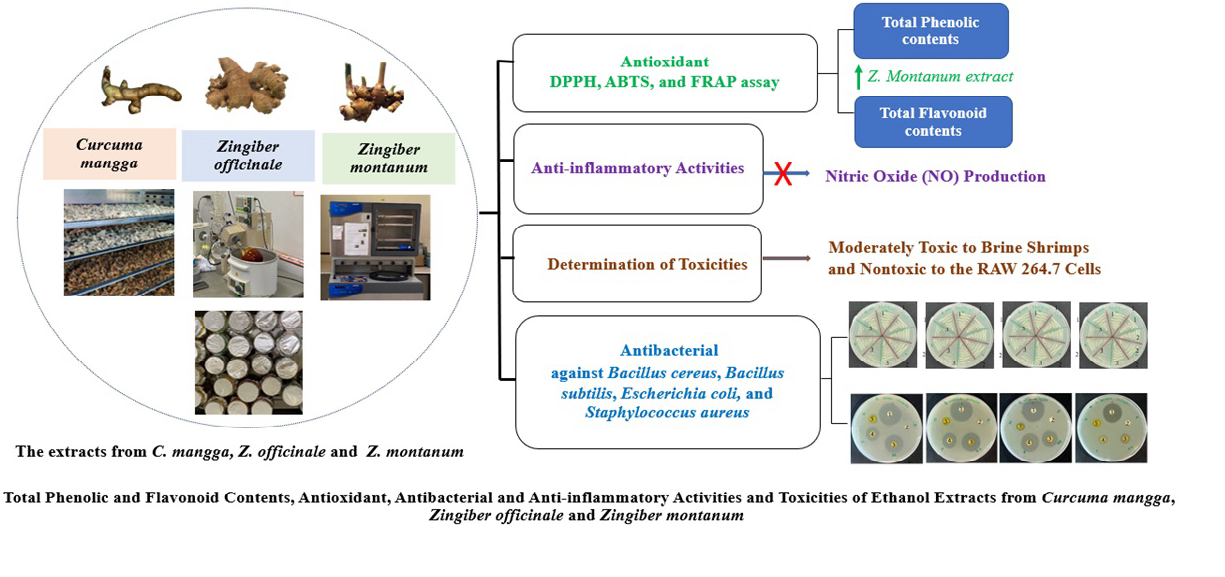
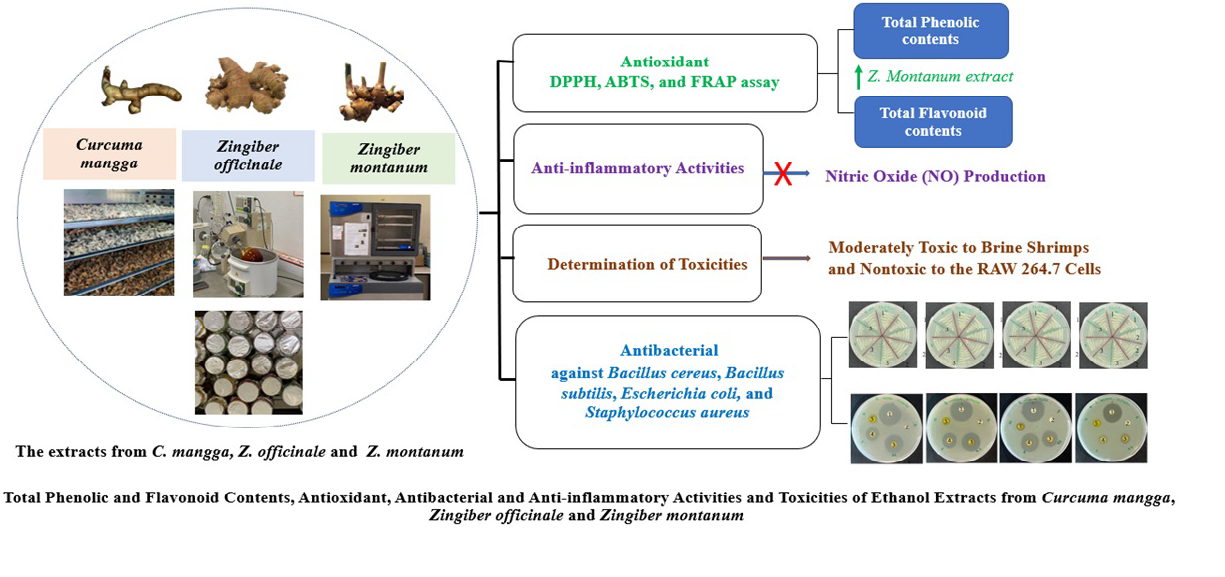
The objectives of this study were to determine and to compare total phenolic and flavonoid contents (TPC and TFC), antioxidant, antibacterial and anti-inflammatory activities and toxicities of ethanol extracts from Curcuma mangga, Zingiber officinale and Zingiber montanum. The study was performed by determinations of 1) TPC using Folin-Ciocalteu reagent method and TFC using colorimetric method of aluminum chloride, 2) antioxidant activities using DPPH, ABTS and FRAP assay, 3) antibacterial activities through evaluation inhibition of bacterial growth, MIC and MBC against Bacillus cereus, Bacillus subtilis, Escherichia coli, and Staphylococcus aureus, 4) anti-inflammatory activity using Griess reaction to measure nitric oxide (NO) production in LPS-stimulated RAW 264.7 macrophage cells and 5) toxicities using lethality assay in brine shrimps and MTT assay in the RAW 264.7 cells. The results revealed that all the extracts possess TPC and TFC, antioxidant, antibacterial and anti-inflammatory activities which the highest TPC and TFC and strongest activities were found in the Z. montanum extract. However, the extracts showed mildly to moderately toxic to brine shrimps, consider to Artemia salina nauplii, and nontoxic to the RAW 264.7 cells. And also, the results confirm the utilization of these extracts for the treatment and/or management of diseases that related to antioxidant, antibacterial and anti-inflammatory activities.
HIGHLIGHTS
- The ethanol extracts from mangga, Z. officinale and Z. montanum possess antioxidant, anti-inflammatory and antibacterial activities.
- Antioxidant activity of the extracts is attributed to radical scavenging by DPPH and ABTS assay, and reducing mechanisms by FRAP assays.
- The extracts display anti-inflammatory activity by inhibition NO production, and exhibit antibacterial activity through inhibition of bacterial growth and bactericidal activity.
- The montanum extract exhibits the activities more potent than the extracts from C. mangga and Z. officinale.
- The extracts can be developed potentially for antioxidant, anti-inflammatory and antibacterial agents.
GRAPHICAL ABSTRACT
Downloads
References
NA Indis and F Kurniawan. Determination of free radical scavenging activity from aqueous extract of Curcuma mangga by DPPH method. J. Phys. Conf. Ser. 2016; 710, 012043.
K Kaewkroek, C Wattanapiromsakul and S Tewtrakul. Anti-inflammatory mechanisms of compounds from Curcuma mangga rhizomes using RAW 264.7 macrophage cells. Nat. Prod. Commun. 2010; 5, 1547-50.
SNA Malek, GS Lee, SL Hong, H Yaacob, NA Wahab, JFF Weber and SAA Shah. Phytochemical and cytotoxic investigations of Curcuma mangga rhizomes. Molecules 2011; 16, 4539-48.
D Pujimulyani, WA Yulianto, A Setyowati, S Arumwardana and R Rizal. Antidiabetic and antioxidant potential of Curcuma mangga Val. extract and fractions. Asian J. Agr. Biol. 2018; 6, 162-8.
TSAT Kamazeri, O Abd Samah, M Taher, D Susanti and H Qaralleh. Antimicrobial activity and essential oils of Curcuma aeruginosa, Curcuma mangga, and Zingiber cassumunar from Malaysia. Asian Pac. J. Trop. Med. 2012; 5, 202-09.
N Aryaeian and H Tavakkoli. Ginger and its effects on inflammatory diseases. Adv. Food Tech. Nutr. Sci. Open J. 2015; 1, 97-101.
I Kravchenko, L Eberle, M Nesterkina, A Kobernik. Anti-inflammatory and analgesic activity of ointment based on dense ginger extract (Zingiber officinale). J. Herbmed Pharmacol. 2019; 8, 126-32.
N Zammel, M Saeed, N Bouali, S Elkahoui, JM Alam, T Rebai, MA Kausar, M Adnan, AJ Siddiqui and R Badraoui. Antioxidant and anti-inflammatory effects of Zingiber officinale Roscoe and Allium subhirsutum: In silico, biochemical and histological study. Foods 2021; 10, 1383.
N Ahmed, MI Karobari, A Yousaf, RN Mohamed, S Arshad, SN Basheer, SW Peeran, TY Noorani, AA Assiry, AS Alharbi and CY Yean. The antimicrobial efficacy against selective oral microbes, antioxidant activity and preliminary phytochemical screening of Zingiber officinale. Infect. Drug Resist. 2022; 15, 2773-85.
M Sharifi-Rad, EM Varoni, B Salehi, J Sharifi-Rad, KR Matthews, SA Ayatollahi, F Kobarfard, SA Ibrahim, D Mnayer, ZA Zakaria, M Sharifi-Rad, Z Yousaf, M Iriti, A Basile and D Rigano. Plants of the genus Zingiber as a source of bioactive phytochemicals: From tradition to pharmacy. Molecules 2017; 22, 2145.
P Thepthong, K Rattakarn, N Ritchaiyaphum, S Intachai and W Chanasit. Effect of extraction solvents on antioxidant and antibacterial activity of Zingiber montanum rhizomes. ASEAN J. Sci. Technol. Rep. 2023; 26, 1-9.
S Bua-in and Y Paisooksantivatana. Essential oil and antioxidant activity of Cassumunar ginger (Zingiberaceae: Zingiber montanum (Koenig) Link ex Dietr.) collected from various parts of Thailand. Agr. Nat. Res. 2009; 43, 467-75.
A Singharach, S Thongpraditchote, N Anantachoke and R Temsiririrkkul. Anti-inflammatory activity of Zingiber montanum (J. König) Link ex Dietr extracts prepared by deep frying in coconut oil. Pharmaceut. Sci. Asia 2020; 47, 51-7.
A Jitoe, T Masuda, IGP Tengah, DN Suprapta, I Gara and N Nakatani. Antioxidant activity of tropical ginger extracts and analysis of the contained curcuminoids. J. Agr. Food Chem. 1992; 40, 1337-40.
N Buddhakala and C Talubmook. Toxicity and antidiabetic activity of ethanolic extract of Sphagneticola trilobata (L.) Pruski flower in rats. J. Ethnopharmacol. 2020; 262, 113-28.
B Yongkhamcha and N Buddhakala. Phytochemical compositions, nutritional contents, cytotoxicity, and anti-inflammatory activity of different extracts from Spirogyra neglecta (Hassall) Kützing. Trends Sci. 2023; 20, 6528.
C Khamphukdee, Y Chulikhit, O Monthakantirat, J Maneenet, C Boonyarat and S Daodee. Phytochemical constituents and antioxidative activity of Schleichera oleosa fruit. Trop. J. Nat. Prod. Res. 2021; 5, 1445-9.
DZ Zheleva-Dimitrova. Antioxidant and acetylcholinesterase inhibition properties of Amorpha fruticosa L. and Phytolacca americana L. Pharmacogn. Mag. 2013; 9, 109-13.
JS Youn, YJ Kim, HJ Na, HR Jung, CK Song, SY Kang and JY Kim. Antioxidant activity and contents of leaf extracts obtained from Dendropanax morbifera LEV are dependent on the collecting season and extraction conditions. Food Sci. Biotechnol. 2019; 28, 201-7.
S Chaiyong, A Menakongka, N Sutthanont and R Thongchai. Gas chromatography-mass spectrometry analysis and antimicrobial activity and cytotoxic effect of Stephania oblata Craib. Agr. Nat. Res. 2021; 55, 237-44.
N Buddhakala and B Yongkhamcha, S Rattanaloeadnusorn and C Talubmook. Phytochemicals and antidiabetic, antioxidant and anti-inflammatory activities of ethanol flower extract of Syzygium aromaticum (L.) Merr. & Perry (Myrtaceae). Trend. Sci. 2023; 20, 3583.
S Sakuljaitrong, N Buddhakala, M Buddhakala, S Asawawibul, S Buatone, Y Tongaram and C Talubmook. Phytochemicals, cytotoxicity, inhibitory effect on nitric oxide production and alpha-glucosidase activity, and DPPH scavenging activity of leaf extract from Gymnema inodorum (Lour.) Decne. Trends Sci. 2023; 20, 6548.
S Maposa, AJ Afolayan and GA Otunola. Toxicity assessment of Vachellia karro (Hayne) Banfi and Galasso pods using brine shrimp assay. Pharmacogn. J. 2020; 12, 1-5.
AMA Ali, MEM El-Nour and SM Yagi. Total phenolic and flavonoid contents and antioxidant activity of ginger (Zingiber officinale Rosc.) rhizome callus and callus treated with some elicitors. J. Genet. Eng. Biotechnol. 2018; 16, 677-82.
Y Li, Y Hong, Y Han, Y Wang and L Xia. Chemica characterization and antioxidant activities comparison in fresh, dried, stir-frying and carbonized ginger. J. Chromatogr. B Anal. Tech. Biomed. Life Sci. 2016; 1011, 223-32.
LM Clemen-Pascual, RAS Macahig and NRL Rojas. Comparative toxicity, phytochemistry, and use of 53 Philippine medicinal plants. Toxicol. Rep. 2022; 9, 22-35.
Downloads
Published
How to Cite
Issue
Section
License
Copyright (c) 2024 Walailak University

This work is licensed under a Creative Commons Attribution-NonCommercial-NoDerivatives 4.0 International License.





