
Mechanical Properties, Morphology and Biodegradability of Biopolymer Composites Prepared from Thermoplastic Starch and Polybutylene Succinate Reinforced with Rice Straw Fiber
DOI:
https://doi.org/10.48048/tis.2025.9767Keywords:
Thermoplastic starch, Polybutylene succinate, Rice straw fiber, Physico-mechanical test, Scanning electron micrographs, BiodegradabilityAbstract
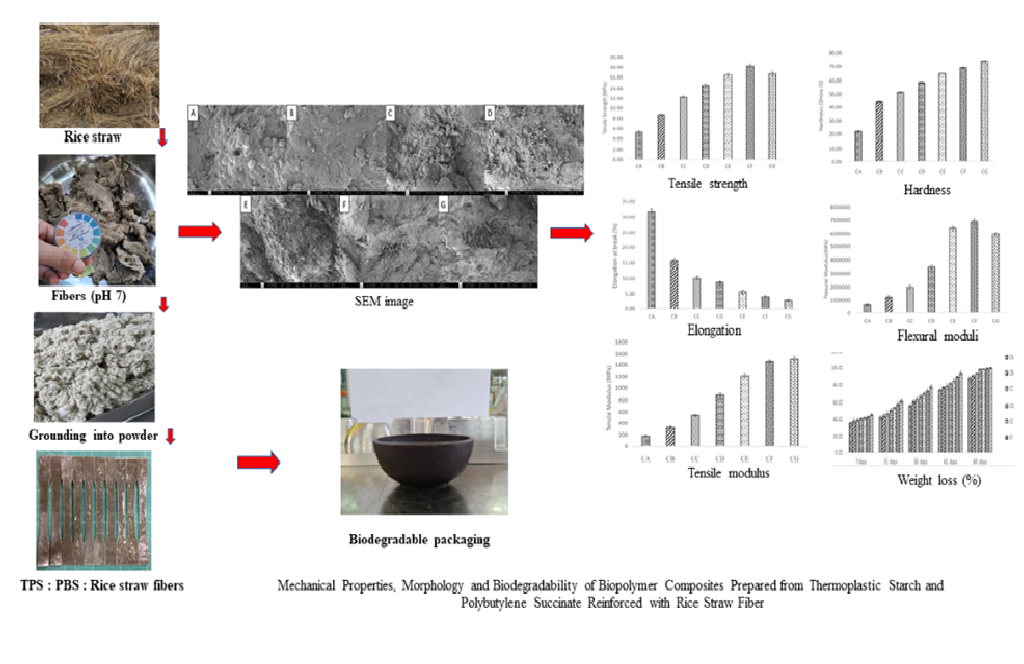
Plastic utilization is increasing extensively with an increase serious impacts to human health and environment due to difficult degradation of petroleum-based plastics. This study was designed to develop biodegradable plastics from thermoplastic starch (TPS) and polybutylene succinate (PBS) reinforced with rice straw fiber (RSF) and investigate mechanical and physical properties, morphology and biodegradability of these plastic to verify whether they can be used as a petroleum-based plastic replacement. The biopolymer composites were prepared from TPS and BTS reinforced with various RSF content of 0, 10, 15, 20, 25, 30, and 35 %. The composites were prepared in an internal mixer at a temperature of 145 °C for 15 min and molded in Hot Compression Molding at 145 °C. The tensile test, impact test, hardness test, flexural test along with morphological examination and biodegradability determination were performed. The results revealed that tensile strength and tensile modulus increased while elongation at break decreased with increasing RSF content. Also, increasing RSF content increased hardness and flexural modulus but decreased impact strength. Scanning electron micrographs demonstrated the composites uniform and compact surface structure, homogenously and effectively distribution, interfacial adhesion of the RSF within the matrix and decreased spaces in the matrix replaced by the RSF. The morphological characteristics of the composites were correlated with physical and mechanical properties. The biodegradability of the composites was influenced by the RSF content and duration of soil burial treatment. The biopolymer composites developed from TPS and PBS reinforced with RSF can be used as a replacement of petroleum-based plastics and provide the sustainable, biodegradable, low cost, and environmental friendly bioplastics, especially reinforced with 30 % RSF.
HIGHLIGHTS
- Rice straw, a natural material with high productivity from renewable resources and low cost provides an excellent fiber substance for the development of biodegradable plastics to replace petroleum-based plastics.
- Rice straw fiber as a reinforcement can improve the mechanical properties, morphology and biodegradability of the biopolymer composites.
- Biopolymer composites prepared from TPS and PBS reinforced with RSF could provide the sustainable, biodegradable, low cost as well as the environmental friendly bioplastics.
- Utilization of rice straw fibers as a reinforcing agent in thermoplastic composites could decrease negative impact from rice straw open - burning and value-added of rice straw.
GRAPHICAL ABSTRACT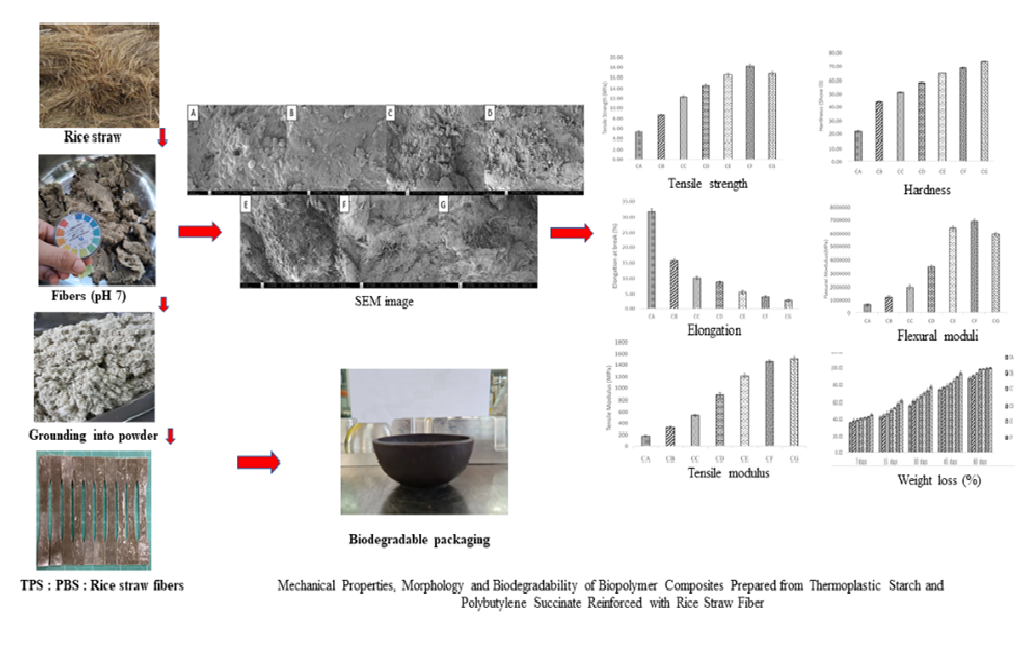
Downloads
References
J Soares, I Miguel, C Venâncio, I Lopes and M Oliveira. Public views on plastic pollution: Knowledge, perceived impacts, and pro-environmental behaviours. Journal of Hazardous Materials 2021; 412, 125227.
M Ilyas, W Ahmad, H Khan, S Yousaf, K Khan and S Nazir. Plastic waste as a significant threat to environment - a systematic literature review. Reviews on Environmental Health 2018; 33(4), 383-406.
D Pan, F Su, C Liu and Z Guo. Research progress for plastic waste management and manufacture of value-added products. Advanced Composites and Hybrid Materials 2020; 3, 443-461.
PGCNT Pilapitiya and AS Ratnayake. The world of plastic waste: A review. Cleaner Materials 2024; 11, 100220.
ZN Diyana, R Jumaidin, MZ Selamat, I Ghazali, N Julmohammad, N Huda and RA Ilyas. Physical properties of thermoplastic starch derived from natural resources and its blends: A review. Polymers 2021; 13(9), 1396.
D Rahardiyan, EM Moko, JS Tan and CK Lee. Thermoplastic starch (TPS) bioplastic, the green solution for single-use petroleum plastic food packaging - A review. Enzyme and Microbial Technology 2023; 168, 10260.
MB Agustin, B Ahmmad, SMM Alonzo and FM Patriana. Bioplastic based on starch and cellulose nanocrystals from rice straw. Journal of Reinforced Plastics and Composites 2014; 33(24), 2205-2213.
L Aliotta, M Seggiani, A Lazzeri, V Gigante and P Cinelli. A brief review of poly (butylene succinate) (PBS) and its main copolymers: Synthesis, blends, composites, biodegradability, and applications. Polymers 2022; 21, 14(4), 844.
ML Sanyang, SM Sapuan, M Jawaid, MR Ishak and J Sahari. Effect of plasticizer type and concentration on dynamic mechanical properties of sugar palm starch-based films. International Journal of Polymer Analysis and Characterization 2015; 20(7), 627-636.
G Abera, B Woldeyes, HD Demash and G Miyake. The effect of plasticizers on thermoplastic starch films developed from the indigenous Ethiopian tuber crop Anchote (Coccinia abyssinica) starch. International Journal of Biological Macromolecules 2020; 155, 581-587.
AABA Mohammed, Z Hasan, AAB Omran, AM Elfaghi, MA Khattak, RA Ilyas and SM Sapuan. Effect of various plasticizers in different concentrations on physical, thermal, mechanical, and structural properties of wheat starch-based films. Polymers 2022; 15(1), 63.
N Jacquel, R Saint-Loup, JP Pascault, A Rousseau and F Fenouillot. Bio-based alternatives in the synthesis of aliphatic-aromatic polyesters dedicated to biodegradable film applications. Polymer 2015; 59, 234-242.
SA Rafiqah, A Khalina, AS Harmaen, IA Tawakkal, K Zaman, M Asim, MN Nurrazi and CH Lee. A review on properties and application of bio-based poly(butylene succinate). Polymers 2021; 13(9), 1436.
C Scolaro, S Brahimi, A Falcone, V Beghetto and A Visco. Mechanical and physical changes in bio-polybutylene-succinate induced by UVC ray photodegradation. Polymers 2024; 16(9), 1288.
CP Rivero, Y Hu, TH Kwan, C Webb, C Theodoropoulos, W Daoud and CSK Lin. Bioplastics from solid waste. In: JWC Wong, RD Tyagi and A Pandey (Eds.). Current developments in biotechnology and bioengineering: Solid waste management. Elsevier, Amsterdam, The Netherlands, 2017, p. 1-26.
ST Lim, YH Hyun, HJ Choi and MS Jhon. Synthetic biodegradable aliphatic polyester/ montmorillonite nanocomposites. Chemistry of Materials 2002; 14(4), 1839-1844.
KS Savitha, BR Paghadar, MS Kumar and RL Jagadish. Polybutylene succinate, a potential bio-degradable polymer: Synthesis, copolymerization and bio-degradation. Polymer Chemistry 2022; 13(24), 3562-3612.
N Shin, SH Kim, J Oh, S Kim, Y Lee, Y Shin, S Choi, SK Bhatia, YG Kim and YH Yang. Reproducible polybutylene succinate (PBS)-degrading artificial consortia by introducing the least type of PBS-degrading strains. Polymers 2024; 16(5), 651.
JB Zeng, YD Li, QY Zhu, KK Yang, XL Wang and YZ Wang. A novel biodegradable multiblock poly(ester urethane) containing poly(L-lactic acid) and poly(butylene succinate) blocks. Polymer 2009; 50(5), 1178-1186.
G Dogossy and T Czigan. Thermoplastic starch composites reinforced by agricultural by-products: Properties, biodegradability, and application. Journal of Reinforced Plastics and Composites 2011; 30(21), 1819-1825.
YA El-Shekeil, SM Sapuan, K Abdan and ES Zainudin. Influence of fiber content on the mechanical and thermal properties of Kenaf fiber reinforced thermoplastic polyurethane composites. Materials and Design 2012; 40, 299-303.
RK Ozlowski and M Wladyka-Przybylak. Natural fibers as reinforcing materials for composites. Processes: State of the Art and Future Developments 2007; 4, 961-968.
Y Zhao, J Qiu, H Feng and M Zhang. The interfacial modification of rice straw fiber reinforced poly(butylene succinate) composites: Effect of aminosilane with different alkoxy groups. Journal of Applied Polymer Science 2012; 125(4), 3211-3220.
KG Satyanarayana, GGC Arizaga and F Wypych. Biodegradable composites based on lignocellulosic fibers-An overview. Progress in Polymer Science 2009; 34(9), 982-1021.
S Laya, S Shamina and PP Moossa. Production of bioplastic from rice straw cellulose. The Pharma Innovation Journal 2022; SP-11(9), 1742-1744.
I Kumar, V Bandaru, S Yampracha, L Sun and B Fungtammasan. Limiting rice and sugarcane residue burning in Thailand: Current status, challenges and strategies. Journal of Environmental Management 2020; 276, 111228.
E Cassou. Agricultural pollution: Field burning. World Bank Group, Washington DC, 2018.
K Kanokkanjana and S Garivait. Alternative rice straw management practices to reduce field open burning in Thailand. International Journal of Environmental Science and Development 2013; 4(2), 119-123.
T Suramaythangkoor and SH Gheewala. Potential alternatives of heat and power technology application using rice straw in Thailand. Applied Energy 2010; 87(1), 128-133.
EF Kristensen and JK Kristensen. Development and test of small-scale batch-fired straw boilers in Denmark. Biomass and Bioenergy 2004; 26(6), 561-569.
M Sain. Production of bioplastics and sustainable packaging materials from rice straw to eradicate stubble burning: A Mini-Review. Environment Conservation Journal 2020; 21(3), 1-5.
P Jagadeesh, M Puttegowda, YGT Girijappa, SM Rangappa and S Siengchin. Effect of natural filler materials on fiber reinforced hybrid polymer composites: An Overview. Journal of Natural Fibers 2022; 19(11), 4132-4147.
MNF Norrrahim, NAM Kasim, VF Knight, NA Halim, NAA Shah, SAM Noor, SH Jamal, KK Ong, WMZW Yunus, MAA Farid, MA Jenol and IR Ahmad. Performance evaluation of cellulose nanofiber reinforced polymer composites Functional Composites and Structures 2021; 3, 24001.
GW Hardi, BK Dewi, SAL Toruan, S Nurjanah, SA Fitriana and L Yunita. Synthesis of cellulose straw and rice husk as raw materials for bioplastic production. Hydrogen: Jurnal Kependidikan Kimia 2024; 12(6), 1419-1428.
F Bilo, S Pandini, L Sartore, LE Depero, G Gargiulo, A Bonassi, S Federici and E Bontempi. A sustainable bioplastic obtained from rice straw. Journal of Cleaner Production 2018; 200, 357-368.
M Yusefi, MS Lee-Kiun, K Shameli, SY Teow, RR Ali, KK Siew, HY Chan, MMT Wong, WL Lim and K Kuča. 5-Fluorouracil loaded magnetic cellulose bionanocomposites for potential colorectal cancer treatment. Carbohydrate Polymers 2021; 273, 118523.
P Cinelli, M Seggiani, N Mallegni, V Gigante and A Lazzeri. Processability and degradability of PHA-based composites in terrestrial environments. International Journal of Molecular Sciences 2019; 20(2), 284.
P Shah, R Prajapati and P Singh. Enrichment of mechanical properties of biodegradable composite containing waste cellulose fiber and thermoplastic starch. European Journal of Advances in Engineering and Technology 2017; 4(4), 282-283.
FA Ghasemi, MN Niyaraki, I Ghasemi and S Daneshpayeh. Predicting the tensile strength and elongation at break of PP/graphene/glass fiber/EPDM nanocomposites using response surface methodology. Mechanics of Advanced Materials and Structures 2021; 28(10), 981-989.
H Ahmad and D Rodrigue. High‐performance wood‐reinforced crosslinked high‐density polyethylene composites. Polymer Engineering and Science 2024; 64(6), 2459-2475.
MM Mahdy, SY Mahfouz, AF Tawfic and MAEM Ali. Performance of rice straw fibers on hardened concrete properties under effect of impact load and gamma radiation. Fibers 2023; 11(5), 42.
Y Boztoprak. Physical, mechanical, and flammability properties of Wood-Plastic Composites (WPC) containing beech-wood flour and flame-retardant additives. Polymers 2024; 16(20), 2944.
RA Pérez-Camargo, B Fernández-D’Arlas, D Cavallo, T Debuissy, E Pollet, L Avérous and AJ Müller. Tailoring the structure, morphology, and crystallization of isodimorphic poly(butylene succinate-ran-butylene adipate) random copolymers by changing composition and thermal history. Macromolecules 2017; 50, 597-608.
P Senthamaraikannan, SS Saravanakumar, VP Arthanarieswaran and P Sugumaran. Physico-chemical properties of new cellulosic fibers from bark of Acacia planifrons. International Journal of Polymer Analysis and Characterization 2016; 21(3), 207-213.
AN Balaji, MKV Karthikeyan and V Vignesh. Characterization of new natural cellulosic fiber from kusha grass. International Journal of Polymer Analysis and Characterization 2016; 21(7), 599-605.
E Diniardi, Nelfiyanti, KH Mahmud, H Basri and AI Ramadhan. Analysis of the tensile strength of composite material from fiber bags. Journal of Applied Science and Advanced Technology 2019; 2(2), 39-48.
N Ketata, B Seantier, N Guermazi and Y Grohens. Processing and properties of flax fibers reinforced PLA/PBS biocomposites. Materials Today: Proceedings 2022; 53(1), 228-236.
H Haryanto, RH Nilakandhi and A Chafidz. Effect of the addition of rice straw nanofiber and zinc oxide on the mechanical properties and biodegradability of bioplastic. In: Proceedings of the 5th International Conference on Engineering and Applied Technology, Banjarmasin, Indonesia. 2023, p. 70007.
A Ashori. Effects of nanoparticles on the mechanical properties of rice straw/polypropylene composites. Journal of Composite Materials 2013; 47(2), 149-154.
S Bismarck, M Mishra and T Lampke. Plant fibres as reinforcement for green composites. In: AM Mohanty (Ed.). Natural fibres, biopolymers, and biocomposites. CRC Press, Boca Raton, Florica, 2005, p. 37-108.
J Mishra, S Acharya, AB Taksande, R Prasad, PK Munjewar and MB Wanjari. Occupational risks and chronic obstructive pulmonary disease in the Indian subcontinent: A critical review. Cureus 2023; 15(6), e41149.
S Thaipakdee and P Chiaranpanpong. 2022, Study on mechanical and physical properties of biodegradable polymers from polylactic acid, polybutylene succinate, and rice straw fibers. Bachelor’s thesis. Rajamangala University of Technology Isan, Nakhon Ratchasima, Thailand.
I Ismail, Ismaturrahmi, Zakaria, Zulfalina, Z Jalil and SH Fadzullah. Mechanical properties of rice straw fiber-reinforced polypropylene composite. In: Proceedings of the 3rd International Conference on Natural and Environmental Sciences, Banda Aceh, Indonesia. 2019, p. 12013.
ES Zainudin and SM Sapuan. Impact strength and hardness properties of banana pseudo-stem filled unplastisized PVC composites. Multidiscipline Modeling in Materials and Structures 2009; 5(3), 277-282.
W Wertsungnoen and B Puangklang. Study of mechanical properties and degradability of thermoplastic starch from cassava starch blended with polybutylene succinate and polylactic acid. In: Proceedings of the Conference on Engineering, Science, Technology, and Architecture, Kalasin University, Kalasin, Thailand. 2023, p. 1277-1284.
M Wanapat, S Kang, N Hankla and K Phesatcha. Effect of rice straw treatment on feed intake, rumen fermentation and milk production in lactating dairy cows. African Journal of Agricultural Research 2013; 8(17), 1677-1687.
K Jarakamjorn. 2013, Enhancing compatibility and toughness of polymer blends between thermoplastic starch and polylactic acid. Bachelor’s thesis. Suranaree University of Technology, Nakhon Ratchasima, Thailand.
H Nakajima, P Dijkstra and K Loos. The recent developments in biobased polymers toward general and engineering applications: Polymers that are upgraded from biodegradable polymers, analogous to petroleum-derived polymers, and newly developed. Polymers 2017; 9(10), 523.
DD Silva, M Kaduri, M Poley, O Adir, N Krinsky, J Shainsky-Roitman and A Schroeder. Biocompatibility, biodegradation and excretion of polylactic acid (PLA) in medical implants and theranostic systems. Chemical Engineering Journal 2018; 340, 9-14.
J Zhu and C Wang. Biodegradable plastics: Green hope or greenwashing? Marine Pollution Bulletin 2020; 161, 111774.
R Zhang and Z Zhang. Biogasification of rice straw with an anaerobic-phased solids digester system. Bioresource Technology 1999; 68(3), 235-245.
AT Hendriks and G Zeeman. Pretreatments to enhance the digestibility of lignocellulosic biomass. Bioresource Technology 2009; 100(1), 10-18.
H Bansi, R Risiyanto and AR Indriawaty. Use of microbes to improve nutritional value of rice straw. In: Proceedings of the International Conference on Livestock Production and Veterinary Technology, West Java, Indonesia. 2012, p. 99-103.
JX Liu and ER Ørskov. Cellulase treatment of untreated and steam pre-treated rice straw-effect on in vitro fermentation characteristics. Animal Feed Science and Technology 2000; 88(3-4), 189-200.
NYL Loh, HY Pang, WT Tee, BYZ Hiew, S Hanson, S Chong, S Thangalazhy-Gopakumar, S Gan and LY Lee. Synthesis of renewable and cost-effective bioplastic from apple waste: Physicochemical and biodegradability studies. Waste and Biomass Valorization 2023; 14, 3235-3252.
P Chanjula, V Petcharat and A Cherdthong. Effects of fungal (Lentinussajor-caju) treated oil palm frond on performance and carcass characteristics in finishing goats. Asian-Australasian Journal of Animal Sciences 2017; 30(6), 811-818.
Published
How to Cite
Issue
Section
License
Copyright (c) 2025 Walailak University

This work is licensed under a Creative Commons Attribution-NonCommercial-NoDerivatives 4.0 International License.





