
Comparative Effects of Extracts from Black Rice or Pathum Rice Combined with Cereals on Blood Glucose Levels, Serum Insulin Levels and Blood Chemistry in Diabetic Rats
DOI:
https://doi.org/10.48048/tis.2024.8522Keywords:
Black rice, Pathum rice, Cereals, Blood glucose, Blood Chemistry, Serum insulin, DiabetesAbstract
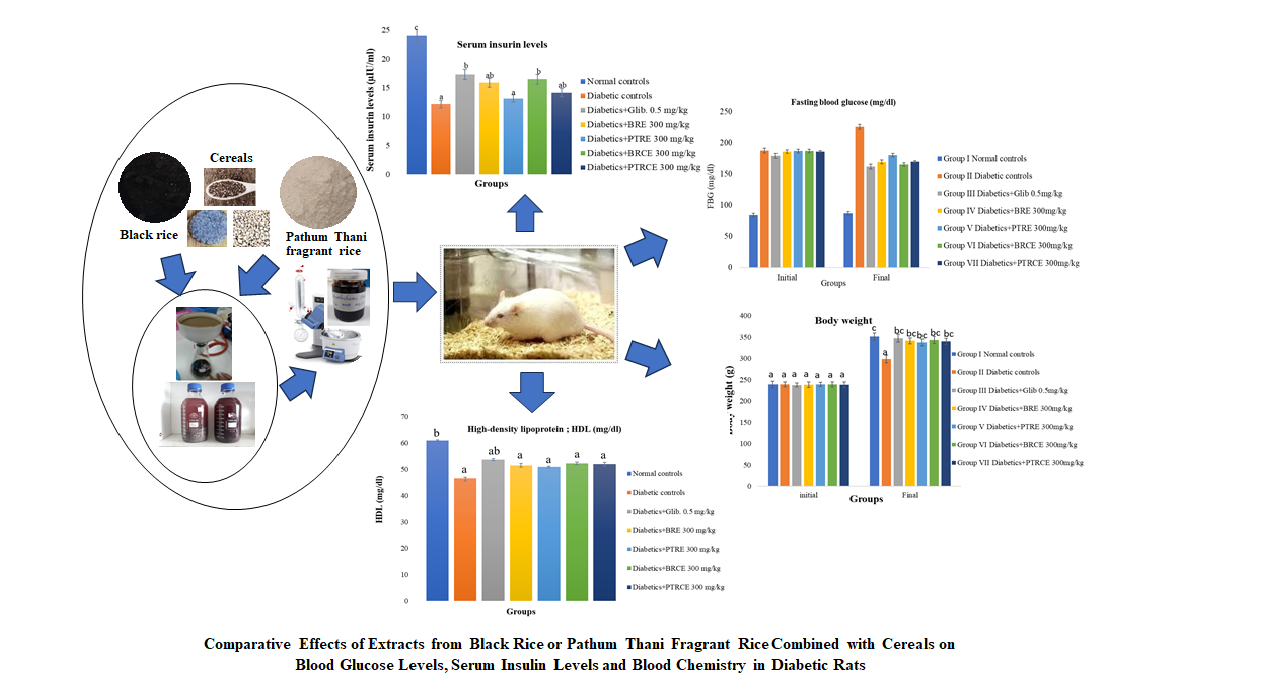
Rice is one of the major cereal crops in several Asian countries. It contains a variety of nutrients and provides valuable health benefits. The antidiabetic activity of rice combined with cereals has not been studied. Therefore, the present study was carried out to determine and compare the effects of extracts from Black rice (BRE), Pathum rice (PTRE), Black rice combined with cereals (BRCE), and Pathum rice combined with cereals (PTRCE) on body weight, blood glucose levels, serum insulin levels and blood chemistry of Streptozotocin (STZ)-induced diabetic rats. The results revealed that BRCE exhibited the highest activity in reducing fasting blood glucose (FBG) levels and increasing serum insulin levels, and also recovered the lipid profiles, renal function and hepatic function resulting from STZ in the diabetic rats, followed by BRE, PTRCE and PTRE, respectively. Also, BRCE exhibited an activity with similar potential to Glibenclamide. The findings indicate that the rice extracts possess antidiabetic activity which exerts the activity by increasing serum insulin resulting in reduction of blood glucose. Rice combined with cereals provides better antidiabetic activity and could be a source of valuable antidiabetic materials.
HIGHLIGHTS
- Extracts from Black rice and Pathum Thani fragrant rice exhibit antidiabetic activity in Streptozotocin-induced diabetic rats.
- Antidiabetic activity of the extracts from Black rice and Pathum Thani fragrant rice is due to an increase in insulin secretion.
- Black rice exhibits antidiabetic activity higher than Pathum Thani fragrant rice.
- Combination with cereals could enhance the antidiabetic activity of rice.
- The extracts from Black rice and Pathum Thani fragrant rice may be useful for the management of diabetes mellitus.
GRAPHICAL ABSTRACT
Downloads
References
American Diabetes Association. Standards of medical care in diabetes. Diabetes Care 2014; 37, S14-S80.
DE Okwu. Phytochemicals and vitamin content of indigenous spices of Southeastern Nigeria. J. Sustain Agr. Environ. 2004; 6, 30-4.
WMW Nazaimoon and BAK Khalid. Tocotrienols-rich diet decreases advanced glycosylation end-products in non-diabetic rats and improves glycemic control in streptozotocin-induced diabetic rats. Malays. J. Pathol. 2002; 24, 77-82.
R Sobhy, M Eid, F Zhan, H Liang and B Li. Toward understanding the in vitro anti-amylolytic effects of three structurally different phytosterols in an aqueous medium using multispectral and molecular docking studies. J. Mol. Liq. 2019; 283, 225-34.
SB Ghatak and SS Panchal. Protective effect of oryzanol isolated from crude rice bran oil in experimental model of diabetic neuropathy. Rev. Bras. Farmacogn. 2012; 22, 1092-103.
A Untereiner, S Abdo, A Bhattacharjee, H Gohil, F Pourasgari, N Ibeh, M Lai, B Batchuluun, A Wong, N Khuu, Y Liu, Rijjal DA, N Winegarden, C Virtanen, BA Orser, O Cabrera, G Varga, J Rocheleau, FF Dai and MB Wheeler. GABA promotes β-cell proliferation, but does not overcome impaired glucose homeostasis associated with diet-induced obesity. FASEB J. 2019; 33, 3968-84.
K Takemoto, W Doi and N Masuoka. Protective effect of vitamin E against alloxan-induced mouse hyperglycemia. Biochim. Biophys. Acta 2016; 1862, 674-50.
J Tian, HN Dang, J Yong, WS Chui, MP Dizon, CK Yaw and DL Kaufman. Oral treatment with γ -aminobutyric acid improves glucose tolerance and insulin sensitivity by inhibiting inflammation in high fat diet-fed mice. PLoS One 2011; 6, e25338.
SM Han and JS Lee. Production and its anti-hyperglycemic effects of γ-Aminobutyric BAK. Mycobiology 2017; 45, 199-203.
KK Adom and RH Liu. Antioxidant activity of grains. J Agr. Food Chem. 2002; 50, 6182-7.
AS Wahyuni and R Munawwaroh. Economic value added of black rice bran as antidiabetic: Pharmacology and Phytochemistry Studies. National Journal of Physiology, Tamil Nadu, India, 2014.
AS Wahyuni, R Munawaroh and M Da’i. Antidiabetic mechanism of ethanol extract of black rice bran on diabetic rats. Nat. J. Physiol. Pharm. Pharmacol. 2016; 6, 106-10.
H Shimoda, M Aitani, J Tanaka and S Hitoe. Purple rice extract exhibits preventive activities on experimental diabetes models and human subjects. Rice Res. 2015; 3, 137.
B Pittayaporn, S Phumon, J Sakda, W Sutee and M Sugunya. Comparison of grain yield and 2-acetyl-1-pyrroline (2AP) content in leaves and grain of two Thai fragrant rice cultivars cultivated at greenhouse and open-air conditions. Aust. J. Crop Sci. 2019; 13, 159-69.
BJ Venn and JI Mann. Cereal grains, legumes and diabetes. Eur. J. Clin. Nutr. 2004; 58, 1443-61.
N Buddhakala and C Talubmook. Toxicity and antidiabetic activity of ethanolic extract of Sphagneticola trilobata (L.) Pruski flower in rats. J. Ethnopharmacol. 2020; 262, 113-28.
C Talubmook, A Forrest and M Parsons. Streptozotocin-induced diabetes modulates presynaptic and postsynaptic function in the rat ileum. Eur. J. Pharmacol. 2003; 496, 153-8.
A Sharma, AK Sharma, T Chand, M Khardiya and KC Yadav. Antidiabetic and antihyperlipidemic activity of Cucurbita maxima Duchense (pumpkin) seeds on streptozotocin induced diabetic rats. J. Pharmacogn. Phytochem. 2013; 1, 108-16.
M Elsner, B Guldbakke, M Tiedge, R Munday and S Lenzen. Relative importance of transport and alkylation for pancreatic beta-cell toxicity of streptozotocin. Diabetologia 2000; 43, 1528-33.
P Ramakrishnan, D Ramadoss, P Muthulingam, R Nedunchezhian and K Krishnamoorthy. Antidiabetic, antihyperlipidemic, antioxidant property of Cordia obliqua on streptozotocin induced diabetic rats. J. Young Pharm. 2017; 9, 321-6.
MN Chatterjea and R Shinde. Text book of medical biochemistry, diabetes mellitus. Jaypee Brothers Medical Publishers, New Delhi, India, 2002.
D Harrison, KK Griendling, U Landmesser, B Hornig and H Drexler. Role of oxidative stress in atherosclerosis. Am. J. Cardiol. 2003; 91, 7A-11A.
A Garg and SM Grundy. Management of dyslipidemia in NIDDM. Diabetes Care 1990; 13, 15369
E Lecumberri, L Goya, R Mateos, M Alía, S Ramos, M Izquierdo-Pulido and L Bravo. A diet rich in dietary fiber from cocoa improves lipid profile and reduces malondialdehyde in hypercholesterolemic rats. Nutrition 2007; 23, 332-41.
C Elder. Ayurveda for diabetes mellitus: A review of the biomedical literature. Altern. Ther. Health Med. 2004; 10, 44-50.
RAS Sancho and GM Pastore. Evaluation of the effects of anthocyanins in type 2 diabetes. Food Res. Int. 2012; 46, 378-86.
Z Hou, P Qing and G Ren. Effect of anthocyanin-rich extract from black rice (Oryza sativa L. Japonica) on chronically alcohol-induced liver damage in rats. J. Agr. Food Chem. 2010; 58, 3191-6.
Downloads
Published
How to Cite
Issue
Section
License
Copyright (c) 2024 Walailak University

This work is licensed under a Creative Commons Attribution-NonCommercial-NoDerivatives 4.0 International License.





