Network Pharmacology-Based Investigation and Molecular Docking Validation of the Therapeutic Targets of Moringa Oleifera Against Diabetes Through Network Approach
DOI:
https://doi.org/10.48048/tis.2027.14127Keywords:
oringa oleifera, Network pharmacology, Molecular docking, Antidiabetic potential, Bioactive compounds, Ellagic acid, Phytochemical screening, Glucose metabolism, In silico toxicity, Drug-likenessAbstract
This study investigates the antidiabetic potential of Moringa oleifera through an integrated network pharmacology and molecular docking approach to elucidate its multi-target therapeutic mechanisms. An initial screening of 30 phytochemical compounds resulted in the identification of 11 bioactive molecules exhibiting high gastrointestinal absorption and favorable drug-likeness properties, indicating strong oral bioavailability. Network pharmacology analysis revealed 14 common protein targets shared between the selected compounds and diabetes-related pathways, highlighting key regulatory roles in glucose metabolism, insulin signaling, and inflammatory modulation. Protein-protein interaction and pathway enrichment analyses further supported the involvement of these targets in critical metabolic processes associated with diabetes pathogenesis. Molecular docking simulations confirmed stable ligand-target interactions, with binding affinities ranging from −5.0 to −9.3 kcal/mol. Among the identified compounds, ellagic acid demonstrated the strongest binding affinity and structural stability, suggesting its potential as a promising lead compound. In addition, in silico toxicity assessment indicated favorable safety profiles for all screened compounds, with LD₅₀ values exceeding 2,500 mg/kg and classification within Toxicity Classes IV and V. Overall, these findings provide a robust theoretical basis for the development of Moringa oleifera-derived bioactive compounds as safe and effective candidates for diabetes management and support further experimental and clinical investigations.
HIGHLIGHTS
- Integrated network pharmacology and molecular docking reveal the multi-target mechanisms of Moringa oleifera in diabetes management.
- Screening of 30 phytochemicals identified 3 best bioactive compounds, namely ellagic acid, anthraquinone, and phenolic steroid, which demonstrated strong molecular docking activity, high oral bioavailability, favorable drug-likeness properties, and acceptable toxicity profiles as potential antidiabetic agents.
- Network analysis identified 14 key protein targets involved in glucose metabolism, insulin signaling, and inflammatory modulation.
- Ellagic acid emerged as a promising lead compound with the strongest binding affinity and structural stability at -9.3 kcal/mol.
- In silico toxicity assessments confirmed favorable safety profiles for all compounds with LD50 values exceeding 2,500 mg/kg.
GRAPHICAL ABSTRACT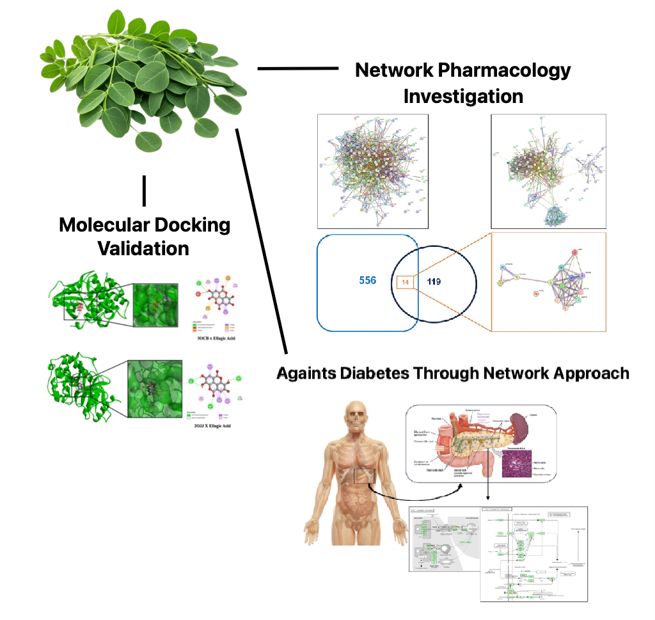
Downloads
References
OA Ojo, HS Ibrahim, DE Rotimi, AD Ogunlakin and AB Ojo. Diabetes mellitus: From molecular mechanism to pathophysiology and pharmacology. Medicine in Novel Technology and Devices 2023; 19, 100247.
F Siddiqui and V Bakshi. Hydroalcoholic extraction, phytoconstituent profiling by LC-HRMS, and computational analysis of Lantana camara as potential glucokinase, alpha amylase, alpha glucosidase, and DPP-IV inhibitors. Chemical Methodologies 2025; 9(12), 1189-1220.
MAB Khan, MJ Hashim, JK King, RD Govender, H Mustafa and J Al-Kaabi. Epidemiology of type 2 diabetes—global burden of disease and forecasted trends. Journal of Epidemiology and Global Health 2020; 10(1), 107-111.
L Sacchetta, M Chiriacò, L Nesti, S Leonetti, G Forotti, A Natali, A Solini and D Tricò. Synergistic effect of chronic kidney disease, neuropathy, and retinopathy on all-cause mortality in type 1 and type 2 diabetes: A 21-year longitudinal study. Cardiovascular Diabetology 2022; 21(1), 233.
BS Modjtahedi, J Wu, TQ Luong, NK Gandhi, DS Fong and W Chen. Severity of diabetic retinopathy and the risk of future cerebrovascular disease, cardiovascular disease, and all-cause mortality. Ophthalmology 2021; 128(8), 1169-1179.
BA Perkins, JL Sherr and C Mathieu. Type 1 diabetes glycemic management: Insulin therapy, glucose monitoring, and automation. Science 2021; 373(6554), 522-527.
J Blahova, M Martiniakova, M Babikova, V Kovacova, V Mondockova and R Omelka. Pharmaceutical drugs and natural therapeutic products for the treatment of type 2 diabetes mellitus. Pharmaceuticals 2021; 14(8), 806.
X Tian, W Wang, L Zhang, L Wang, K Zhang, X Ge, Z Luo, Y Zhao, X Zhai and C Li. Acupuncture and drug combination therapy for abnormal glucose metabolism: Exploring synergistic enhancement and reduced toxicity mechanisms. Diabetes, Metabolic Syndrome and Obesity 2024; 17, 4525-4537.
D Meireles, J Gomes, L Lopes, M Hinzmann and J Machado. A review of properties, nutritional and pharmaceutical applications of Moringa oleifera: Integrative approach on conventional and traditional Asian medicine. Advances in Traditional Medicine 2020; 20(4), 495-515.
FS Owens III, O Dada, JW Cyrus, OO Adedoyin and G Adunlin. The effects of Moringa oleifera on blood glucose levels: A scoping review of the literature. Complementary Therapies in Medicine 2020; 50, 102362.
E Nova, N Redondo-Useros, RM Martínez-García, S Gómez-Martínez, LE Díaz-Prieto and A Marcos. Potential of Moringa oleifera to improve glucose control for the prevention of diabetes and related metabolic alterations: A systematic review of animal and human studies. Nutrients 2020; 12(7), 2050.
A Leone, SD Lello, S Bertoli, S Ravasenghi, RD Amicis, F Menichetti, G Fico, L Santogistini, B Mohamed-Iahdih, SML Saleh and A Battezzati. Moringa oleifera leaf powder enhances glycemic control in Sahrawi women with type 2 diabetes: Findings from a 3-month unblinded randomized controlled trial. PharmaNutrition 2025; 31, 100434.
MB Afridi, H Sardar, G Serdaroğlu, SWA Shah, KF Alsharif and H Khan. SwissADME studies and density functional theory (DFT) approaches of methyl-substituted curcumin derivatives. Computational Biology and Chemistry 2024; 112, 108153.
H Natsir, NH Hasan, NU Permatasari, W Rauf, Anita, P Taba and RA Arfah. Novel anti-cancer agents: Potential of protease enzymes from Vibrio alginolyticus as a breast cancer therapy for MCF-7 cells. Trends in Sciences 2025; 22(10), 10450.
A Marbán-González, V Ramírez-Cid, A Cristóbal-Ramírez and JL Medina-Franco. Exploiting PubChem and other public databases for virtual screening in 2025: What are the latest trends? Expert Opinion on Drug Discovery 2025; 20(11), 1387-1403.
L Fu, L Zhao, F Li, F Wen, P Zhang, X Yang and Y Wang. Pharmacological mechanism of quercetin in the treatment of colorectal cancer by network pharmacology and molecular simulation. Journal of Biomolecular Structure and Dynamics 2024; 42(13), 7065-7076.
M Hu, H Yan, H Li, Y Feng, W Sun, Y Ren, L Ma, W Zeng, F Huang, Z Jiang and H Dong. Use of network pharmacology and molecular docking to explore the mechanism of action of Curcuma in the treatment of osteosarcoma. Scientific Reports 2023; 13(1), 9569.
Q Huang, R Liu, J Liu, Q Huang, S Liu and Y Jiang. Integrated network pharmacology analysis and experimental validation to reveal the mechanism of anti-insulin resistance effects of Moringa oleifera seeds. Drug Design, Development and Therapy 2020; 14, 4069-4084.
VS Patil, SH Deshpande, DR Harish, AS Patil, R Virge, S Nandy and S Roy. Gene set enrichment analysis, network pharmacology and in silico docking approach to understand the molecular mechanism of traditional medicines for the treatment of diabetes mellitus. Journal of Proteins and Proteomics 2020; 11(4), 297-310.
S Zarougui, M Er-Rajy, A Faris, H Imtara, ME Fadili, AA Qurtam, FA Nasr, M Al-Zharani and M Elhallaoui. 3D computer modeling of inhibitors targeting the MCF-7 breast cancer cell line. Frontiers in Chemistry 2024; 12, 1384832.
SE Rhabori, M Alaqarbeh, AE Aissouq, M Bouachrine, S Chtita and F Khalil. Design, 3D-QSAR, molecular docking, ADMET, molecular dynamics, and MM-PBSA simulations for new anti-breast cancer agents. Chemical Physics Impact 2024; 8, 100455.
K Kavitha, JV Jothikanth, KP Kaniga, KS Manoj, RP Revathi, ER Esakiprasanth, MS Mohan, SNL Gowri, JR Jubilee, SM Srinithi and KH Lokesh. Synthesis, molecular docking, in silico drug-likeness, and in vitro cytotoxicity study on MCF-7 cell line of quinazolin-4-one scaffold. Journal of Young Pharmacists 2024; 16(4), 725-734.
P Banerjee, E Kemmler, M Dunkel and R Preissner. ProTox 3.0: A webserver for the prediction of toxicity of chemicals. Nucleic Acids Research 2024; 52(W1), W513-W520.
P Banerjee, O Ulker, I Ozkan and OC Ulker. The investigation of the toxicity of organophosphorus flame retardants (OPFRs) by using in silico toxicity prediction platform ProTox-3.0. Toxicology Mechanisms and Methods 2025; 35(1), 32-42.
R Gašparová. In silico studies of biological activity and toxicity of naturally occurring buchenavianines. Chemistry Proceedings 2025; 18(1), 99.
H Mude, PA Maroju, A Balapure, R Ganesan and JR Dutta. Water-soluble caffeic acid-dopamine acid-base complex exhibits enhanced bactericidal, antioxidant, and anticancer properties. Food Chemistry 2022; 374, 131830.
K Chen, X Chen, L Liang and X Xu. Gallic acid-aided cross-linking of myofibrillar protein fabricated soluble aggregates for enhanced thermal stability and a tunable colloidal state. Journal of Agricultural and Food Chemistry 2020; 68(41), 11535-11544.
B Cheng, W Wang, X Niu, Y Ren, T Liu, H Cao, S Wang, Y Tu, J Chen, S Liu, X Yang and J Chen. Discovery of novel and highly potent resorcinol dibenzyl ether-based PD-1/PD-L1 inhibitors with improved drug-like and pharmacokinetic properties for cancer treatment. Journal of Medicinal Chemistry 2020; 63(24), 15946-15959.
NF Shamsudin, QU Ahmed, S Mahmood, SAA Shah, MN Sarian, MMAK Khattak, A Khatib, ASMS Sabere, YM Yusoff and J Latip. Flavonoids as antidiabetic and anti-inflammatory agents: A review on structure–activity relationship-based studies and meta-analysis. International Journal of Molecular Sciences 2022; 23(20), 12605.
A Selka, FJN Moutombi, M Cormier and M Touaibia. Phenethyl esters and amide of ferulic acid, hydroferulic acid, homovanillic acid, and vanillic acid: Synthesis, free radical scavenging activity, and molecular modeling as potential cholinesterase inhibitors. Molbank 2020; 2020(3), M1151.
YZ Zheng, G Deng, R Guo, ZM Fu and DF Chen. Effects of different ester chains on the antioxidant activity of caffeic acid. Bioorganic Chemistry 2020; 105, 104341.
R Majeed and AK Mahmood. Phytochemical and antioxidant analysis of ginger (Zingiber officinale) Ethanol Extract. Advancements in Life Sciences 2025; 12(2), 331-339.
DA Omoboyowa, G Singh, JO Fatoki and OE Oyeneyin. Computational investigation of phytochemicals from Abrus precatorius seeds as modulators of peroxisome proliferator-activated receptor gamma (PPARγ). Journal of Biomolecular Structure and Dynamics 2023; 41(12), 5568-5582.
SC Yavuz. Synthesis of new two 1,2-disubstituted benzimidazole compounds: Their in vitro anticancer and in silico molecular docking studies. BMC Chemistry 2024; 18(1), 146.
S Nallapaty, N Malothu, SK Konidala, AR Areti and C Guntupalli. HR-LCMS metabolite profiling and in silico evaluation of the antidiabetic activity of methanolic leaf extract of Chrozophora rottleri (Geiseler) A. Juss. ex Spreng. Indian Journal of Pharmaceutical Education and Research 2024; 58(4), 1277-1286.
AI Alqosaibi. Small molecule 6''-O-malonylglycitin inhibits ERK2 activity and promotes cytotoxicity in colon adenocarcinoma cells paving for the colon cancer treatment. Advancements in Life Sciences 2025; 12(4), 753-761.
AH Umar, SA Widuri, YC Sulistyaningsih and D Ratnadewi. Integrating metabolomic analysis, network pharmacology, and molecular docking to underlying pharmacological mechanism and ethnobotanical rationalization for diabetes mellitus: Study on medicinal plant Fibraurea tinctoria Lour. Phytochemical Analysis 2025; 36(4), 912-933.
Downloads
Published
How to Cite
Issue
Section
License
Copyright (c) 2026 Walailak University

This work is licensed under a Creative Commons Attribution-NonCommercial-NoDerivatives 4.0 International License.