
Cytotoxicity Evaluation of Silver Nanoparticles Synthesized Using Ethanol Extract of White Galangal (Alpinia galanga) Rhizome against Liver Cancer Cell Line (Huh7it): An In Vitro and In Silico Study
DOI:
https://doi.org/10.48048/tis.2026.13059Keywords:
Alpinia galanga, Green synthesis, Hepatocellular carcinoma, LC–MS, Molecular docking, Alpinia galanga, Green synthesis, Hepatocellular carcinom, LC-MS, Molecular dockingAbstract
Liver cancer remains one of the leading causes of cancer deaths worldwide, with hepatocellular carcinoma being the most commonly occurring form. In an attempt to find safe and effective alternative therapies, this study assessed the anti-cancer potential of ethanol-based silver nanoparticles synthesized from Alpinia galanga rhizomes (white galangal) (AgNPs-AG). The metabolite profile of the ethanol extract, analyzed by LC-MS, identified 20 major compounds, among which 2,3-Dihydroxybenzoylserine emerged as the top anticancer candidate (Pa = 0.383) based on PASS prediction. Green synthesis of silver nanoparticles was successfully achieved using the extract as a reducing and stabilizing agent.
Comprehensive characterization confirmed the formation of stable silver nanoparticles. UV-Vis spectroscopy showed a characteristic surface plasmon resonance peak at 420 nm, while FT-IR analysis revealed the presence of –OH and C=O functional groups that functioned as capping agents. Particle size analysis showed an average size of 6.35 nm with a uniform distribution, and a zeta potential of –28.6 mV indicated good colloidal stability. Further in silico molecular docking supports the anticancer potential of 2,3-Dihydroxybenzoylserine, which shows strong binding to Caspase-9 (–7.3 kcal/mol), implying intrinsic apoptosis pathway activation.
In vitro toxicity was evaluated using the Huh7it hepatocellular carcinoma cell line. Treatment with AgNPs-AG at concentrations ranging from 6.25 to 200 μg/mL for 24 and 48 h of incubation caused a decrease in cell viability, depending on the dose and time. The IC₅₀ values obtained were 71.046 μg/mL (24 h) and 63.395 μg/mL (48 h), indicating increased cytotoxicity with longer exposure. Collectively, findings highlight the encouraging potential of AgNPs-AG as a novel candidate for liver cancer therapy.
HIGHLIGHTS
- Green-synthesized silver nanoparticles using Alpinia galanga ethanol extract exhibit high colloidal stability and small particle size, 6.35 nm.
- LC-MS profiling identified 20 metabolites, some of which can act as bioreductants and contribute to anticancer activity.
- AgNPs-AG exhibited time- and dose-dependent cellular toxicity against Huh7it hepatocellular cancer cells.
- The cytotoxic effects were associated with ROS-mediated mitochondrial apoptosis and inhibition of PI3K/Akt/mTOR signaling.
- In silico docking revealed strong binding of 2,3-Dihydroxybenzoylserine with caspase-9, EGFR, CDK4, and p53, supporting the mechanisms of apoptosis and cell cycle arrest.
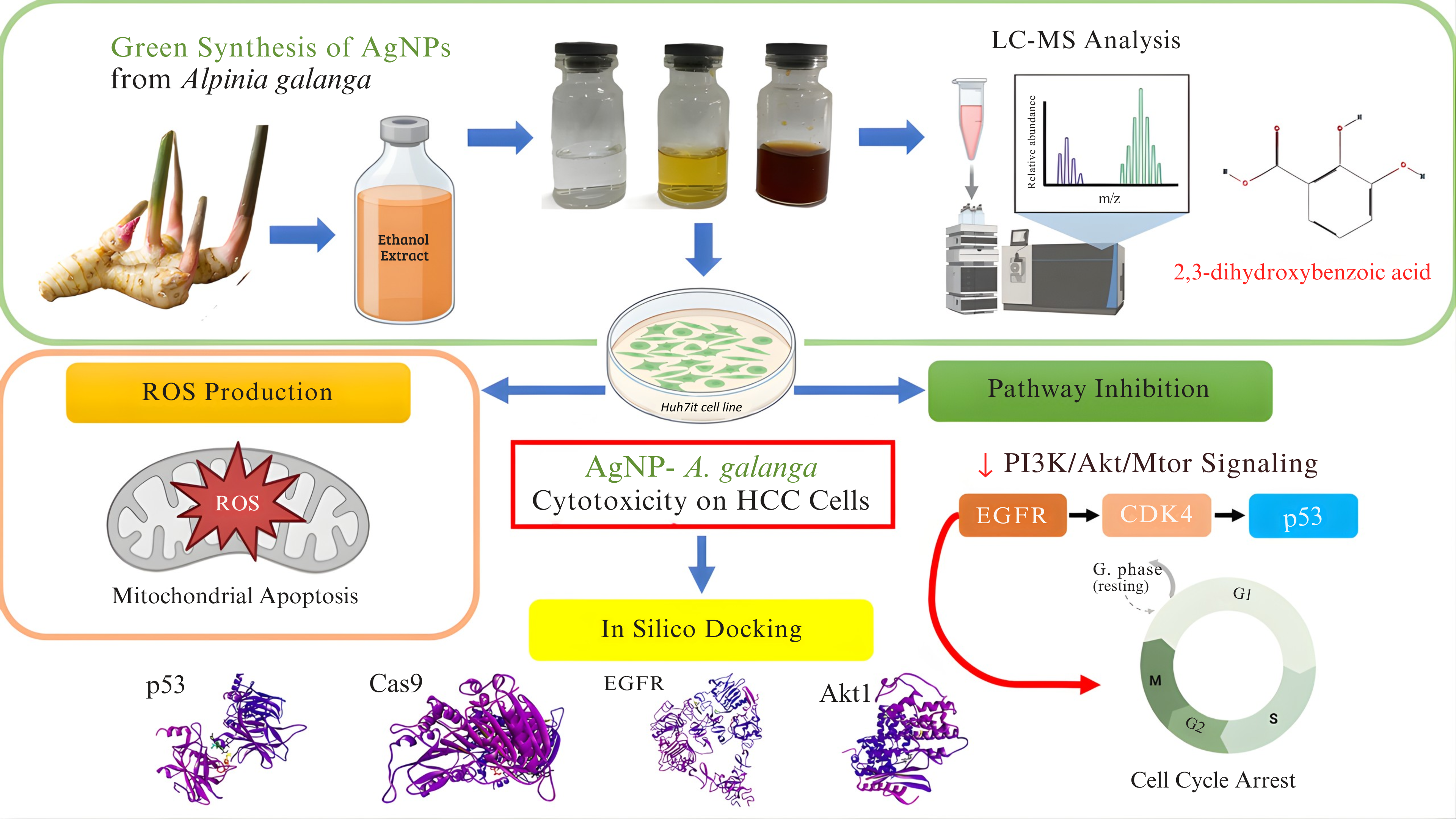
GRAPHICAL ABSTRACT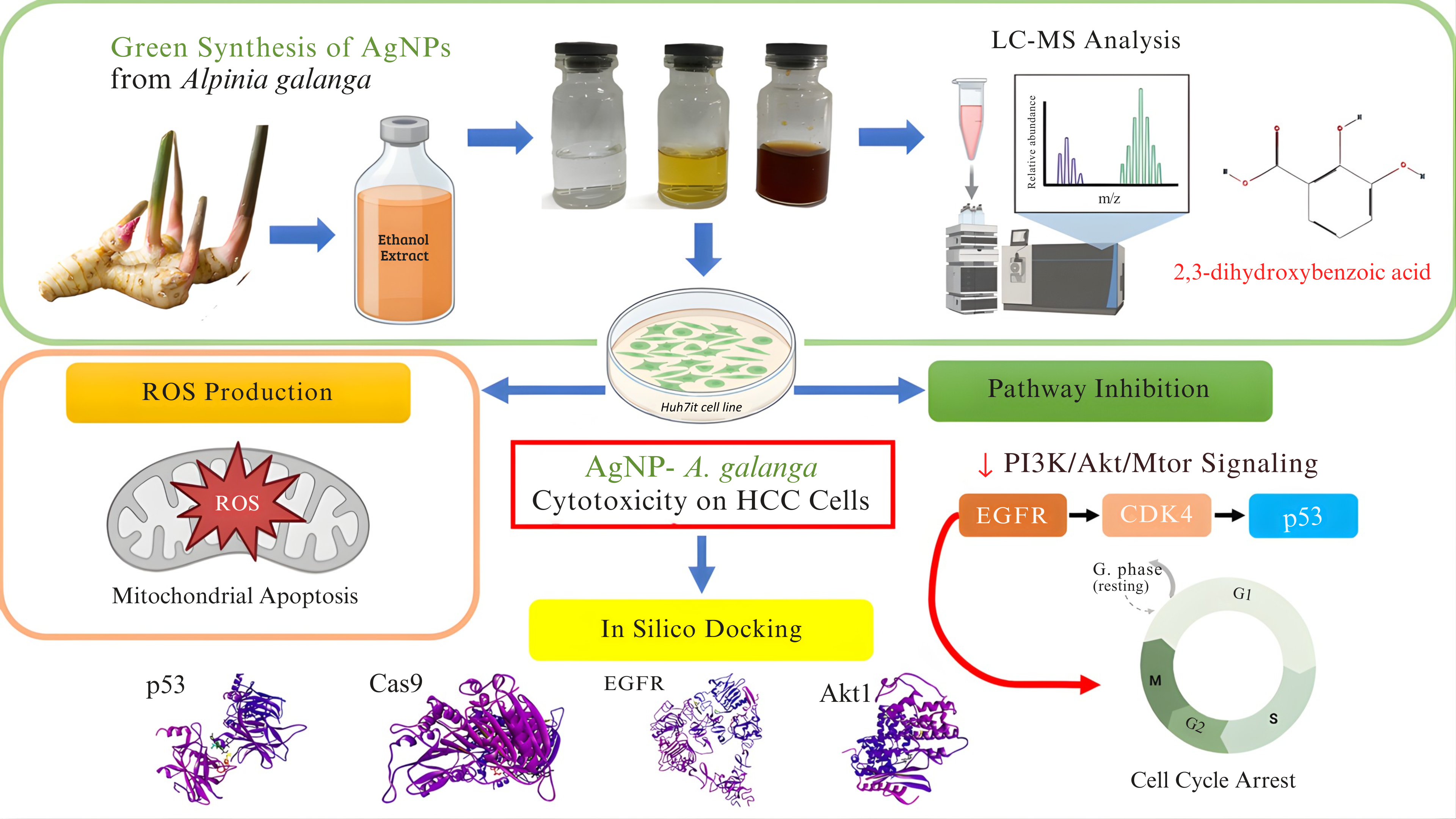
Downloads
References
H Sung, J Ferlay, RL Siegel, M Laversanne, I Soerjomataram, A Jemal and F Bray. Global cancer statistics 2020: GLOBOCAN estimates of incidence and mortality worldwide for 36 cancers in 185 countries. CA: A Cancer Journal for Clinicians 2021; 71(3), 209-249.
A Alqahtani, Z Khan, A Alloghbi, TS Said Ahmed, M Ashraf and DM Hammouda. Hepatocellular carcinoma: Molecular mechanisms and targeted therapies. Medicina 2019; 55(9), 526.
J Wang, K Qiu, S Zhou, Y Gan, K Jiang, D Wang and H Wang. Risk factors for hepatocellular carcinoma: An umbrella review of systematic review and meta-analysis. Annals of Medicine 2025; 57(1), 2455539.
M Dimri and A Satyanarayana. Molecular signaling pathways and therapeutic targets in hepatocellular carcinoma. Cancers 2020; 12(2), 491.
YH Su, KF Ng, MC Yu, TJ Wu, TS Yeh, WC Lee, YS Lin, TH Hsieh, CY Lin, CT Yeh and TC Chen. Impact of epidermal growth factor receptor protein and gene alteration on Taiwanese hepatocellular carcinomas. Journal of Gastroenterology and Hepatology 2015; 30(9), 1397-1404.
Z Li, L Qu, W Luo, Y Tian, H Zhai, K Xu and H Zhong. Mig-6 is down-regulated in HCC and inhibits the proliferation of HCC cells via the P-ERK/Cyclin D1 pathway. Experimental and Molecular Pathology 2017; 102(3), 492-499.
D Wang, W Ruan, L Fan, H Xu, Q Song, H Diao, R He, Y Jin and A Zhang. Hypermethylation of Mig-6 gene promoter region inactivates its function, leading to EGFR/ERK signaling hyperphosphorylation, and is involved in arsenite-induced hepatic stellate cells activation and extracellular matrix deposition. Journal of Hazardous Materials 2022; 439, 129577.
S Gao, X Jiang, L Wang, S Jiang, H Luo, Y Chen and C Peng. The pathogenesis of liver cancer and the therapeutic potential of bioactive substances. Frontiers in Pharmacology 2022; 13, 1029601.
R Kim, T Kin and WT Beck. Impact of complex apoptotic signaling pathways on cancer cell sensitivity to therapy. Cancers 2024; 16(5), 984.
AR Khairullah, TI Solikhah, ANM Ansori, A Fadholly, SC Ramandinianto, R Ansharieta, A Widodo, KHP Riwu, N Putri, A Proboningrat, MKJ Kusala, BW Rendragraha, ARS Putra and A Anshori. A review of an important medicinal plant: Alpinia galanga (L.) Willd. Systematic Reviews in Pharmacy 2020; 11(10), 387-395.
K Mardhiyyah, YI Ryandini and Y Hermawan. Red and white galangal puree antioxidant activity and phytochemistry screening. Jurnal Jamu Indonesia 2021; 6(1), 23-31.
J Li, JYS Lim, JQ Eu, AKMH Chan, BC Goh, L Wang and ALA Wong. Reactive oxygen species modulation in the current landscape of anticancer therapies. Antioxidants & Redox Signaling 2024; 41(4-6), 322-341.
RG Baradwaj, MV Rao and TS Kumar. Novel purification of 1'S-1'-acetoxychavicol acetate from Alpinia galanga and its cytotoxic plus antiproliferative activity in colorectal adenocarcinoma cell line SW480. Biomedicine & Pharmacotherapy 2017; 91, 485-493.
MJ Nirmala, U Kizhuveetil, A Johnson, R Nagarajan and V Muthuvijayan. Cancer nanomedicine: A review of nano-therapeutics and challenges ahead. RSC Advances 2023; 13(13), 8606-8629.
H Atmaca, ÇÇ Pulat and S Ilhan. Synthesis of silver nanoparticles using Alpinia officinarum rhizome extract induces apoptosis through down-regulating Bcl-2 in human cancer cells. Biologia Futura 2022; 73(3), 327-334.
G Mustafa, S Younas, HS Mahrosh, MF Albeshr and EA Bhat. Molecular docking and simulation-binding analysis of plant phytochemicals with the hepatocellular carcinoma targets epidermal growth factor receptor and caspase-9. Molecules 2023; 28(8), 3583.
Y Saubari, K Nastiti dan M Mambang. Uji farmakognostik and identidikasi senyawa pada beberapa tingkatan fraksi ekstrak etanol daun lengkuas (Alpinia galanga) (in Indonesian). Journal Pharmaceutical Care and Sciences 2020; 1(1), 102-110.
MI Tangkau, Fatimawali and EJ Suoth. Antioxidant activity of ethanol extract white Galangal stem (Alpina galanga) with ABTS method. Pharmacon 2023; 12(3), 358-366.
E Ahmad, A Athar, Nimisha, Q Zia, AK Sharma, M Sajid, M Bharadwaj, MA Ansari and SS Saluja. Harnessing nature’s potential: Alpinia galanga methanolic extract mediated green synthesis of silver nanoparticle, characterization and evaluation of anti-neoplastic activity. Bioprocess and Biosystems Engineering 2024; 47(8), 1183-1196.
RB Patil and AD Chougale. Analytical methods for the identification and characterization of silver nanoparticles: A brief review. Materials Today: Proceedings 2021; 47, 5520-5532.
AA Azmi and NM Ahyat. Green synthesis of silver nanoparticles using rhizhome extract of galangal, Alpinia galanga. Malaysian Journal of Analytical Sciences 2015; 19(6), 1187-1193.
G Rajkumar and R Sundar. Biogenic one-step synthesis of silver nanoparticles (AgNPs) using an aqueous extract of Persea americana seed: Characterization, phytochemical screening, antibacterial, antifungal and antioxidant activities. Inorganic Chemistry Communications 2022; 143, 109817.
S Hayaza, SPA Wahyuningsih, RJK Susilo, AA Permanasari, SA Husen, D Winarni, H Punnapayak and W Darmanto. Anticancer activity of okra raw polysaccharides extracts against human liver cancer cells. Tropical Journal of Pharmaceutical Research 2019; 18(8), 1667-1672.
MA Herdiansyah, ANM Ansori, VD Kharisma, MRT Alifiansyah, D Anggraini, QAP Priyono, PA Yusniasari, AJT Fetty, R Zainul, M Rebezov, E Kolesnik and N Maksimiuk. In silico study of cladosporol and its acyl derivatives as anti-breast cancer against alpha-estrogen receptor. Biosaintifika: Journal of Biology & Biology Education 2024; 16(1), 142-154.
NS Aini, ANM Ansori, MA Herdiansyah, VD Kharisma, MH Widyananda, AAA Murtadlo and H Purnobasuki. Antimalarial potential of phytochemical compounds from Garcinia atroviridis Griff. ex T. Anders targeting multiple proteins of Plasmodium falciparum 3D7: An in silico approach. BIO Integration 2024; 5(1), 967.
SH Deshpande, AB Muhsinah, ZK Bagewadi, GM Ankad, MH Mahnashi, DA Yaraguppi, IA Shaikh, AA Khan, HV Hegde and S Roy. In silico study on the interactions, molecular docking, dynamics and simulation of potential compounds from Withania somnifera (L.) Dunal root against cancer by targeting KAT6A. Molecules 2023; 28(3), 1117.
G Suresh Kumar, R Manivannan and B Nivetha. In silico identification of flavonoids from Corriandrum sativum seeds against Coronavirus Covid-19 main protease. Journal of Drug Delivery & Therapeutics 2021; 11(2), 145-152.
L Marciniak, M Nowak, A Trojanowska, B Tylkowski and R Jastrzab. The effect of pH on the size of silver nanoparticles obtained in the reduction reaction with citric and malic acids. Materials 2020; 13(23), 5444.
M Kamali, SAA Ghorashi and MA Asadollahi. Controllable synthesis of silver nanoparticles using citrate as complexing agent: Characterization of nanopartciles and effect of pH on size and crystallinity. Iranian Journal of Chemistry and Chemical Engineering 2012; 31(4), 21-28.
D Veeragoni, S Deshpande, HK Rachamalla, A Ande, S Misra and SR Mutheneni. In vitro and in vivo anticancer and genotoxicity profiles of green synthesized and chemically synthesized silver nanoparticles. ACS Applied Bio Materials 2022; 5(5), 2324-2339.
SY Wang, H Zhao, HT Xu, XD Han, YS Wu, FF Xu, XB Yang, U Göransson and B Liu. Kaempferia galanga L.: Progresses in phytochemistry, pharmacology, toxicology and ethnomedicinal uses. Frontiers in Pharmacology 2021; 12, 675350.
T Ziruo, M Shulipan, WY Zhang and WT Zhou. Cinnamaldehyde induces apoptosis of human cervical cancer SiHa cells and down-regulates the expression of HPV E6/E7 protein. Natural Product Research and Development 2022; 34(9), 1565-1572.
A Abbassi, P Yaghmaei and L Hosseinzadeh. Cinnamaldehyde potentiates cytotoxic and apoptogenic effects of doxorubicin in prostate cancer cell line. Research in Pharmaceutical Sciences 2024; 19(4), 425-435.
W An, Y Zhang, H Lai, Y Zhang, H Zhang, G Zhao, M Liu, Y Li, X Lin and S Cao. Alpinia katsumadai Hayata induces growth inhibition and autophagy related apoptosis by regulating the AMPK and Akt/mTOR/p70S6K signaling pathways in cancer cells. Oncology Reports 2022; 48(2), 142.
J Fu, Y Wang, M Sun, Y Xu and L Chen. Antibacterial activity and components of the methanol-phase extract from rhizomes of pharmacophagous plant Alpinia officinarum Hance. Molecules 2022; 27(13), 4308.
N Maiti, VV Malkar, T Mukherjee and S Kapoor. Investigating the interaction of aminopolycarboxylic acid (APCA) ligands with silver nanoparticles: A Raman, surface-enhanced Raman and density functional theoretical study. Journal of Molecular Structure 2018; 1156, 592-601.
S Jayant, JJ Khandare, Y Wang, AP Singh, N Vorsa and T Minko. Targeted sialic acid–doxorubicin prodrugs for intracellular delivery and cancer treatment. Pharmaceutical Research 2007; 24(11), 2120-2130.
A Vatankhah, SH Moghaddam, F Oroojalian, P Kesharwani and A Sahebkar. Sialic acid-functionalized nanomaterials for targeted cancer therapy, diagnosis, and theranostics. International Journal of Pharmaceutics 2025; 681, 125901.
C Battisegola, C Billi, MC Molaro, ME Schiano, M Nieddu, M Failla, E Marini, S Albrizio, F Sodano and MG Rimoli. Galactose: A versatile vector unveiling the potentials in drug delivery, diagnostics, and theranostics. Pharmaceuticals 2024; 17(3), 308.
A Corti, AM Gasparri, M Ghitti, A Sacchi, F Sudati, M Fiocchi, V Buttiglione, L Perani, A Gori, S Valtorta, RM Moresco, F Pastorino, M Ponzoni, G Musco and F Curnis. Glycine N methylation in NGR tagged nanocarriers prevents isoaspartate formation and integrin binding without impairing CD13 recognition and tumor homing. Advanced Functional Materials 2017; 27(36), 1701245.
L Boek-Dohalská, P Hodek, M Šulc and M Stiborová. α-Naphthoflavone acts as activator and reversible or irreversible inhibitor of rabbit microsomal CYP3A6. Chemico-Biological Interactions 2001; 138(1), 85-106.
D Zhou, D Chen, J Wu, T Feng, P Liu and J Xu. Dicerandrol C suppresses proliferation and induces apoptosis of HepG2 and HeLa cancer cells by inhibiting β-catenin signaling pathway. Marine Drugs 2022; 22(6), 278.
OL Nosareva, DS Orlov, EV Shakhristova and EA Stepovaya. Molecular mechanisms of the effects of n-ethylmaleimide and 1,4-dithioerythritol on regulation of apoptosis in P19 cells under hypoxia. Bulletin of Siberian Medicine 2020; 19(2), 72-77.
Q Zheng, H Yang, J Wei, JL Tong and YQ Shu. The role and mechanisms of nanoparticles to enhance radiosensitivity in hepatocellular cell. Biomedicine & Pharmacotherapy 2013; 67(7), 569-575.
X Chen, H Li, L Tian, Q Li, J Luo and Y Zhang. Analysis of the physicochemical properties of acaricides based on Lipinski's rule of five. Journal of Computational Biology 2020; 27(9), 1397-1406.
NI Mongalo, OS Soyingbe and TJ Makhafola. Antimicrobial, cytotoxicity, anticancer and antioxidant activities of Jatropha zeyheri Sond. roots (Euphorbiaceae). Asian Pacific Journal of Tropical Biomedicine 2019; 9(7), 307-314.
X Chen, H Li, L Tian, Q Li, J Luo and Y Zhang. Analysis of the physicochemical properties of acaricides based on Lipinski's rule of five. Journal of Computational Biology 2022; 27(9), 1397-1406.
Y Haryani, Y Melanie, M Novita, R Hendra and GF Kartika. IAI SPECIAL EDITION: Green synthesis of silver nanoparticles from Alpinia galanga extract with microwave irradiation and antibacterial activity against Escherichia coli. Pharmacy Education 2022; 22(2), 20-23.
P Imchen, M Ziekhrü, BK Zhimomi and T Phucho. Biosynthesis of silver nanoparticles using the extract of Alpinia galanga rhizome and Rhus semialata fruit and their antibacterial activity. Inorganic Chemistry Communications 2022; 142, 109599.
M Asif, R Yasmin, R Asif, A Ambreen, M Mustafa and S Umbreen. Green synthesis of silver nanoparticles (AgNPs), structural characterization, and their antibacterial potential. Dose-Response 2022; 20(2), 15593258221088709.
AH Watoni, LOAN Ramadhan, MD Rahmatullah, AIDK Bunga and Supardi. Optimization of silver nanoparticles synthesis using Alpinia galanga L. Willd rhizome extract and their stability study. Journal of Pure & Applied Chemistry Research 2022; 11(1), 83-101.
MA Sofi, S Sunitha, SK Pasha and D Choi. An overview of antimicrobial and anticancer potential of silver nanoparticles. Journal of King Saud University - Science 2022; 34(2), 101791.
F Rodríguez-Félix, AG López-Cota, MJ Moreno-Vásquez, AZ Graciano-Verdugo, IE Quintero-Reyes, CL Del-Toro-Sánchez and JA Tapia-Hernández. Sustainable-green synthesis of silver nanoparticles using safflower (Carthamus tinctorius L.) waste extract and its antibacterial activity. Heliyon 2021; 7(4), e06923.
S Hemmati, A Rashtiani, MM Zangeneh, P Mohammadi, A Zangeneh and H Veisi. Green synthesis and characterization of silver nanoparticles using Fritillaria flower extract and their antibacterial activity against some human pathogens. Polyhedron 2019; 158, 8-14.
A Almatroudi. Unlocking the potential of silver nanoparticles: From synthesis to versatile bio-applications. Pharmaceutics 2024; 16(9), 1232.
AK Alzubaidi, WJ Al-Kaabi, A Al Ali, S Albukhaty, H Al-Karagoly, GM Sulaiman, M Asiri and Y Khane. Green synthesis and characterization of silver nanoparticles using flaxseed extract and evaluation of their antibacterial and antioxidant activities. Applied Sciences 2023; 13(4), 2182.
P Khandel, SK Shahi, DK Soni, RK Yadaw and L Kanwar. Alpinia calcarata: potential source for the fabrication of bioactive silver nanoparticles. Nano Convergence 2018; 5(1), 37.
S Behboodi, F Baghbani-Arani, S Abdalan and SA Sadat Shandiz. Green engineered biomolecule-capped silver nanoparticles fabricated from Cichorium intybus extract: In vitro assessment on apoptosis properties toward human breast cancer (MCF-7) cells. Biological Trace Element Research 2019; 187(2), 392-402.
S Pasieczna-Patkowska, M Cichy and J Flieger. Application of Fourier transform infrared (FTIR) spectroscopy in characterization of green synthesized nanoparticles. Molecules 2025; 30(3), 684.
S Joseph and B Mathew. Microwave assisted biosynthesis of silver nanoparticles using the rhizome extract of Alpinia galanga and evaluation of their catalytic and antimicrobial activities. Journal of Nanoparticles 2014; 2014(1), 967802.
S Perugu, V Nagati and M Bhanoori. Green synthesis of silver nanoparticles using leaf extract of medicinally potent plant Saraca indica: a novel study. Applied Nanoscience 2016; 6(5), 747-753.
A Salayová, Z Bedlovičová, N Daneu, M Baláž, Z Lukáčová Bujňáková, Ľ Balážová and Ľ Tkáčiková. Green synthesis of silver nanoparticles with antibacterial activity using various medicinal plant extracts: Morphology and antibacterial efficacy. Nanomaterials 2021; 11(4), 1005.
SEI Boudagha, C Sobhi, H Bendif, EÖÇ Uyanikgil, A Abdennouri, M Ökeer, C Bensouici, M Boudiaf, A Zouaoui, HA Rudayni, F Boufahja and S Garzoli. Green synthesis of silver nanoparticles using Cynoglossum creticum leaf extract: eco-friendly approach for antibacterial, antioxidant, and sensing applications. Appl. Biochem. Biotechnol. 2025; 197(12), 7981-8007.
SM Abu Nayem, N Sultana, MA Haque, B Miah, MM Hasan, T Islam, MM Hasan, A Awal, J Uddin and AJS Ahammad. Green synthesis of gold and silver nanoparticles by using Amorphophallus paeoniifolius tuber extract and evaluation of their antibacterial activity. Molecules 2020; 25(20), 4773.
V Babu Nagati, R Koyyati, MR Donda, J Alwala, KR Kundle and PRM Padigya. Green synthesis and characterization of silver nanoparticles from Cajanus cajan leaf extract and its antibacterial activity. International Journal of Nanomaterials and Biostructures 2012; 2(3), 39-43.
F Esmaile, H Koohestani and H Abdollah-Pour. Characterization and antibacterial activity of silver nanoparticles green synthesized using Ziziphora clinopodioides extract. Environmental Nanotechnology, Monitoring & Management 2020; 14, 100303.
M Sánchez-Díez, P Romero-Jiménez, N Alegría-Aravena, CE Gavira-O’Neill, E Vicente-García, J Quiroz-Troncoso, R González-Martos, C Ramírez-Castillejo and JM Pastor. Assessment of cell viability in drug therapy: IC50 and other new time-independent indices for evaluating chemotherapy efficacy. Pharmaceutics 2025; 17(2), 247.
S Salispriaji, APD Nurhayati, M Santoso and FA Wati. Effect of Trisindolina-5 compound on Cancer Stem Cell (CSC) proliferation in-vitro. BIO Web of Conferences 2024; 89, 01005.
RI Geran, NH Greenberg, MM MacDonald. Protocols for screening chemical agents and natural products against animal tumors and other biological systems. Cancer Chemotherapy Reports 1972; 3(2), 17-27.
SF Thai, KA Wallace, CP Jones, H Ren, BT Castellon, J Crooks, EA Grulke and KT Kitchin. Differential genomic effects on signaling pathways by two different CeO2 nanoparticles in HepG2 cells. Journal of Nanoscience and Nanotechnology 2015; 15(12), 9925-9937.
A Kafesa, W Darmanto and SPW Wahyuningsih. Silver nanoparticles with modified synthesis use sodium borohydride reducing agent and okra (Abelmoschus esculentus L.) raw polysaccharide extract as an anti-colon cancer. Trends in Sciences 2024; 21(11), 8149.
E Ahmadian, SM Dizaj, E Rahimpour, A Hasanzadeh, A Eftekhari, J Halajzadeh and H Ahmadian. Effect of silver nanoparticles in the induction of apoptosis on human hepatocellular carcinoma (HepG2) cell line. Materials Science and Engineering: C 2018; 93, 465-471.
Z Wang, G Qu, L Su, L Wang, Z Yang, J Jiang, S Liu and G Jiang. Evaluation of the biological fate and the transport through biological barriers of nanosilver in mice. Current Pharmaceutical Design 2013; 19(37), 6691-6697.
J Naik and M David. ROS mediated apoptosis and cell cycle arrest in human lung adenocarcinoma cell line by silver nanoparticles synthesized using Swietenia macrophylla seed extract. Journal of Drug Delivery Science and Technology 2023; 80, 104084.
MC Barton and G Lozano. p53 activation paradoxically causes liver cancer. Cancer Research 2022; 82(16), 2824-2825.
M Isaq, YL Ramachandra, PS Rai, A Chavan, R Sekar, MJ Lee and P Somu. Biogenic synthesized silver nanoparticles using fungal endophyte Cladosporium oxysporum of Vateria indica induce apoptosis in human colon cancer cell line via elevated intracellular ROS generation and cell cycle arrest. Journal of Molecular Liquids 2023; 386, 122601.
A El-Hussein, I Mfouo-Tynga, M Abdel-Harith and H Abrahamse. Comparative study between the photodynamic ability of gold and silver nanoparticles in mediating cell death in breast and lung cancer cell lines. Journal of Photochemistry and Photobiology B: Biology 2015; 153, 67-75.
F Fontana, G Giannitti, S Marchesi and P Limonta. The PI3K/Akt pathway and glucose metabolism: a dangerous liaison in cancer. International Journal of Biological Sciences 2024; 20(8), 3113-3134.
PS Mundi, J Sachdev, C McCourt and K Kalinsky. AKT in cancer: New molecular insights and advances in drug development. British Journal of Clinical Pharmacology 2016; 82(4), 943-956.
MR Mohamed, SA Osman, AA Hassan, AI Raafat, MM Refaat and SA Fathy. Gemcitabine and synthesized silver nanoparticles impact on chemically induced hepatocellular carcinoma in male rats. International Journal of Immunopathology and Pharmacology 2024. https://doi.org/10.1177/03946320241263352
NA Azhar, SZ Ghozali, SAA Bakar, V Lim and NH Ahmad. Suppressing growth, migration, and invasion of human hepatocellular carcinoma HepG2 cells by Catharanthus roseus-silver nanoparticles. Toxicology in Vitro 2020; 67, 104910.
SJ Wu, LT Ng and CC Lin. Cinnamaldehyde-induced apoptosis in human PLC/PRF/5 cells through activation of the proapoptotic Bcl-2 family proteins and MAPK pathway. Life Sciences 2005; 77(8), 938-951.
J Li, Y Teng, S Liu, Z Wang, Y Chen, Y Zhang, S Xi, S Xu, R Wang and X Zou. Cinnamaldehyde affects the biological behavior of human colorectal cancer cells and induces apoptosis via inhibition of the PI3K/Akt signaling pathway. Oncology Reports 2016; 35(3), 1501-1510.
OV Morozova. Silver nanostructures: limited sensitivity of detection, toxicity and anti-inflammation effects. International Journal of Molecular Sciences 2021; 22(18), 9928.
YP Hsiao, WW Lai, SB Wu, CH Tsai, SC Tang, JG Chung and JH Yang. Triggering apoptotic death of human epidermal keratinocytes by malic Acid: Involvement of endoplasmic reticulum stress-and mitochondria-dependent signaling pathways. Toxins 2015; 7(1), 81-96.
N Khurana, MPS Ishar, A Gajbhiye and RK Goel. PASS assisted prediction and pharmacological evaluation of novel nicotinic analogs for nootropic activity in mice. European Journal of Pharmacology 2011; 662(1-3), 22-30.
B Chand. Structure–bioactivity-relationships and crystallographic analysis of secondary interactions in pregnane-based steroids. Journal of Chemical Crystallography 2011; 41(12), 1901-1926.
DM Hasyim, I Musfiroh, R Hendra, TM Fakih, NKK Ikram and M Muchtaridi. In silico approaches for the discovery of novel pyrazoline benzenesulfonamide derivatives as anti-breast cancer agents against Estrogen receptor alpha (ERα). Applied Sciences 2025; 15(15), 8444.
G Mustafa, HS Mahrosh, M Zafar, SA Attique and R Arif. Exploring the antihyperglycemic potential of tetrapeptides devised from AdMc1 via different receptor proteins inhibition using in silico approaches. International Journal of Immunopathology and Pharmacology 2022. https://doi.org/10.1177/03946320221103120
AI Dara and P Husni. Teknik meningkatkan kelarutan obat (In Indonesian). Farmaka 2017; 15(4), 49-57.
J Baell, M Congreve, P Leeson and C Abad-Zapatero. Ask the experts: past, present and future of the rule of five. Future Medicinal Chemistry 2013; 5(7), 745-752.
OA Raevsky, VI Fetisov, EP Trepalina, JW McFarland and KJ Schaper. Quantitative estimation of drug absorption in humans for passively transported compounds on the basis of their physico‐chemical parameters. Quantitative Structure-Activity Relationships 2000; 19(4), 366-374.
DR Dwijayanti, A Mamamia, RYN Maulana, N Rosyadah and N Widodo. Beyond a spice: harnessing the anti-inflammatory potential of Indonesian ginger ̶ insights into gingerenones and isogingerenone. Cogent Food & Agriculture 2025; 11(1), 2568198.
H Wang, M Guo, H Wei and Y Chen. Targeting p53 pathways: mechanisms, structures and advances in therapy. Signal Transduction and Targeted Therapy 2023; 8(1), 92.
B Ahmed, S Khan, F Nouroz, U Farooq and S Khalid. Exploring multi-target inhibitors using in silico approach targeting cell cycle dysregulator–CDK proteins. Journal of Biomolecular Structure and Dynamics 2022; 40(19), 8825-8839.
XH Xia, X Dai, H Yu, S Zhou, Z Fan, G Wei, Q Tang, Q Gong and F Bi. EGFR-PI3K-PDK1 pathway regulates YAP signaling in hepatocellular carcinoma: the mechanism and its implications in targeted therapy. Cell Death & Disease 2018; 9(3), 269.
T Couri and A Pillai. Goals and targets for personalized therapy for HCC. Hepatology International 2019; 13(2), 125-137.
SA Khan and TKW Lee. Investigations of nitazoxanide molecular targets and pathways for the treatment of hepatocellular carcinoma using network pharmacology and molecular docking. Frontiers in Pharmacology 2022; 13, 968148.
AS Alanazi, TO Mirgany, AA Alsfouk, NA Alsaif and MM Alanazi. Antiproliferative activity, multikinase inhibition, apoptosis-inducing effects and molecular docking of novel isatin–purine hybrids. Medicina 2023; 59(3), 610.
Published
How to Cite
Issue
Section
License
Copyright (c) 2026 Walailak University

This work is licensed under a Creative Commons Attribution-NonCommercial-NoDerivatives 4.0 International License.





