
Silver Nanoparticles with Modified Synthesis Use Sodium Borohydride Reducing Agent and Okra (Abelmoschus Esculentus L.) Raw Polysaccharide Extract as an Anti-Colon Cancer
DOI:
https://doi.org/10.48048/tis.2024.8149Keywords:
Nanosilver, NaBH4, Okra Raw Polysaccharide Extract (ORPE), HCT 116, Apoptosis, Necrosis, AnticancerAbstract
Nanomedicine using nanoparticles has become a new trend in the treatment of colon cancer. Nanosilver is known to have antibacterial, antifungal, antidiabetic, and anticancer properties. The most common and easy way to make nanosilver is using the reducing agent sodium borohydride, but this inorganic compound element has high toxicity to the body. Polysaccharides have long been known as anticancer agents with low toxicity and few side effects. Okra (Abelmoschus esculentus L.), a flowering plant from the Malvaceae family found in tropical and subtropical areas, and the crude polysaccharide extract from the pods has the highest polysaccharide content. This research aims to determine the effect of raw okra polysaccharide extract (ORPE) as a reducing agent for making nanosilver on its ability as an anti-colon cancer cell line HCT 116. Experiments were carried out by modifying and optimizing the manufacture of AgNPs by reducing NaBH4 with ORPE, 16 concentrations each with repetition 3 times. Characteristic tests were carried out using UV-Vis Spectrophotometry, Particle Size Analyzer, Scanning Electron Microscopy, Transmission Electron Microscopy, cell viability testing with MTT assay, and evaluation of potential apoptosis and necrosis using Annexin V-PI flow cytometry. PSA test for average particle size. Two groups 1 (AgNP-NaBH4) and 2 (AgNP-ORPE) each had repeated measurements 3 times in 16 concentrations. The mean PSA test and zeta potential value for group 1 = 232.5 ± 25.47 nm / –42.23 ± 1.45 mV and 2 = 779.66 ± 112.45 nm / –23.15 ± 3.65 mV. TEM showed that the size of Group 1 was 50.85 nm (ꭓ = 113.14 nm) and Group 2 was 121.43 nm (ꭓ = 248.52 nm). SEM showed that the morphology of both groups was round in shape (group 2 with slight agglomeration). The absorbance spectrum is formed at a wavelength of 389 nm (group 1) and 281.5 nm (group 2). The IC50 value obtained by group 1 = 76.68 mmol/L with 60.3 % apoptotic cells, 3.74 % necrosis and group 2 = 92.58 mmol/L with 81.4 % apoptotic cells and 4.95 % necrosis. ORPE as a nanosilver-reducing agent has been proven to have the potential to induce cell death and cause changes in mitochondrial membrane permeability in the intrinsic pathway of apoptosis.
HIGHLIGHTS
- This is experimental research related to the development of anti-cancer drugs using silver-nanoparticles and Okra extract as anti-cancer agents.
- The use of the Okra plant as an anti-cancer agent has enormous potential because it has few side effects for cancer patients.
- The drug developed shows stable characteristics and provides a significant positive impact in inhibiting the growth of colon cancer cells.
GRAPHICAL ABSTRACT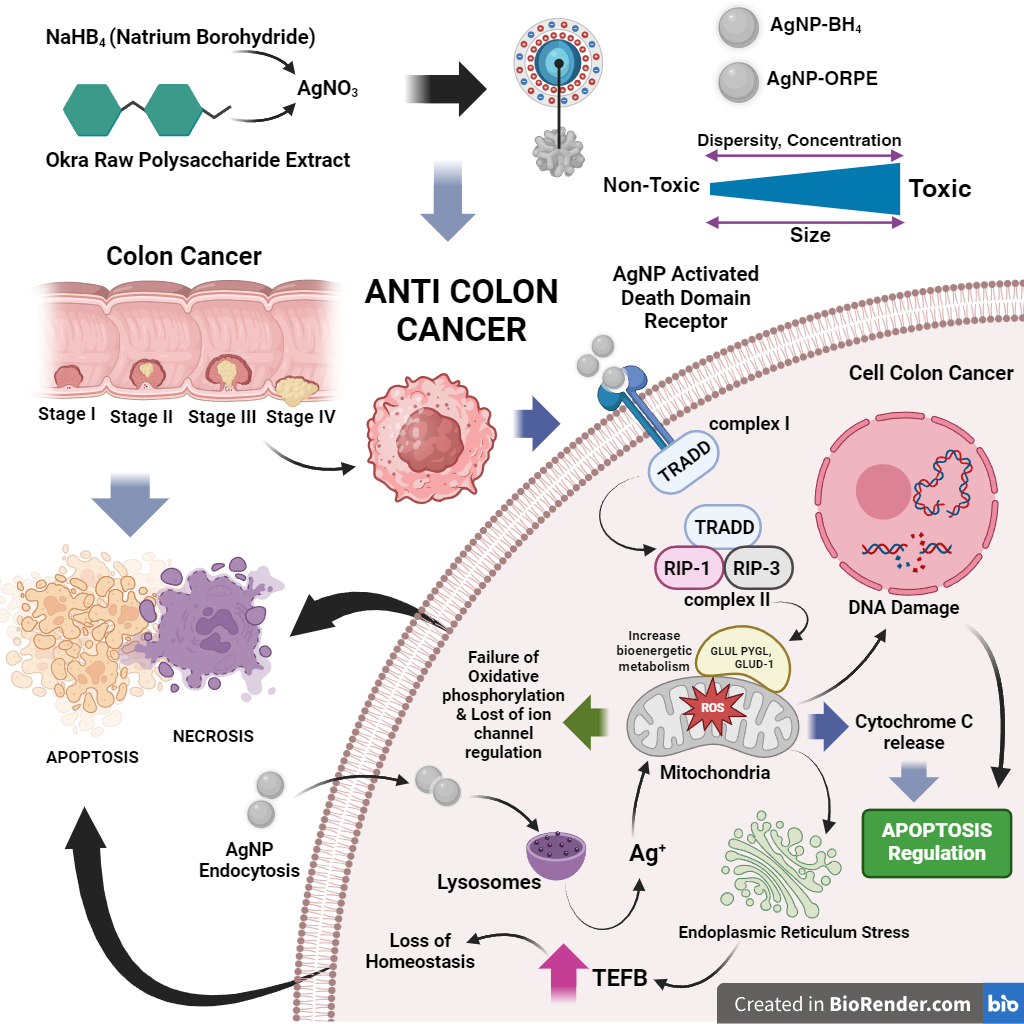
Downloads
References
I Mármol, C Sánchez-de-Diego, AP Dieste, E Cerrada and MJR Yoldi. Colorectal carcinoma: A general overview and future perspectives in colorectal cancer. Int. J. Mol. Sci. 2017; 18, 197.
MS Padang and L Rotty. Adenokarsinoma kolon: Laporan kasus. E CliniC 2020; 8, 229-36.
American Cancer Society. Colorectal cancer facts & figures 2020-2022. American Cancer Society, Georgia, 2022.
F Bray, J Ferlay, I Soerjomataram, RL Siegel, LA Torre and A Jemal. Global cancer statistics 2018: GLOBOCAN estimates of incidence and mortality worldwide for 36 cancers in 185 countries. CA Canc. J. Clinicians 2018; 68, 394-424.
RM McQuade, V Stojanovska, JC Bornstein and K Nurgali. Colorectal cancer chemotherapy: The evolution of treatment and new approaches. Curr. Med. Chem. 2017; 24, 1537-57.
JW Kim, SW Han, JY Cho, IJ Chung, JG Kim, KH Lee, KU Park, SK Baek, SC Oh, MA Lee, D Oh, B Shim, JB Ahn, D Shin, JW Lee and YH Kim. Korean red ginseng for cancer-related fatigue in colorectal cancer patients with chemotherapy: A randomised phase III trial. Eur. J. Canc. 2020; 130, 51-62.
M Patwekar, N Sehar, F Patwekar, A Medikeri, S Ali, RM Aldossri and MU Rehman. Novel immune checkpoint targets: A promising therapy for cancer treatments. Int. Immunopharm. 2024; 126, 111186.
Y Zhang, A Rajput, N Jin and J Wang. Mechanisms of immunosuppression in colorectal cancer. Cancers 2020; 12, 3850.
T Hillman. Bacteriobot drug-liposome carriers: An optimization of cancer-drug delivery to the colon by manipulating the gut microbiome. Nanoparticle 2019; 1, 1.
MA Octavia. 2021, Aktivitas Fraksi Etanol Biji Melinjo (Gnetum gnemon L.) Terhadap Sel Kanker Kolon (WiDr) Sebagai Agen Ko-Kemoterapi. Master Thesis. Universitas Muhammadiyah, Yogyakarta, Indonesia.
HA Lakshita. 2020, Aktivitas Fraksi N-Heksan Daun Binahong (Anredera Cordifolia (Tenore) Steenis) Terhadap Sel Kanker Kolon (WIDR) sebagai Agen Ko-Kemoterapi. Master Thesis. Universitas Muhammadiyah, Yogyakarta, Indonesia.
YH To, K Degeling, S Kosmider, R Wong, M Lee, C Dunn, G Gard, A Jalali, V Wong, M IJzerman, P Gibbs and J Tie. Circulating tumour DNA as a potential cost-effective biomarker to reduce adjuvant chemotherapy overtreatment in stage II colorectal cancer. Pharmacoeconomics 2021; 39, 953-64.
RFCPA Helderman, DR Löke, J Verhoeff, HM Rodermond, GGWV Bochove, M Boon, SV Kesteren, JJG Vallejo, HP Kok, PJ Tanis, NAP Franken, J Crezee and AL Oei. The temperature-dependent effectiveness of platinum-based drugs mitomycin-C and 5-FU during hyperthermic intraperitoneal chemotherapy (HIPEC) in colorectal cancer cell lines. Cells 2020; 9, 1775.
KCY Huang, SF Chiang, WTL Chen, TW Chen, CH Hu, PC Yang, TW Ke and KSC Chao. Decitabine augments chemotherapy-induced PD-L1 upregulation for PD-L1 blockade in colorectal cancer. Cancers 2020; 12, 462.
S Hayaza, SPA Wahyuningsih, RJK Susilo, AA Permanasari, SA Husen, D Winarni, H Punnapayak and W Darmanto. Anticancer activity of okra raw polysaccharides extracts against human liver cancer cells. Trop. J. Pharmaceut. Res. 2019; 18, 1667-72.
MA AbuDalo, IR Al-Mheidat, AW Al-Shurafat, C Grinham and V Oyanedel-Craver. Synthesis of silver nanoparticles using a modified Tollens’ method in conjunction with phytochemicals and assessment of their antimicrobial activity. PeerJ 2019; 7, e6413.
C Yao, L Zhang, J Wang, Y He, J Xin, S Wang, H Xu and Z Zhang. Gold nanoparticle mediated phototherapy for cancer. J. Nanomaterials 2016; 2016, 5497136.
S Hayaza, SPA Wahyuningsih, RJK Susilo, SA Husen, D Winarni, RA Doong and W Darmanto. Dual role of immunomodulation by crude polysaccharide from okra against carcinogenic liver injury in mice. Heliyon 2021; 7, e06183.
A Demange and S Fleutot. Synthesis and characterization of a silver nanoparticle- based material. Nanoparticle 2020; 2, 05.
H Ma, W Jiang, J Ding, M Li, Y Cheng, S Sun, C Fu and Y Liu. Polymer nanoparticle-based chemotherapy for spinal malignancies. J. Nanomaterials 2016; 2016, 4754190.
K Mavani and M Shah. Synthesis of silver nanoparticles by using sodium borohydride as a reducing agent. Int. J. Eng. Res. Tech. 2014; 2, 1-5.
S Ghazal, N Khandannasab, Hasan Ali Hosseini, Z Sabouri, A Rangrazi and M Darroudi. Green synthesis of copper-doped nickel oxide nanoparticles using okra plant extract for the evaluation of their cytotoxicity and photocatalytic properties. Ceram. Int. 2021; 47, 27165-76.
IMD Rosa, JM Kenny, D Puglia, C Santulli and F Sarasini. Morphological, thermal and mechanical characterization of okra (Abelmoschus esculentus) fibres as potential reinforcement in polymer composites. Compos. Sci. Tech. 2010; 70, 116-22.
M Hafeez, SM Hassan, SS Mughal, M Munir and MK Khan. Antioxidant, antimicrobial and cytotoxic potential of Abelmoschus esculentus. Chem. Biomol. Eng. 2020; 5, 69.
C He, L Bai, D Liu and B Liu. Interaction mechanism of okra (Abelmoschus esculentus L.) seed protein and flavonoids: Fluorescent and 3D-QSAR studies. Food Chem. X 2023; 20, 101023.
DS Kumar, DE Tony, AP Kumar, KA Kumar, DBS Rao and R Nadendla. A review on: Abelmoschus esculentus (OKRA). Int. Res. J. Pharmaceut. Appl. Sci. 2013; 3, 129-32.
Y Cui, J Wu, Y Chen, F Ji, X Li, J Yang, SB Hong, Z Zhu and Y Zang. Optimization of near-infrared reflectance models in determining flavonoid composition of okra (Abelmoschus esculentus L.) pods. Food Chem. 2023; 418, 135953.
SPA Wahyuningsih, M Pramudya, IP Putri, D Winarni, NII Savira and W Darmanto. Crude polysaccharides from okra pods (Abelmoschus esculentus) grown in Indonesia enhance the immune response due to bacterial infection. Adv. Pharmacol. Sci. 2018; 2018, 8505383.
NMA Sufyani, NA Hussien and YM Hawsawi. Characterization and anticancer potential of silver nanoparticles biosynthesized from Olea chrysophylla and lavandula dentata leaf extracts on HCT116 colon cancer cells. J. Nanomaterials 2019; 2019, 7361695.
J Yang, X Chen, S Rao, Y Li, Y Zang and B Zhu. Identification and quantification of flavonoids in Okra (Abelmoschus esculentus L. Moench) and antiproliferative activity in vitro of four main components identified. Metabolites 2022; 12, 483.
A Michalcová, L Machado, I Marek, M Martinec, M Sluková and D Vojtěch. Properties of Ag nanoparticles prepared by modified Tollens’ process with the use of different saccharide types. J. Phys. Chem. Solid. 2018; 113, 125-33.
ST Galatage, AS Hebalkar, SV Dhobale, OR Mali, PS Kumbhar, SV Nikade and SG Killedar. Silver nanoparticles: Properties, synthesis, characterization, applications and future trends. In: S Kumar, P Kumar and CS Pathak (Eds.). Silver micro-nanoparticles - properties, synthesis, characterization, and applications. IntechOpen, London, 2021.
SA Musthafa, K Muthu, S Vijayakumar, SJ George, S Murali, J Govindaraj and G Munuswamy-Ramanujam. Lectin isolated from Abelmoschus esculentus induces caspase mediated apoptosis in human U87 glioblastoma cell lines and modulates the expression of circadian clock genes. Toxicon 2021; 202, 98-109.
HT Phan and AJ Haes. What does nanoparticle stability mean? J. Phys. Chem. C. 2019; 123, 16495-507.
Mikhailova EO. Silver Nanoparticles: Mechanism of Action and Probable Bio-Application. J. Funct. Biomater. 2020; 11, 20794983.
YG Yuan, S Zhang, JY Hwang and IK Kong. Silver nanoparticles potentiates cytotoxicity and apoptotic potential of camptothecin in human cervical cancer cells. Oxidative Med. Cell. Longevity 2018; 2018, 6121328.
JRD Carvalho, JW Setubal, RLD Sousa, MPR D’Almeida, TN Alves, VBD Silva, IDSMD Souza and HJCD Assis. Cultivares de quiabeiro sob diferentes polinizações e seus efeitos na qualidade física e fisiológica das sementes/ Okra cultivars under different pollinations and their effects on the physical and physiological quality of seeds. Braz. J. Dev. 2020; 6, 94728-38.
H Liu, Q Yao, X Wang, H Xie, C Yang, H Gao and C Xie. The research progress of crosstalk mechanism of autophagy and apoptosis in diabetic vascular endothelial injury. Biomed. Pharmacother. 2024; 170, 116072.
L Brice, T Girardet and S Fleutot. Nanoparticles toxicity and biocompatibility tests. Nanoparticle 2020; 2, 06.
Downloads
Published
How to Cite
Issue
Section
License
Copyright (c) 2024 Walailak University

This work is licensed under a Creative Commons Attribution-NonCommercial-NoDerivatives 4.0 International License.





