
Apoptotic Effect of Simpor Leaf Extract (Dillenia suffruticosa) from Belitung on Colorectal Cancer Cells WiDr
DOI:
https://doi.org/10.48048/tis.2024.8316Keywords:
Simpor, GC-MS, MTT, IC50, Annexin V/PI, Flow cytometry, WiDrAbstract
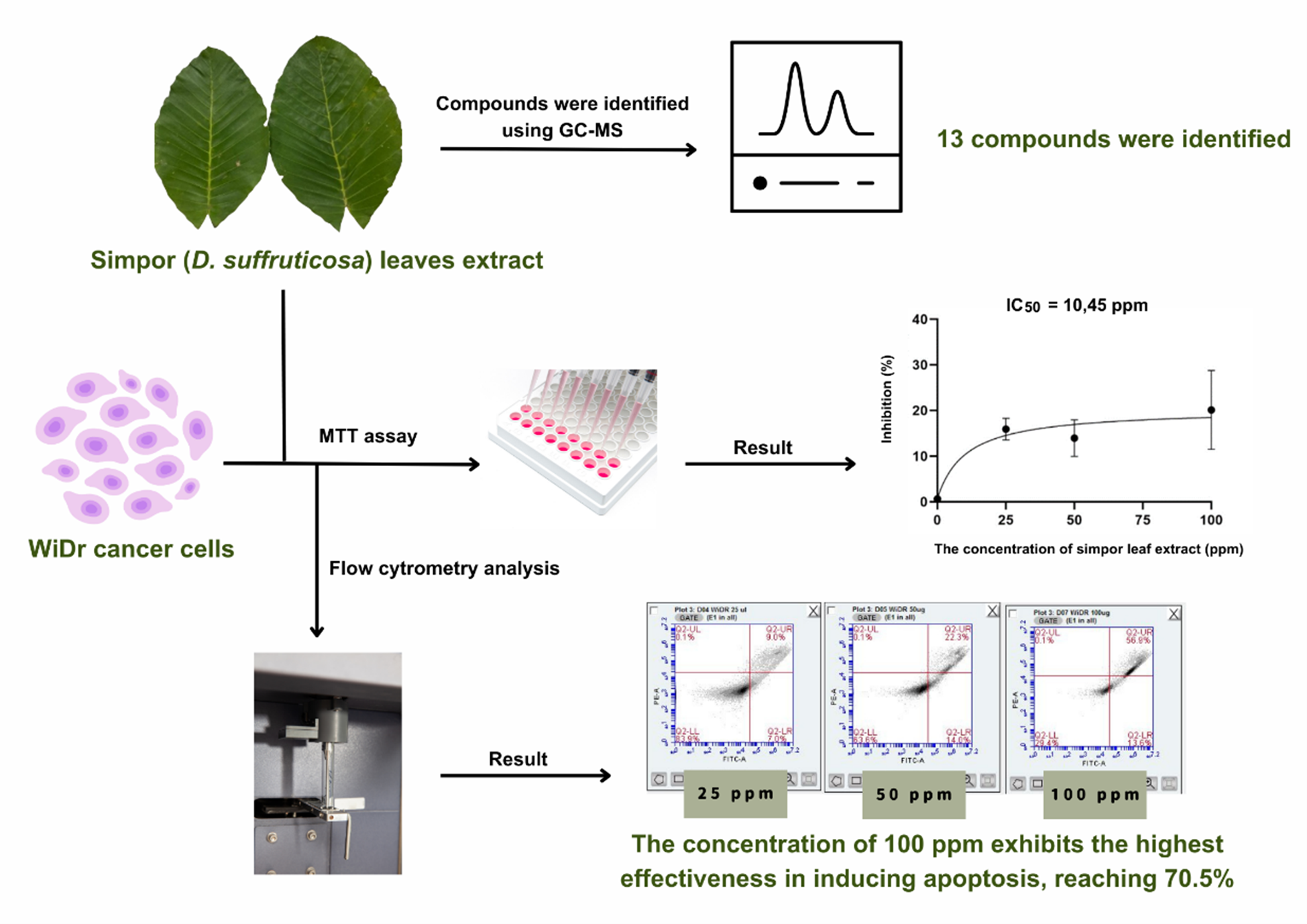
Colorectal cancer is the second deadliest cancer worldwide. The side effects and resistance of existing chemotherapy drugs are the background for various studies looking for potential plant extracts as new anticancer agents. This study aims to determine the cytotoxic activity of simpor leaf extract from Belitung and its effect on apoptosis of WiDr colorectal cancer cells. The compound content in simpor leaf extract was analyzed using Gas Chromatography-Mass Spectrometry (GC-MS). The cytotoxic activity of simpor leaf extract at different concentrations (25, 50 and 100 ppm) was determined by the MTT test and apoptosis induction by Annexin V/PI flow cytometry analysis. Based on the GC-MS chromatogram results, 13 different compounds were detected. Analysis of the relationship between extract concentration and the percentage of WiDr cell inhibition showed that an extract concentration of 100 ppm was the concentration with the highest percentage of inhibition (20.12 % ± 4.99) compared to concentrations of 50 ppm (13.95 % ± 2.32) and 25 ppm (15.90 % ± 1.38) with an inhibitory concentration value (IC50) of simpor leaf extract of 10.45 ppm. Induction of WiDr cell apoptosis by the extract was influenced by the concentration of simpor leaf extract, which was increase in the percentage of apoptotic cells from 16 % at a concentration of 25 ppm to 70.5 % at a concentration of 100 ppm. The results of this study show that simpor leaf extract from Belitung is able to induce apoptosis in WiDr colorectal cancer cells.
HIGHLIGHTS
- Colorectal cancer treatment faces challenges such as drug resistance and side effects, leading to research on plant-based anticancer agents like simpor leaf extract from Belitung.
- Simpor leaf extract demonstrated cytotoxic effects on WiDr colorectal cancer cells, achieving an inhibition rate of 20.12 % at a concentration of 100 ppm and an IC50 value of 10.45 ppm.
- This study shows that simpor leaf extract can induce apoptosis in WiDr colorectal cancer cells, with the percentage of apoptotic cells increasing from 16 % at 25 ppm to 70.5 % at 100 ppm.
GRAPHICAL ABSTRACT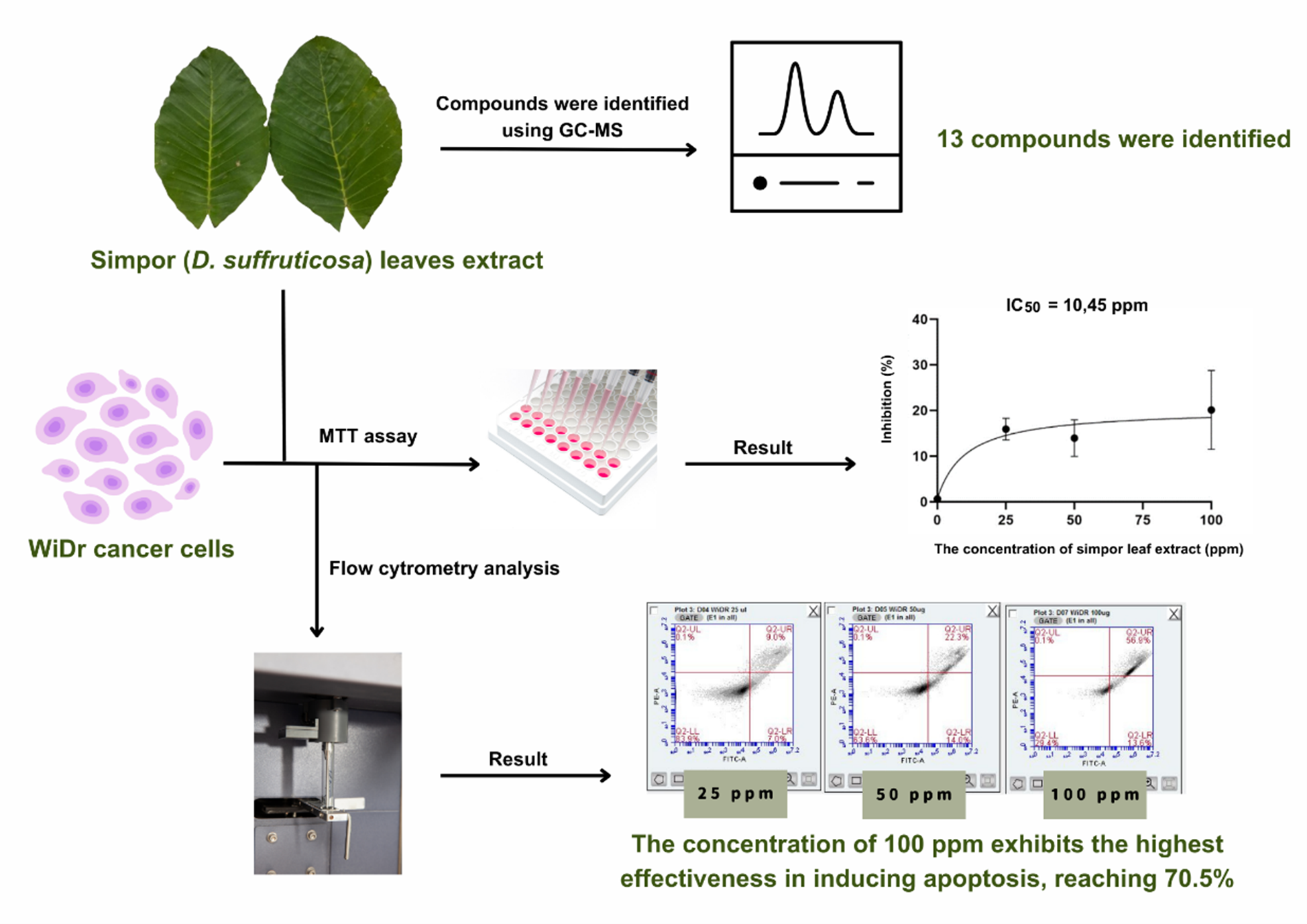
Downloads
References
H Sung, J Ferlay, RL Siegel, M Laversanne, I Soerjomataram, A Jemal and F Bray. Global cancer statistics 2020: GLOBOCAN estimates of incidence and mortality worldwide for 36 cancers in 185 countries. CA Cancer J. Clin. 2021; 71, 209-49.
Z Sahebi, M Emtyazjoo, PG Mostafavi and S Bonakdar. Antiproliferative activity of Portunus segnis muscle extract on apoptosis of colon cancer cell line (HT-29). Iran. J. Fish. Sci. 2022; 21, 157-73.
MS Hossain, H Karuniawati, AA Jairoun, Z Urbi, DJ Ooi, A John, YC Lim, KMK Kaderi, AKM Mohiuddin, LC Ming, KW Goh and MA Hadi. Colorectal cancer: A review of carcinogenesis, global epidemiology, current challenges, risk factors, preventive and treatment strategies. Cancers 2022; 14, 1732.
V Syafriana, A Febriani, S Suyatno, N Nurfitri and F Hamida. Antimicrobial activity of ethanolic extract of Sempur (Dillenia suffruticosa (Griff.) Martelli) leaves against pathogenic microorganisms. Borneo J. Pharm. 2021; 4, 135-44.
JB Foo, LS Yazan, YS Tor, A Wibowo, N Ismail, N Armania, YK Cheah and R Abdullah. Dillenia suffruticosa dichloromethane root extract induced apoptosis towards MDA-MB-231 triple-negative breast cancer cells. J. Ethnopharmacol. 2016; 187, 195-204.
N Armania, LS Yazan, SN Musa, IS Ismail, JB Foo, KW Chan, H Noreen, AH Hisyam, S Zulfahmi and M Ismail. Dillenia suffruticosa exhibited antioxidant and cytotoxic activity through induction of apoptosis and G2/M cell cycle arrest. J. Ethnopharmacol. 2013; 146, 525-35.
YS Tor, LS Yazan, JB Foo, N Armania, YK Cheah, R Abdullah, MU Imam, N Ismail and M Ismail. Induction of apoptosis through oxidative stress-related pathways in MCF-7, human breast cancer cells, by ethyl acetate extract of Dillenia suffruticosa. BMC Complementary Altern. Med. 2014; 14, 55.
MPY Goh, AM Basri, H Yasin, H Taha and N Ahmad. Ethnobotanical review and pharmacological properties of selected medicinal plants in Brunei Darussalam: Litsea elliptica, Dillenia suffruticosa, Dillenia excelsa, Aidia racemose, Vitex pinnata, and Senna alata. Asian Pac. J. Trop. Biomed. 2017; 7, 173-80.
S Rahayu, J Chang, A Supiyani and A Prasetiyo. Simpor leaf extract (Dillenia suffruticosa) induced apoptosis of the MCF-7 and HepG2 cell lines. J. Appl. Pharm. Sci. 2023; 13, 107-13.
K Momin and SC Thomas. GC-MS analysis of antioxidant compounds present in different extracts of an endemic plant Dillenia scabrella (Dilleniaceae) leaves and barks. Int. J. Pharm. Sci. Res. 2020; 11, 2262-73.
R Kumar, A Saneja and KA Panda. Lung in cancer: Methods and protocol. Humana Press, New York, 2021, p. 213-23.
J Ren, J Wang, S Karthikeyan, H Liu and J Cai. Natural anti-phytopathogenic fungi compound phenol, 2,4-bis(1,1-dimethylethyl) from Pseudomonas fluorescens TL-1. Indian J. Biochem. Biophys. 2019; 56, 162-8.
MD Shah, BAV Maran, M Iqbal, FF Ching, MTM Lal, RB Othman and R Shapawi. Antiparasitic activity of the medicinal plant Dillenia suffruticosa against the marine leech Zeylanicobdella arugamensis (Hirudinea) and its phytochemical composition. Aquacult. Res. 2020; 51, 215-21.
G Sabithira and R Udayakumar. GC-MS analysis of methanolic extracts of leaf and stem of Marsilea minuta (Linn.). J. Complementary Altern. Med. Res. 2017; 3, 1-13.
A Boadu, R Karpoormath and M Nlooto. Spondias mombin: Biosafety and GC-MS analysis of anti-viral compounds from crude leaf extracts. Adv. Trad. Med. 2023; 24, 349-72.
AA Hamed, DM Eskander and MSEM Badawy. Isolation of secondary metabolites from marine Streptomyces sparsus ASD203 and evaluation its bioactivity. Egypt. J. Chem. 2022; 65, 539-47.
M Nithya, C Ragavendran and D Natarajan. Antibacterial and free radical scavenging activity of a medicinal plant Solanum xanthocarpum. Int. J. Food Prop. 2018; 21, 313-27.
RN Kumar. Phytochemical characterization of bioactive compound from the Ensete superbum seed powder. Int. J. Pure Appl. Biosci. 2018; 6, 635-43.
S Siswadi and GS Saragih. Phytochemical analysis of bioactive compounds in ethanolic extract of Sterculia quadrifida R. Br. AIP Conf. Proc. 2021; 2353, 030098.
SA Gaikwad and SP Nalawade. GC-MS analysis for separation and identification of bioactive compounds from freshwater Cyanobacterium Nostoc fuscescence. J. Adv. Sci. Res. 2020; 11, 327-30.
NF Sianipar, K Assidqi, S Yuliani and R Purnamaningsih. Anticancer activity of nanoemulsion formulation of rodent tuber mutant extract (Typhonium flagelliforme) on human breast cancer cell line. Rasayan J. Chem. 2021; 14, 535-44.
V Aparna, KV Dileep, PKMandal, P Karthe, C Sadasivan and M Haridas. Anti-inflammatory property of n-Hexadecanoic acid: Structural evidence and kinetic assessment. Chem. Biol. Drug Des. 2012; 80, 434-9.
K Krishnamoorthy and P Subramaniam. Phytochemical profiling of leaf, stem, and tuber parts of Solena amplexicaulis (Lam.) Gandhi using GC-MS. Int. Scholarly Res. Not. 2014; 2014, 567409.
NPA Astiti and Y Ramona. GC-MS analysis of active and applicable compounds in methanol extract of sweet star fruit (Averrhoa carambola L.) leaves. HAYATI J. Biosci. 2021; 28, 12.
GG Beulah, PT Soris and VR Mohan. GC-MS determination of bioactive compounds of Dendrophthoe falcata (L.F) Ettingsh: An epiphytic plant. Int. J. Health Sci. Res. 2018; 8, 261-9.
SG Sipahelut. Perbandingan komponen aktif minyak atsiri dari daging buah pala kering cabinet dryer melalui metode distilasi air dan air-uap (in Indonesian). AGRITEKNO: Jurnal Teknologi Pertanian 2019; 8, 8-13.
A López-Cobo, B Martín-García, A Segura-Carretero, A Fernández-Gutiérrez and AM Gómez-Caravaca. Comparison of two stationary phases for the determination of phytosterols and tocopherols in mango and its by-products by GC-QTOF-MS. Int. J. Mol. Sci. 2017; 18, 1594.
H Qanash, AS Bazaid, NK Binsaleh, M Patel, OW Althomali and BB Sheeha. In vitro antiproliferative apoptosis induction and cell cycle arrest potential of Saudi Sidr honey against colorectal cancer. Nutrients 2023; 15, 3448.
B Shashni, S Ariyasu, R Takeda, T Suzuki, S Shiina, K Akimoto, T Maeda, N Aikawa, R Abe, T Osaki, N Itoh and S Aoki. Size-based differentiation of cancer and normal cells by a particle size analyzer assisted by a cell-recognition PC software. Biol. Pharm. Bull. 2018; 41, 487-503.
EG Fischer. Nuclear morphology and the biology of cancer cells. Acta Cytol. 2020; 64, 511-9.
E Halimatushadyah, M Da’I and M Nursid. Sitotoksisitas dan induksi apoptosis ekstrak etanol teripang Holothuria atra Jaeger, 1833 pada beberapa sel kanker (in Indonesian). Jurnal Pascapanen dan Bioteknologi Kelautan dan Perikanan 2018; 13, 101-10.
T Widiandani, T Tandian, BD Zufar, A Suryadi, BT Purwanto, S Hardjono and Siswandono. In vitro study of pinostrobin propionate and pinostrobin butyrate: Cytotoxic activity against breast cancer cell T47D and its selectivity index. J. Publ. Health Afr. 2023; 14, 2516.
A Nego and O Sebayang. Efek kardiotoksik obat kemoterapi doxorubicin (in Indonesian). Jurnal Ilmiah Mahasiswa Kedokteran Indonesia 2019; 7, 1-5.
Y Kurashina, C Imashiro, M Hirano, T Kuribara, K Totani, K Ohnuma, J Friend and K Takemura. Enzyme-free release of adhered cells from standard culture dishes using intermittent ultrasonic travelling wabes. Commun. Biol. 2019; 2, 393.
F Zhao, P Wang, RD Lucardi, Z Su and S Li. Natural sources and bioactivities of 2,4-di-tert-butylphenol and its analogs. Toxins 2020; 12, 35.
M Mellado, M Soto, A Madrid, I Montenegro, C Jara-Gutiérrez, J Villena, E Werner, P Godoy and LF Aguilar. In vitro antioxidant and antiproliferative effect of the extracts of Ephedra chilensis K. Presl. aerial parts. BMC Complementary Altern. Med. 2019; 19, 53.
B Bharath, K Perinbam, S Devanesan, MS AlSalhi and M Saravanan. Evaluation of the anticancer potential of Hexadecanoic Acid from brown algae Turbinaria ornata on HT-29 colon cancer cells. J. Mol. Struct. 2021; 1235, 130229.
N Abutaha, M Al-Zharani, A Alotaibi, MAW Cordero, A Bepari and S Alarifi. In vitro and in vivo investigation of polypharmacology of propolis extract as anticancer, antibacterial, anti-inflammatory, and chemical properties. Open Chem. 2021; 19, 864-74.
SH Salem, SS El-Maraghy, AY Abdel-Mallek, MAA Abdel-Rahman, EHM Hassanein, OA Al-Bedak and FEZAA El-Aziz. The antimicrobial, antibiofilm, and wound healing properties of ethyl acetate crude extract of an endophytic fungus Paecilomyces sp. (AUMC 15510) in earthworm model. Sci. Rep. 2022; 12, 19239.
S Kandasamy, SK Sahu and K Kandasamy. In silico studies on fungal metabolite against skin cancer protein (4,5-Diarylisoxazole HSP90 Chaperone). ISRN Dermatol. 2012; 2012, 626214.
SL Fink and BT Cookson. Apoptosis, pyroptosis, and necrosis: Mechanistic description of dead and dying eukaryotic cells. Infect. Immun. 2005; 73, 1907-16.
Downloads
Published
How to Cite
Issue
Section
License
Copyright (c) 2024 Walailak University

This work is licensed under a Creative Commons Attribution-NonCommercial-NoDerivatives 4.0 International License.





