
Salinity-Dependent Modulation of Antioxidant Defense, Apoptosis Enzymes, and Molecular Complexes Interaction in Tilapia Exposed to Polystyrene Nanoplastics
DOI:
https://doi.org/10.48048/tis.2026.13125Keywords:
Nanoplastics, Fish, Health, Apoptosis, Molecular dockingAbstract
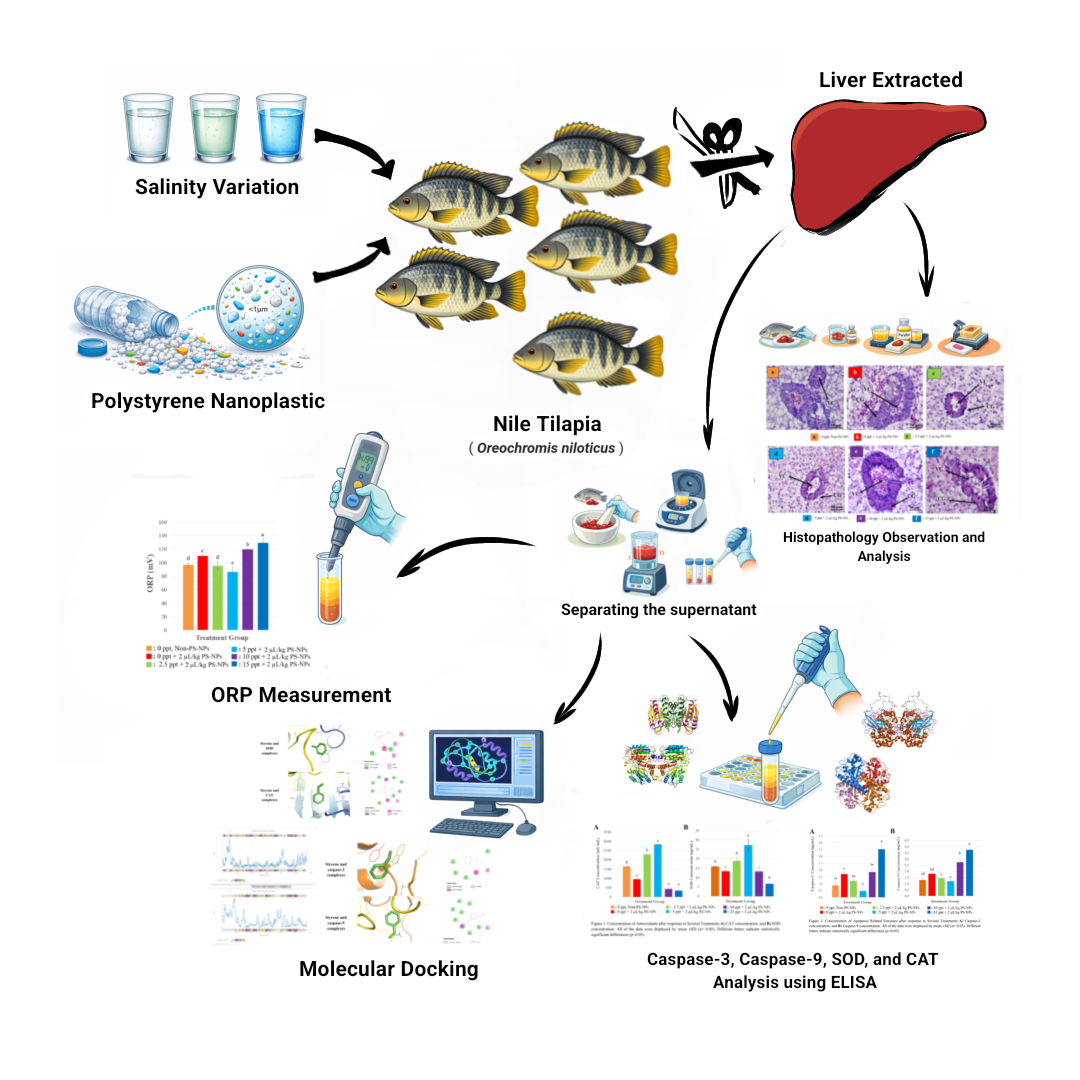
Nanoplastics (NPs) are emerging contaminants due to their persistence, bioaccumulation, and small particle size. These pollutants are derived from the breakdown of larger plastic debris and frequently enter aquatic environments through runoff from unmanaged landfills and illegal dumping sites. Based on the habitat, fish could be found in some ecosystem actually, such as in fresh water, breakish water, and marine water. Moreover, NPs can affect the physiology and biochemistry of fish, potentially altering oxidative balance and triggering apoptosis. The information about the effects of NP exposure on fish in different salinity level was still limited, therefore this study aimed to examine the effects of polystyrene nanoplastics (PS-NPs) on antioxidant activity and apoptosis-inducing enzymes in tilapia’s strain Jatimbulan (Oreochromis niloticus) under varying salinity levels. Tilapia were divided into control groups (without NPs) and treatment groups exposed to PS-NPs (2 µL/kg) at salinities of 0, 2.5, 5, 10, and 15 ppt for 25 days. Antioxidant enzymes (catalase (CAT) and superoxide dismutase (SOD)) and apoptosis-related enzymes (caspase-3 and caspase-9) were quantified using ELISA test. Molecular docking was conducted using the styrene monomer (CID: 7501) as the ligand, and CAT, SOD, caspase-3, and caspase-9 as target receptors. Docking analysis and validation revealed that exposure of PS-NPs significantly reduced antioxidant levels and increased activity of apoptosis-related enzymes, particularly in fish reared at higher salinities. The results showed that exposure to PS-NPs on 0 ppt significantly reduced concentration of antioxidant enzymes and increased apoptosis-related enzymes levels. On different salinity level, it showed that salinity modulates NP toxicity by influencing antioxidant enzymes and apoptosis-related enzymes. Moreover, the molecular docking experiment revealed that CAT (−5.3 kcal/mol) and caspase-9 (−4.6 kcal/mol) proteins were found to be most affected by the presence of PS-NPs in cells, as evidenced by highest binding affinity compared to other test proteins. Molecular docking indicates direct interactions of styrene monomers with catalase and caspase-9, suggesting disruption of oxidative stress regulation and apoptosis pathways. In conclusion, this study highlighted the risk of NP pollution in different salinity level, representative of some aquatic ecosystems, persuading to be care and find mitigation solution to reduce the impact of NP pollution, such as remediation.
HIGHLIGHTS
- Exposure to PS-NPs significantly reduced CAT and SOD concentration.
- Caspase-3 and -9 levels increased on fish exposured PS-NPs, particularly at higher salinities.
- Docking analysis and validation revealed that exposure of PS-NPs significantly reduced antioxidant levels and increased activity of apoptosis-related enzymes, particularly in fish reared at higher salinities.
- Docking analysis and validation revealed that exposure of PS-NPs significantly reduced antioxidant levels and increased activity of apoptosis-related enzymes, particularly in fish reared at higher salinities.
GRAPHICAL ABSTRACT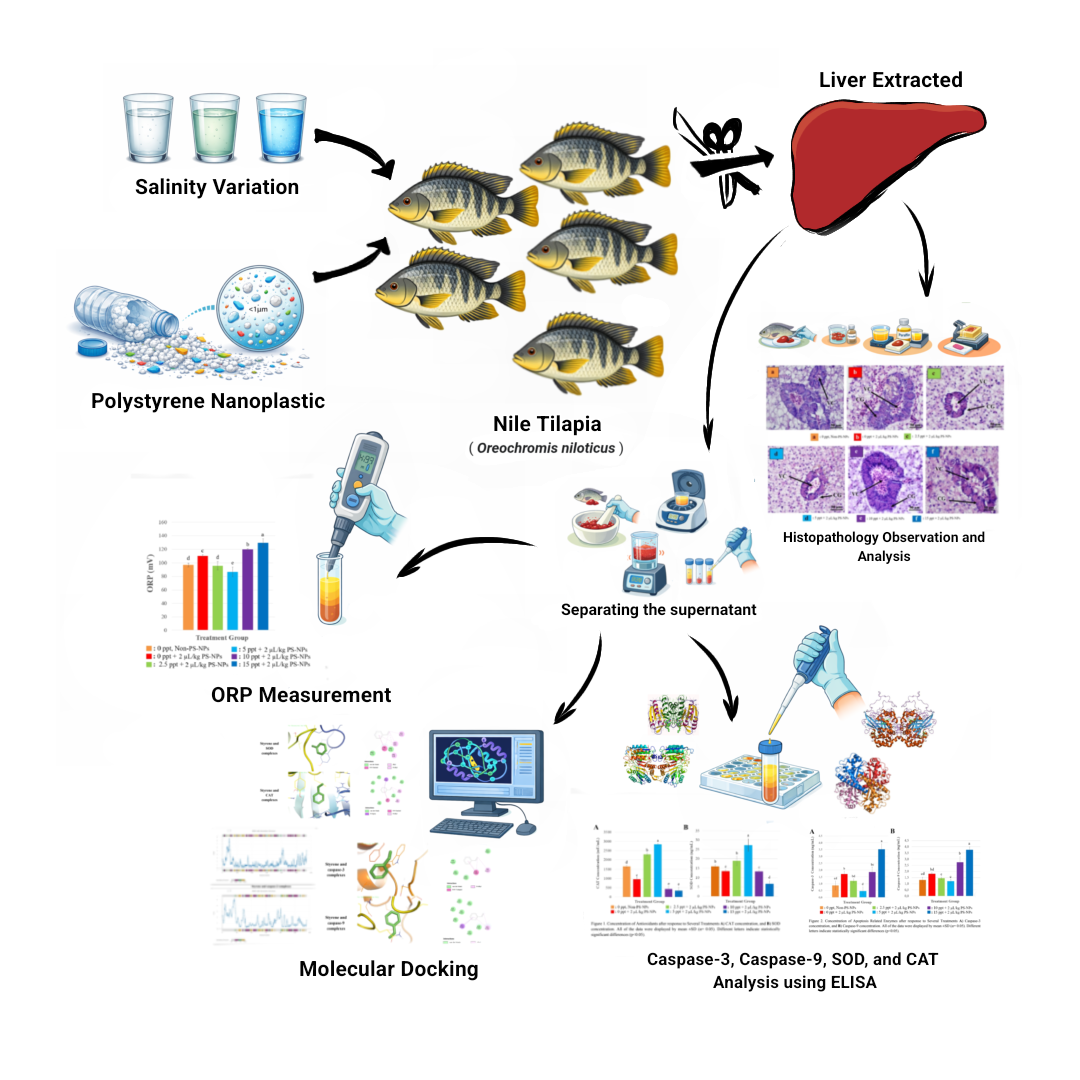
Downloads
References
A Hayati, M Pramudya, H Soepriandono, AR Astri, MR Kusuma, S Maulidah, W Adriansyah and FRP Dewi. Assessing the recovery of steroid levels and gonadal histopathology of tilapia exposed to polystyrene particle pollution by supplementary feed. Veterinary World 2022; 15(2), 517-523.
Aunurohim, D Saptarini, A Junaedi, S Dewi, E Danilyan, H Adro’i, P Putra and A Hayati. Characteristics of microplastics in water and fish and their relationship with migration from the East Coast of Surabaya, Indonesia. Egyptian Journal of Aquatic Biology and Fisheries 2025; 29(2), 2371-2392.
A Hayati, WP Wilujeng, M Pramudya, FRP Dewi, Sugiharto, B Muchtaromah and RJK Susilo. The effect of exposure to polystyrene nanoplastics on cytokine levels and reproductive system of male tilapia. Tropical Journal of Natural Product Research 2024; 8(2), 6300-6303.
H Triwahyudi, L Soehargo, L Muniroh, RN Qolbi, TQ Aini, RFZ Kurnia, PAD Putra, M Pramudya, B Muchtaromah and A Hayati. Potential of red seaweed ( Dichotomania obtusata ) on immune response and histopathology of rat testis exposed to nanoplastics. Tropical Journal of Natural Product Research 2023; 7(5), 2969-2973.
J Kong, L Zhao, Q Chen, T Gao, P Xu and F Sun. Review of the toxic effects and mechanisms of polystyrene micro/nanoplastics across multiple animal species. Journal of Hazardous Materials Advances 2025; 20, 100938.
A Hayati, M Pramudya, Aunurohim, AS Junaedi, FA Nurbani, WP Wilujeng, M Iqbal, FRP Dewi and V Lim. Micro-Nanoplastics pollution and its oxidative stress-induced effects on fish physiology in coastal waters of surabaya. Journal of Animal Health and Production 2025; 13(2), 435-444.
M Yang and WX Wang. Differential cascading cellular and subcellular toxicity induced by two sizes of nanoplastics. Science of The Total Environment 2022; 829, 154593.
J Pei, S Chen, L Li, K Wang, A Pang, M Niu, X Peng, N Li, H Wu and P Nie. Impact of polystyrene nanoplastics on apoptosis and inflammation in zebrafish larvae: Insights from reactive oxygen species perspective. Science of The Total Environment 2024; 948, 174737.
M Iqbal, MNF Siregar, GZ Sofa, HR Saputra, M Pramudya, FRP Dewi, A Soegianto, F Saputra, Aunurohim and A Hayati. Nanoplastic-Induced immune modulation and histopathological changes in oreochromis niloticus at different SalinityNanoplastic-Induced immune modulation and histopathological changes in oreochromis niloticus at different salinity levels levels. Journal of Animal Health and Production 2025; 13(2), 235-242.
RJK Susilo, M Pramudya, FRP Dewi, W Seftiarini, D Hidayati, A Aunurohim, V Lim, MA Herdiansyah and A Hayati. Adverse effect of polystyrene nanoplastics in impairing glucose metabolism in liver injury. International Journal of Molecular Sciences 2025; 26(10), 4870.
J Li, H Liu and JP Chen. Microplastics in freshwater systems: A review on occurrence, environmental effects, and methods for microplastics detection. Water Research 2018; 137, 362-374.
H Wu, J Guo, Y Yao and S Xu. Fish and shellfish immunology polystyrene nanoplastics induced cardiomyocyte apoptosis and myocardial inflammation in carp by promoting ROS production. Fish & Shellfish Immunology 2022; 125, 1-8.
M Safitri, FA Nurbani, ML Hidayaturrohman, F Jamaluddin, KR Wulandari, M Pramudya, FRP Dewi, L Vuanghao and A Hayati. Potential of macang (Mangifera foetida) bark extract on antioxidant levels and pro-a poptotic proteins in rats (Rattus norvegicus) exposed to polystyrene nanoplastics. Sains Malaysiana 2025; 54(6), 1477-1487.
FJ Emon, J Hasan, SIM Shahriar, N Islam, MS Islam and M Shahjahan. Increased ingestion and toxicity of polyamide microplastics in Nile tilapia with increase of salinity. Ecotoxicology and Environmental Safety 2024; 282, 116730.
HM Pratiwi, T Takagi, S Rusni and K Inoue. Euryhaline fish larvae ingest more microplastic particles in seawater than in freshwater. Scientific Reports 2023; 13(1), 1-10.
E Besseling, JTK Quik, M Sun and AA Koelmans. Fate of nano- and microplastic in freshwater systems: A modeling study. Environmental Pollution 2017; 220, 540-548.
AJR Watts, MA Urbina, S Corr, C Lewis and TS Galloway. Ingestion of plastic microfibers by the crab carcinus maenas and its effect on food consumption and energy balance. Environmental Science & Technology 2015; 49(24), 14597-14604.
B Li, W Liang, L Quan-Xing, S Fu, C Ma, Q Chen, L Su, NJ Craig and H Shi. Fish ingest microplastics unintentionally. Environmental Science & Technology 2021; 55(15), 10471.
CT Walsh and BC Pease. The use of clove oil as an anaesthetic for the longfinned eel, Anguilla reinhardtii (Steindachner). Aquaculture Research 2002; 33(8), 627-635.
R Siskandar, A Hendriana, J Ekasari and BR Kusumah. Automated Redox Monitoring System (ARMS): An instrument for measuring dissolved oxygen levels using a potential redox sensor (ORP) in a prototype of shrimp farming pond with an Internet-Based monitoring system. Journal of Aquaculture And Fish Health 2022; 11(2), 238-246.
MRT Alifiansyah, MA Herdiansyah, RC Pratiwi, RP Pramesti, NW Hafsyah, AP Rania, ERPP Ju, PA Cahyono, Litazkiyyah, SK Muhammad, AAA Murtadlo, VD Kharisma, ANM Ansori, V Jakhmola, PK Ashok, JM Kalra, H Purnobasuki and IA Pratiwi. QSAR of acyl alizarin red biocompound derivatives of Rubia tinctorum roots and its ADMET properties as anti-breast cancer candidates againts MMP-9 protein receptor: In silico study. Food Systems 2024; 7(2), 312-320.
AN Muhammad, A Ijaz, A Khalid, K Rafique, R Tabassum and A Zahra. Renal effects of graphite oxide sheets in albino rats (Rattus norvegicus): A preliminary study. BIO Integration 2024; 5(1), e966.
MA Herdiansyah, R Rizaldy and MRT Alifiansyah. Molecular interaction analysis of ferulic acid (4-hydroxy-3-methoxycinnamic acid) as main bioactive compound from palm oil waste against MCF-7 receptors: An in silico study. Narra J 2024; 4(2), e775.
Y Zhou, L Zhao, H Xu, EG Xu, M Li and Y Wang. Long-Term exposure to polystyrene nanoplastics impairs the liver health of medaka. Water 2022; 14(17), 2767.
F Saputra, AD Pramata, A Soegianto and SY Hu. Polystyrene nanoplastics cause developmental abnormalities, oxidative damage and immune toxicity in early zebrafish development. Comparative Biochemistry and Physiology Part C: Toxicology & Pharmacology 2025; 295, 110216.
MN Monier, ASA El-Naby, RM Fawzy, F Samir, SHH Shady, YS Grana, NM Albaqami and M Abdel-Tawwab. Growth performance, antioxidant, and immune responses of Nile tilapia (Oreochromis niloticus) fed on low-fishmeal diets enriched with sodium chloride and its adaptability to different salinity levels. Fish Physiology and Biochemistry 2025; 51(1), 6.
P Angadi, M Das and R Roy. Effect of high salinity acclimation on glucose homeostasis in Mozambique tilapia (Oreochromis mossambicus ). Fish Physiology and Biochemistry 2021; 47(6), 2055-2065.
X Zhang, X Chen, L Gao, Z Hai-Ting, J Li, Y Ye, Z Qing-Ling, Z Jia-Lang and X Yan. Transgenerational effects of microplastics on Nrf2 signaling, GH/IGF, and HPI axis in marine medaka Oryzias melastigma under different salinities. Science of the Total Environment 2024; 906, 167170.
Y Lu, Y Zhang, Y Deng, W Jiang, Y Zhao, J Geng, L Ding and H Ren. Uptake and accumulation of polystyrene microplastics in zebrafish (Danio rerio) and toxic effects in liver. Environmental Science & Technology 2016; 50(7), 4054-4060.
Z Zhou, W Zhou, G Liu, C Zhu, M Han, T Zhu, Q Jiang and W Lv. Effects of polystyrene nanoplastics on apoptosis, digestive enzymes, and intestinal histological structure and flora of swamp eel (Monopterus albus). Environmental Science: Nano 2024; 11(3), 1085-1096.
VP Vineetha, K Suresh and D Pillai. Impact of sub-chronic polystyrene nanoplastics exposure on hematology, histology, and endoplasmic reticulum stress-related protein expression in Nile tilapia (Oreochromis niloticus). Comparative Biochemistry and Physiology Part B: Biochemistry & Molecular Biology 2024; 273, 110982.
A Agarwal and AD Bui. Oxidation-reduction potential as a new marker for oxidative stress: Correlation to male infertility. Investigative and Clinical Urology 2017; 58(6), 385-399.
B Withyachumnarnkul, P Pongtippatee and J Ruangsri. Comparative proteomic profiling represents an inhibition of protein synthesis to regulate osmotic stress in Nile tilapia (Oreochromis niloticus) embryos. Comparative Biochemistry and Physiology Part D: Genomics and Proteomics 2024; 49, 101173.
NS Aini, ANM Ansori, MA Herdiansyah, VD Kharisma, MH Widyananda, AAA Murtadlo, DDR Turista, TH Sucipto, S Sahadewa, FD Durry, V Jakhmola, M Rebezov, VP Kartashev, K Rachmawati, PA Wiradana, T Karpagam and H Purnobasuki. Antimalarial potential of phytochemical compounds from garcinia atroviridis Griff ex. T. Anders targeting multiple proteins of plasmodium falciparum 3D7: An in silico approach. BIO Integration 2024; 5(1), e967.
A Azhagesan, N Chandrasekaran and A Mukherjee. Ecotoxicology and environmental safety multispectroscopy analysis of polystyrene nanoplastic interaction with diastase α-amylase. Ecotoxicology and Environmental Safety 2022; 247, 114226.
MBD Ávila and WFDA Jr. Development of machine learning models to predict inhibition of 3-dehydroquinate dehydratase. Chemical Biology & Drug Design 2018; 92(2), 1468-1474.
A Hyun-Kyu, KM Chung, H Park, J Hong, G Ji-Eun, H Choi, YW Lee, J Choi, JY Mun and Y Seong-Woon. CASP9 (caspase 9) is essential for autophagosome maturation through regulation of mitochondrial homeostasis. Autophagy 2020; 16(9), 1598-1617.
SI Wanandi, A Limanto, E Yunita, RA Syahrani, M Louisa, AE Wibowo and S Arumsari. In silico and in vitro studies on the anti-cancer activity of andrographolide targeting survivin in human breast cancer stem cells. PLoS One 2020; 15(11), e0240020.
Q Wang, F Huang, K Liang, W Niu, X Duan, X Jia, X Wu, P Xu and L Zhou. Polystyrene nanoplastics affect digestive function and growth in juvenile groupers. Science of the Total Environment 2022; 808, 152098.
CP des Gachons and PAS Breslin. Salivary amylase: Digestion and metabolic syndrome. Current Diabetes Reports 2016; 16(10), 102.
RM Wijaya, MA Hafidzhah, VD Kharisma and AA Parikesit. COVID-19 in silico drug with zingiber officinale natural product compound library targeting the mpro protein. Makara Journal of Science 2021; 25(3), 5.
S Wang, X Sun, W Cui and S Yuan. MM/PB(GB)SA benchmarks on soluble proteins and membrane proteins. Frontiers in Pharmacology 2022; 13, 1018351.
Published
How to Cite
Issue
Section
License
Copyright (c) 2026 Walailak University

This work is licensed under a Creative Commons Attribution-NonCommercial-NoDerivatives 4.0 International License.





