
Liquid Soap from Waste Cooking Oil Containing Betel and Aloe Vera Creates Low Risk to Allergic Contact Dermatitis in Rat Skin
DOI:
https://doi.org/10.48048/tis.2024.8127Keywords:
Liquid soap, Betel leaf, Aloe vera, Allergic contact dermatitis, Polymorphonuclear cells, Mast cells, MacrophagesAbstract
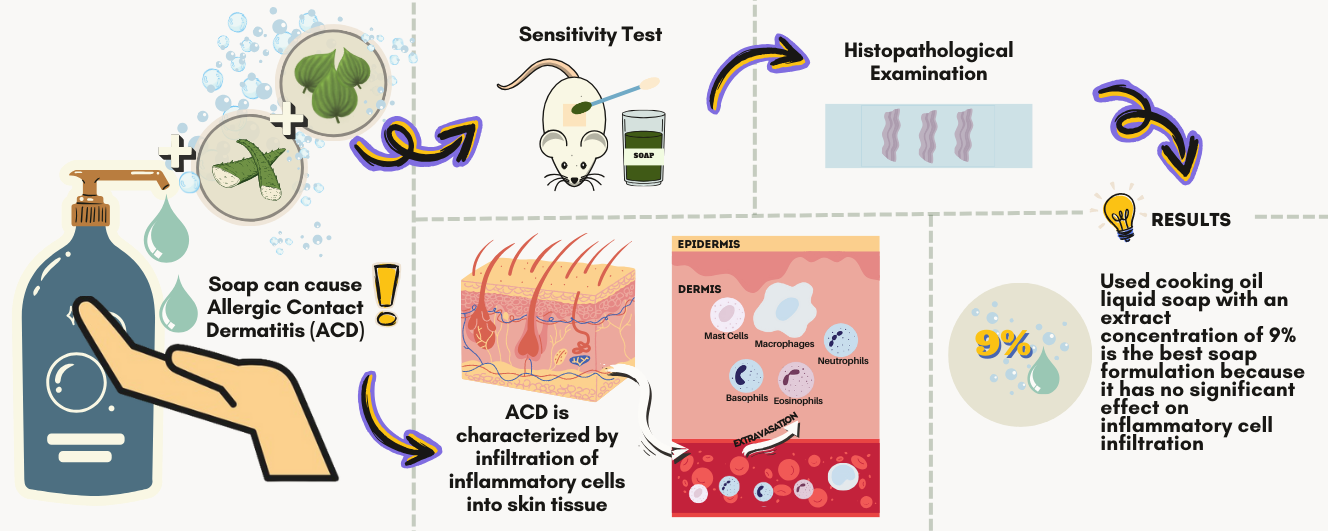
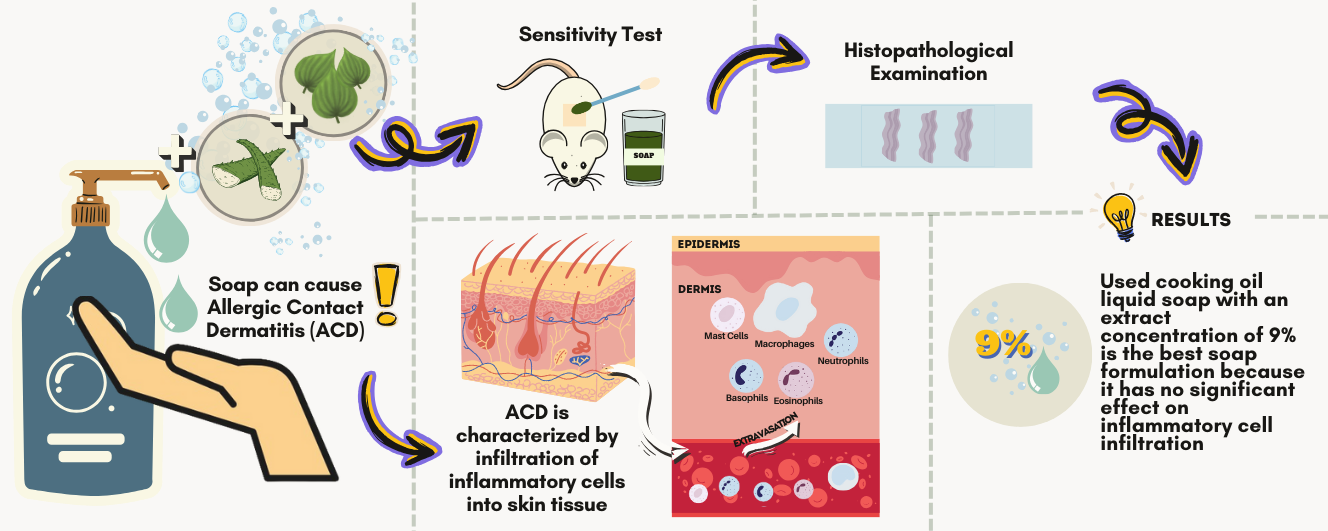
The quality of used cooking oil can be improved by purifying it using bagasse activated charcoal. Purified used cooking oil can be used as raw material for soap. Use of soap can cause allergic contact dermatitis (ACD). Skin suffering from ACD is characterized by inflammatory cell infiltration of the skin, the inflammatory cells involved are mast cells, macrophages and polymorphonuclear cells (PMN), namely basophils, eosinophils and neutrophils. Therefore, inflammatory cells were chosen as a parameter for the ACD response to the use of used cooking oil liquid soap containing betel and aloe vera. Liquid soap formed was use an extract concentration of 4.5, 9 and 15 %. Skin sensitivity testing was tested on male Wistar rats aged 2 - 3 months for 14 days. Quantitative data was obtained through histopathological examination of the number of inflammatory cells, which were analyzed statistically. The results showed that the use of liquid soap with an extract concentration of 9 % (4.24 ± 0.74) and 15 % (3.96 ± 0.25) had no effect on basophil infiltration. The use of liquid soap with an extract concentration of 4.5 % (2.96 ± 1.17, 6.42 ± 0.86, 5.96 ± 0.38), 9 % (3.12 ± 0.47, 4.62 ± 0.68, 6.42 ± 1.06) and 15 % (3.36 ± 0.41, 5.08 ± 0.30, 6.44 ± 0.55) had no effect on infiltration of neutrophils, eosinophils and macrophages. The use of liquid soap with an extract concentration of 9 % (4.60 ± 0.86) had no effect on mast cell infiltration. Therefore, it can be concluded that the best concentration of 9 % extract betel and aloe vera showed no infiltration of inflammatory cells in rats’ skin given soap from waste cooking oil. Thus, that the soap formed from waste cooking oil treated with bagasse activated charcoal and contain betel and aloe vera is predicted safe to used.
HIGHLIGHTS
- High use of cooking oil results in high waste of cooking oil. Used cooking oil can be used to make liquid soap.
- Betel and Aloe Vera have antiseptic and anti-inflammatory benefits.
- The ingredients in soap can cause an Allergic Contact Dermatitis (ACD) response, one of which is characterized by infiltration of inflammatory cells in skin tissue. Polymorphonuclear inflammatory cells (PMN), namely Basophils, Neutrophils, Eosinophils; Mast Cells; and Macrophages are inflammatory cells involved in ACD.
- The addition of green betel leaf extract and aloe vera did not have a significant effect on inflammatory cell infiltration. Betel and aloe vera extracts have the potential to act as anti-inflammatories in the ACD response.
- This research shows that used cooking oil liquid soap with an extract concentration of 9 % is the best liquid soap formulation because it does not have a significant effect on the infiltration of PMN inflammatory cells, mast cells and macrophages.
GRAPHICAL ABSTRACT
Downloads
References
M Kasman, H Hadrah, S Suraya and B Andika. Analysis of the utilization of used cooking oil into glycerol using the hydrolysis method. Jurnal Daur Lingkungan 2023; 6, 8-11.
S Rahayu, F Pujiono, M Dewi and A Prasetiyo. Baggasse charcoal optimization based on different concentration and immersing time to stabilize quality of cooking oil. J. Phys. Conf. Ser. 2019; 1402, 55025.
S Rahayu, Supriyatin and A Bintari. Activated carbon-based bio-adsorbent for reducing free fatty acid number of cooking oil. AIP Conf. Proc. 2018; 2019, 50004.
S Sugiharta, N Yuniarsih and D Ridwanuloh. Evaluation of used cooking oil purification using carbon active resin coated powder based on free fatty acid content. Jurnal Buana Farma 2021; 1, 15-22.
A Susilawaty, H Ibrahim and NT Ugi. Utilization of used cooking oil with the addition of clove leaf extract (Syzygium aromaticum) as an antiseptic soap in reducing the number of germs on the palms. Higiene 2017; 3, 16-21.
SA Dimpudus, PVY Yamlean and A Yudistira. Formulation of antiseptic liquid soap with ethanol extract of water henna flower (Impatiens balsamina L.) and test its effectiveness against Staphylococcus aureus bacteria in vitro. Pharmacon 2017; 6, 208-15.
A Novita, F Darusman and SE Priani. Literature review antiseptic liquid bath soap contains natural ingredients. Pros. Farm. 2021; 7, 219-24.
A Almasyhuri and D Sundari. Antiseptic activity test of ethanol extract of betel leaves (Piper betle Linn.) in mouthwash against Staphylococcus aureus in vitro. Jurnal Kefarmasian Indonesia 2019; 9, 10-8.
DW Dewi, S Khotimah and DF Liana. Utilization of aloe vera infusion (Aloe vera L) as an antiseptic hand sanitizer against the number of germ colonies. Jurnal Cerebellum 2016; 2, 577-89.
S Arbab, H Ullah, W Weiwei, X Wei, SU Ahmad, L Wu and J Zhang. Comparative study of antimicrobial action of aloe vera and antibiotics against different bacterial isolates from skin infection. Vet. Med. Sci. 2021; 7, 2061-7.
LK Dewi, AH Sarosa, C Wahyu, N Hayati, R Parasu and E Amalia. The effect of solvent type on the antibacterial power of extracted green betel leaves (Piper Betle L.) on the activity of Staphylococcus Epidermidis. J. Innovat. Appl. Tech. 2021; 7, 1161-5.
K Nisyak, A Hisbiyah and A Haqqo. Antibacterial activity of ethanol extract and green betel essential oil against methicillin resistant Staphylococcus aureus. J. Pharmaceut. Care Anwar Medika 2022; 5, 1-14.
Zulfikri, PR Nasution and C Dianti. Antibacterial activity of ethanol extract of green betel leaves (Piper betle Linn.) against Escherichia coli bacteria. Sains Medika 2023; 1, 298-302.
A Widyasanti, Y Qurratu’Ain and S Nurjanah. Pembuatan sabun mandi cair berbasis minyak kelapa murni (VCO) dengan penambahan minyak biji kelor (Moringa oleifera Lam). Chimica Et Natura Acta 2017; 5, 77.
A Goossens. Cosmetic contact allergens. Cosmetics 2016; 3, 5.
P Kumar and R Paulose. Patch testing in suspected allergic contact dermatitis to cosmetics. Dermatol. Res. Pract. 2014; 2014, 695387.
AK Brys, LG Rodriguez-Homs, J Suwanpradid, AR Atwater and AS MacLeod. Shifting paradigms in allergic contact dermatitis: The role of innate immunity. J. Investig. Dermatol. 2020; 140, 21-8.
CE Hachem, P Marschall, P Hener, A Karnam, SR Bonam, P Meyer, E Flatter, MC Birling, J Bayry and M Li. IL-3 produced by T cells is crucial for basophil extravasation in hapten-induced allergic contact dermatitis. Front. Immunol. 2023; 14, 1151468.
SY Jo, MH Kim, H Lee, SH Lee and WM Yang. Ameliorative and synergic effects of derma-H, a new herbal formula, on allergic contact dermatitis. Front. Pharmacol. 2020; 11, 1019.
W Li, F Ding, Y Zhai, W Tao, J Bi, H Fan, N Yin and Z Wang. IL-37 is protective in allergic contact dermatitis through mast cell inhibition. Int. Immunopharm. 2020; 83, 106476.
S Radonjic-Hoesli, MC Brüggen, L Feldmeyer, HU Simon and D Simon. Eosinophils in skin diseases. Semin. Immunopathol. 2021; 43, 393-409.
PR Oktaviandari, IW Sudira and IK Berata. Inflammatory cells infiltration in histopathology of small intestine of kampong chicken that were given herb of ashitaba leaves and new castle disease vaccine. Indonesia Medicus Veterinus 2020; 9, 716-26.
A Syamsun, IL Harahap and L Herlina. Effect of submersion in sea water and fresh water on histopathological changes in wistar rat organs. J. Classroom Action Res. 2022; 4, 87-91.
FS Permata and A Febrianto. The ointment of peel dragon fruit (Hylicereus costaricensis) extract decreased the Interleukin-2 (IL-2) expression and the number of mononuclear inflammation cells toward open wound in skin of rats wistar. Vet. Biomed. Clin. J. 2019; 1, 72-82.
D Rahadianti and Herlinawati. Natural immune system and adaptive immune system. Nusantara Hasana J. 2022; 2, 98-106.
L Chen, H Deng, H Cui, J Fang, Z Zuo, J Deng, Y Li, X Wang and L Zhao. Inflammatory responses and inflammation-associated diseases in organs. Oncotarget 2018; 9, 7204-18.
E Abd, SA Yousuf, MN Pastore, K Telaprolu, YH Mohammed, S Namjoshi, JE Grice and MS Roberts. Skin models for the testing of transdermal drugs. Clin. Pharmacol. 2016; 8, 163-76.
SM Utami and IR Denanti. Antibacterial effectiveness test of liquid hand washing soap made from aloe vera mucus (Aloe barbadensis Miller) against Eschericia coli and Staphylococcus aureus. Edu Masda J. 2018; 2, 63-72.
M Elidasari, IMJ Arrishy, AKS Arsy and G Anugraha. Antimicrobial effectiveness of betel leaf extract (Piper betle Linn) compared to Triclosan, Chlorhexidine gluonate, on Staphylococcus aureus and Streptococcus pyogenes as hand washing soap. Teikyo Med. J. 2022; 45, 6755-62.
E Takayama and A Yoshioka. A case of leukoderma probably caused by a soap containing neem oil. J. Cutan. Immunol. Allergy 2021; 4, 175-7.
K Aziz, MI Badruttamam and Rikadyanti. Test the effectiveness of red betel leaf extract as an insecticide on Aedes aegypti mosquito larvae. Jurnal Ilmiah Fitomedika Indonesia 2023; 1, 12-8.
F Suarantika, VM Patricia and H Rahma. Optimization of the extraction process of green betel leaves (Piper betle L.) which have antioxidant activity based on empirical use. Jurnal Ilmiah Medicamento 2023; 9, 16-21.
A Amaliah, E Sobari and N Mukminah. Yield and physical characteristics of green betel leaf (Piper betle L.) oleoresin extract with hexane solvent. In: Proceedings of the 10th Industrial Research Workshop and National Seminar, Jawa Barat, Indonesia. 2019, p. 273-8.
Ministry of Health Republic Indonesia. Indonesian herbal pharmacopoeia. Ministry of Health Republic Indonesia, Jakarta, Indonesia, 2017.
DAK Mulangsri. Antibacterial activity of ethanol extract of young and old leaves of green betel (Piper Betle L.) against Staphylococcus aureus bacteria. Exact Scholar Sci. J. 2018; 1, 1-4.
AN Setiawan, SN Wijayanti and AD Makrufi. Pendampingan pengembangan lidah buaya menjadi berbagai olahan dan produk kesehatan sebagai branding keunggulan SMK muhammadiyah 2 turi. Warta LPM 2021; 24, 603-13.
F Yuza, IA Wahyudi and S Larnani. The effect of giving aloe vera extract (Aloe Barbadensis Miller) to the tooth socket on the density of collagen fibers after extraction of guinea pig (Cavia Porcellus) teeth. Majalah Kedokteran Gigi Indonesia 2014; 21, 127-35.
RA Wijaya, Latifah and W Pratjojo. Formulation of aloe vera extract cream as an alternative for healing burns. J. Chem. Sci. 2013; 2, 213-7.
AN Septiawan, E Emelda and S Husein. Antioxidant activity of a combination of ethanol extract of aloe vera (Aloe vera L.) and green algae (Ulva lactuca L.). Inpharnmed Journal 2021; 4, 11.
Suhaimi, T Indrawati and S Kumala. Gel formulation combination of dry extract of aloe vera (Aloe vera. (L) brum. f) and thick extract of red betel leaves (Piper crocatum ruiz & pav) for antibacterial acne causes. Medical Sains Jurnal Ilmiah Kefarmasian 2019; 3, 139-52.
S Rahayu, R Sulviani, TH Kurniati, H Dianhar, RK Asharo, Subandrate and ZBM Taher. Physicochemical profile of used cooking oil-based liquid hand soap with activated carbon sugarcane bagasse bio adsorbent technology. AIP Conf. Proc. 2024; 2982, 50042.
SA Bidilah, O Rumape and E Mohamad. Optimization of stirring time and KOH volume for liquid soap made from used cooking oil. Journal Entropi 2017; 12, 55-60.
S Rahayu, A Supiyani, R Darmansyah and R Amalia. Pre-treatment of used cooking oil with sugarcane bagasse activated carbon reduces the risk of hepatotoxicity in rats (Spargue Dawley). Bioma 2020; 18, 83-90.
S Mutia, Fauziah and Z Thomy. Effect of giving ethanol extract of andong leaves (Cordyline fruticosa (L.) A. Chev) on total cholesterol and triglyceride levels in the blood of white rats (Rattus norvegicus) hypercholesterolemia. Jurnal Bioleuser 2018; 2, 29-35.
Y Marsono, P Triwitono, ED Arianti, H Gunawan and R Indrawanto. Effect of banana pulp isomaltose-oligosaccharides and fibercreme on blood glucose and lipid levels and digesta profile of diabetic rats. Agritech 2020; 40, 190-8.
SW Nugroho, KR Fauziyah, D Sajuthi and HS Darusman. Normal blood pressure profile of white rats (Rattus norvegicus) wistar and sprague-dawley strains. Acta Veterinaria Indonesiana 2018; 6, 32-7.
DE Putri, A Supiyani, ANP Putri and E Mushonnifah. Malondialdehyde (MDA) levels on mice atopic dermatitis treated with pearl grass (Hedyotis corymbosa (L.) Lamk) extract cream. Malays. J. Med. Health Sci. 2021; 17, 5-8.
National Agency of Drug and Food Control. In vivo preclinical toxicity test. National Agency of Drug and Food Control, Jakarta, Indonesia, 2022.
TT Hien, TTK Ngan, NPT Nhan, PNQ Anh and LTH Nhan. Evaluate the properties of body wash from coconut oil in Ben Tre province. AIP Conf. Proc. 2022; 2610, 60009.
K Iwashita, R Etani, M Kai and M Ojima. Effect of standard skin care treatments on skin barrier function in X-irradiated hairless mice. Asia Pac. J. Oncol. Nurs. 2023; 10, 100149.
Y Kobayashi, K Narita, K Chiba, H Takemoto, M Morita and K Morishita. Effects of L-citrulline diet on stress-induced cold hypersensitivity in mice. Phcog. Res. 2014; 6, 297-302.
SA Gunawan, IK Berata and IW Wirata. Skin histopathology in the healing of incision wounds in white rats after administration of extracellular matrix (ECM) derived from pig urinary vesica. Indonesia Medicus Veterinus 2019; 8, 2477-6637.
LP Dwita, V Ladeska, A Ramadhani, DR Augusta and RT Saufia. Benefits of ethanol extract of beef remek leaves (Hemigraphis colorata W. Bull) on burns in rats. Jurnal Tumbuhan Obat Indonesia 2020; 13, 32-41.
N Fatimatuzzahro, RC Prasetya and S Puri. Potential of 5 % Argiope modesta spider silk extract as an anti-inflammatory agent in Wistar rat gingival wounds. Padjadjaran Journal of Dental Researchers and Students 2021; 5, 133-9.
S Isdadiyanto, AR Pratiwi and SM Mardiati. Rattus norvegicus hepatosomatic index hyperlipidemia after exposure to ethanol extract of Azadirachta Indica leaves. Buletin Anatomi Fisiologi 2022; 7, 110-9.
J Xu, H Xiong, Z Zhao, M Luo, Y Ju, G Yang and Z Mei. Genistein suppresses allergic contact dermatitis through regulating the MAP2K2/ERK pathway. Food Funct. 2021; 12, 4556-69.
T Maotsela, G Danha and E Muzenda. Utilization of waste cooking oil and tallow for production of toilet ‘bath’ soap. Procedia Manuf. 2019; 35, 541-5.
L Sukeksi, AJ Sidabutar and C Sitorus. Making soap using kapok fruit skin (Ceiba petandra) as an alkali source. Jurnal Teknik Kimia USU 2017; 6, 8-13.
A Jack, P Norris and F Storrs. Allergic contact dermatitis to plant extracts in cosmetics. Semin. Cutan. Med. Surg. 2013; 32, 140-6.
M Voss, J Kotrba, E Gaffal, K Katsoulis-Dimitriou and A Dudeck. Mast cells in the skin: Defenders of integrity or offenders in inflammation? Int. J. Mol. Sci. 2021; 22, 4589.
T Rustemeyer. Immunological mechanisms in allergic contact dermatitis. Curr. Treat. Options Allergy 2022; 9, 67-75.
FL Filon. Penetration of metals through the skin barrier. Metal allergy. Springer Cham, Switzerland, 2018, p. 67-74.
HL Yamaguchi, Y Yamaguchi and E Peeva. Role of innate immunity in allergic contact dermatitis: An update. Int. J. Mol. Sci. 2023; 24, 12975.
National Center for Biotechnology Information. Type IV hypersensitivity reaction, Available at: https://www.ncbi.nlm.nih.gov/books/NBK562228/#NBK562228pubdet, accessed December 2023.
H Sakai, T Ishida, K Sato, K Mandokoro, S Yabe, F Sato, Y Chiba, R Kon, N Ikarashi and J Kamei. Interference of skin scratching attenuates accumulation of neutrophils in murine allergic contact dermatitis model. Inflammation 2019; 42, 2226-35.
FC Weber, T Németh, JZ Csepregi, A Dudeck, A Roers, B Ozsvári, E Oswald, LG Puskás, T Jakob, A Mócsai and SF Martin. Neutrophils are required for both the sensitization and elicitation phase of contact hypersensitivity. J. Exp. Med. 2015; 212, 15-22.
LEM Heeb, C Egholm, D Impellizzieri, F Ridder and O Boyman. Regulation of neutrophils in type 2 immune responses. Curr. Opin. Immunol. 2018; 54, 115-22.
T Hashimoto, JD Rosen, KM Sanders and G Yosipovitch. Possible role of neutrophils in itch. Itch 2018; 3, e17.
L Garibyan, CG Rheingold and EA Lerner. Understanding the pathophysiology of itch. Dermatol. Ther. 2013; 26, 84-91.
J Iype and M Fux. Basophils orchestrating eosinophils’ chemotaxis and function in allergic inflammation. Cells 2021; 10, 895.
H Shah, S Eisenbarth, CA Tormey and AJ Siddon. Behind the scenes with basophils: An emerging therapeutic target. Immunother. Adv. 2021; 1, Itab008.
J Dudeck, J Kotrba, R Immler, A Hoffmann, M Voss, VI Alexaki, L Morton, SR Jahn, K Katsoulis-Dimitriou, S Winzer, G Kollias, T Fischer, SA Nedospasov, IR Dunay, T Chavakis, AJ Müller, B Schraven, M Sperandio and A Dudeck. Directional mast cell degranulation of tumor necrosis factor into blood vessels primes neutrophil extravasation. Immunity 2021; 54, 468-83.
K Suzuki, K Meguro, D Nakagomi and H Nakajima. Roles of alternatively activated M2 macrophages in allergic contact dermatitis. Allergol. Int. 2017; 66, 392-7.
INK Besung, NM Astawa, K Suata and NK Suwiti. Relationship between the macrophage activity with interleukin-6 levels and titers of antibodies against Salmonella typhi. Indonesian J. Vet. Sci. 2016; 10, 1-4.
J Handajani, S Fatimah, R Asih and A Latif. Decreased IL-1β levels of macrophages exposed to actinomycetemcomitans bacterial aggregates after administration of temu putih essential oil. Majalah Kedokteran Gigi Indonesia 2015; 20, 130-5.
K Nakai. Multiple roles of macrophage in skin. J. Dermatol. Sci. 2021; 104, 2-10.
K Kubota, A Kakishita, M Okasaka, Y Tokunaga and S Takata. Effect of alkyl structure (straight chain/branched chain/unsaturation) of C18 fatty acid sodium soap on skin barrier function. Appl. Sci. 2020; 10, 4310.
EH Choi. Aging of the skin barrier. Clin. Dermatol. 2019; 37, 336-45.
E Proksch and J Brasch. Abnormal epidermal barrier in the pathogenesis of contact dermatitis. Clin. Dermatol. 2012; 30, 335-44.
S Ira and A Auliyah. Study of pH and moisure content in SNI of bar bath soap in jabedebog. In: Proceedings of the Meeting and Scientific Presentation of Standardization, Indonesia. 2020, p. 293-300.
A Prihanto and B Irawan. Utilization of used cooking oil to make bath soap. Metana 2018; 14, 55-9.
D Silsia, L Susanti and R Apriantonedi. Effect of KOH concentration on the characteristics of calamansi orange scented liquid soap from used cooking oil having Kalamansi cittrus fragrance. Jurnal Agroindustri 2017; 7, 11-9.
VT Tran, TB Nguyen, HC Nguyen, NHN Do and PK Le. Recent applications of natural bioactive compounds from Piper betle (L.) leaves in food preservation. Food Contr. 2023; 154, 110026.
M Madhumita, P Guha and A Nag. Optimization of the exhaustive hydrodistillation method in the recovery of essential oil from fresh and cured betel leaves (Piper betle L.) using the Box-Behnken design. J. Food Process. Preservation 2019; 43, e14196.
P Phensri, K Thummasema, U Sukatta, S Morand and C Pruksakorn. In vitro antimicrobial activity of Piper betle leaf extract and some topical agents against methicillin-resistant and methicillin-susceptible Staphylococcus strains from canine pyoderma. Animals 2022; 12, 3203.
ADA Lopes, FND Fonseca, TM Rocha, LBD Freitas, EVO Araújo, DVT Wong, RCPL Júnior and LKAM Leal. Eugenol as a promising molecule for the treatment of dermatitis: Antioxidant and anti-inflammatory activities and its nanoformulation. Oxidative Med. Cell. Longevity 2018; 2018, 8194849.
P Tammannavar, C Pushpalatha, S Jain and SV Sowmya. An unexpected positive hypersensitive reaction to eugenol. BMJ Case Rep. 2013; 2013, bcr2013009464.
CF Estevão-Silva, R Kummer, FC Fachini-Queiroz, R Grespan, GAND Melo, S Baroni, RKN Cuman and CA Bersani-Amado. Anethole and eugenol reduce in vitro and in vivo leukocyte migration induced by fMLP, LTB4, and carrageenan. J. Nat. Med. 2014; 68, 567-75.
GN Handayani. Activity test of ethanol extract of aloe vera leaves on inhibiting the growth of Staphylococcus aureus and Candida albicans. Biosel 2019; 8, 1-8.
F Wang, J Liu, Q An, Y Wang, Y Yang, T Huo, S Yang, R Ju and Q Quan. Aloe extracts inhibit skin inflammatory responses by regulating NF-κB, ERK, and JNK signaling pathways in an LPS-induced RAW264.7 macrophages model. Clin. Cosmet. Investig. Dermatol. 2023; 16, 267-78.
M Sánchez, E González-Burgos, I Iglesias and MP Gómez-Serranillos. Pharmacological update properties of Aloe vera and its major active constituents. Molecules 2020; 25, 1324.
FW Liu, FC Liu, YR Wang, HI Tsai and HP Yu. Aloin protects skin fibroblasts from heat stress-induced oxidative stress damage by regulating the oxidative defense system. PLos One 2015; 10, e0143528.
D Hekmatpou, F Mehrabi, K Rahzani and A Aminiyan. The effect of aloe vera clinical trials on prevention and healing of skin wound: A systematic review. Iranian J. Med. Sci. 2019; 44, 1-9.
Downloads
Published
How to Cite
Issue
Section
License
Copyright (c) 2024 Walailak University

This work is licensed under a Creative Commons Attribution-NonCommercial-NoDerivatives 4.0 International License.





