
Structure Guided Natural Product Discovery: Isolation and Computational Optimization of Novel Baeckenone-Derived MurA Enzyme Inhibitors
DOI:
https://doi.org/10.48048/tis.2026.13006Keywords:
Antibacterial, Baeckenones, Molecular dynamics, Multidrug-Resistant bacteria, MurA inhibitorAbstract
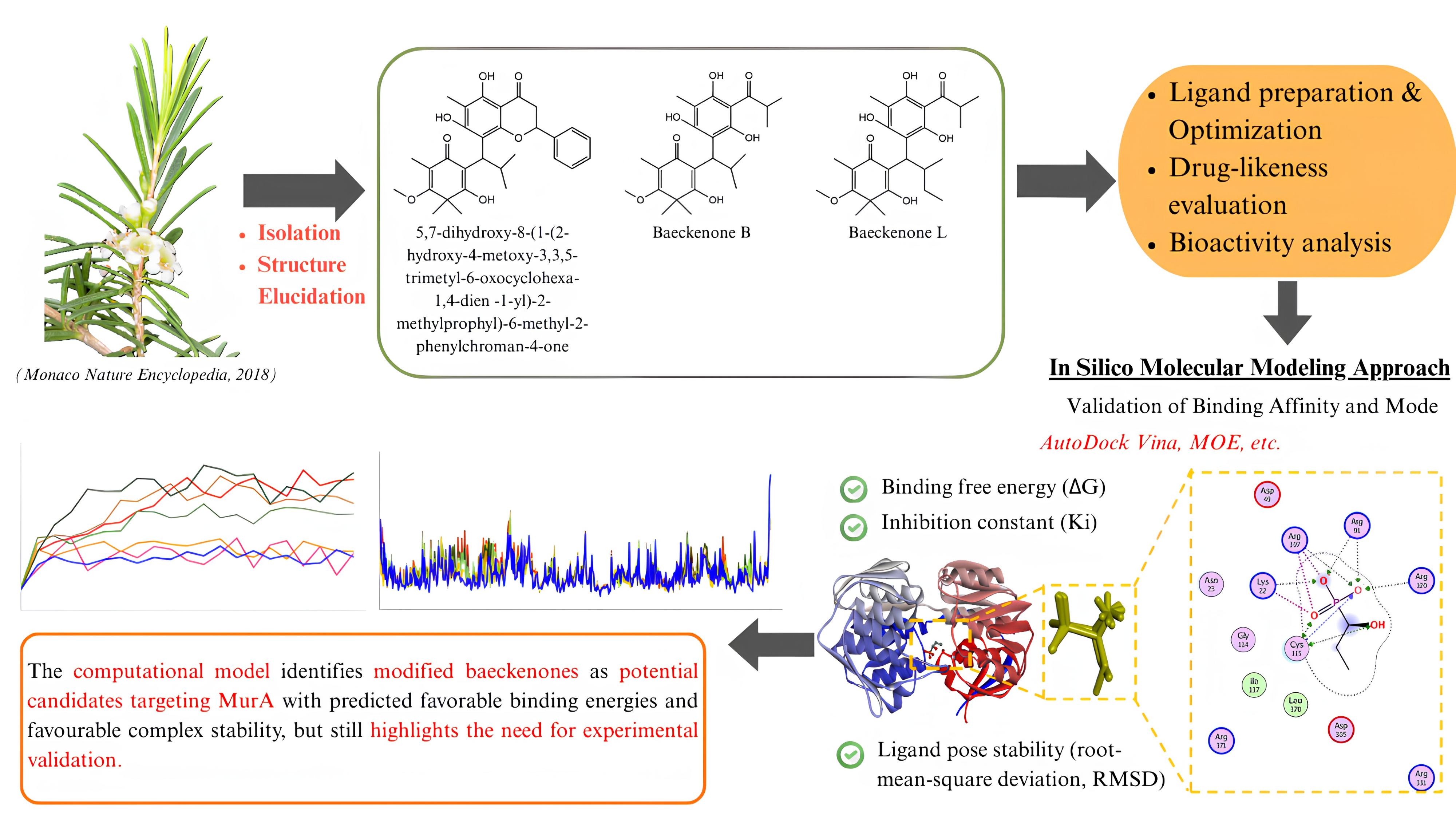
The rapid spread of multidrug-resistant bacteria has created an urgent, global need for novel antibacterial agents capable of overcoming existing resistance mechanisms. This computational study employs an integrated in silico approach to explore the potential of baeckenone compounds as MurA enzyme inhibitor. We report the isolation of 3 compounds from Baeckea frutescens: (5,7-dihydroxy-8-(1-(2-hydroxy- 4-methoxy-3,3,5-trimethyl -6-oxocyclohexa-1,4-dien-1-yl)-2-methylpropyl)-6-methyl-2-phenylchroman-4-one), Baeckenone B, and Baeckenone L (a novel phoroglucinol). These natural compounds served as starting points for in silico structure-based optimization to predict enhanced MurA binding. All derivatives were evaluated for predicted drug likeness, bioactivity scores, and toxicity profile. Molecular docking against MurA was validated by successful re-docking of fosfomycin (RMSD = 0.394 Å). Binding stability was further assessed through 20 ns molecular dynamics (MD) simulations and MM-PBSA free energy calculations. Structural optimization predicted improved drug-likeness (all modified derivatives complied with Lipinski’s Rule of Five), enhanced bioactivity scores, and suggested in silico membrane integrity antagonist potential without predicted toxicity. Docking analysis indicated higher predicted binding affinities for modified compounds (ΔG = ‒7.3 to ‒7.7 kcal/mol), surpassing the non-covalent binding component of fosfomycin (ΔG = ‒4.5 kcal/mol). MD simulations confirmed enhanced complex stability, with modified ligands exhibiting lower RMSD (0.612 - 1.120 Å), reduced residue fluctuations (RMSF), and favorable MM-PBSA binding energies. Modified Baeckenone B showed the most promising predicted profile (ΔG = ‒7.4 kcal/mol, Ki = 0.58 µM), and stable binding (RMSD = 0.612 Å). This computational study provides a framework for prioritizing baeckenone derivatives for future experimental validation as novel antibacterial agents against multidrug-resistant pathogens.
HIGHLIGHTS
- A new phloroglucinol, Baeckenone L, was successfully isolated from Baeckea frutescens.
- Structure-based optimization enhanced predicted drug-likeness and bioactivity profiles.
- Modified derivatives showed superior predicted non-covalent binding compared to fosfomycin’s non-covalent component under the same docking protocol, though fosfomycin’s clinical mechanism involves covalent inhibition.
- MD simulations confirmed superior stability and favorable energetics of optimized ligands.
- Modified Baeckenone B emerged as a computationally promising candidate for MurA inhibition, with predicted sub-micromolar affinity and favorable drug-like properties, warranting experimental validation.
GRAPHICAL ABSTRACT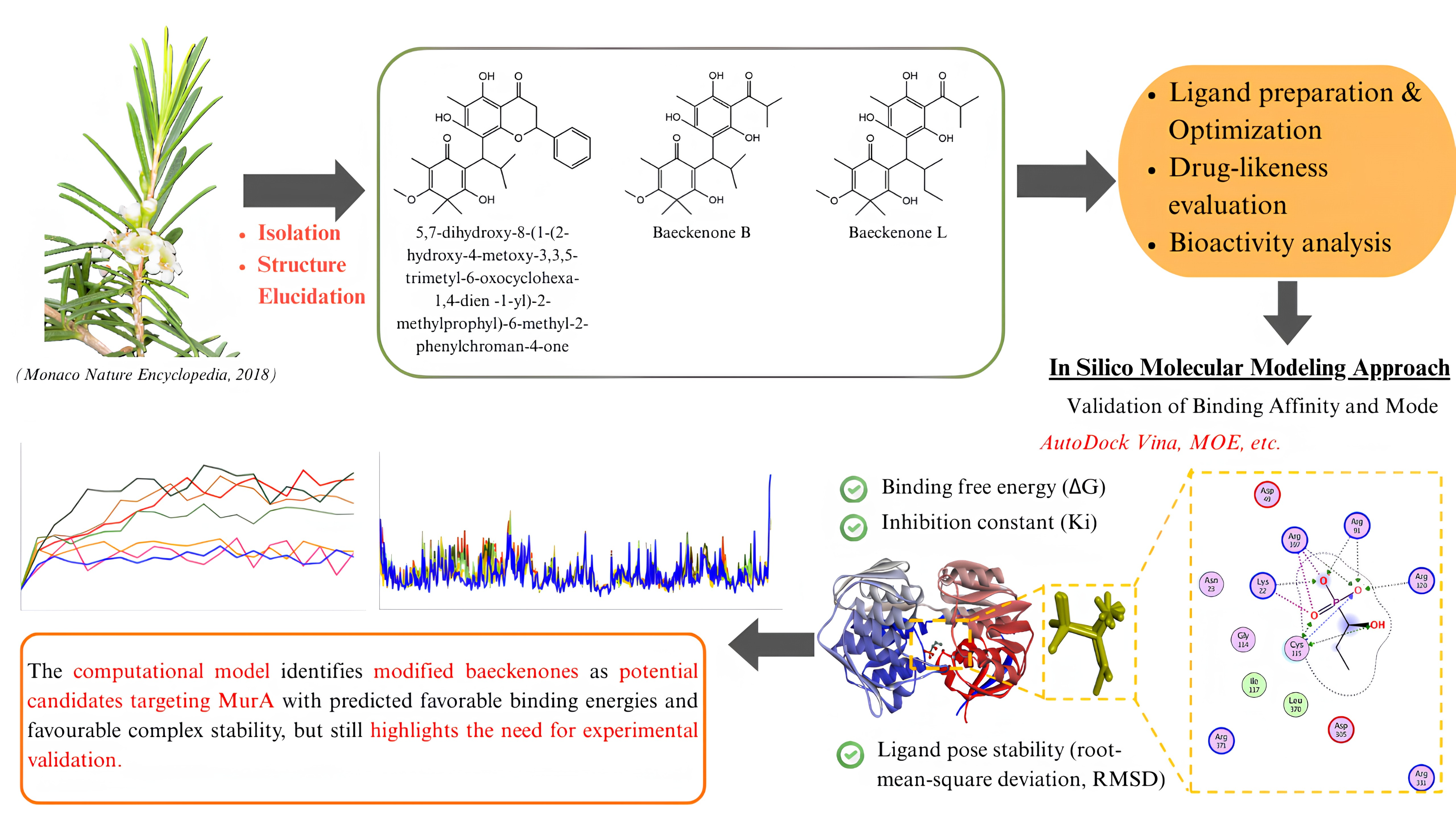
Downloads
References
AW Septama, N Simbak and EP Rahmi. Prospect of plant-based flavonoids to overcome antibacterial resistance: A mini-review. Walailak Journal of Science and Technology 2020; 17(5), 503-513.
M Song, Y Liu, T Li, X Liu, Z Hao, S Ding, P Panichayupakaranant, K Zhu and J Shen. Plant natural flavonoids against multidrug resistant pathogens. Advanced Science 2021; 8(15), 2100749.
K Dwivedi, AK Mandal, O Afzal, ASA Altamimi, A Sahoo, MA Alossaimi, WH Almalki, A Alzahrani, MA Barkat, TM Almeleebia, SNMN Ullah and M Rahman. Emergence of nano-based formulations for effective delivery of flavonoids against topical infectious disorders. Gels 2023; 9(8), 671.
F Farhadi, B Khameneh, M Iranshahi and M Iranshahy. Antibacterial activity of flavonoids and their structure–activity relationship: An update review. Phytotherapy Research 2018; 33(1), 13-40.
M Miklasińska‐Majdanik, M Kępa, RD Wojtyczka, D Idzik and TJ Wąsik. Phenolic compounds diminish antibiotic resistance of Staphylococcus aureus clinical strains. International Journal of Environmental Research and Public Health 2018; 15(10), 2321.
FA Resende, LG Nogueira, TM Bauab, W Vilegas and EA Varanda. Antibacterial potential of flavonoids with different hydroxylation patterns. Eclética Química 2015; 40, 173-179.
T WY and B GD. Unusual metabolites of Baeckea frutescens. Tetrahedron 1996; 52(29), 9735-9742.
K Nisa, T Ito, Subehan, T Matsui, T Kodama and H Morita. New acylphloroglucinol derivatives from the leaves of Baeckea frutescens. Phytochemistry Letters 2016; 15, 42-45.
DTL Huong, DX Duc and NT Son. Baeckea frutescens L: A review on phytochemistry, biosynthesis, synthesis, and pharmacology. Natural Product Communications 2023; 18(7), 1-22.
Y Zhou, B Utama, S Pratap, A Supandy, X Song, TT Tran, HH Mehta, CA Arias and Y Shamoo. Enolpyruvate transferase MurAAA149E, identified during adaptation of enterococcus faecium to daptomycin, increases stability of MurAA–MurG interaction. Journal of Biological Chemistry 2023; 299(3), 102912.
A Sorlózano, I Lopez-Machado, M Albertuz-Crespo, LJ Martínez-González and JG Fernández. Characterization of fosfomycin and nitrofurantoin resistance mechanisms in Escherichia Coli isolated in clinical urine samples. Antibiotics 2020; 9(9), 534.
AH Lima, AM dos Santos, CN Alves and J Lameira. Computed insight into a peptide inhibitor preventing the induced fit mechanism of MurA enzyme from Pseudomonas aeruginosa. Chemical Biology & Drug Design 2016; 89(4), 599-607.
OB Kapitan, L Ambarsari and S Falah. Inhibition docking simulation of zerumbone, gingerglycolipid B, and curzerenone compound of zingiber zerumbet from timor Island against MurA enzyme. Journal of Applied Chemical Science Internationalpp 2016; 3, 279-288.
S Kamboj and R Singh. Chromanone-A prerogative therapeutic scaffold: An overview. Arabian Journal for Science and Engineering 2022; 47(1), 75-111.
P Petakh and O Kamyshnyi. AMR mechanisms in L. interrogans serovars: A comprehensive study. Frontiers in Cellular and Infection Microbiology 2024; 14, 1384427.
FM Sezgin, M Avcu, E Sevim and UT Babaoğlu. In vitro activity of fosfomycin on biofilm in community-acquired staphylococcus aureus isolates. Clinical and Experimental Health Sciences 2019; 9(3), 202-209.
Y Tanrıverdi-Çaycı, DB Güne, M Ertokatlı, K Hacıeminoğlu-Ülker and A Birinci. Prevalence of fosfomycin resistance among enterobacterales isolates in a tertiary care Hospital from Turkey. Infectious Diseases & Clinical Microbiology 2022; 4(4), 252-257.
X Yu, X Zhu, Y Zhou, Q Li, Z Hu, T Li, J Tao, M Dou, M Zhang and Y Shao and R Sun. Discovery of N-Aryl-Pyridine-4-Ones as novel potential agrochemical fungicides and bactericides. Journal of Agricultural and Food Chemistry 2019; 67(50), 13904-13913.
R Frlan, M Hrast and S Gobec. Inhibition of MurA enzyme from escherichia coli by flavonoids and their synthetic analogues. ACS Omega 2023; 8(36), 33006-33016.
I Kurniawan, L Ambarsari, PA Kurniatin and ST Wahyudi. Novel compounds design of acertannin, hamamelitannin, and Petunidin-3-Glucoside typical compounds of african leaves (Vernonia amygdalina Del) as antibacterial based on QSAR and molecular docking. Jurnal Jamu Indonesia 2023; 8(2), 326.
I Kurniawan and NS Winarno. Unlocking antibacterial potential: Thiophene-2-carbaldehyde modification of acertannin from african leaves as MurA enzyme inhibitors. Jurnal Ners 2025; 9(4), 7602-7612.
SA Khan, SU Khan, Fozia, N Ullah, M Shah, R Ullah, I Ahmad and A Alotaibi. Isolation, structure elucidation and in silico prediction of potential drug-like flavonoids from Onosma chitralicum targeted towards functionally important proteins of drug-resistant bad bugs. Molecules 2021; 26(7), 2048.
BD VanScoy, J McCauley, EJ Ellis-Grosse, OO Okusanya, SM Bhavnani, A Forrest and PG Ambrose. Exploration of the pharmacokinetic-pharmacodynamic relationships for fosfomycin efficacy using an in vitro infection model. Antimicrobial Agents and Chemotherapy 2015; 59(12), 7170-7177.
AAN Shadrina, Y Herdiyati, I Wiani, MH Satari and D Kurnia. Prediction mechanism of nevadensin as antibacterial agent against S. Sanguinis: In vitro and in silico studies. Combinatorial Chemistry & High Throughput Screening 2022; 25(9), 1488-1497.
Q Liu, A Luo, H Jin, X Si and M Li. Machine learning‐based discovery of a novel noncovalent MurA inhibitor as an antibacterial agent. Chemical Biology & Drug Design 2025; 105(3), 70084.
JP James, PD Ail, L Crasta, RS Kamath, MH Shura and TJ Sindhu. In silico ADMET and molecular interaction profiles of phytochemicals from medicinal plants in Dakshina Kannada. Journal of Health and Allied Sciences NU 2024; 14, 190-201.
J Wang, F Yuan, M Kendre, Z He, S Dong, A Patil and K Padvi. Rational design of allosteric inhibitors targeting C797S mutant EGFR in NSCLC: An integrative in silico and in-vitro study. Frontiers in Oncology 2025; 15, 1590779.
B Li, Z Wang, Z Liu, Y Tao, C Sha, M He and X Li. DrugMetric: Quantitative drug-likeness scoring based on chemical space distance. Briefings in Bioinformatics 2024; 25(4), 321.
X Chen, H Li, L Tian, Q Li, J Luo and Y Zhang. Analysis of the physicochemical properties of acaricides based on Lipinski’s rule of five. Journal of Computational Biology 2020; 27(9), 1397-1406.
C Boss, J Hazemann, T Kimmerlin, M von Korff, U Lüthi, O Peter, T Sander and R Siegrist. The screening compound collection: A key asset for drug discovery. CHIMIA 2017; 71, 667.
K Long, SJ Kostman, CA Fernandez, JC Burnett and DM Huryn. Do zebrafish obey lipinski rules? ACS Medicinal Chemistry Letters 2019; 10(6), 1002-1006.
A Furukawa, CE Townsend, J Schwochert, CR Pye, MA Bednarek and RS Lokey. Passive membrane permeability in cyclic peptomer scaffolds is robust to extensive variation in side chain functionality and backbone geometry. Journal of Medicinal Chemistry 2016; 59(20), 9503-9512.
A Singh and MA Azam. MurF ligase inhibitors: An overview of antibacterial activity. Letters in Drug Design & Discovery 2023; 20(11), 1675-1687.
I Kurniawan and AU Rohmatika. Molecular docking, QSAR, and bioactivity prediction of Uncaria gambir flavonoids as antibacterial agents targeting MurA enzyme. Biointerface Research in Applied Chemistry 2026; 16(1), 32.
A Hentsch, M Guberman, S Radetzki, S Kaushik, M Huizenga, Y He, J Contzen, B Kuhn, J Benz, M Schippers, J Paul, L Leibrock, L Collin, M Wittwer, A Topp, F O’Hara, D Heer, R Hochstrasser, J Blaising, JP von Kries and M Nazaré. Highly specific miniaturized fluorescent monoacylglycerol lipase probes enable translational research. Journal of the American Chemical Society 2025; 147(12), 10188-10202.
A Kousaxidis, L Kováčiková, I Nicolaou, M Štefek and A Geronikaki. Non-acidic bifunctional benzothiazole-based thiazolidinones with antimicrobial and aldose reductase inhibitory activity as a promising therapeutic strategy for sepsis. Medicinal Chemistry Research 2021; 30, 1837-1848.
Z Ranković. CNS drug design: Balancing physicochemical properties for optimal brain exposure. Journal of Medicinal Chemistry 2015; 58(6), 2584-2608.
Y Goto and H Suga. The RaPID platform for the discovery of pseudo-natural macrocyclic peptides. Accounts of Chemical Research 2021; 54(18), 3604-3617.
R Mutiah, C Ayatillah, YYA Indrawijaya and A Suryadinata. Prediction of anti-sars CoV-2 activity from green tea catechin (Camellia Sinensis L. Kuntze) compound against to receptors non-structural protein 3 (6W6Y) and non-structural protein 5 (6M2N). Majalah Obat Tradisional 2022; 27(1), 24-31.
S Atoyebi, F Bunglawala, N Cottura, S Grañana-Castillo, MC Montanha, A Olagunju, M Siccardi and C Waitt. Physiologically‐based pharmacokinetic modelling of long‐acting injectable cabotegravir and rilpivirine in pregnancy. British Journal of Clinical Pharmacologyvol 2024; 91(4), 989-1002.
AP Sousa, MS Oliveira, DA Fernandes, MDL Ferreira, LV Cordeiro, MFV Souza, LMD Fernandes, HDS Souza, AAO Filho, HLF Pessoa and RCS Sá. In silico, in vitro, and ex vivo studies of the toxicological and pharmacological properties of the flavonoid 5,7-Dihydroxy-3,8,4’-Trimethoxy. Brazilian Journal of Medical and Biological Research 2021; 54(10), 11203.
JTS Coimbra, R Feghali, RP Ribeiro, MJ Ramos and PA Fernandes. The importance of intramolecular hydrogen bonds on the translocation of the small drug piracetam through a lipid bilayer. RSC Advances 2020; 11(2), 899-908.
SH Emam, RA Hassan, EO Osman, MIA Hamed, AM Abdou, MM Kandil, EM Elbaz and DS Mikhail. Coumarin derivatives with potential anticancer and antibacterial activity: Design, synthesis, VEGFR‐2 and DNA gyrase inhibition, and in silico studies. Drug Development Research 2023; 84(3), 475-499.
S Gavale, D Zade, KB Patil, R Yadav, PR Murumkar and R Kadu. Synthesis, characterization, and computational insights of flavone derivatives as promising antimicrobial agents. Chemistry & Biodiversity 2025; 22(12), 02136.
MRU Ahsan, S Paul, MS Alam and AFMM Rahman. Synthesis, biological properties, in silico ADME, molecular docking studies, and FMO analysis of chalcone derivatives as promising antioxidant and antimicrobial agents. ACS Omega 2025; 10(5), 4367-4387.
SU Chavan, SA Waghmare, SS Bodke and AR Bendale. Exploring 1,3,4-Oxadiazole derivatives as potent α-amylase inhibitors: Design, synthesis, and biological evaluation. Eurasian Journal of Chemistry 2023; 28(4), 112.
A Chaurasyia, PA Chawla, V Monga and G Singh. Rhodanine derivatives: An insight into the synthetic and medicinal perspectives as antimicrobial and antiviral agents. Chemical Biology & Drug Design 2022; 101(3), 500-549.
Y Zhou, B Utama, S Pratap, A Supandy, X Song, TT Tran, HH Mehta, CA Arias and Y Shamoo. Enolpyruvate transferase MurAAA149E, identified during adaptation of enterococcus faecium to daptomycin, increases stability of MurAA–MurG interaction. Journal of Biological Chemistryvol 2023; 299(3), 102912.
SH Pattanashetty, KM Hosamani, AK Shettar and RM Shafeeulla. Design, synthesis and computational studies of novel carbazole n‐phenylacetamide hybrids as potent antibacterial, anti‐inflammatory, and antioxidant agents. Journal of Heterocyclic Chemistry 2018; 55(7), 1765-1774.
I Kurniawan and AU Rohmatika. Molecular docking, QSAR, and bioactivity prediction of Uncaria gambir flavonoids as antibacterial agents targeting MurA enzyme. Biointerface Research in Applied Chemistry 2026; 16(1), 32.
Jia, M Zheng, C Zhang, B Li, C Lu, Y Bai, Q Tong, X Hang, Y Ge, L Zeng, M Zhao, F Song, H Zhang, L Zhang, K Hong and H Bi. Killing of Staphylococcus aureus persisters by a multitarget natural product chrysomycin A. Science Advances 2023; 9(31), 5995.
I Kurniawan and H Zahra. Review: Gallotannins; biosynthesis, structure activity relationship, anti-inflammatory and antibacterial activity. Current Biochemistry 2021; 8(1), 1-16.
I Purwaningsih, IP Maksum, D Sumiarsa and S Sriwidodo. Pharmacokinetics and toxicity overview of active compounds berberine, palmatine, and jatrorrhizine from fibraurea tinctoria lour: Drug-likeness, ADMET prediction, and in vivo extract toxicity assessment. Journal of Toxicology 2025; 7251602.
J Bradic, A Petrovic, M Nikolic, N Nedeljkovic, M Andjic, N Kladar, S Bolevich, V Jakovljevic and A Kocovic. Newly developed semi-solid formulations containing Mellilotus officinalis extract: Characterization, assessment of stability, safety, and anti-inflammatory activity. Pharmaceutics 2024; 16(8), 1003.
NT El‐Shamy, A Alkaoud, RK Hussein, MA Ibrahim, AG Alhamzani and MM Abou-Krisha. DFT, ADMET and molecular docking investigations for the antimicrobial activity of 6,6′-Diamino-1,1′,3,3′-tetramethyl-5,5′-(4-chlorobenzylidene)bis[pyrimidine-2,4(1H,3H)-dione]. Molecules 2022; 27(3), 620.
PS Ramalingam, P Balakrishnan, S Rajendran, J Arunachalam, R Rajasekaran and S Arumugam. Identification of dietary bioflavonoids as potential inhibitors against KRAS G12D mutant—novel insights from computer-aided drug discovery. Current Issues in Molecular Biology 2023; 45(3), 2136-2156.
O Ejiohuo, D Bajia, J Pawlak and A Szczepankiewicz. Asoprisnil as a novel ligand interacting with stress-associated glucocorticoid receptor. Biomedicines 2024; 12(12), 2745.
Y Sun, M Zhang, Y Zhang, Y Zheng, J Li, Q Cai, A Wang and Y Qu. Synergistic and antagonistic mechanisms of Arctium Lappa L. polyphenols on human neutrophil elastase inhibition: Insights from molecular docking and enzymatic kinetics. Molecules 2025; 30(13), 2764.
A Dubey, S Dotolo, PW Ramteke, A Facchiano and A Marabotti. Searching for chymase inhibitors among chamomile compounds using a computational-based approach. Biomolecules 2019; 9(1), 5.
M Islam, A Hossain, I Yamari, O Abchir, S Chtita, F Ali, SMA Kawsar. Synthesis, antimicrobial, molecular docking against bacterial and fungal proteins and in silico studies of glucopyranoside derivatives as potent antimicrobial agents. Chemistry & Biodiversity 2024; 21(9), 202400932.
S Salentin, SB Schreiber, VJ Haupt, MF Adasme and M Schroeder. PLIP: Fully automated protein–ligand interaction profiler. Nucleic Acids Research 2015; 43(1), 443-447.
MY Jin, H Yu, Q Deng, Z Wang, JY Wang, HL Li and H Liang. Virtual screening and molecular dynamics simulation study of ATP-competitive inhibitors targeting mTOR protein. PLoS One 2025; 20(5), 0319608.
A Musoev, S Numonov, Z You and H Gao. Discovery of novel DPP-IV inhibitors as potential candidates for the treatment of Type 2 Diabetes mellitus predicted by 3D QSAR pharmacophore models, molecular docking and de novo evolution. Molecules 2019; 24(16), 2870.
L Zheng, J Fan and Y Mu. OnionNet: A multiple-layer intermolecular-contact-based convolutional neural network for protein–ligand binding affinity prediction. ACS Omega 2019; 4(14), 15956-15965.
D Dubey, A Dubey, A Tufail and AK Rai. Assessment of optimal analytical techniques and computational approaches for investigating toxic elements and compounds in pyrotechnic materials (Green Crackers). Applied Organometallic Chemistry 2025; 39(9), 70361.
D Solano-Orrala, DA Silva-Cullishpuma, E Díaz-Cruces, VM Gómez-López, J Toro-Mendoza, GG D’Ayala, J Troconis, C Narváez-Muñoz, F Alexis, MT Mercader-Ros, C Lucas-Abellán and C Zamora-Ledezma. Exploring the potential of nonpsychoactive cannabinoids in the development of materials for biomedical and sports applications. ACS Applied Bio Materials 2024; 7(12), 8177-8202.
MF Chabán, M Hrast, R Frlan, DG Graikioti, CM Athanassopoulos and MC Carpinella. Inhibition of MurA enzyme from Escherichia coli and Staphylococcus aureus by diterpenes from Lepechinia meyenii and their synthetic analogs. Antibiotics 2021; 10(12), 1535.
MVD de Oliveira, KS da Costa, JRA Silva, J Lameira and AH Lima. Role of UDP‐N‐acetylmuramic acid in the regulation of mura activity revealed by molecular dynamics simulations. Protein Science 2024; 33(4), 4969.
ES İstifli. Chemical composition, antioxidant and enzyme inhibitory activities of Onosma bourgaei and Onosma trachytricha and in silico molecular docking analysis of dominant compounds. Molecules 2021; 26(10), 2981.
FR Mahendra, I Prakoso, A Marzelino, MR Fadhillah, Syukriyansyah, MMA Hasibuan, JF Suparningtyas, M Kristiadi, AG Setiawan, FI Rahman, AN Sari, NR Raysendria, I Kurniawan, W Arozal and Kusmardi. Optimisation of peptides targeting reverse transcriptase HIV-1 using QSAR, machine learning, and computational approaches. Frontiers in Pharmacology 2025; 16, 1707377.
RAP Irsal, GM Gholam, DA Firdaus, N Liwanda and F Chairunisa. Molecular docking and dynamics of xylocarpus granatum as a potential parkinson’s drug targeting multiple enzymes. Borneo Journal of Pharmacy 2024; 7(2), 161-171.
F Zhang, J Graham, T Zhai, Y Liu and Z Huang. Discovery of MurA inhibitors as novel antimicrobials through an integrated computational and experimental approach. Antibiotics (Basel, Switzerland) 2022; 11(4), 528.
MT Khazaal, AHI Faraag and HH El-Hendawy. In vitro and in silico studies of enterobactin-inspired ciprofloxacin and fosfomycin first generation conjugates on the antibiotic resistant E. Coli OQ866153. BMC Microbiology 2024; 24, 95.
S Akash, G Abdelkrim, I Bayil, ME Hosen, N Mukerjee, AF Shater, FM Saleh, GM Albadrani, MQ Al-Ghadi, MM Abdel-Daim and TT Tok. Antimalarial drug discovery against malaria parasites through haplopine modification: An advanced computational approach. Journal of Cellular and Molecular Medicine 2023; 27(20), 3168-3188.
MLBEN Amor, E Lanez, Y Bekkar, A Adaika, T Lanez, K Nesba and L Bechki. Exploring the interactions of ferrocenylmethylnucleobase derivatives with BSA and HHb: Insights from electrochemical, spectroscopic, ADMET, in silico docking, and MD simulations. ChemistrySelect 2025; 10(6), 202404678.
JU Ting, MCS Tan, VAS Ng, SJY Macalino, VC Linis and GG Oyong. Molecular simulations of unexplored philippine plant constituents on the inhibition of the proinflammatory marker NF-κB P50 subunit. Crystals 2024; 14(5), 438.
AK Umar, JH Zothantluanga, K Aswin, S Maulana, MS Zubair, H Lalhlenmawia, M Rudrapal and D Chetia. Antiviral phytocompounds “ellagic acid” and “(+)-sesamin” of bridelia retusa identified as potential inhibitors of SARS-CoV-2 3CL pro using extensive molecular docking, molecular dynamics simulation studies, binding free energy calculations, and bioactivi. Structural Chemistry 2022; 33, 1445-1465.
MH Abbas, AR Alanzi, KI Sahibzada, M Nawaz, G Fatima and D Wei. Identification of novel inhibitors targeting Mycobacterium abscessus InhA through virtual screening, docking, and molecular dynamic simulations. Scientific Reports 2025; 15, 12795.
SJ Hamid, T Salih and TA Aziz. Rational design, computational analysis and antibacterial activities of synthesized peptide-based molecules targeting quorum sensing-dependent biofilm formation in Pseudomonas aeruginosa. Pharmaceuticals 2025; 18(10), 1572.
M Yasir, J Park, ET Han, JH Han, WS Park, J Choe and W Chun. Investigating natural product inhibitors of IKKα: Insights from integrative in silico and experimental validation. Molecules 2025; 30(9), 2025.
M Menteş and C Yandım. Identification of PPA1 inhibitor candidates for potential repurposing in cancer medicine. Journal of Cellular Biochemistry 2023; 124(10), 1646-1663.
RM Laki and E Pourbasheer. Design of new anti‐influenza structures based on 3D‐QSAR, molecular docking and molecular dynamics studies. Chemistry & Biodiversity 2025; 22(9), 202500587.
F Zare, E Ataollahi, P Mardaneh, A Sakhteman, V Keshavarz, A Solhjoo and L Emami. A combination of virtual screening, molecular dynamics simulation, MM/PBSA, ADMET, and DFT calculations to identify a potential DPP4 inhibitor. Scientific Reports 2024; 14, 7749.
NH Aljarba, MS Hasnain, MM Bin-Meferij and S Alkahtani. Design & discovery of small molecule COVID-19 inhibitor via dual approach based virtual screening and molecular simulation studies. Journal of King Saud University - Science 2022; 34, 101867.
BJ Harris, X Cheng and PD Frymier. Structure and function of photosystem I–[FeFe] Hydrogenase protein fusions: An all-atom molecular dynamics study. The Journal of Physical Chemistry B 2016; 120(4), 599-609.
KM Gokhale, N Joshi and RR Alavala. Acetohydroxyacid Synthase (AHAS) inhibitors as antitubercular agents: Insights from molecular docking and dynamics simulations. Chemistry & Biodiversity 2025; 22(6), 202402631.
AA Hendi, P Virk, MA Awad, M Elobeid, KMO Ortashi, MM Alanazi, FH Alkallas, MM Almoneef and MA Abdou. In silico studies on zinc oxide based nanostructured oil carriers with seed extracts of Nigella sativa and Pimpinella anisum as potential inhibitors of 3CL protease of SARS-CoV-2. Molecules 2022; 27(13), 4301.
S Ullah, F Ullah, W Rahman, A Ullah, S Haider and C Yueguang. Elucidating the inhibitory mechanism of Zika Virus NS2B-NS3 protease with dipeptide inhibitors: Insights from molecular docking and molecular dynamics simulations. PLoS One 2024; 19(8), 0307902.
Published
How to Cite
Issue
Section
License
Copyright (c) 2026 Walailak University

This work is licensed under a Creative Commons Attribution-NonCommercial-NoDerivatives 4.0 International License.





