
Rapid and Eco-Friendly Quantification of Phenolic Compounds in Roselle Powder Using ATR-FTIR Coupled with Chemometric Modeling
DOI:
https://doi.org/10.48048/tis.2026.12671Keywords:
ATR-FTIR spectroscopy, Chemometrics, Green analytical chemistry, Phenolic compounds, Roselle powder analysisAbstract
Phenolic compounds are key contributors to the nutritional, functional, and commercial quality of roselle (Hibiscus sabdariffa L.) calyces; however, their routine quantification commonly relies on chromatographic methods that are time-consuming, solvent-intensive, and impractical for rapid quality control. This study aimed to develop a rapid and eco-friendly analytical approach for quantifying chlorogenic acid, caffeic acid, and rutin in roselle powder using attenuated total reflectance Fourier-transform infrared (ATR-FTIR) spectroscopy combined with chemometric modeling. Fifty samples representing different cultivars, drying methods, and geographical origins were analyzed. Elastic net classification achieved high accuracies for cultivar (96%) and geographical origin (92%), and moderate discrimination of drying methods (80%). Quantitative prediction using partial least squares regression showed excellent performance for chlorogenic acid (R2P = 0.9108), while caffeic acid and rutin showed moderate predictive ability (R2P = 0.5357 and 0.6490, respectively). External validation yielded prediction deviations generally below 10%. These results demonstrate that ATR-FTIR coupled with chemometrics provides a rapid, solvent-free, and reliable platform for phenolic profiling, with strong potential for sustainable quality control and process optimization in roselle-based food products.
HIGHLIGHTS
- ATR-FTIR combined with chemometrics enables rapid phenolic quantification
- Chlorogenic acid shows excellent predictive accuracy using optimized PLSR
- Cultivar and origin strongly influence roselle phenolic composition
- Drying method has minimal effect on phenolic stability under mild conditions
- FTIR–chemometric workflow offers a sustainable alternative to HPLC-PDA
GRAPHICAL ABSTRACT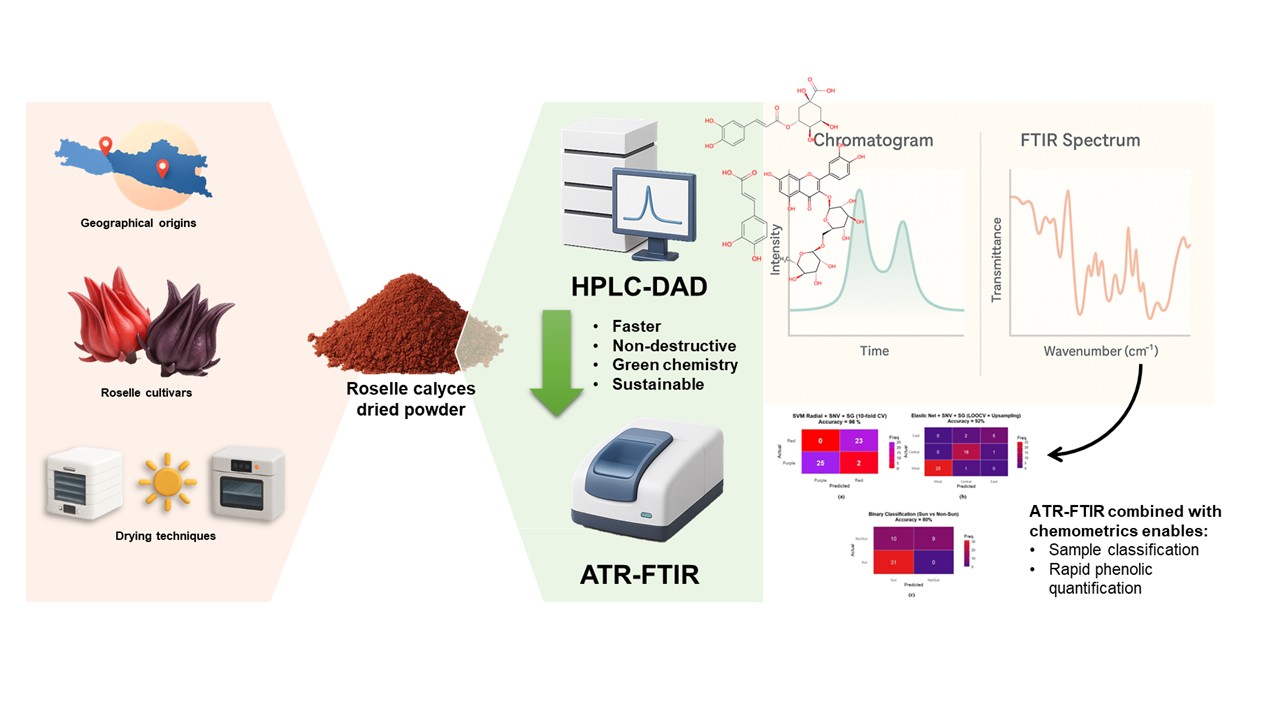
Downloads
References
BW Hapsari, Manikharda and W Setyaningsih. Methodologies in the analysis of phenolic compounds in roselle (Hibiscus sabdariffa L.): Composition, biological activity, and beneficial effects on human health. Horticulturae 2021; 7(2), 35.
JA Izquierdo-Vega, DA Arteaga-Badillo, M Sánchez-Gutiérrez, JA Morales-González, N Vargas-Mendoza, CA Gómez-Aldapa, J Castro-Rosas, L Delgado-Olivares, E Madrigal-Bujaidar and E Madrigal-Santillán. Organic acids from roselle (Hibiscus sabdariffa L.): A brief review of its pharmacological effects. Biomedicines 2020; 8(5), 100.
I Research. Roselle market size, share, growth, and industry analysis, by type (flower tea, direct eating products), by application (food & beverages, pharma & healthcare), regional insights and forecast to 2034. Molecules 2025; 30(18), 3795.
LY Chew, SK Teng, YP Neo, YY Sim and SC Chew. The potential of roselle (Hibiscus sabdariffa) plant in industrial applications: A promising source of functional compounds. Journal of Oleo Science 2024; 73(3), 275-292.
ID Larasati, C Carrera, HN Lioe, T Estiasih, ND Yuliana, HRD Ray, M Palma and W Setyaningsih. Anthocyanin extraction from roselle (Hibiscus sabdariffa L.) calyces: A microwave-assisted approach using Box-Behnken design. Journal of Agriculture and Food Research 2024; 18, 101480.
T Ahmed, MR Rana, M A Hossain, S Ullah and M Suzauddula. Optimization of ultrasound-assisted extraction using response surface methodology for total anthocyanin content, total phenolic content, and antioxidant activities of roselle (Hibiscus sabdariffa L.) calyces and comparison with conventional Soxhlet extraction. Biomass Conversion and Biorefinery 2023; 14(22), 28985-28999.
A Sanou, K Konaté, K Kabakdé, R Dakuyo, D Bazié, S Hemayoro and MH Dicko. Modelling and optimisation of ultrasound-assisted extraction of roselle phenolic compounds using the surface response method. Scientific Reports 2023; 13(1), 358.
W Setyaningsih, IE Saputro, CA Carrera, M Palma and C García-Barroso. Fast determination of phenolic compounds in rice grains by UPLC-PDA: Method development and validation. Journal of Agricultural and Food Chemistry 2019; 67(10), 3018-3027.
L Mizzi, C Chatzitzika, R Gatt and V Valdramidis. HPLC analysis of phenolic compounds and flavonoids with overlapping peaks. Food Technology and Biotechnology 2020; 58(1), 12-19.
R Joshi, R Sathasivam, PK Jayapal, AK Patel, BV Nguyen, MA Faqeerzada, SU Park, Shu Lee, MS Kim, I Baek and BK Cho. Comparative determination of phenolic compounds in Arabidopsis thaliana leaf powder under distinct stress conditions using FT-IR and FT-NIR spectroscopy. Plants 2022; 11(7), 836.
A Wakiuchi, S Jasial, S Asano, R Hashizume, M Hatanaka, Y Ohnishi, T Matsubara, H Ajiro, T Sugawara, M Fujii and T Miyao. Chemometrics approach based on wavelet transforms for estimation of monomer concentrations from FTIR spectra. ACS Omega 2023; 8(22), 19781-19788.
G Bekiaris, D Tagkouli, G Koutrotsios, N Kalogeropoulos and GI Zervakis. Pleurotus mushrooms content in glucans and ergosterol assessed by ATR-FTIR spectroscopy and multivariate analysis. Foods 2020; 9(4), 535.
F Arifah, LQ Aini and A Muhibuddin. Molecular and morphological characterization of fungi isolated from nutmeg (Myristica fragrans) in North Sulawesi, Indonesia. Biodiversitas Journal of Biological Diversity 2023; 24(1), 441-453.
A Rohman, MAB Ghazali, A Windarsih, Irnawati, S Riyanto, FM Yusof and S Mustafa. Comprehensive review on application of FTIR spectroscopy coupled with chemometrics for authentication analysis of fats and oils in food products. Molecules 2020; 25(22), 5485.
S Pasieczna-Patkowska, M Cichy and J Flieger. Application of Fourier transform infrared (FTIR) spectroscopy in characterization of green synthesized nanoparticles. Molecules 2025; 30(3), 684.
P Visciano and M Schirone. Rapid methods for assessing food safety and quality. Foods 2020; 9(4), 533.
D Ballesteros-Vivas, B Socas-Rodríguez, J A Mendiola, E Ibáñez and A Cifuentes. Green food analysis: Current trends and perspectives. Current Opinion in Green and Sustainable Chemistry 2021; 31, 100522.
Badan Standardisasi Nasional. SNI 3836:2013 teh kering dalam kemasan. Badan Standardisasi Nasional, Jakarta, Indonesia, 2013.
RN Fathimah, W Setyaningsih, C Carrera and M Palma. Microwave-assisted extraction of phenolics from Hibiscus sabdariffa flowers: Method development and validation. Proceedings 2021; 70(1), 51.
W Setyaningsih, WORS Warni, ID Larasati, R Yanti and T Utami. Bioprocess strategies for maximizing SCOBY growth and evaluating fermentation dynamics on phenolic content and antioxidant activity in roselle-based kombucha. Phytomedicine Plus 2025; 5(2), 100791.
K Banwo, A Sanni, D Sarkar, O Ale and K Shetty. Phenolics-linked antioxidant and anti-hyperglycemic properties of edible roselle (Hibiscus sabdariffa Linn.) calyces targeting type 2 diabetes nutraceutical benefits in vitro. Frontiers in Sustainable Food Systems 2022; 6, 660831
MAS Aishah, T Rohana, M A Masni and L Jalifah. Growth and phenolic constituents production of roselle (Hibiscus sabdariffa var. UKMR-2) in response to soil media. Journal of Physics: Conference Series 2019; 1358, 012003.
JI Lyu, JM Kim, DG Kim, JB Kim, SH Kim, JW Ahn, SY Kang, J Ryu and SJ Kwon. Phenolic compound content of leaf extracts from different roselle (Hibiscus sabdariffa) accessions. Plant Breeding and Biotechnology 2020; 8, 1-10.
S Yagi, AI Uba, KI Sinan, D Piatti, G Sagratini, G Caprioli, SM Eltigani, I Lazarova and G Zengin. Comparative study on the chemical profile, antioxidant activity, and enzyme inhibition capacity of red and white Hibiscus sabdariffa variety calyces. ACS Omega 2023; 8(45), 42511-42521.
Z Zori, V Dragović-Uzelac, S Pedisi, Č Kurtanjek and IE Garofuli. Kinetics of the degradation of anthocyanins, phenolic acids and flavonols during heat treatments of freeze-dried sour cherry Marasca paste. ACS Omega 2023; 8(45), 42511-42521.
R ElGamal, C Song, A M Rayan, C Liu, S Al-Rejaie and G ElMasry. Thermal degradation of bioactive compounds during drying process of horticultural and agronomic products: A comprehensive overview. Agronomy 2023; 13(6), 1580.
ME Topal and B Șahin. Effects of different drying methods on Camellia sinensis: Investigation of quality parameters and drying kinetics using artificial neural networks. LWT 2025; 229, 118172.
S Rohani, FR Martha, T Mundijo, Y Astri, M Zilda and A Meilianti. Spectroscopic characterization of rosella flower extract (Hibiscus sabdariffa L.) and its antibacterial activity against Enterobacter aerogenes. Indonesian Journal of Medical Laboratory Science and Technology 2025; 7(1), 12-22.
P Wongsa, P Phatikulrungsun and S Prathumthong. FT-IR characteristics, phenolic profiles and inhibitory potential against digestive enzymes of 25 herbal infusions. Scientific Reports 2022b; 12(1), 6631.
S Dayang, M Irwanto, N Gomesh and B Ismail. Natural dyes from roselle flower as a sensitizer in dye-sensitized solar cell (DSSC). Indonesian Journal of Electrical Engineering and Computer Science 2018; 9(1), 191-197.
S Thummajitsakul and K Silprasit. Analysis of FTIR spectra, flavonoid content and anti-tyrosinase activity of extracts and lotion from Garcinia schomburgkiana by multivariate method. Trends in Sciences 2022; 19(18), 5780-5780.
S Türker-Kaya and CW Huck. A review of mid-infrared and near-infrared imaging: Principles, concepts and applications in plant tissue analysis. Molecules 2017; 22(1), 168.
AP Craig, AS Franca, LS Oliveira, J Irudayaraj and K Ileleji. Application of elastic net and infrared spectroscopy in discriminating defective and non-defective roasted coffees. Talanta 2014; 128, 393-400.
H Zou and T Hastie. Regularization and variable selection via the elastic net. Journal of the Royal Statistical Society B 2005; 67(2), 301-320.
Å Rinnan, FVD Berg and SB Engelsen. Review of the most common pre‐processing techniques for near‐infrared spectra. Trends in Analytical Chemistry 2009; 28(10), 1201-1222.
MD Peris-Díaz and A Krężel. A guide to good practice in chemometric methods for vibrational spectroscopy, electrochemistry, and hyphenated mass spectrometry. TrAC Trends in Analytical Chemistry 2021; 135, 116157.
F Zhang, X Tang and L Li. Origins of baseline drift and distortion in Fourier transform spectra. Molecules 2022; 27(13), 4287.
M Krysa, M Szymańska-Chargot and A Zdunek. FT-IR and FT-Raman fingerprints of flavonoids: A review. Food Chemistry 2022; 393, 133430.
Y Zhang, X Li, H Li, L Huang, J Huang and Q Tang. Rapid and non-destructive determination of tea polyphenols content in Chongzhou new loquat tea lines based on near-infrared spectroscopy. Food Science and Technology 2023; 43, e004023.
J Ezenarro and D Schorn-García. How are chemometric models validated? A systematic review of linear regression models for NIRS data in food analysis. Journal of Chemometrics 2025; 39(6), e70036.
A Rohman, A Windarsih, MAM Hossain, MR Johan, ME Ali and NA Fadzilah. Application of near- and mid-infrared spectroscopy combined with chemometrics for discrimination and authentication of herbal products: A review. Journal of Applied Pharmaceutical Science 2019; 9(3), 137-147.
Published
How to Cite
Issue
Section
License
Copyright (c) 2025 Walailak University

This work is licensed under a Creative Commons Attribution-NonCommercial-NoDerivatives 4.0 International License.





