
Molecular Dynamics Simulation of Bioactive Compounds from Moringa Oleifera Leaf Powder Extract as Antidiabetic by Inhibiting α-Amylase and α-Glucosidase Enzymes
DOI:
https://doi.org/10.48048/tis.2025.10964Keywords:
Moringa oleifera, Diabetes mellitus, In silico, In vitro, α-amylase, α-glucosidaseAbstract
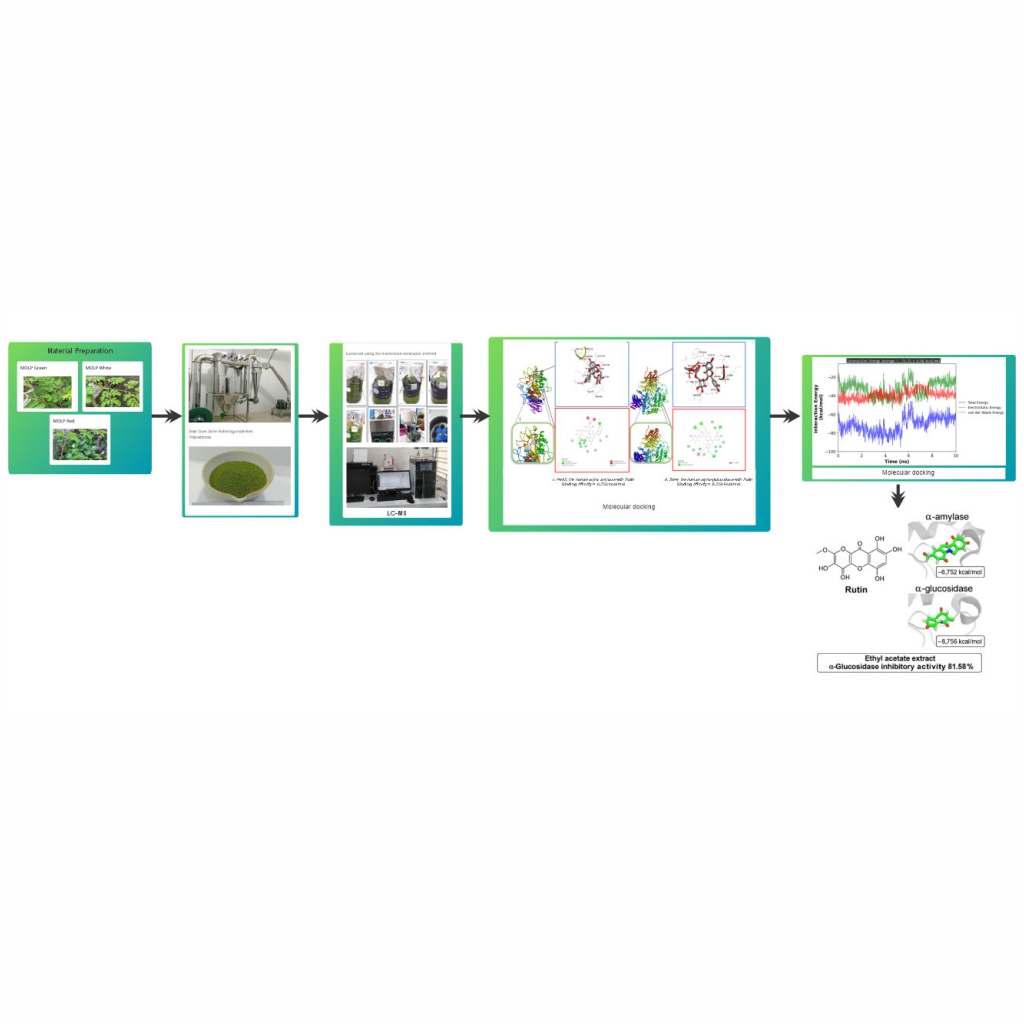
Diabetes is a chronic disease that has caused around 6.7 million deaths a year or one death every 5 s. Diabetes therapy usually focuses on the insulin hormone. In fact, in addition to regulating carbohydrate metabolism by the insulin hormone, therapy can be done by inhibiting several enzymes such as α-amylase and α-glucosidase in the starch and glycogen metabolism pathway as a source of blood glucose. This study investigates Moringa oleifera leaf powder (MOLP) from different Leaf stalk colors were screened for their inhibitory action of α-amylase and α-glucosidase against type 2 diabetes through molecular docking, molecular dynamics simulation, and in vitro enzyme inhibition. Rutin showed the highest binding affinity among 57 tested compounds. This compound simultaneously binds to the 2 target proteins of α-amylase and α-glucosidase, with higher binding affinity values of –6.752 mol–1 for α-amylase and –8.756 mol–1 for α-glucosidase. The rutin glucosidase revealed to be the most stable molecule with the highest binding free energy through molecular dynamics simulation was MM-GBSA Binding Energy = –33.3645 ± 5.0338 kcal mol–1 and MM-PBSA Binding Energy = 1.8598 ± 5.5359 kcal mol–1, indicating that it could compete with the inhibitor native ligand. The α-glucosidase inhibitory activity of the ethyl acetate extract achieved 81.58% inhibition, while acarbose achieved 84.47%. Rutin has the best potential as an inhibitor of the α-glucosidase enzyme and the stability of its interaction compared to other flavonoid groups, making it a prospective drug candidate for type 2 diabetes.
HIGHLIGHTS
- Fifty-seven compounds from Moringa oleifera leaf powder (MOLP) were screened for α-amylase and α-glucosidase inhibitory activity using molecular docking and dynamics simulation.
- Rutin exhibited the highest dual inhibitory potential against both α-amylase and α-glucosidase enzymes.
- Binding affinity of rutin surpassed that of the control inhibitor acarbose in molecular docking studies.
- Molecular dynamics simulation confirmed the stability of rutin–enzyme complexes, particularly with α-glucosidase.
- Ethyl acetate extract of oleifera demonstrated high α-glucosidase inhibitory activity (81.58%), close to acarbose (84.47%).
GRAPHICAL ABSTRACT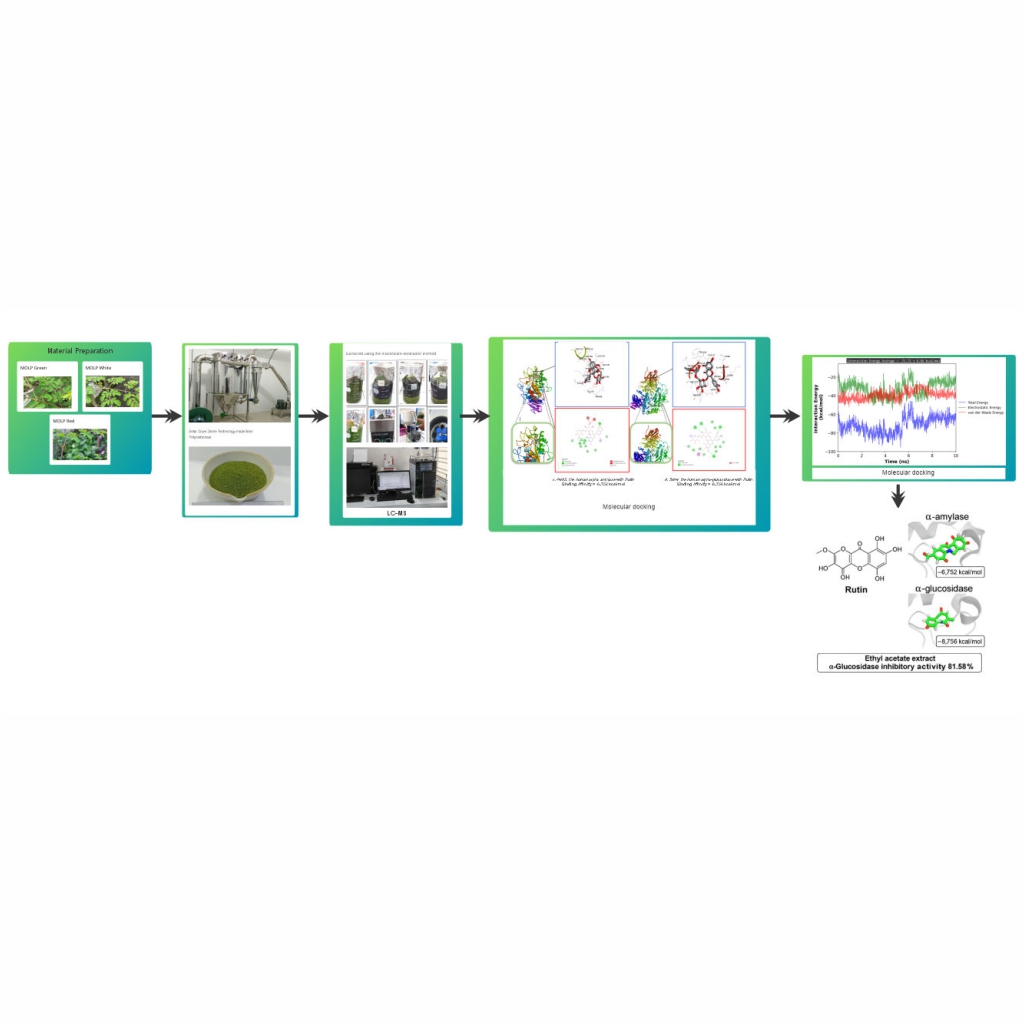
Downloads
References
H Mechchate, I Es-Safi, R Conte, C Hano, A Amaghnouje, FZ Jawhari, N Radouane, N Bencheikh, A Grafov and D Bousta. In vivo and in vitro antidiabetic and anti-inflammatory properties of flax (Linum usitatissimum L.) seed polyphenols. Nutrients 2021; 13(8), 2759.
H Sun, P Saeedi, S Karuranga, M Pinkepank, K Ogurtsova, BB Duncan, C Stein, A Basit, JCN Chan, JC Mbanya, ME Pavkov, A Ramachandaran, SH Wild, S James, WH Herman, P Zhang, C Bommer, S Kuo, EJ Boyko and DJ Magliano. IDF Diabetes Atlas: Global, regional and country-level diabetes prevalence estimates for 2021 and projections for 2045. Diabetes Research and Clinical Practice 2022; 183, 109119.
R Amelia, J Harahap and H Wijaya. The role of physical activity on glucose transporter-4, fasting blood glucose level and glycate hemoglobin in type 2 diabetes mellitus patients in Medan, Indonesia. Family Medicine & Primary Care Review 2021; 23(3), 274-278.
RW Sibony, O Segev, S Dor and I Raz. Overview of oxidative stress and inflammation in diabetes. Journal of Diabetes 2024; 16(10), e70014.
H Ouassou, T Zahidi, S Bouknana, M Bouhrim, H Mekhfi, A Ziyyat, A Legssyer, M Aziz and M Bnouham. Inhibition of α-glucosidase, intestinal glucose absorption, and antidiabetic properties by Caralluma europaea. Evidence-Based Complementary and Alternative Medicine 2018; 2018(1), 1-8.
H Natsir, AW Wahab, A Laga and AR Arif. Inhibitory activities of Moringa oleifera leaf extract against α-glucosidase enzyme in vitro. Journal of Physics: Conference Series 2018; 979, 012019.
S Akyüz, İ Kurt-Celep, Y İnan, OE Özdemir, E Celep and E Yesilada. In vitro evaluation of the bioactivity and bioaccessibility of Hypericum olympicum L. South African Journal of Botany 2021; 142, 316-324.
WT Muzumbukilwa, M Nlooto and PMO Owira. Hepatoprotective effects of moringa oleifera lam (Moringaceae) leaf extracts in streptozotocin-induced diabetes in rats. Journal of Functional Foods 2019; 57(12), 75-82.
GL King. The role of inflammatory cytokines in diabetes and its complications. Journal of Periodontology 2008; 79(85), 1527-1534.
ZF Ma, J Ahmad, H Zhang, I Khan and S Muhammad. Evaluation of phytochemical and medicinal properties of Moringa (Moringa oleifera) as a potential functional food. South African Journal of Botany 2020; 129, 40-46.
MZ Mumtaz, F Kausar, M Hassan, S Javaid and A Malik. Anticancer activities of phenolic compounds from Moringa oleifera leaves: In vitro and in silico mechanistic study. Beni-Suef University Journal of Basic and Applied Sciences 2021; 10(1), 12.
G Domínguez-Rodríguez, ML Marina and M Plaza. In vitro assessment of the bioavailability of bioactive non-extractable polyphenols obtained by pressurized liquid extraction combined with enzymatic-assisted extraction from sweet cherry (Prunus avium L.) pomace. Food Chemistry 2022; 385(2), 132688.
UF Magaji, O Sacan and R Yanardag. Alpha amylase, alpha glucosidase and glycation inhibitory activity of Moringa oleifera extracts. South African Journal of Botany 2020; 128, 225-230.
X Fu, D Wang, T Belwal, Y Xu, L Li and Z Luo. Sonication-synergistic natural deep eutectic solvent as a green and efficient approach for extraction of phenolic compounds from peels of Carya cathayensis Sarg. Food Chemistry 2021; 355(45), 129577.
D Benouchenne, I Bellil, S Akkal, C Bensouici and D Khelifi. LC-MS/MS analysis, antioxidant and antibacterial activities of Algerian fir (Abies numidica de LANNOY ex CARRIÈRE) ethylacetate fraction extracted from needles. Journal of King Saud University - Science 2020; 32(8), 3321-3327.
AN Ananda, T Triawanti, B Setiawan, AC Makati, JA Putri and SJ Raharjo. In silico study of the flavonoid compound of Sauropus androgynus leaves ON RNA-Dependent RNA polymerase (RdRp) SARS-CoV-2. Aspects of Molecular Medicine 2024; 3(1), 100032.
WL Jorgensen and J Tirado-Rives. Potential energy functions for atomic-level simulations of water and organic and biomolecular systems. Proceedings of the National Academy of Sciences 2005; 102(19), 6665-6670.
LS Dodda, ICD Vaca, J Tirado-Rives and WL Jorgensen 1. LigParGen web server: An automatic OPLS-AA parameter generator for organic ligands. Nucleic Acids Research 2017; 45(W1), W331-W336.
N Saada, MR Abdullah, A Hamaideh and A Abu-Romman. Application of stochastic analysis, modeling and simulation (SAMS) to selected hydrologic data in the middle east. Engineering, Technology and Applied Science Research 2019; 9(3), 4261-4264.
Y Khalak, G Tresadern, M Aldeghi, HM Baumann, DL Mobley, BLD Groot and V Gapsys. Alchemical absolute protein-ligand binding free energies for drug design. Chemical Science 2021; 12(1), 13958-13971.
M Didandeh, AH Souderjani and M Asgari. Applications of molecular dynamics simulation in nanomedicine. In: Thomas J. Webster (Ed.). Nanomedicine: Technologies and applications. 2nd Eds. Woodhead Publishing, Cambridge, UK, 2023, p. 397-405.
M Mohammadi, V Zambare, L Malek, C Gottardo, Z Suntres and L Christopher. Lichenochemicals: Extraction, purification, characterization, and application as potential anticancer agents. Expert Opinion on Drug Discovery 2020; 15(5), 575-601.
AH Tripathi, N Negi, R Gahtori, A Kumari, P Joshi, LM Tewari, Y Joshi, R Bajpai, DK Upreti and SK Upadhyay. A review of anti-cancer and related properties of lichen-extracts and metabolites. Anti-Cancer Agents in Medicinal Chemistry 2021; 22(1), 115-142.
C Bitwell, SS Indra, C Luke and MK Kakoma. A review of modern and conventional extraction techniques and their applications for extracting phytochemicals from plants. Scientific African 2023; 19, e01585.
MMAN Ranjha, S Irfan, JM Lorenzo, B Shafique, R Kanwal, M Pateiro, RN Arshad, L Wang, GA Nayik, U Roobab and RM Aadil. Sonication, a potential technique for extraction of phytoconstituents: A systematic review. Processes 2021; 9(8), 1406.
M Nadeem, MMAN Ranjha, K Ameer, A Ainee, Z Yasmin, S Javaria and TF Teferra. Effect of sonication on the functional properties of different citrus fruit juices. International Journal of Fruit Science 2022; 22(1), 568-580.
A Daina, O Michielin and V Zoete. SwissADME: A free web tool to evaluate pharmacokinetics, drug-likeness and medicinal chemistry friendliness of small molecules. Scientific Reports 2017; 7, 1-13.
ZW Teclegeorgish, YM Aphane, NS Mokgalaka, P Steenkamp and VJ Tembu. Nutrients, secondary metabolites and anti-oxidant activity of Moringa oleifera leaves and Moringa-based commercial products. South African Journal of Botany 2021; 142(2021), 409-420.
B Zainab, Z Ayaz, MS Alwahibi, S Khan, H Rizwana, DW Soliman, A Alawaad and AM Abbasi. In-silico elucidation of Moringa oleifera phytochemicals against diabetes mellitus. Saudi Journal of Biological Sciences 2020; 27(9), 2299-2307.
P Kashyap, S Kumar, CS Riar, N Jindal, P Baniwal, RPF Guiné, PMR Correia, R Mehra and H Kumar. Recent advances in drumstick (Moringa oleifera) leaves bioactive compounds: Composition, health benefits, bioaccessibility, and dietary applications. Antioxidants 2022; 11(2), 402.
A Fidyasari, T Estiasih, SN Wulan and A Khatib. The physicochemical, functional, and pasting properties of Moringa oleifera leaf powder from different leaf stalk colors. CyTA - Journal of Food 2024; 22(1), 2402062.
SJ Raharjo, C Mahdi, N Nurdiana, T Kikuchi and F Fatchiyah. Binding energy calculation of patchouli alcohol isomer cyclooxygenase complexes suggested as COX-1/COX-2 selective inhibitor. Advances in Bioinformatics 2014; 2014(3), 1-12.
P Listiyani and VD Kharisma. A novel antiviral candidate from moringa oleifera through dual targeting mechanism of SARS-CoV-2 protease: Computational screening. Genbinesia Journal of Biology 2023; 2(2), 63-75.
A Proboningrat, VD Kharisma, ANM Ansori, R Rahmawati, A Fadholly, GAV Posa, SA Sudjarwo, FA Rantam and AB Achmad. In silico study of natural inhibitors for human papillomavirus-18 E6 protein. Research Journal of Pharmacy and Technology 2022; 15(3), 1251-1256.
KA Peele, CP Durthi, T Srihansa, S Krupanidhi, VS Ayyagari, DJ Babu, M Indira, AR Reddy and TC Venkateswarulu. Molecular docking and dynamic simulations for antiviral compounds against SARS-CoV-2: A computational study. Informatics in Medicine Unlocked 2020; 19, 100345.
S Genheden and U Ryde. The MM/PBSA and MM/GBSA methods to estimate ligand-binding affinities. Expert Opinion on Drug Discovery 2015; 10(5), 449-461.
I Pattola, S Maryam and R Razak. In vitro activity test of a-glucosidase enzyme inhibition of moringa oleifera L. leaves extract. Pharmacy Reports 2022; 1(1), 17-20.
D Kurnia, F Zakiyah, W Budiana and I Andriansyah. In vitro inhibitory activity of the α -glucosidase enzyme from Eucheuma cottonii macroalgae extract. Jurnal Kimia Riset 2025; 10, 102-112.
A García-Gurrola, AL Martínez, A Wall-Medrano, FJ Olivas-Aguirre, E Ochoa-Ruiz and AA Escobar-Puentes. Phytochemistry, anti-cancer, and anti-diabetic properties of plant-based foods from mexican agrobiodiversity: A review. Foods 2024; 13(24), 1-37.
TO Jimoh. Enzymes inhibitory and radical scavenging potentials of two selected tropical vegetable (Moringa oleifera and Telfairia occidentalis) leaves relevant to type 2 diabetes mellitus. Revista Brasileira de Farmacognosia 2018; 28(1), 73-79.
M Nurkhozin and S Mulyanti. Biokimia: Struktur dan Fungsi Biomolekul. Yogyakarta Andi Publisher, Indonesia, 2017.
A Mehmood, S Javid, MF Khan, KS Ahmad and A Mustafa. In vitro total phenolics, total flavonoids, antioxidant and antibacterial activities of selected medicinal plants using different solvent systems. BMC Chemistry 2022; 16(1), 64.
AEE Viado, L Purnamasari and JFD Cruz. Anti-diabetic effects of Hibiscus spp. extract in rat and mice models: A review. The Indonesian Journal of Nutrition 2022; 11(1), 39-48.
Published
How to Cite
Issue
Section
License
Copyright (c) 2025 Walailak University

This work is licensed under a Creative Commons Attribution-NonCommercial-NoDerivatives 4.0 International License.





