
A Validated Ultrasound-Assisted UPLC-PDA-QDa Method for Safflower Flavonoid Glycosides: Box-Behnken Optimization and Drying-Induced Compositional Changes
DOI:
https://doi.org/10.48048/tis.2026.12594Keywords:
Antioxidants, Carthamus tinctorius, Edible flower, Hydroxysafflor yellow A, Method development, Rapid method, Ultrasound-assisted extractionAbstract
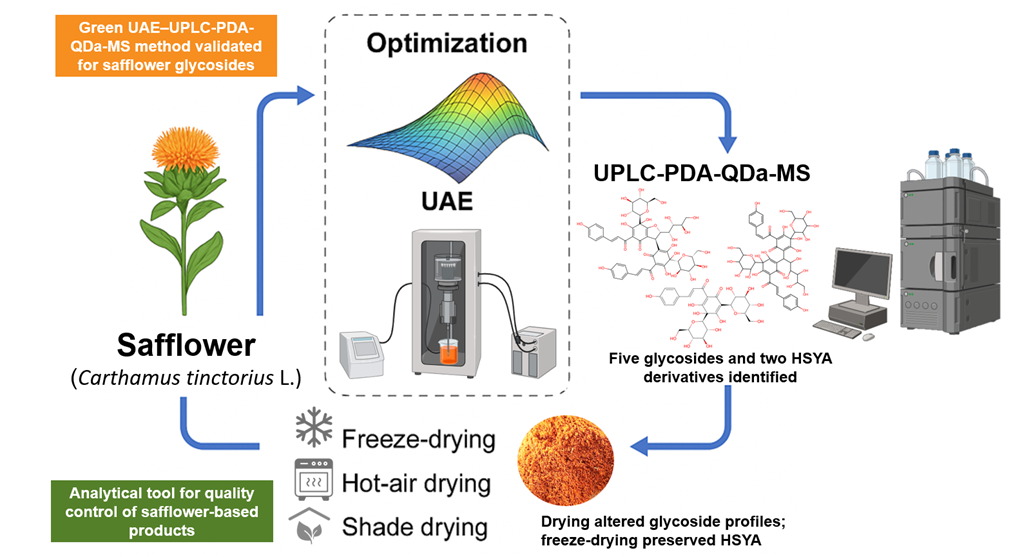
Safflower (Carthamus tinctorius L.) is widely recognized for its therapeutic and nutritional value, primarily attributed to flavonoid glycosides with strong antioxidant activities. To establish a rapid, green, and reliable analytical approach, an ultrasound-assisted extraction (UAE) method coupled with UPLC-PDA-QDa-MS was developed, optimized, and validated. The extraction parameters, including solvent concentration, solid-to-liquid ratio, temperature, and time, were optimized using Box-Behnken design, yielding the best extraction efficiency at 50% methanol, 0.3:20 (g mL⁻¹), 30 °C, and 15 min. The method demonstrated good linearity (R² = 0.9927), satisfactory precision (CV < 11%), and accuracy (recoveries 90% - 100%), with limits of detection and quantification of 2.967 and 8.992 ppm, respectively, meeting ICH Q2 criteria. Five major flavonoid glycosides and two HSYA-derived compounds were identified, and the flavonoid glycosides were determined on a semi-quantitative basis as HSYA equivalents. Application of the validated method to safflower samples subjected to different drying treatments revealed significant compositional variations, where freeze-drying best preserved hydroxysafflor yellow A (HSYA), while hot-air drying favored other glycosides. The method provides a robust analytical tool for comparative profiling and quality control of safflower-derived products and supports green extraction and validation strategies in functional food and phytopharmaceutical research.
HIGHLIGHTS
- Green UAE–UPLC-PDA-QDa-MS method validated for safflower glycosides.
- Box–Behnken design optimized solvent ratio, temperature, and time.
- Five glycosides and two HSYA derivatives identified.
- Drying altered glycoside profiles; freeze-drying preserved HSYA.
- Analytical tool for quality control of safflower-based products.
GRAPHICAL ABSTRACT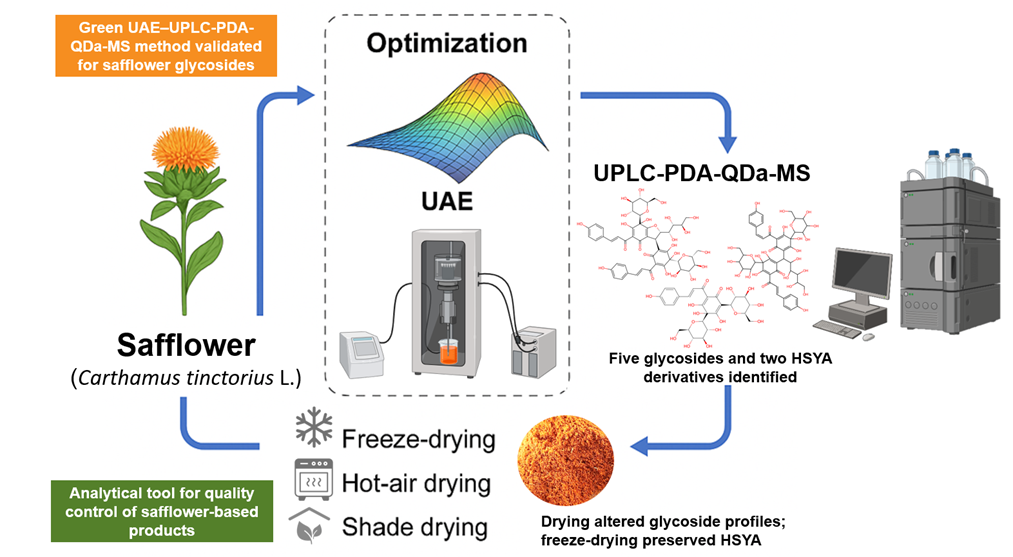
Downloads
References
E Delshad, M Yousefi, P Sasannezhad, H Rakhshandeh and Z Ayati. Medical uses of Carthamus tinctorius L. (safflower): A comprehensive review from traditional medicine to modern medicine. Electron Physician 2018; 10(4), 6672-6681.
OK Buyukkurt, G Guclu, C Barutcular, S Selli and H Kelebek. LC-MS/MS fingerprint and simultaneous quantification of bioactive compounds in safflower petals (Carthamus tinctorius L.). Microchemical Journal 2021; 171, 106850.
R Hamsidi, A Widyawaruyanti, AF Hafid, W Ekasari, MH Malaka, H Kasmawati, NI Akib, W Wahyuni and S Sabarudin. Profil fitokimia ekstrak etanol bunga kasumba turate (Carthamus tinctorius L.) yang berpotensi sebagai antimalaria. Pharmauho Jurnal Farmasi Sains dan Kesehatan 2018; 4(2), 40-42.
I Kim, J Bae and BJ Kim. Carthami flos regulates gastrointestinal motility functions. Integrative Medicine Research 2017; 6(4), 404-408.
T Makino, H Wakushima, T Okamoto, Y Okukubo, K Saito and Y Kano. Effects of kangen-karyu on coagulation system and platelet aggregation in mice. Biological and Pharmaceutical Bulletin 2002; 25(4), 523-525.
M Abudayyak, EÖ Nath and G Özhan. Toxic potentials of ten herbs commonly used for aphrodisiac effect in Turkey. Turkish Journal of Medical Sciences 2015; 45(3), 496-506.
Z Yan, R Alimu, J Wan, X Liao, S Lin, S Dai, F Chen, S Zhang, Y Tong, H Liu, R Qin and J Liu. Composition of major quinochalcone hydroxysafflor yellow A and anhydrosafflor yellow B is associated with colour of safflower (Carthamus tinctorius) during colour-transition but not with overall antioxidant capacity: A study on 144 cultivars. Food Research International 2022; 162, 112098.
H Cheng, C Yang, P Ge, Y Liu, MM Zafar, B Hu, T Zhang, Z Luo, S Lu, Q Zhou, A Jaleel and M Ren. Genetic diversity, clinical uses, and phytochemical and pharmacological properties of safflower (Carthamus tinctorius L.): An important medicinal plant. Frontiers in Pharmacology 2024; 15, 1374680.
I Adamska and P Biernacka. Bioactive substances in safflower flowers and their applicability in medicine and health-promoting foods. International Journal of Food Science 2021; 2021, 6657639.
LL Zhang, K Tian, ZH Tang, XJ Chen, ZX Bian YT Wang and JJ Lu. Phytochemistry and pharmacology of Carthamus tinctorius L. American Journal of Chinese Medicine 2016; 44(2), 197-226.
Y Chen, Q Xiang, F Peng, S Gao, L Yu, Y Tang, Z Yang, W Pu, X Xie and C Peng. The mechanism of action of safflower total flavonoids in the treatment of endometritis caused by incomplete abortion based on network pharmacology and 16S rDNA sequencing. Journal of Ethnopharmacology 2023; 315, 116639.
ZJ Pu, SJ Yue, GS Zhou, H Yan, XQ Shi, ZH Zhu, SL Huang, GP Peng, YY Chen, JQ Bai, XP Wang, SL Su, YP Tang and JA Duan. The comprehensive evaluation of safflowers in different producing areas by combined analysis of color, chemical compounds, and biological activity. Molecules 2019; 24(18), 3381.
K Lin, Z Qin, C Qu, X Chen, Q Jiang, M Li, Q Zheng and D Li. Hydroxyl safflower yellow B combined with doxorubicin inhibits the proliferation of human breast cancer MCF-7 cells. Oncology Letters 2021; 21(5), 426.
K Yan, X Wang, H Zhu, H Pan, L Wang, H Yang, M Liu, M Jin, B Zang and F Gong. Safflower yellow improves insulin sensitivity in high-fat diet-induced obese mice by promoting peroxisome proliferator-activated receptor-γ2 expression in subcutaneous adipose tissue. Journal of Diabetes Investigation 2020; 11(6), 1457-1469.
AD Permana, A Sam, ANF Marzaman, A Rahim, F Nainu, MA Bahar, RM Asri and L Chabib. Solid lipid nanoparticles cyclodextrin-decorated incorporated into gellan gum-based dry floating in situ delivery systems for controlled release of bioactive compounds of safflower (Carthamus tinctorius. L): A proof of concept study in biorelevant media. International Journal of Biological Macromolecules 2023; 237, 124084.
MG Rasul. Conventional extraction methods use in medicinal plants, their advantages and disadvantages. International Journal of Basic Sciences and Applied Computing. 2018; 2(6), 10-14.
S Sai-Ut, A Teksee, J Pongsetkul, S Sinthusamran and S Rawdkuen. Optimization of ultrasonic assisted ethanolic extraction for natural pigments from butterfly pea flower applied in Thai dessert using Box-Behnken approach. Food Chemistry: X 2024; 22, 101484.
LG Santos and VG Martins. Optimization of the green extraction of polyphenols from the edible flower Clitoria ternatea by high-power ultrasound: A comparative study with conventional extraction techniques. Journal of Applied Research on Medicinal and Aromatic Plants 2023; 34, 100458.
S Manzoor, R Rashid, BP Panda, V Sharma and M Azhar. Green extraction of lutein from marigold flower petals, process optimization and its potential to improve the oxidative stability of sunflower oil. Ultrasonics Sonochemistry 2022; 85, 105994.
XH Wang and JP Wang. Effective extraction with deep eutectic solvents and enrichment by macroporous adsorption resin of flavonoids from Carthamus tinctorius L. Journal of Pharmaceutical and Biomedical Analysis 2019; 176, 112804.
NMD Oktaviani, ID Larasati, AW Nugroho, W Setyaningsih and M Palma. Ultrasound-assisted extraction of L-tryptophan from chamomile flower: Method development and application for flower parts characterization and varietal difference. Trends in Sciences 2024; 21(3), 7348.
A Briliantama, NMD Oktaviani, S Rahmawati, W Setyaningsih and M Palma. Optimization of ultrasound-assisted extraction (UAE) for simultaneous determination of individual phenolic compounds in 15 dried edible flowers. Horticulturae 2022; 8(12), 1216.
T Bacchetti, C Morresi, L Bellachioma and G Ferretti. Antioxidant and pro-oxidant properties of Carthamus tinctorius, hydroxy safflor yellow A, and safflor yellow A. Antioxidants 2020; 9(2), 119.
KY Ruan, TF Lu, J Zhou, X Liang, S Wang, YQ Xia and T Wang. Bio-derived solvent based salt-responsive system for simultaneous extraction and in-situ enrichment of polysaccharides and phenolics from Carthamus tinctorius L. flower. Separation and Purification Technology 2024; 349, 127795.
SLC Ferreira, RE Bruns, HS Ferreira, GD Matos, JM David, GC Brandao, EGP da Silva, LA Portugal, PS dos Reis, AS Souza and WNL dos Santos. Box-Behnken design: An alternative for the optimization of analytical methods. Analytica Chimica Acta 2007; 597(2), 179-186.
V Reungoat, C Morad and I Ioannou. Response surface methodology applied to the optimization of phenolic compound extraction from Brassica. IntechOpen, London, 2021.
AOAC. Official methods of analysis. 18th ed. Association of Official Analytical Chemists (AOAC International), Maryland, 2005.
S Zia, MR Khan, MA Shabbir, AA Maan, MKI Khan, M Nadeem, AA Khalil, A Din and RM Aadil. An inclusive overview of advanced thermal and nonthermal extraction techniques for bioactive compounds in food and food-related matrices. Food Reviews International 2020; 38(6), 1166-1196.
K Kumar, S Srivastav and VS Sharanagat. Ultrasound assisted extraction (UAE) of bioactive compounds from fruit and vegetable processing by-products: A review. Ultrasonics Sonochemistry 2021; 70, 105325.
ICH. Validation of analytical procedures: Text and methodology Q2 (R1). International Conference on Harmonisation (ICH), Geneva, Switzerland, 2005.
O Núñez and P Lucci. Applications and uses of formic acid in liquid chromatography-mass spectrometry analysis. Advances in Chemistry Research 2013; 20, 16.
CP Shelor, K Yoshikawa and PK Dasgupta. Automated programmable generation of broad pH range volatile ionic eluents for liquid chromatography. Analytical Chemistry 2021; 93(13), 5442-5450.
W Yang, W Si, J Zhang, M Yang, H Pan, J Wu, S Qiu, C Yao, J Hou, W Wu and D Guo. Selective and comprehensive characterization of the quinochalcone C-glycoside homologs in Carthamus tinctorius L. by offline comprehensive two-dimensional liquid chromatography/LTQ Orbitrap MS coupled with versatile data mining strategies. RSC Advances 2016; 6(1), 495-506.
M Gilar and UD Neue. Peak capacity in gradient reversed-phase liquid chromatography of biopolymers: Theoretical and practical implications for the separation of oligonucleotides. Journal of Chromatography A 2007; 1169(1-2), 139-150.
Z Zhang, R Liu, X Pu, Y Sun and X Zhao. Evaluation of the sub-chronic toxicity of a standardized flavonoid extract of safflower in rats. Regulatory Toxicology and Pharmacology 2017; 85, 98-107.
VA Kurkin. Saffloroside, a new flavonoid from flowers of Carthamus tinctorius L. Journal of Pharmacognosy and Phytochemistry 2015; 4(1), 29-31.
F Mirzajani, F Bernard, SM Zeinali and R Goodarzi. Identification of hydroxy-safflor yellow A, safflor yellow B, and precarthaminin safflower using LC/ESI–MSMS. Journal of Food Measurement and Characterization 2015; 9, 332-336.
QD Do, AE Angkawijaya, PL Tran-Nguyen, LH Huynh, FE Soetaredjo, S Ismadji and YH Ju. Effect of extraction solvent on total phenol content, total flavonoid content, and antioxidant activity of Limnophila aromatica. Journal of Food and Drug Analysis 2014; 22(3), 296-302.
E Espada-Bellido, M Ferreiro-Gonzalez, C Carrera, M Palma, JA Alvarez, GF Barbero and J Ayuso. Extraction of antioxidants from blackberry (Rubus ulmifolius L.): Comparison between ultrasound- and microwave-assisted extraction techniques. Agronomy 2019; 9(11), 745.
YY Sim, WTJ Ong and KL Nyam. Effect of various solvents on the pulsed ultrasonic assisted extraction of phenolic compounds from Hibiscus cannabinus L. leaves. Industrial Crops and Products 2019; 140, 111708.
R Duraisamy, T Shuge, B Worku, AK Berekete and KM Ramasamy. Extraction, screening and spectral characterization of tannins from Acacia xanthophloea (fever tree) bark. Research Journal of Textile and Leather RJTL 2020; 1(1), 1-10.
F Medini, H Fellah, R Ksouri and C Abdelly. Total phenolic, flavonoid and tannin contents and antioxidant and antimicrobial activities of organic extracts of shoots of the plant Limonium delicatulum. Journal of Taibah University for Science 2014; 8(3), 216-224.
M Aourach, AV González-de-Peredo, M Vázquez-Espinosa, H Essalmani, M Palma and GF Barbero. Optimization and comparison of ultrasound and microwave-assisted extraction of phenolic compounds from cotton-lavender (Santolina chamaecyparissus L.). Agronomy 2021; 11(1), 84.
C Slimani, M Fadil, C Rais, R Ullah, Z Iqbal, A Santanatoglia, G Caprioli, M Benjelloum, A Lazraq and A Bouyahya. Optimization of phenolic compounds extraction and antioxidant activity from Moroccan Crocus sativus L. by-products using predictive modeling and Box-Behnken design. Microchemical Journal 2025; 212, 113444.
P Garcia-Oliveira, F Chamorro, J Simal-Gandara, MA Prieto and L Cassani. Improving phenolic compound extraction from Arnica montana flowers through multivariate optimization of heat and ultrasound-assisted methods. Sustainable Chemistry and Pharmacy 2024; 41, 101722.
N Boussetta, E Soichi, JL Lanoisellé and E Vorobiev. Valorization of oilseed residues: Extraction of polyphenols from flaxseed hulls by pulsed electric fields. Industrial Crops and Products 2014; 52, 347-353.
CH Lee, TH Lee, H Ya’Akob, S Wong and HB Jannet. Optimization of ultrasound-assisted extraction of total flavonoids content from the white flowering variety of Melastoma malabathricum. Jurnal Kejuruteraan 2019; 2(1), 91-102.
S Zaidi, N Chaher-Bazizi, T Kaddour, Z Medjahed and N Benaida-Debbache. Optimization of ultrasound-assisted extraction of phenolic compounds from Pistacia lentiscus with the study of their antioxidant and anti-inflammatory potential. Sustainable Chemistry and Pharmacy 2024; 41, 101678.
F Brahmi, F Blando, R Sellami, S Mehdi, LD Bellis, C Negro, H Haddadi-Guemghar, K Madani and L Makhlouf-Boulekbache. Optimization of the conditions for ultrasound-assisted extraction of phenolic compounds from Opuntia ficus-indica [L.] Mill. Flowers and comparison with conventional procedures. Industrial Crops and Products 2022; 184, 114977.
DC Montgomery. Design and analysis of experiments eight edition. John Wiley & Sons, Inc., Hoboken, 2013.
W Setyaningsih, IE Saputro, M Palma and CG Barroso. Stability of 40 phenolic compounds during ultrasound-assisted extractions (UAE). AIP Conference Proceedings 2016; 1755(1), 080009.
N Oo, KA Shiekh, S Jafari, I Kijpatanasilp and K Assatarakul. Characterization of marigold flower (Tagetes erecta) extracts and microcapsules: Ultrasound-assisted extraction and subsequent microencapsulation by spray drying. Foods 2024; 13(15), 2436.
F Chemat, N Rombaut, AG Sicaire, A Meullemiestre, AS Fabiano-Tixier and M Abert-Vian. Ultrasound assisted extraction of food and natural products. Mechanisms, techniques, combinations, protocols and applications. A review. Ultrasonics Sonochemistry 2017; 34, 540-560.
S Kittibunchakul, P Temviriyanukul, P Chaikham and V Kemsawasd. Effects of freeze drying and convective hot-air drying on predominant bioactive compounds, antioxidant potential and safe consumption of maoberry fruits. LWT 2023; 184, 114992.
D Nowak and E Jakubczyk. The freeze-drying of foods—the characteristic of the process course and the effect of its parameters on the physical properties of food materials. Foods 2020; 9(10), 1488.
A Fudholi, MY Othman, MH Ruslan and K Sopian. Drying of Malaysian Capsicum annuum L . (red chili ) dried by open and solar drying. International Journal of Photoenergy 2013; 2013, 167895.
YH Yang, HW Zhou and ZZ Du. Effect of drying methods on aroma, taste and antioxidant activity of Dendrobium officinale flower tea: A sensomic and metabolomic study. Food Research International 2024; 187, 114455.
J Miao, J Liu, X Gao, F Lu and X Yang. Effects of different drying methods on chemical compositions, antioxidant activity and anti-α-glucosidase activity of Coreopsis tinctoria flower tea. Heliyon 2022; 8(11), 11784.
H Chaaban, I Ioannou, L Chebil, M Slimane, C Gerardin, C Paris, C Charbonnel, L Chekir and M Ghoul. Effect of heat processing on thermal stability and antioxidant activity of six flavonoids. Journal of Food Processing and Preservation 2017; 41(5), 13203.
F Zhao, P Wang, Y Jiao, X Zhang, D Chen and H Xu. Hydroxysafflor yellow A: A systematical review on botanical resources, physicochemical properties, drug delivery system, pharmacokinetics, and pharmacological effects. Frontiers in Pharmacology 2020; 11, 579332.
KA Gaidhani, M Harwalkar, D Bhambere and PS Nirgude. Lyophilization/freeze drying - A review. World Journal of Pharmaceutical Research 2015; 4(8), 516-543.
J Xiao. Recent advances on the stability of dietary polyphenols. eFood 2022; 3(3), 21.
Published
How to Cite
Issue
Section
License
Copyright (c) 2025 Walailak University

This work is licensed under a Creative Commons Attribution-NonCommercial-NoDerivatives 4.0 International License.





