
Identification of Bioactive Peptide Inhibitors of Cyclooxygenase-2 from Peanut Worm (Siphonosoma australe): An In Silico Studies
DOI:
https://doi.org/10.48048/tis.2025.9565Keywords:
Anti-inflammatory, COX-2 inhibitor, In silico, Molecular docking, Peptide, Peanut worm, Siphonosoma australeAbstract
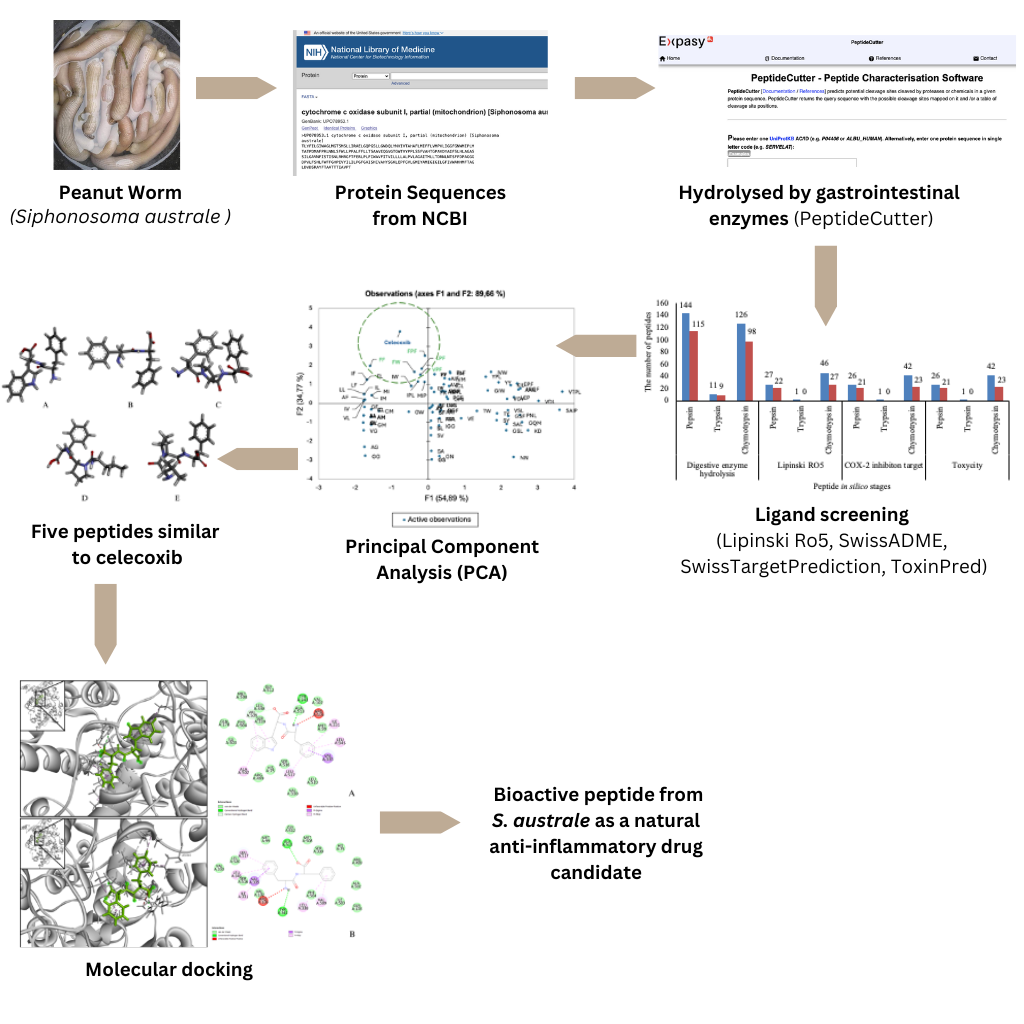
The study was conducted to address the growing need for safer and more effective anti-inflammatory medications, given the side effects associated with conventional anti-inflammatory drugs. Natural sources, such as bioactive peptides, present a promising alternative. The research aimed to generate cyclooxygenase-2 (COX-2) inhibitory peptides from Siphonosoma australe and evaluate their potential as natural anti-inflammatory drug candidates using in silico methods. The PeptideCutter, SwissADME, SwissTargetPrediction, ToxinPred, and principal component analysis (PCA) were utilised to generate peptides, followed by molecular docking using Yasara-structure software. The study identified 113 peptides as suitable candidates based on their physicochemical properties, COX-2 inhibitory potential, and safety profiles. PCA narrowed these down to 5 peptides; Phenylalanine-Tryptophan (FW), Phenylalanine-Phenylalanine (FF), Phenylalanine-Proline-Phenylalanine (FPF), Leucine-Proline-Phenylalanine (LPF), and Valine-Proline-Phenylalanine (VPF) with similar characteristics to celecoxib. Among these, the FW peptide exhibited the best binding energy (–9.32 kcal/mol) and significant inhibitory interactions with COX-2 through hydrogen bonds with Tyr341 and Val509, hydrophobic interactions with Ile331, Val335, Leu345, Ala502, and Leu517, and plenty of amino acid residues in van der Waals forces. The findings highlight the therapeutic potential of peptides from Siphonosoma australe as natural COX-2 inhibitors, offering a safer alternative to synthetic drugs for managing inflammation. This research contributes to the development of natural anti-inflammatory therapeutics, addressing a critical need in pharmacological research.
HIGHLIGHTS
- Discovery of bioactive peptides from Siphonosoma australe with potential to inhibit COX-2, a key enzyme linked to inflammation, showcasing a natural alternative to synthetic anti-inflammatory drugs.
- Utilization of in silico methods to rapidly generate and evaluate 503 peptides, reducing time and cost compared to traditional experimental approaches.
- Advanced bioinformatic tools like PeptideCutter, SwissADME, SwissTargetPrediction, and PCA were used to narrow down 113 suitable peptides, ultimately identifying 5 promising candidates (FW, FF, FPF, LPF, and VPF).
- The FW peptide demonstrated the best molecular docking results, with a binding energy of –9.32 kcal/mol and effective interactions with COX-2, highlighting its potential as a potent anti-inflammatory agent.
- This study provides a strong basis for the development of natural COX-2 inhibitors from marine organisms, contributing to the ongoing search for safer, bio-based anti-inflammatory drugs.
GRAPHICAL ABSTRACT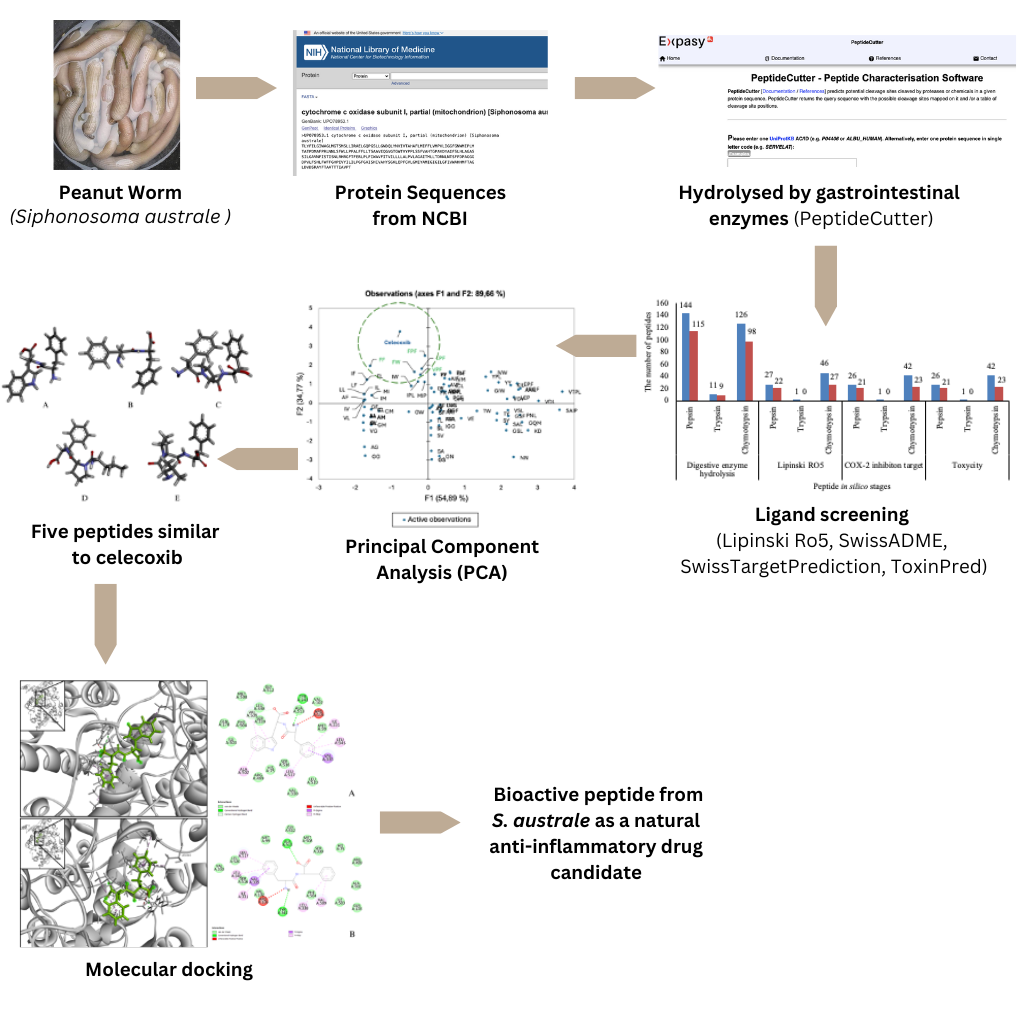
Downloads
References
J Gandhi, L Khera, N Gaur, C Paul and R Kaul. Role of modulator of inflammation cyclooxygenase-2 in gamma herpes virus mediated tumorigenesis. Frontiers in Microbiology 2017; 8, 538.
SL Manna, CD Natale, D Florio and D Marasco. Peptides as therapeutic agents for inflammatory-related diseases. International Journal of Molecular Sciences 2018; 19(9), 2714.
R Sohail, M Mathew, KK Patel, SA Reddy, Z Haider, M Naria, A Habib, ZU Abdin, WR Chaudhry and A Akbar. Effects of non-steroidal anti-inflammatory drugs (NSAIDs) and gastroprotective NSAIDs on the gastrointestinal tract: A narrative review. Cureus 2023; 15(4), e37080.
M Dadar, Y Shahali, S Chakraborty, M Prasad, F Tahoori, R Tiwari and K Dhama. Anti-inflammatory peptides: Current knowledge and promising prospects. Inflammation Research 2019; 68(2), 125-145.
J Li, X Xie, C Zhu, Y Guo and S Chen. Edible peanut worm (Sipunculus nudus) in the Beibu Gulf: Resource, aquaculture, ecological impact and counterplan. Journal of Ocean University of China 2017; 16(5), 825-830.
CX Zhang, ZR Dai and QX Cai. Anti-inflammatory and anti-nociceptive activities of Sipunculus nudus L. extract. Journal of Ethnopharmacology 2011; 137(3), 1177-1182.
P Sangtanoo, P Srimongkol, T Saisavoey, O Reamtong and A Karnchanatat. Anti-inflammatory action of two novel peptides derived from peanut worms (Sipunculus nudus) in lipopolysaccharide-induced RAW264.7 macro phages. Food & Function 2020; 11, 552-560.
H Lin, Z Zheng, J Yuan, C Zhang, W Cao and X Qin. Collagen peptides derived from Sipunculus nudus accelerate wound healing. Molecules 2021; 26(5), 1385.
Y Qi, J Zhou, X Shen, M Chalamaiah, S Lv, H Luo and L Chen. Bioactive properties of peptides and polysaccharides derived from peanut worms: A review. Marine Drugs 2021; 20(1), 10.
R Indrati. Bioactive peptides from legumes and their bioavailability. In: JC Jimenez-Lopez and A Clemente (Eds.). Legumes research. Vol 2. IntechOpen, London, 2021.
S Muthukrishnan, A Manickam, R Prakasham and S Kannaiah. In silico studies of Byttneria herbacea Roxb. bioactive compounds against anti-inflammatory (COX-1) protein. Journal of Microbiology, Biotechnology and Food Sciences 2024; 13(5), e10249.
XY Meng, HX Zhang, M Mezei and M Cui. Molecular docking: A powerful; approach for structure-based drug discovery. Current Computer Aided-Drug Design 2011; 7(2), 146-157.
Protein Data Bank, Available at: https://www.rcsb.org/, accessed April 2024.
NCBI, Available at: https://www.ncbi.nlm.nih.gov/protein/?term=siphonosoma+australe, accessed May 2024.
Peptide Cutter, Available at: https://web.expasy.org/peptide_cutter/, accessed May 2024.
SwissADME, Available at: http://www.swissadme.ch/index.php, accessed May 2024.
Swiss Target Prediction, Available at: http://www.swisstargetprediction.ch/, accessed May 2024.
Toxinpred, Available at: https://webs.iiitd.edu.in/raghava/toxinpred/, accessed May 2024.
SMILES string format, Available at: https://www.novoprolabs.com/tools/convert-peptide-to-smiles-string, accessed May 2024.
3D structure format, Available at: https://www.novoprolabs.com/tools/smiles2pdb, accessed May 2024.
Nurhikma. 2017, Characterization and screening of bioactive peanut worms (Siphonosoma australe-australe) from Southeast Sulawesi. Master Thesis. Institut Pertanian Bogor University, Bogor, Indonesia.
L Gu, Q Zhu, X Zou and R Song. Antibacterial effect of shrimp by-products hydrolysate on specific spoilage organisms of squid. Molecules 2023; 28(10), 4105.
CA Lipinski, F Lombardo, BW Dominy and PJ Feeney. Experimental and computational approaches to estimate solubility and permeability in drug discovery and development settings. Advanced Drug Delivery Reviews 2001; 23(1-3), 3-25.
A Daina, O Michielin and V Zoete. SwissTargetPrediction: Updated data and new features for efficient prediction of protein targets of small molecules. Nucleic Acids Research 2019; 47(W1), W357-W364.
S Gupta, P Kapoor, K Chaudhary, A Gautam and R Kumar. In silico approach for predicting toxicity of peptides and proteins. PLoS One 2013; 8(9), e73957.
RK Vishwakarma, A Negi and DS Negi. Development of potential COX inhibitor as anti-inflammatory agents from leaves of Lantana camara by in-vitro analysis, molecular docking and ADMET prediction. Journal of the Indian Chemical Society 2022; 99(10), 100694.
KR Surana, AR Kapadnis, PD Nikam, MR Salave, PS Bachhav, CS Nerkar, VV Ahire, DM Patil and DD Sonawane. Overview of formulation and evaluation aspects of celecoxib. International Journal of Recent Scientific Research 2022; 13(2), 314-323.
NUA Mohsin, S Aslam, M Ahmad, M Irfan, SA Al-Hussain and MEA Zaki. Cyclooxygenase-2 (COX-2) as a target of anticancer agents: A review of novel synthesized scaffolds having anticancer and COX-2 inhibitory potentialities. Pharmaceuticals 2022; 15(12), 1471.
P Kavaliauskas, FS Opazo, W Acevedo, R Petraitiene, B Grybaitė, K Anusevičius, V Mickevičius, S Belyakov and V Petraitis. Synthesis, biological activity, and molecular modelling studies of naphthoquinone derivatives as promising anticancer candidates targeting COX-2. Pharmaceuticals 2022; 15(5), 541.
Z Hong, J Xie, L Tao, JJ Dai, T Li, L Zhang, Y Bai, X Hu, J Chen, J Sheng and Y Tian. Exploration of cyclooxygenase-2 inhibitory peptides from walnut dreg proteins based on in silico and in vitro analysis. Food Science and Human Wellness 2024; 13(3), 1636-1644.
P Singh, S Kaur, J Kaur, G Singh and R Bhatti. Rational design of small peptides for optimal inhibition of cyclooxygenase-2: Development of a highly effective anti-inflammatory agent. Journal of Medicinal Chemistry 2016; 59(8), 3920-3934.
M Ahmadi, S Bekeschus, KD Weltmann, TV Woedtke and K Wende. Non-steroidal anti-inflammatory drugs: Recent advances in the use of synthetic COX-2 inhibitors. RSC Medicinal Chemistry 2022; 13(5), 471-496.
Published
How to Cite
Issue
Section
License
Copyright (c) 2025 Walailak University

This work is licensed under a Creative Commons Attribution-NonCommercial-NoDerivatives 4.0 International License.





