
The Impact of Flacourtia inermis Roxb (Tomi-Tomi) Sourdough Prepared Using Different Drying Techniques on the Physicochemical Attributes and Characteristics of Sourdough Bread
DOI:
https://doi.org/10.48048/tis.2025.8745Keywords:
Sourdough, Lactic acid bacteria, Yeast, Cabinet-drying, Freeze-drying, Tomi-tomi fruitAbstract
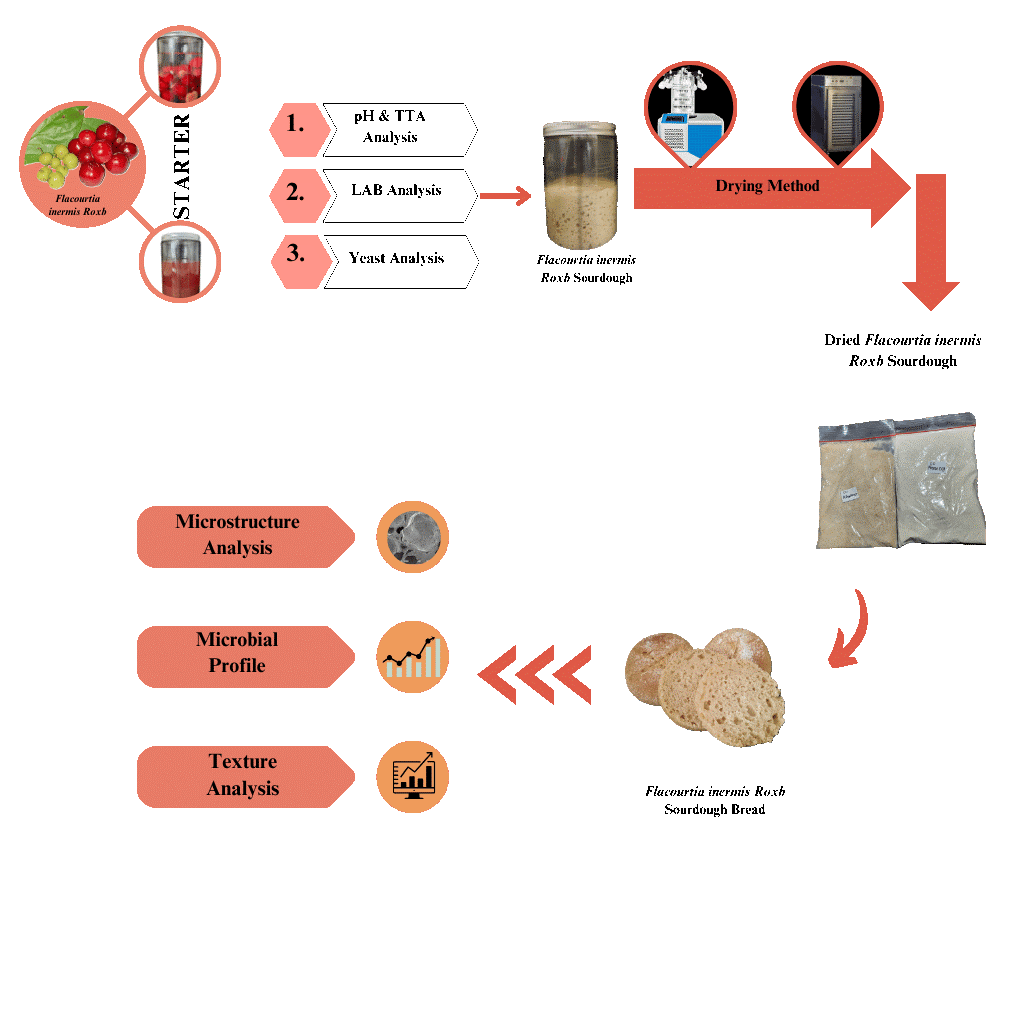
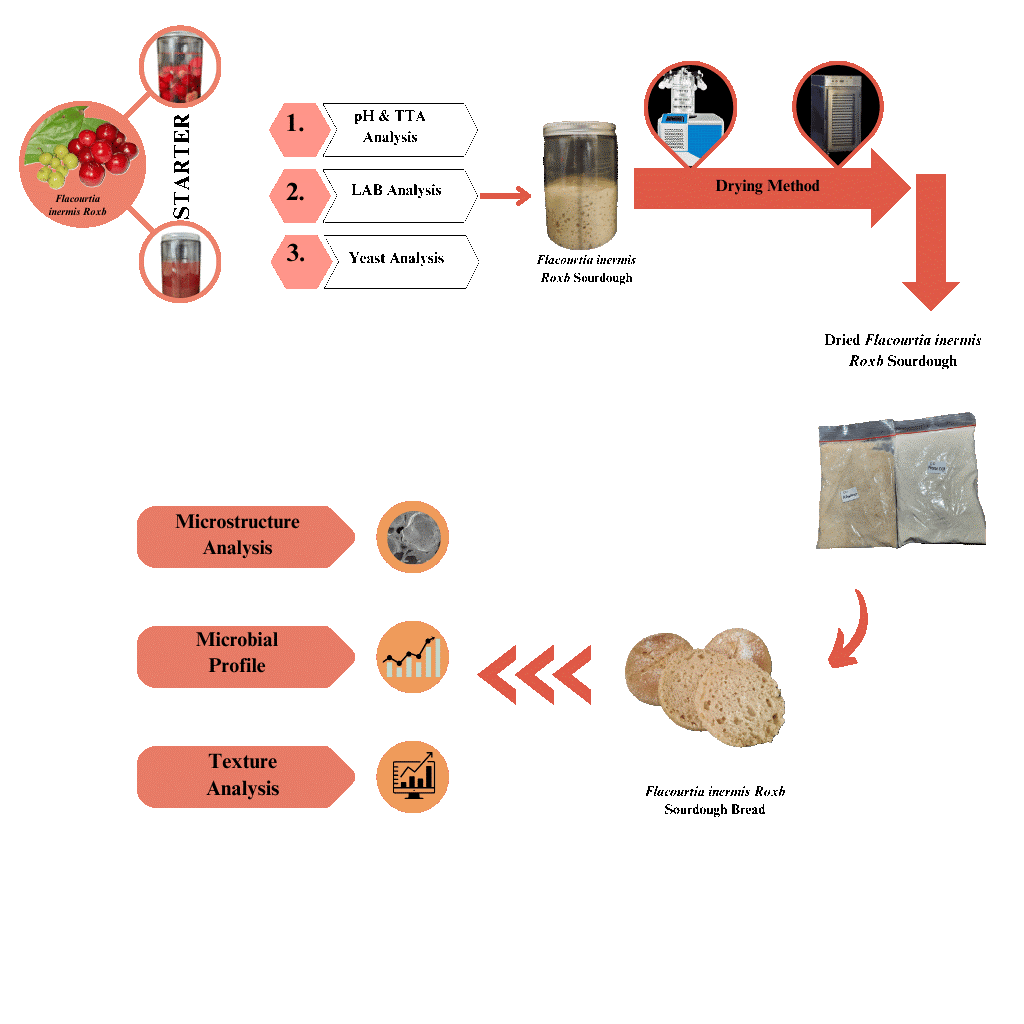
The study aimed to produce dried sourdough tomi-tomi (Flacourtia inermis Roxb) with 2 different drying methods: Cabinet-driying (CD) and freeze-driying (FD) and investigate the effect of the dried sourdough on the viability of lactic acid bacteria (LAB) and yeast. The tomi-tomi dried-sourdough samples were used in breads production to observe the impact on the bread properties. Satisfactory results were obtained with CD and FD dried sourdough, there was no significant reduction in viability of lactic acid bacteria (LAB), yeast and specific volume of the bread. Nevertheless, the CD and FD dried sourdough significantly reduced the cell density of the bread compared to control. The addition of tomi-tomi juice increased the LAB and yeast production. The result of CD and FD dried sourdough with rehydration may be used for bread-making without bakery’s yeast activator addition.
HIGHLIGHTS
- Tomi-tomi fruit (Flacourtia inermis Roxb) has the potential to be a starter of sourdough as it has a higher substrate nutrition value and bears fruit year-round.
- Driying methods (freeze-drying and cabinet-drying) have a major influence on tomi-tomi sourdough properties (pH and number of viability LAB and yeast cells).sss
- Rehydration for dried sourdough starter affects cell recovery of LAB and yeast.
- Dried sourdough by cabinet drying improved the loaf volume and texture of bread.
GRAPHICAL ABSTRACT
Downloads
References
A Comasio, S van Kerrebroeck and L de Vuyst. Lemon juice and apple juice used as source of citrate and malate, respectively, enhance the formation of buttery aroma compounds and/or organic acids during Type 2 and Type 3 sourdough productions performed with Companilactobacillus crustorum LMG 23699. International Journal of Food Microbiology 2021; 339, 109020.
F Minervini, R Di Cagno, A Lattanzi, M De Angelis, L Antonielli, G Cardinali, S Cappelle and M Gobbetti. Lactic acid bacterium and yeast microbiotas of 19 sourdoughs used for traditional/typical Italian breads: Interactions between ingredients and microbial species diversity. Applied and Environmental Microbiology 2012; 78(4), 1251-1264.
Y Yu, L Wang, H Qian, H Zhang and X Qi. Contribution of spontaneously-fermented sourdoughs with pear and navel orange for the bread-making. LWT 2018; 89, 336-343.
IR Danila, R Yanti and DA Suroto. Microbiota properties and texture of rice flour bread with pineapple starter. Journal of Applied Agricultural Science and Technology 2023; 7(3), 225-235.
F Minervini, G Celano, A Lattanzi, M de Angelis and M Gobbetti. Added ingredients affect the microbiota and biochemical characteristics of durum wheat type-I sourdough. Food Microbiology 2016; 60, 112-123.
JO Omedi, J Huang, W Huang, J Zheng, Y Zeng, B Zhang, L Zhou, F Zhao, N Li and T Gao. Suitability of pitaya fruit fermented by sourdough LAB strains for bread making: Its impact on dough physicochemical, rheo-fermentation properties and antioxidant, antifungal and quality performance of bread. Heliyon 2021; 7(11), e08290.
Flacourtia Inermis - National Parks Board, Available at: https://www.nparks.gov.sg/florafaunaweb/flora/2/9/2920, accessed July 2024.
MD Calvert, AA Madden, LM Nichols, NM Haddad, J Lahne, RR Dunn and EA McKenney. A review of sourdough starters: Ecology, practices, and sensory quality with applications for baking and recommendations for future research. PeerJ 2021; 9, e11389.
K Arora, H Ameur, A Polo, R Di Cagno, CG Rizzello and M Gobbetti. Thirty years of knowledge on sourdough fermentation: A systematic review. Trends in Food Science & Technology 2021; 108, 71-83.
N Caglar, E Ermis and MZ Durak. Spray-dried and freeze-dried sourdough powders: Properties and evaluation of their use in breadmaking. Journal of Food Engineering 2021; 292, 110355.
MH Ertop, ŞM İlter, F Yilmaz, C Baltaci and A Gündoğdu. Quality properties of wheat breads incorporated with dried sourdoughs produced with different fermentation and drying methods. Food Science and Technology Research 2018; 24(6), 971-980.
E Bartkiene, G Schleining, G Juodeikiene, D Vidmantiene, V Krungleviciute, T Rekstyte, L Basinskiene, M Stankevicius, I Akuneca, O Ragazinskiene and A Maruska. The influence of lactic acid fermentation on biogenic amines and volatile compounds formation in flaxseed and the effect of flaxseed sourdough on the quality of wheat bread. LWT - Food Science and Technology 2014; 56(2), 445-450.
H Robert, V Gabriel, D Lefebvre, P Rabier, Y Vayssier and C Fontagné-Faucher. Study of the behaviour of Lactobacillus plantarum and Leuconostoc starters during a complete wheat sourdough breadmaking process. LWT - Food Science and Technology 2006; 39(3), 256-265.
H Zhou, Y Jin, T Hong, N Yang, B Cui, X Xu and Z Jin. Effect of static magnetic field on the quality of frozen bread dough. LWT 2022; 154, 112670.
I Demirkesen, G Sumnu and S Sahin. Image analysis of gluten-free breads prepared with chestnut and rice flour and baked in different ovens. Food and Bioprocess Technology 2013; 6(7), 1749-1758.
P Puerta, R Garzón, CM Rosell, S Fiszman, L Laguna and A Tárrega. Modifying gluten-free bread’s structure using different baking conditions: Impact on oral processing and texture perception. LWT 2021; 140, 110718.
Y Zhou, X She, S Zhu and X Zhou. The study of microbial diversity and volatile compounds in Tartary sbuckwheat sourdoughs. Food Chemistry: X 2022; 14, 100353.
S Saud, T Xiaojuan and S Fahad. The consequences of fermentation metabolism on the qualitative qualities and biological activity of fermented fruit and vegetable juices. Food Chemistry: X 2024; 21, 101209.
JJ Buenrostro-Figueroa, M Velázquez, O Flores-Ortega, JA Ascacio-Valdés, S Huerta-Ochoa, CN Aguilar and LA Prado-Barragán. Solid state fermentation of fig (Ficus carica L.) by-products using fungi to obtain phenolic compounds with antioxidant activity and qualitative evaluation of phenolics obtained. Process Biochemistry 2017; 62, 16-23.
W Wu, G Xiao, Y Yu, Y Xu, J Wu, J Peng and L Li. Effects of high pressure and thermal processing on quality properties and volatile compounds of pineapple fruit juice. Food Control 2021; 130, 108293.
J Tomić, T Dapčević-Hadnađev, D Škrobot, N Maravić, N Popović, D Stevanović and M Hadnađev. Spontaneously fermented ancient wheat sourdoughs in breadmaking: Impact of flour quality on sourdough and bread physico-chemical properties. LWT 2023; 175, 114482.
S Behboudi-Jobbehdar, C Soukoulis, L Yonekura and I Fisk. Optimization of spray-drying process conditions for the production of maximally viable microencapsulated L. acidophilus NCIMB 701748. Drying Technology 2013; 31(11), 1274-1283.
YC Liu, PS Wu, SH Teng and MJ Wu. Identification of dominant microbes and functional analysis of sourdough starters made of dried Longan and Raisin. In Proceedings of the IEEE 5th Eurasia Conference on Biomedical Engineering, Healthcare and Sustainability. Engineering Proceedings, 2023, 55(1), 17.
FB Siepmann, V Ripari, N Waszczynskyj and MR Spier. Overview of sourdough technology: From production to marketing. Food and Bioprocess Technology 2018; 11, 242-270.
M Gobbetti, A Corsetti and J Rossi. Interaction between lactic acid bacteria and yeasts in sour-dough using a rheofermentometer. World Journal of Microbiology & Biotechnology, 1995; 11, 625-630.
C Graça, M Edelmann, A Raymundo, I Sousa, R Coda, T Sontag-Strohm and X Huang. Yoghurt as a starter in sourdough fermentation to improve the technological and functional properties of sourdough-wheat bread. Journal of Functional Foods 2022; 88, 104877.
Flavornet, Available at: https://www.flavornet. org/flavornet.html, accessed June 2024.
C Pétel, B Onno and C Prost. Sourdough volatile compounds and their contribution to bread: A review. Trends in Food Science & Technology 2017; 59, 105-123.
MNNQ Izzreen, ÅS Hansen and MA Petersen. Volatile compounds in whole meal bread crust: The effects of yeast level and fermentation temperature. Food Chemistry 2016; 210, 566-576.
T Liu, Y Li, FA Sadiq, H Yang, J Gu, L Yuan, YK Lee and G He. Predominant yeasts in Chinese traditional sourdough and their influence on aroma formation in Chinese steamed bread. Food Chemistry 2018; 242, 404-411.
Downloads
Published
How to Cite
Issue
Section
License
Copyright (c) 2024 Walailak University

This work is licensed under a Creative Commons Attribution-NonCommercial-NoDerivatives 4.0 International License.





